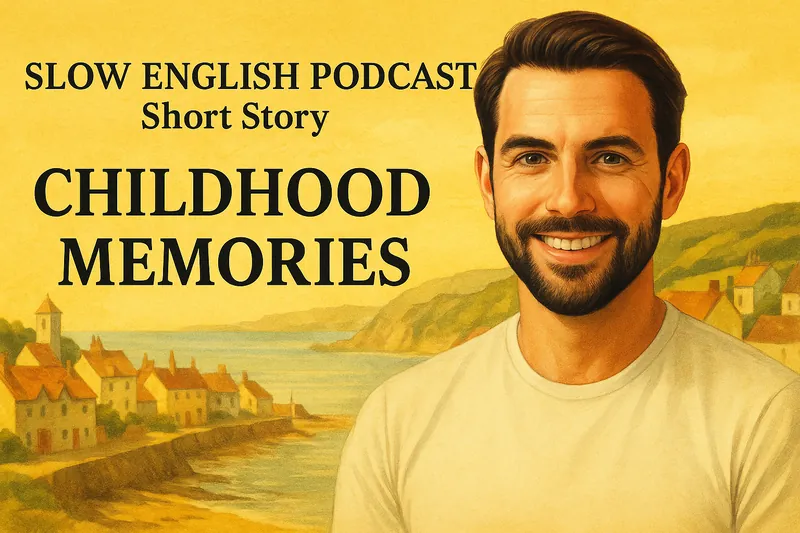
A Childhood Memory That Changed the Way — cover

EPISODE 10 · 37 MIN · MIND & MOTIVATION

A Childhood Memory That Changed the Way

We’re building a Patreon platform where you’ll find lots of extra materials to help you improve faster — all at very affordable levels.

Full episode notes on Acast ↗

Find your country — or stay in English

100% English mode

ENHello, my friends.

ENIm Martinthe voice youve been listening to for a while now.

ENBut today, I want to do something different.

ENToday, I want to tell you about menot as a teacher, not as a podcaster, but as a little boy who once believed he would never be able to speak.

ENI was born in a small coastal town in southern England.

ENIt was one of those places where the sound of seagulls mixed with the smell of salt and fish from the harbour.

ENThe streets were narrow and full of laughter, and the sea was never far awayalways whispering in the background.

ENOur house was tinytwo floors, a blue door, and windows that always smelled of tea and toast.

ENIt was never quiet.

ENThere was always music, or someone talking, or the kettle boiling in the kitchen.

ENMy parentsEdward and Carolinewere simple people with extraordinary warmth.

ENMy father worked for the railway, and his hands always smelled of metal and oil.

ENHe had the calm voice of a storyteller, the kind that made you believe every train had a soul and every journey had a secret.

ENMy mother was a nurse, the kind who never needed to raise her voice to be heard.

ENShe had soft eyes, quick hands, and the power to make everyone feel safeeven strangers.

ENWe didnt have much money, but we had everything that really mattered: stories, music, and endless cups of tea.

ENFrom the very beginning, language was both my friend and my enemy.

ENI started speaking latelater than most children.

ENAnd when I finally began, my words arrived broken, trembling, stuck between breaths.

ENInstead ofgood morning,” I would say, g-g-g-g-guh-mornin’, and my face would turn red like a tomato.

ENI remember feeling as if the words were trapped inside melike birds hitting the walls of a cage.

ENThats when I learned a word that would follow me for years: stutter.

ENA stutter means that your voice stops or repeats sounds when you try to speak.

ENIts not because you dont know what to sayits because the muscles in your mouth and throat dont move smoothly.

ENYou know the word, but it refuses to come out.

ENYou can hear it perfectly in your mind, but your tongue and breath fight against each other.

ENFor a child, thats a scary thingto have thoughts full of color and music, and not be able to let them out.

ENSometimes, I felt invisible.

ENOther times, I felt broken.

ENBut my family never let me feel less.

ENMy mother would kneel beside me, touch my shoulder gently, and whisper, “Its okay, darling.

ENWords will come when theyre ready.”

ENShe never rushed me.

ENShe never finished my sentences.

ENShe just waitedwith patience, with love, and with a cup of tea cooling beside her.

ENAnd slowly, she was right.

ENThe words did comenot perfectly, not quicklybut they came.

ENThey arrived like shy little birds, stepping out into the open for the first time.

ENThey wobbled, hesitated, and sometimes flew back into silence.

ENBut one day, they began to sing.

ENGrandparents and Accents

ENI was lucky to grow up in a family that sounded like a small orchestra.

ENEvery person in my family spoke in a different rhythm, a different melody, a different music.

ENMy grandfather Arthur was from Liverpool.

ENHis voice was deep, rough, and full of lifelike an old jazz record spinning on a Sunday morning.

ENHe spoke fast, laughed loud, and every sentence seemed to bounce up and down with the famous Scouse accent.

ENWhen he said, “Alright, lad?” it sounded like a song.

ENMy grandmother Rose was Scottish, born near the Highlands, and her words rolled like waves breaking on stones.

ENShe used to tell me stories of the northcastles, ghosts, and endless rain.

ENWhen she laughed, her rs danced in the air.

ENSometimes I didnt understand every word, but I always understood the feeling.

ENThat was my first lesson about languages: you dont have to understand every word to understand every heart.

ENThen there was Uncle George, my fathers brother.

ENHe had lived in Ireland for years, and when he came to visit, it felt like a festival.

ENHis accent was musicallight, rising and falling like a violin.

ENHe called everyonemy friendand had a thousand stories that always ended in laughter.

ENHe could imitate anyonethe postman, the baker, even the Queen.

ENEvery Christmas, when we all sat together in my grandparentsliving room, it was like sitting inside a symphony.

ENOne voice high, another low, one quick, another slow.

ENI used to close my eyes and just listen.

ENIt was better than television.

ENIt was language as music.

ENAnd even though I was a childquiet, shy, still fighting with my stutterI loved those sounds.

ENThey were proof that there were many ways to speak, and all of them were beautiful.

ENIn our family, no one corrected your accent.

ENNo one said, “Thats wrong.”

ENEveryone just spoke, and the room filled with melody.

ENLooking back, I think thats when I started to fall in love with languagenot the grammar, not the rules, but the voices.

ENI began to notice that the same word could sound completely different depending on who said it.

ENTea,” for example.

ENMy grandmother saidtay.”

ENMy uncle saidtee.”

ENMy mother, softly, saidtea, love?” like a small kindness in a cup.

ENThats when I realized something magical: language wasnt fixedit was alive.

ENIt could sing, dance, and change shape depending on who you were.

ENMaybe thats why, even though I struggled to speak fluently, I was never afraid of sound.

ENI was surrounded by people who treated speech not as a competition, but as a kind of art.

ENMy grandfather used to say, “Dont worry about how it sounds, ladjust make sure its true.”

ENI didnt understand it then, but I do now.

ENHe meant: its better to speak with heart than to speak perfectly.

ENThat sentence, I think, became one of the invisible rules of my life.

ENEven now, when I teach English, I still tell my students the same thing: “Dont aim to sound perfectaim to sound real.”

ENThe Piano and the Stutter

ENOne afternoon, when I was five years old, everything changed.

ENIt happened quietly, like most important things in life do.

ENMy aunt Nora arrived at our house with a big surprise.

ENShe was wearing her red scarfthe one that always smelled of lavenderand behind her, two men carried something covered with an old blanket.

ENWhen they placed it in the living room and pulled the blanket away, I saw a piano.

ENA real piano.

ENIt was old and scratched, with two keys missing, but to me it looked like a treasure chest.

ENAunt Nora smiled and said, “Its missing a few teeth, but it still sings.”

ENI remember touching the keys with my small hands.

ENThey felt cold, smooth, and mysterious.

ENThen I pressed one.

ENMiddle C.

ENA single note filled the roomsoft, clear, and perfect.

ENIt vibrated in the air, and for a moment, it felt like the whole house was listening.

ENThat sound didnt hesitate.

ENIt didnt break or stutter.

ENIt just was.

ENPure.

ENSimple.

ENFree.

ENAnd I remember thinking, “If only I could speak the way the piano speaks.”

ENFrom that day, the piano became my secret friend.

ENWhen I couldnt say the words, I played.

ENWhen I felt embarrassed, I played.

ENWhen the words got stuck in my throat, I let my fingers say what my mouth couldnt.

ENI didnt know it then, but music was teaching me rhythmthe same rhythm I would one day use to speak fluently.

ENEvery key became a word.

ENEvery melody, a sentence.

ENSometimes I played the same note again and again, until it felt like breathing.

ENMy mother used to peek into the room and smile quietly.

ENShe never asked me to stop.

ENShe said later that she loved the sound because it reminded her that I was trying.

ENAnd she was rightI was trying to make the world listen to me in the only language I had.

ENMy father noticed, too.

ENOn weekends, he started bringing home old vinyl records.

ENThe Beatles.

ENNat King Cole.

ENSimon & Garfunkel.

ENHed put one on the record player, sit down with his cup of tea, close his eyes, and say, “Listen carefully, Martin.

ENThis is what words want to sound like.”

ENI didnt understand what he meant, but I listened anyway.

ENI listened to the rhythm, the pauses, the emotion behind the voices.

ENSometimes I repeated the words in a whisperslow, careful, almost singing.

ENAnd when I whispered them to the rhythm of the song, the stutter disappeared.

ENNo breaks.

ENNo fear.

ENJust sound and meaning moving together.

ENThat was the moment I realized that speech and music are not so different.

ENThey both need breath.

ENThey both need feeling.

ENThey both need rhythm.

ENAnd I began to wonder if maybejust maybemusic could teach me how to talk.

ENSo every evening, after dinner, while the adults talked in the kitchen, I sat at the piano.

ENThe lights were low, and I played until my fingers hurt a little.

ENSometimes, I invented melodies that sounded like questions.

ENOther times, like answers.

ENIt didnt matter if they were good or bad.

ENWhat mattered was that I was finally expressing myselffluently, even if it wasnt with words.

ENMusic became my first real teacher.

ENIt taught me that communication isnt only about what you sayits about how you feel when you say it.

ENIt taught me patience, rhythm, and courage.

ENAnd above all, it gave me something I had never felt before: confidence.

ENBecause when I played, no one laughed.

ENNo one corrected me.

ENNo one waited for me to finish a sentence.

ENThe piano didnt care if I hesitated.

ENIt just listened.

ENAnd for a boy who couldnt always find his voice, that was everything

ENThe Day of the Poem

ENSchool, for me, was never easy.

ENI liked learningI really didbut words scared me.

ENEvery day began with the same silent prayer: “Please dont make me read aloud today.”

ENBecause reading aloud meant stuttering aloud.

ENIt meant hearing my voice break in front of everyone.

ENIt meant seeing the teachers kind smile turn into quiet pity.

ENAnd it meant hearing the giggles that children cant always hide.

ENOne morning, when I was seven, our teacher, Mrs. Collins, said we were going to have a poetry recital.

ENEach of us would stand in front of the class and read a short poem.

ENThe word recital sounded beautifulbut also terrifying.

ENIt meant standing up.

ENIt meant speaking.

ENIt meant no piano to hide behind.

ENI remember holding my paper so tightly that it started to shake in my hands.

ENThe poem was shortjust four lines.

ENIt began:

ENThere once was a boy who dreamed of the sea.”

ENI had practiced it at home.

ENI knew it by heart.

ENBut when Mrs. Collins called my name — “Martin Brooks, please” — my heart started beating so loudly I could hardly hear her voice.

ENMy legs felt heavy, like they were made of stone.

ENThe classroom suddenly seemed too bright, too quiet.

ENI walked slowly to the front, my shoes squeaking on the floor.

ENAll eyes were on me.

ENI opened my mouth.

ENNothing came out.

ENThe silence grew.

ENThen, finally, I tried to speak.

ENTh-th-th-there w-w-w-was a b-b-b-boy…”

ENThe words tumbled out like broken glass.

ENSome of the children giggled.

ENOne whispered to another.

ENI wanted to disappear.

ENMy face was burning, and my throat felt like it was closing.

ENBut thensomething unexpected happened.

ENFrom the second row, my best friend, Danny, began to whisper.

ENQuietly.

ENSoftly.

ENHe whispered the lines with me, one word behind, like an echo.

ENThere once was a boy who dreamed of the sea…”

ENHis voice was calm.

ENSteady.

ENKind.

ENAnd for some reason, hearing his whisper made me breathe differently.

ENMy lungs slowed down.

ENMy rhythm changed.

ENI followed his voice like a melody, and the stutter began to fade.

ENI took a deep breath and tried again.

ENThere once was a boy who dreamed of the sea.”

ENThis time, it came out whole.

ENNo breaks.

ENNo fear.

ENJust wordssimple, clean, alive.

ENI couldnt believe it.

ENWhen I finished, Mrs. Collins smiled.

ENNot a teachers smilea real, proud, human smile.

ENThe class clapped, softly at first, then louder.

ENEven the children who had laughed before were now smiling too.

ENDanny grinned and gave me a small thumbs up.

ENThat momentthat tiny act of friendshipchanged everything for me.

ENIt taught me something Ive never forgotten: communication isnt about being perfect.

ENIts about being understood.

ENDanny didnt correct me.

ENHe didnt rescue me.

ENHe joined me.

ENHe made my fear smaller by sharing it.

ENThat was the first time I realized that language is not just something you sayits something you share.

ENAfter class, Mrs. Collins stopped me by the door.

ENShe said, “Martin, you have a beautiful voice.

ENYou just need to trust it.”

ENI remember those words more clearly than the poem itself.

ENA beautiful voice.

ENI had never thought of my voice as beautiful before.

ENThat sentence stayed in my mind for yearsmaybe forever.

ENBecause it wasnt about how I sounded.

ENIt was about how I felt when I finally let the words go.

ENThat night, I couldnt sleep.

ENI kept thinking about the poem.

ENAbout Dannys whisper.

ENAbout the strange, magical way words had finally decided to leave my mouth.

ENI realized that maybejust maybemy voice wasnt broken after all.

ENIt was just waiting for the right rhythm, the right breath, the right moment.

ENAnd maybe thats true for all of us.

ENSometimes, we just need someone to believe in our voice before we can believe in it ourselves.

ENThe next day, I did something new.

ENI stood in front of the mirror and read the poem again.

ENAlone this time.

ENAnd as I said the words, I imagined Dannys voice beside minecalm, gentle, supportive.

ENI didnt stutter.

ENNot even once.

ENIt felt like magic.

ENBut it wasnt magic.

ENIt was rhythm.

ENIt was connection.

ENIt was the discovery that speaking isnt only about the tongue or the mouthits about the heart.

ENThat day, something small but powerful changed inside me.

ENFor the first time, I didnt see myself asthe boy who stutters.”

ENI saw myself asthe boy who speaksslowly, carefully, but truthfully.”

ENAnd that, in a way, was the beginning of everything that came latermy love for music, for words, for teaching, and for helping others find their own rhythm.

ENBecause thats what Danny gave me.

ENNot just confidencebut rhythm.

ENA way to move through fear.

ENA way to speak through silence

ENSummers at the Seaside

ENAfter that year, something changed in me.

ENI started to notice the sounds of the world around menot just words, but everything.

ENThe waves.

ENThe wind.

ENThe laughter of people walking home from the beach.

ENMy childhood summers were made of those sounds.

ENWarm days that seemed to last forever.

ENThe sky so bright that it almost hurt your eyes.

ENThe taste of salt on your lips after running too close to the sea.

ENThe sticky feeling of ice cream melting faster than you could eat it.

ENThose were the days that built the rhythm of my life.

ENEvery summer, my grandparents came to stay with us for two weeks.

ENThey always brought storiesand too many suitcases.

ENMy grandfather Arthur carried his fishing rods and an old tin box full of shiny hooks.

ENHe said, “You can learn a lot from the sea, ladif you know how to listen.”

ENI didnt understand him at first.

ENTo me, the sea was just noiseloud and wild.

ENBut one morning, while we sat quietly on the pier, I started to hear it differently.

ENThere were patterns in the soundlong waves, short waves, moments of silence.

ENIt was like breathing.

ENAnd I realized: everything in life has its own rhythm.

ENEven the ocean pauses between words.

ENMy grandmother Rose was the opposite of quiet.

ENShe talked from sunrise to sunset.

ENWhile my grandfather fished, she set up picnics on the cliffs.

ENShe always packed too much foodsandwiches, apples, cakesand somehow everything tasted better in the wind.

ENShe told me stories of her childhood in Scotland: hills covered in fog, long winters, and ceilidh dances that lasted all night.

ENHer voice was like a movie in my head.

ENWhen she spoke, I could see what she was saying.

ENAnd sometimes, when the wind was strong, her words almost floated away before they reached me.

ENThats when I learned to listen carefullynot just with my ears, but with my heart.

ENAunt Nora came every summer toothe one who gave me the piano.

ENShe always wore colorful scarves and sang while she cooked.

ENEven the most ordinary afternoon became music when she was around.

ENShe taught me that art wasnt just something you madeit was something you lived.

ENWhen she played guitar, everyone stopped talking.

ENWe just listened.

ENThe sound carried over the cliffs and disappeared into the sea.

ENI used to think the fish could hear her.

ENMaybe they could.

ENSometimes, in the late afternoons, my cousins and I built sandcastles so big they looked like real cities.

ENWe gave them names — “MartintownorSeagull City.”

ENThe waves always destroyed them by morning, but we never cared.

ENThat was another lesson from the sea: nothing beautiful lasts forever, but that doesnt mean it isnt worth building.

ENAt night, when everyone else went inside, I liked to stay a little longer on the beach.

ENThe air was cooler then.

ENThe world quieter.

ENI could hear the sea breathing in the darkcalm, endless, patient.

ENSometimes I sang softly to it, songs I had made up, half-words and half-notes.

ENIt was my secret language.

ENNo stutter, no fear, just sound and peace.

ENThose nights made me dream of other coasts, other voices, other words waiting out there in the world.

ENMy father would join me sometimes, sitting quietly beside me with his cup of tea.

ENHe didnt talk muchhe never needed to.

ENHe was one of those people whose silence felt full, not empty.

ENHe would point to the horizon and say, “Somewhere out there, someone is watching this same sea, right now.”

ENI remember thinking that was the most magical idea I had ever heardthat I was connected to someone I didnt even know, just by looking at the same ocean.

ENMaybe thats why, even today, when I teach languages, I feel that same connection.

ENEvery new word is like a waveit travels, it reaches, it connects.

ENThose seaside summers were my classroom long before I ever stepped into a real one.

ENThey taught me everything a teacher couldnt.

ENPatience.

ENCuriosity.

ENThe art of listening.

ENAnd the quiet truth that everything in lifefrom a sentence to a song to a friendshipmoves in rhythm.

ENIf you listen carefully, you can hear it.

ENThe sound of life itselfspeaking to you.

ENA Boy with a Tape Recorder

ENWhen I turned nine, my father gave me a birthday present that I still remember more clearly than any toy or game I ever had.

ENIt wasnt wrapped in shiny paper.

ENIt wasnt new.

ENIn fact, it looked like something rescued from another century.

ENIt was a tape recorderbig, brown, and heavy, with two plastic reels and a long black cable that looked a bit dangerous.

ENHe placed it on the kitchen table and said, “It doesnt look like much, son, but it can do magic.”

ENI didnt understand what he meant until I pressed the red button.

ENA small click.

ENA gentle hum.

ENAnd then my own breathing filled the air.

ENI froze.

ENIt was the first time I had ever heard myself.

ENMy voice sounded strangehigher, thinner, almost like someone elses.

ENI said, “Hello?”

ENThe tape said back, “H-h-h-h-hello.”

ENI laughed.

ENIt was the sound of my stuttercaptured, real, but somehow less frightening when it came from the speaker.

ENFor the first time, I wasnt running away from my voice.

ENI was listening to it.

ENThat little machine became my best friend.

ENI carried it everywhereto my room, the garden, even the beach.

ENI recorded everything I could find.

ENBirdsong in the morning.

ENMy mothers voice calling from the kitchen, “Martin, teas ready!”

ENThe sound of the rain hitting the window on long Sunday afternoons.

ENI even recorded silencejust to hear what silence sounded like.

ENIt wasnt empty.

ENIt had its own hum, its own secret rhythm.

ENSoon, I started recording myself.

ENNot just my voicemy stories.

ENI read poems, fairy tales, even newspaper headlines, pretending to be a radio announcer.

ENSometimes I sang quietly.

ENOther times, I tried to copy the rhythm of my favorite singers.

ENAnd the strangest thing happened: when I spoke to the tape recorder, I didnt stutter.

ENNot once.

ENIt was as if the microphone understood me better than people did.

ENMaybe because it didnt interrupt.

ENMaybe because it didnt laugh.

ENMaybe because it just listened.

ENEvery night, after finishing my homework, I would sit cross-legged on the floor with my little brown recorder.

ENId press the red button and begin: “Good evening, ladies and gentlemen.

ENThis is Martin Brooks, speaking from his bedroom in Southbridge, near the sea.”

ENIt made me feel powerfulnot in a loud or proud way, but in a peaceful way.

ENLike I had finally found a door between my thoughts and the world.

ENAnd I could open it whenever I wanted.

ENI discovered that recording my voice was a form of freedom.

ENIt was a conversation between me and me.

ENNo judgment.

ENNo pressure.

ENJust curiosity.

ENOne evening, my father came into my room while I was recording.

ENHe didnt say a word.

ENHe just listened.

ENWhen I finished, he said, “You know, Martin, when you speak slowly like that, its beautiful.”

ENAnd that sentencethat one small commentstayed with me for life.

ENHe didnt saygoodorperfect.”

ENHe saidbeautiful.”

ENBecause slow, careful speech has its own beauty.

ENIts real.

ENIts human.

ENIts honest.

ENThe tape recorder became my first teacher, my first audience, and my first stage.

ENIt taught me to hear rhythm not just in music, but in speech.

ENTo feel pauses as part of the melody.

ENTo understand that silence isnt failureits space.

ENThat idea would one day become the heart of everything I teach now: that slow isnt wrong.

ENIts powerful.

ENSometimes, I would leave the recorder running when I went to bed.

ENIt captured the quiet sounds of the nightthe ticking clock, the wind, the faraway sound of a train passing through town.

ENIn the morning, I would listen to it, fascinated.

ENEvery sound told a story.

ENEvery silence had a feeling.

ENIt was like discovering a secret world inside the ordinary one.

ENI didnt know it then, but those nights were the beginning of my life as a storyteller.

ENNot just someone who speaks, but someone who listens deeply.

ENBecause thats what recording does: it teaches you to pay attention.

ENTo every breath.

ENEvery sound.

ENEvery emotion hidden between the words.

ENLooking back now, I realize that tape recorder was more than a machine.

ENIt was the bridge between the boy who couldnt speakand the man who would one day make his living with his voice.

ENIt was the first microphone of Your English Toolbox.

ENThe beginning of everything that came after.

ENAnd in a way, I think Ive been pressing that red button ever since

ENThe Aunt Who Believed

ENAunt Nora wasnt like anyone else in my family.

ENWhere my father was quiet and steady, she was wild and brightlike sunlight through stained glass.

ENShe never entered a room quietly.

ENYou always knew she had arrived because laughter followed her like a shadow.

ENShe wore scarves that looked like rainbows, bangles that sang when she moved her hands, and lipstick the color of ripe cherries.

ENEverywhere she went, she carried the smell of coffee, paint, and sea airher own perfume of life.

ENWhen I was little, she was the person who saw metruly saw meeven when I couldnt find my words.

ENOther adults would say, “Poor boy, he struggles to talk.”

ENBut Nora would smile and say, “He doesnt struggle.

ENHes just composing his sentences.”

ENThat sentence changed the way I felt about myself.

ENComposing.

ENNot failing.

ENCreating.

ENShe made my silence sound like art instead of absence.

ENNora loved to visit our house on weekends.

ENShed sit by the pianothe same one she had given usand play without sheet music, her fingers dancing like they were telling secrets to the keys.

ENSometimes shed call me to sit beside her.

ENShed say, “Play what you feel, not what you know.”

ENAnd I would press the keys softly, awkwardly, until a small tune appearedbroken but honest.

ENShed close her eyes and nod as if Id played a masterpiece.

ENThat was her gift: she didnt just hear notes.

ENShe heard effort.

ENNora had been a painter before she became a music teacher.

ENHer house was full of unfinished canvasesblue skies without clouds, faces without mouths.

ENWhen I asked her why, she said, “Because art doesnt have to be finished to be true.”

ENI think thats why she understood me so well.

ENTo her, I wasnt incompleteI was in progress.

ENEvery time I stuttered, she refused to correct me.

ENInstead, she matched her breathing to mine.

ENShed wait.

ENSometimes shed finish my sentence in a whisper, not to rescue me, but to keep the rhythm alive.

ENShe taught me that communication was like music: if one instrument stops, the song doesnt endit just waits for the next note.

ENOne rainy afternoon, I remember sitting by her side while she tuned her guitar.

ENI asked her, “Aunt Nora, why do I speak like this?”

ENShe smiled, adjusted a string, and said, “Because your thoughts run faster than your words.

ENYoure trying to catch them, thats all.”

ENThen she added something Ill never forget: “Youre not slow, Martin.

ENYoure careful with words.

ENAnd careful people make beautiful speakers.”

ENI didnt completely understand it then, but it planted something inside methe idea that care could be strength.

ENThat precision and emotion could live in the same sentence.

ENNora believed in celebrating small victories.

ENIf I read one paragraph without stuttering, shed clap like I had won an Olympic medal.

ENIf I learned a new song on the piano, shed make hot chocolate and say, “To rhythmour best teacher!”

ENShe made every little progress feel like a miracle.

ENAnd when people believe in you like that, you start to believe in yourself too.

ENBut life, as we know, doesnt always stay light forever.

ENOne winter, when I was ten, Nora fell ill.

ENShe stopped visiting as often, and her laughterthat big, generous laughtergrew quieter.

ENI didnt really understand what was happening.

ENAdults tried to explain, but their voices always broke halfway.

ENAll I knew was that my favorite person in the world was fading, like a song thats almost over.

ENA few weeks later, she was gone.

ENHer funeral was on a cold morning.

ENI remember the church full of flowers, the air thick with silence.

ENSomeone asked if I would play the pianoher pianoone last time.

ENMy hands were shaking.

ENI thought, “I cant.”

ENBut then I heard her voice in my head: “Play what you feel, not what you know.”

ENSo I did.

ENI played the softest tune I could remembera melody we had made up together one summer afternoon.

ENEach note felt like a goodbye.

ENBut it also felt like she was there, listening, proud, smiling that big cherry-lipstick smile.

ENWhen the last note faded, the church was completely still.

ENAnd for the first time in my life, I wasnt afraid of silence.

ENIt didnt mean emptiness.

ENIt meant presence.

ENIt meant her.

ENThat day, I learned the most important lesson Nora ever taught mea lesson that shaped everything I would later become:

ENThat real communication is not about the number of words you speak, but the honesty behind them.

ENThat when you speak with your heart, even a whisper can be powerful.

ENAnd that sometimes, music can say what words never could.

ENAfter her death, I played the piano every day for weeks.

ENNot because I wanted to become a musicianbut because I wanted to keep her voice alive.

ENEvery note I played was like saying, “Im still here.

ENYou taught me how to listen.”

ENAnd in a quiet way, she became part of every story Ive ever told, every sentence Ive ever spoken, and every word Ive ever helped a student find.

ENBecause before I ever had a microphone, I had Aunt Nora.

ENShe was the first person who believed my voice was worth hearing

ENFinding His Own Voice

ENBy the time I turned ten, something inside me had shifted.

ENIt didnt happen suddenlythere was no miracle, no overnight transformation.

ENIt was quieter than that.

ENIt was like the sea at low tide, slowly revealing what had always been there, hidden beneath the waves.

ENI started speaking more often.

ENAt first, in small burstsa sentence here, a question there.

ENThen one day, I realized I could read an entire paragraph without stuttering.

ENIt felt strange.

ENAlmost suspicious.

ENLike walking for the first time after being told you never could.

ENThe words didnt trip anymore.

ENThey walked beside me, calmly, like friends who had finally learned my pace.

ENAnd when I spoke, people listened differentlynot because I was louder, but because I was present.

ENThere was rhythm in my voice nowthe rhythm I had learned from the piano, from the sea, from Aunt Noras laughter.

ENSpeaking was no longer a battle.

ENIt was a dance.

ENMy parents noticed it before I did.

ENOne evening at dinner, my mother put down her fork, looked at me, and said softly, “You dont hesitate anymore, love.”

ENMy father smiled, that quiet proud smile of his, and said, “Told you.

ENHe just needed time to find his rhythm.”

ENAnd I remember feeling tallernot in height, but inside.

ENLike the space around my heart had grown a little bigger.

ENA week later, my teacher, Mrs. Collins, asked our class the big question: “What do you want to be when you grow up?”

ENThe room filled with answers.

ENA firefighter!” someone shouted.

ENAn astronaut!” another said.

ENFootball player!”

ENWhen it was my turn, I hesitated for just a momentnot from fear this time, but from excitement.

ENThen I said, “I want to help people speak.”

ENThe class went quiet for a second, then a few students smiled.

ENMrs. Collins said, “Thats a wonderful dream, Martin.”

ENAnd it was.

ENBecause for me, speaking wasnt just a skillit was freedom.

ENAnd I wanted to give that freedom to others.

ENAfter school that day, I walked home alone, repeating my words out loud.

ENI want to help people speak.”

ENIt sounded powerful, almost like a promise.

ENI didnt know how I would do itI was just a boy with a tape recorder and a head full of sounds.

ENBut deep down, I knew that words would always be my companions.

ENI didnt fear them anymore.

ENThey were no longer wild horses.

ENThey were friends I had finally learned to ride.

ENThat night, before bed, I played the piano one last time.

ENThe same piano Aunt Nora had given us.

ENThe same one I had played at her funeral.

ENI played slowly, softly, letting every note breathe.

ENThen, halfway through, I began to speak over the musicjust small sentences, almost whispers.

ENI am not afraid of words anymore.”

ENI can speak.”

ENI can listen.”

ENI can understand.”

ENIt felt like a conversation between my voice and the musicbetween who I had been, and who I was becoming.

ENAnd for the first time in my life, I liked the sound of my own voice.

ENNot because it was perfect, but because it was mine.

ENFrom that day on, I spoke everywhereto my family, to my friends, to the sea, to my old tape recorder.

ENSometimes I read poems.

ENSometimes I told stories.

ENSometimes I just talked nonsense for the joy of hearing myself talk.

ENEach word was like a step further away from fear.

ENEach sentence was a small victory.

ENAnd every time I finished speaking, I smiledbecause I could still hear Aunt Noras words echoing somewhere in my mind: “Youre not slow, Martin.

ENYoure careful with words.

ENAnd careful people make beautiful speakers.”

ENI didnt know it then, but those years had already written the first chapter of my life as a teacher.

ENBecause the boy who once stuttered now understood something that no textbook could ever teach:

ENThat the most beautiful part of language isnt grammar or vocabularyits courage.

ENThe courage to say something when your voice shakes.

ENThe courage to keep speaking when you want to hide.

ENThe courage to believe that what you have to say matters.

ENLooking back now, I can see how everything was connected.

ENThe laughter of my grandparents.

ENThe rhythm of the waves.

ENThe hum of the old tape recorder.

ENThe music from Aunt Noras piano.

ENThey all became part of my voicea voice made not of perfection, but of patience.

ENAnd maybe thats what makes it mine.

ENBecause I didnt learn to speak by practicing words.

ENI learned to speak by learning to listen.

ENTo others.

ENTo the world.

ENAnd to myself.

ENIf you had told that shy, stuttering little boy that one day he would speak to thousands of people all over the world, he wouldnt have believed you.

ENHe probably would have blushed, looked down, and whispered, “Not me.”

ENBut now, here I amspeaking to you, sharing my story, one slow sentence at a time.

ENAnd if my story can remind you of one thing, let it be this:

ENYour voice matters.

ENEven if it trembles.

ENEven if it takes time.

ENEven if it starts with silence.

ENBecause silence, too, is part of the song.

EN(Soft piano fades inthe same melody from earlier episodes.)

ENThats where my story begins.

ENA small boy, a stutter, a piano, a sea.

ENAnd the slow discovery that sometimes, the quietest voices are the ones that carry the furthest.

EN(Pausemusic lingers.)

ENThank you for listening to my childhood.

ENNext time, Ill tell you about what happened when I left that small coastal townand how the world began to teach me new languages, new rhythms, and new ways to listen.

ENClosing Reflections

ENLooking back now, I see that my childhood wasnt about learning English.

ENIt was about learning connection.

ENEvery accent around me, every record, every hesitationthey built the foundation of who I am today.

ENI still remember my mothers voice whispering when I couldnt find mine:

ENWords will come when theyre ready.”

ENShe was right.

ENThey did.

ENAnd now, here I amspeaking to you, thousands of miles away, hoping my words find their way to your heart.

EN(Soft piano music fades in.)

ENIf youve ever struggled to express yourselfin English or in any languageremember this:

ENYou dont need to be perfect.

ENYou just need to keep listening, breathing, and trying.

ENThats how I began.

ENAnd maybe thats how youll begin too.

EN(Music fades out.)