ENStop.
EPISODE 15 · 23 MIN · MIND & MOTIVATION
Train Your Brain and Mouth to Speak with Confidence
This podcast is narrated using advanced AI voice technology (powered by ElevenLabs) to ensure consistent clarity, natural pacing, and an easy-to-follow listening experience — especially helpful for language learners.
Full episode notes on Acast ↗Find your country — or stay in English
100% English mode
ENDon’t open your grammar book yet.
ENIf you understand English but your mouth freezes when it’s your turn to talk, this is for you.
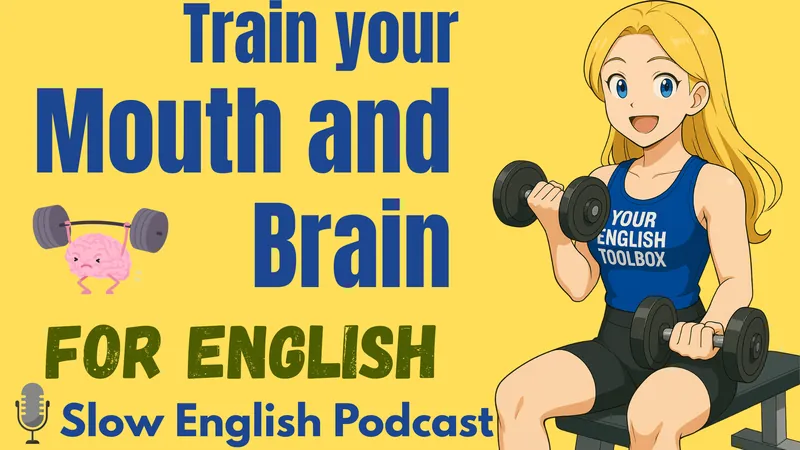
ENToday you’ll learn how to train your mouth and your brain—like athletes train their bodies—so you can finally speak with calm, clarity, and confidence.
ENYou don’t need perfect grammar to start.
ENYou need motion.
ENSmall, daily motion.
ENBy the end of this episode, you’ll have simple tools you can use at home, at work, and on the bus.
ENNo stress, no drama—just steady progress.
ENSo why do so many learners read and listen well, but struggle to speak?
ENBecause speaking is physical.
ENYour mouth has habits from your first language.
ENEnglish asks your lips, tongue, and jaw to move in new ways.
ENThe brain knows the idea, but the mouth hasn’t rehearsed the moves.
ENThat’s not a problem of intelligence; it’s a lack of reps.
ENLike sport: no one lifts once and expects strong muscles.
ENWe need smart, regular training.
ENLet’s make the training practical.
ENThink of your daily English like a short workout: a quick warm-up, a few focused drills, and a cool-down where you reflect and relax.
ENKeep it light, consistent, and varied so you don’t burn out.
ENFirst, shadowing.
ENPick a short audio or video you enjoy—a movie line, a podcast clip, a news sentence.
ENPlay a few seconds, and repeat the words almost at the same time, matching rhythm, stress, and intonation.
ENYou’re not copying just the words; you’re copying the music of the words.
ENStart simple, then add variety.
ENDon’t only shadow “Hello, how are you?” Try different situations: “I’ll have the chicken salad, please.” “Boarding begins at Gate B-12.” “Could you clarify the deadline?” “That view is unbelievable!” “Turn left at the traffic light.” “Let’s split the bill.” “I appreciate your help today.”
ENNotice how each line pushes your mouth in a new direction.
ENSome are quick and bouncy.
ENOthers are long and smooth.
ENThat variety builds agility.
ENIf a line feels hard, break it into chunks.
EN“I’ll have // the chicken salad, please.” Then put it back together.
ENIf you miss a word, don’t stop; keep the rhythm and jump back in.
ENThis trains your mouth to stay flexible during real conversations when you don’t catch every syllable.
ENNow add a tiny daily phrase routine—your warm-up.
ENRotate through short, useful sentences so your mouth wakes up with different rhythms: “I’m running late, but I’m on my way.” “I’ve got two meetings this morning.” “This coffee tastes amazing.” “I’m looking forward to the weekend.” “Let’s keep it simple.” “That makes total sense.” “Could you speak a little slower?” “I’ll handle it after lunch.” “Thanks for your patience.” “I’ll take the bus today.”
ENSay them with feeling.
ENSmile for “This coffee tastes amazing.” Lower your voice for “Could you speak a little slower?” Emotion makes pronunciation more natural because your face and breath move in the right direction.
ENNext, speak out loud even when you’re alone.
ENIt may feel silly at first, but it’s powerful.
ENNarrate your life in English as you go: “Okay, I’m shutting down the laptop.” “Where did I put my keys?” “I’ll wash the dishes, then I’ll read for ten minutes.” “I’m stretching my legs; this chair is not my friend.” “Hmm, I forgot to reply to that email.
ENI’ll do it now.”
ENYou don’t need a partner.
ENYou’re building fluency by connecting words to actions in real time.
ENThat connection—mouth, meaning, movement—teaches faster than silent study.
ENNow, the mind.
ENMany learners translate in their heads and get stuck.
ENSwitch to direct thinking in English.
ENStart tiny: label the world with single words.
EN“Glass.” “Window.” “Rain.” “Hungry.” Then move to mini-phrases.
EN“It’s raining.” “I’m hungry.” “The meeting starts soon.” As your vocabulary grows, your phrases grow.
ENThe point is not big ideas; it’s speed.
ENDirect thinking removes the extra step that slows your speech.
ENA helpful trick is micro-monologues.
ENFor thirty seconds, think in English about one small topic—your breakfast, your plan for the afternoon, what you can see from the window.
ENKeep it light and simple: “Eggs and toast today.
ENToo much salt yesterday.
ENI’ll add fruit.
ENBlueberries if we have them.” Your brain learns to supply words automatically without jumping back to your first language.
ENImmersion is the background music of progress.
ENYou don’t need to move abroad to surround yourself with English.
ENCurate your environment: Change your phone and apps to English.
ENFollow a couple of news accounts designed for learners.
ENWatch short videos with English subtitles.
ENListen to simple stories or interviews while cooking.
ENAdd a few English memes or comics to your feed.
ENRead one short paragraph of news in the morning.
ENMake it enjoyable.
ENIf you love travel, follow travel creators.
ENIf you love tech, follow tech.
ENJoy keeps you consistent.
ENSpeaking of consistency, small daily sessions beat rare marathons.
ENFive honest minutes every day builds more skill than two hours once a month.
ENThink of athletes: they show up, they do their drills, they rest.
ENYou can do the same.
ENUse habit stacking—attach your English to something you already do.
EN“After I make coffee, I shadow two lines.” “When I sit on the bus, I do my phrase warm-up.” Keep the bar low so you never break the chain.
ENLet’s talk mindset, because technique is useless if fear blocks your voice.
ENMany learners wait for perfection before speaking.
ENThat day never comes.
ENThe courage to speak creates the skill to speak.
ENMistakes are not danger; they’re data.
ENThey show you exactly what to practice next.
ENWhen you feel nervous, simplify.
ENSlow your pace, shorten your sentences, and breathe out before you start.
ENThink like a runner: smooth is fast.
ENIf you forget a word, paraphrase.
EN“What’s the word… the thing you use to clean the floor?
ENA mop.” If you don’t understand, guide the conversation: “Could you say that again?” “Do you mean the delivery is Friday or Monday?” “Let me check I got that right.” These are professional communication skills, not beginner crutches.
ENAbout accent: your goal isn’t to delete your identity.
ENYour goal is clear speech.
ENKeep your melody natural and your sounds clear enough to be understood.
ENThat’s success.
ENPeople want your ideas, your energy, your story.
ENA unique accent is part of that story.
ENHere’s a simple way to measure progress without perfectionism: track clarity, comfort, and control.
ENClarity: do people understand you the first time?
ENComfort: do you feel less tension in your face and shoulders when you speak?
ENControl: can you speed up, slow down, and emphasize key words when you want to?
ENIf those three grow, your fluency is growing.
ENLet’s put all the pieces together with a short daily plan—light, flexible, and realistic.
ENOne: Warm-up (one minute).
ENSay three short phrases out loud with emotion.
ENRotate them daily: everyday life, work, travel, social moments.
ENFor example: “Morning!
ENI slept terribly, but I’m alive.” “I’ll join the call at nine sharp.” “One ticket to the city center, please.” “That movie was better than I expected.”
ENTwo: Shadowing drill (two minutes).
ENPlay a quick clip you enjoy and echo it.
ENMatch the rhythm.
ENIf it’s tough, chunk it, then reconnect.
ENThree: Self-talk (one to two minutes).
ENNarrate one tiny task you’re doing right now.
ENKeep it friendly and simple.
ENFour: Mini-monologue (one minute).
ENThink in English about something on your mind—weekend plan, lunch options, or the weather.
ENNo translation.
ENFive: Cool-down (thirty seconds).
ENNote one thing that felt easier than yesterday.
ENSmile at that win.
ENDone.
ENThat tiny plan is enough to keep your mouth active and your brain engaged, even on busy days.
ENOn longer days, you can extend any part, but don’t let the routine become heavy.
ENLight + consistent beats heavy + rare.
ENLet’s add more variety to keep your mouth flexible.
ENHere are quick example lines across different contexts—use them in your warm-ups or shadowing:
ENWork and study: “Let’s align on the next steps.” “I’ll send the draft before lunch.” “Could you share the file with me?” “I’m not sure yet, but here’s my initial idea.”
ENTravel and logistics: “Is this seat taken?” “What time does the last train leave?” “I think we missed our stop.” “Could you recommend a place to eat nearby?”
ENSocial and small talk: “That sounds like a plan.” “How do you know the host?” “I’m new here, but I’m excited to meet people.” “Thanks for inviting me; I had a great time.”
ENFeelings and opinions: “I’m a bit overwhelmed, so I’ll take a short break.” “I completely agree with that.” “I’m not convinced—can we look at another option?” “This made my day.”
ENDaily life: “I’ll grab a quick snack.” “The air feels cooler today.” “I left my charger at home.” “I’ll take the stairs.”
ENYour mouth learns by doing new movements, not by repeating one line forever.
ENKeep switching topics and rhythms so your speaking muscles stay agile.
ENNow, a common question: “What if I don’t understand everything I shadow?” Good news—you don’t have to.
ENThe goal is sound and rhythm training.
ENEven professional athletes practice movements slowly or with assistance before they master the full speed.
ENStay with the flow.
ENIf one sentence is too hard, shorten it or choose a similar, easier sentence with the same rhythm, then return to the original later.
ENAnother question: “How do I avoid translating?” Build bridges with simple connectors that keep you moving even when vocabulary is missing: “Basically…,” “So the point is…,” “In other words…,” “For example…,” and simple structures like “It’s like…,” “It feels like…,” “It looks like….” These connectors allow you to paraphrase and keep the conversation alive.
ENThey buy time while your brain searches for the exact word.
ENYou’ll also make faster progress if you listen for stress and melody.
ENEnglish is a stress-timed language: content words carry the beat, and function words often get reduced.
ENTry it with “I’ll take the bus today.” You’ll likely tap the beat on “take,” “bus,” “today,” and slide lightly over “I’ll” and “the.” When you shadow, exaggerate that music a little; it trains your ear and guides your mouth.
ENLet’s revisit mindset with a truth that helps many learners: most people are kinder than your inner critic.
ENThe “spotlight effect” makes us think everyone notices our mistakes.
ENIn reality, listeners are busy thinking about their own response.
ENIf you show patience, humor, and a willingness to communicate, people will meet you halfway.
ENYour calm will invite their calm.
ENWhat about speed?
ENMany learners rush because they think fast English equals good English.
ENBut clarity beats speed.
ENStart at a comfortable pace, then add speed only where it stays clear.
ENThink like a cyclist changing gears on a hill—control first, then power.
ENAnd remember the principle: your brain will follow your mouth.
ENWhen you speak, you don’t just demonstrate what you know; you create what you know.
ENProduction strengthens memory, builds automatic grammar, and tunes your pronunciation.
ENReading and listening are food.
ENSpeaking is training.
ENLet’s walk through a tiny example to feel this.
ENTake the idea “ask for help at work.” Build three levels, each one small and manageable:
ENLevel 1: “Could you help me?” Level 2: “Could you help me with the budget file?” Level 3: “Could you help me with the budget file?
ENI’m checking last quarter’s numbers, but I’m not sure about the exchange rate.”
ENEach level adds a small piece.
ENYou’re not trying to be Shakespeare; you’re aiming for clear, confident communication.
ENThat is fluency.
ENIf anxiety rises, reset your body.
ENExhale slowly, drop your shoulders, and plant your feet.
ENThen speak.
ENYour voice rides on your breath; steady breath, steady voice.
ENTiny body habits produce big speaking results.
ENHere’s a short checklist you can screenshot in your mind and review before any conversation: • Breathe out.
EN• Start simple.
EN• Emphasize the key word in each sentence.
EN• Paraphrase if you forget a word.
EN• Ask a clarifying question if needed.
EN• Smile with your voice.
ENNow, a few quick myths to release:
ENMyth: “If I keep quiet until I’m perfect, I’ll avoid bad habits.” Reality: silence is the fastest way to freeze your progress.
ENPractice builds the right habits when you choose clear models and repeat them.
ENMyth: “My accent must disappear.” Reality: clarity matters more than accent.
ENAim for sounds that are easy to understand and a melody that fits English rhythm; the rest is personal style.
ENMyth: “I need long study sessions.” Reality: short, focused, daily sessions win.
ENConsistency builds confidence; confidence builds speed.
ENTo make this easier, prepare a tiny personal phrase bank that fits your life.
ENKeep twenty lines on your phone that you actually use.
ENMix contexts and moods.
ENHere’s a starter set—edit freely:
EN“I’ll take care of it.” “Can we push this to tomorrow?” “Thanks, that was really helpful.” “I didn’t catch that—could you repeat it?” “Let me check and get back to you.” “I’m across town; I’ll be there in twenty minutes.” “I’m fine with either option.” “Honestly, I need a break.” “That’s exactly what I was thinking.” “Let’s circle back after lunch.” “I’ll book the tickets tonight.” “Could you send me the details?” “I’m learning—thanks for your patience.” “That’s not ideal, but we’ll figure it out.” “Quick question—do you have a minute?” “I’m excited about this.” “Long day.
ENI need fresh air.” “Great job on the presentation.” “I appreciate your honesty.” “Let’s keep moving.”
ENRotate five lines per day.
ENSpeak them like you mean them.
ENYour mouth will remember the shapes; your brain will remember the paths.
ENOne more sport lesson: progress arrives in waves.
ENAthletes have plateaus, and so will you.
ENA week where everything sounds clumsy does not mean you’re stuck; it means your brain is reorganizing new patterns.
ENTreat those weeks as active recovery.
ENKeep your routine short and kind.
ENFocus on clarity and breath.
ENThe next wave of improvement usually comes right after a patient stretch.
ENIf you like numbers, use simple metrics that reward consistency, not perfection.
ENCount minutes spoken aloud, not errors.
ENCount days in a row, not vocabulary size.
ENA tiny log on your notes app—“4 minutes self-talk, 2 minutes shadowing, felt calmer than yesterday”—will keep your motivation warm.
ENFor extra variety, add lines from service situations you meet often: “Could I have this in a medium, please?” “I’d like to return this; I have the receipt.” “Do you have anything without nuts?” “Is tap water okay?” “Could you email me the confirmation?” “I’ll wait over there.” “It should arrive by Thursday, right?”
ENAnd some universal repair phrases that save any conversation: “Sorry, my connection dropped for a second.” “Let me rephrase that.” “What I meant was…” “Could you give me an example?” “Take your time—I’m listening.”
ENFinally, celebrate small wins out loud.
EN“Today I spoke slower and felt in control.” “I handled a call without switching languages.” These moments matter.
ENThe voice you practice shapes the voice you bring to real life.
ENAs we head to the finish, let’s anchor the core message.
ENYou don’t need permission to speak.
ENYou don’t need perfection to start.
ENYou need motion, variety, and kindness toward yourself.
ENTrain your mouth with shadowing and short phrases.
ENTrain your mind to think in English directly, one small idea at a time.
ENSurround yourself with enjoyable English so your progress feels natural.
ENShow up daily, even for five minutes.
ENAnd treat mistakes as friendly feedback.
ENYour voice matters.
ENIt carries your ideas, your humor, your story.
ENKeep it.
ENPolish it.
ENUse it.
ENWhen you speak, the world hears you—and you hear a stronger version of yourself.
ENBefore we close, tell us one simple English phrase you’ll start repeating daily.
ENWrite it in the comments.
ENShare it so others can borrow it for their warm-ups.
ENAnd if this episode helped, pass it to a friend who needs a nudge to speak.
ENTake this with you: action beats anxiety.
ENRepetition beats hesitation.
ENAnd your brain will follow your mouth.
ENThis is Your English Toolbox—we’ll be here, cheering for every word you dare to say.