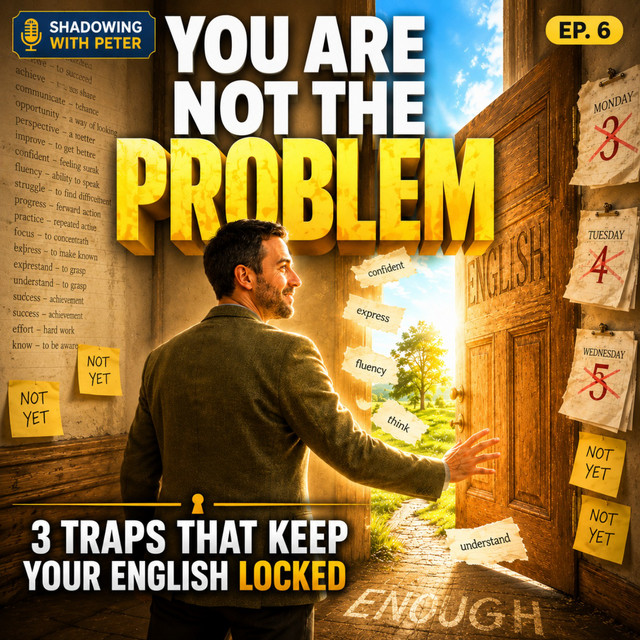
You are not the problem. The 3 Traps that keep your english locked. — cover

EPISODE 19 · 10 MIN

You are not the problem. The 3 Traps that keep your english locked.

Welcome to Shadowing With Peter , the calm corner of the Slow English Podcast where we train your ears step by step.

Full episode notes on Acast ↗

Find your country — or stay in English

100% English mode

ENWelcome to your English toolbox, the Slow English Podcast, where we train your ears step by step.

ENMy name is Peter, today we have a calm shadowing episode.

ENI will speak slowly and you can shadow with me whenever you want.

ENIntroduction You stand in front of a door.

ENIt says English.

ENYou have seen people walk through it easily.

ENThey speak fluently, confidently, naturally.

ENBut when you try to open it, it doesn't move.

ENYou watch videos.

ENYou try apps.

ENYou memorize vocabulary lists.

ENYou work hard, really hard.

ENAnd still, the door stays closed and slowly a thought appears.

ENMaybe I'm not good at languages.

ENMaybe something is wrong with me.

ENBut nothing is wrong with you.

ENThe problem is not you.

ENThe problem is the traps that keep the door locked.

ENInvisible traps that hold millions of learners in the same place.

ENToday, I want to help you escape them.

ENIn the next minutes, I will guide you through the three traps that stop your progress.

ENThree traps that make your English feel slow, heavy, or stuck.

ENAnd three ways to break free.

ENTrap number one is the vocabulary trap.

ENThe idea that you just need more words.

ENIt sounds logical.

ENIt feels productive.

ENSo you collect lists, apps, flashcards.

ENWord after word after word.

ENBut when someone asks you, how are you today?

ENYour mind goes blank.

ENLearning vocabulary is not the same as using vocabulary.

ENKnowing thousands of words means nothing if you cannot create a natural sentence in real life.

ENSo how do you escape this trap?

ENYou speak out loud.

ENEven if your sentences are simple.

ENEven if you know only a few words.

ENUse them every day.

ENLearning English is not about filling your brain.

ENIt is about training your mouth and training your ears.

ENTrap two.

ENWaiting to be ready.

ENTrap number two is waiting for the perfect moment.

ENThe idea that you will speak when you feel ready.

ENYou wait for the perfect sentence.

ENThe perfect accent.

ENThe perfect version of you.

ENBut that moment never comes.

ENSpeaking is scary.

ENYou might forget a word.

ENYou might make a mistake.

ENYou might feel embarrassed.

ENBut that is how everyone starts.

ENSpeaking is like riding a bicycle.

ENYou wobble.

ENYou fall.

ENYou look silly.

ENBut then you find balance.

ENSo do not wait for perfect.

ENDo not wait to feel ready.

ENSpeak now.

ENEven if it is messy.

ENMessy is better than silent.

ENTrap three.

ENBelieving you are the problem.

ENTrap number three is believing you are the problem.

ENYou study for months.

ENMaybe years.

ENBut your progress feels slow.

ENFast conversations confuse you.

ENMistakes repeat.

ENYour confidence drops.

ENAnd the small voice returns.

ENMaybe English isn't for me.

ENThat voice is wrong.

ENYou are not the problem.

ENYour method is the problem.

ENMost learners do too much passive learning.

ENThey watch.

ENThey read.

ENThey listen.

ENBut they do not use the language.

ENReal improvement comes from creation.

ENSpeak to yourself.

ENRecord your voice.

ENWrite short paragraphs.

ENShadow the sentences you hear.

ENAfter every lesson, ask yourself.

ENHow can I say this in my own words?

ENThat question changes everything.

ENTrap one.

ENCollecting vocabulary, but not using it.

ENTrap two.

ENWaiting for the perfect moment.

ENTrap three.

ENBelieving you are the problem.

ENYou are not the problem.

ENYou were just stuck in the traps.

ENAnd now, you can see them clearly.

ENThat English door will not open by magic.

ENYou open it.

ENWith your voice.

ENWith your practice.

ENWith the courage to keep going.

ENYou are much closer than you think.

ENIf this calm, shadowing episode helped you, please leave a small comment before you go.

ENYour comments show the platforms that our community is real, active, and growing.

ENThey help me continue creating more slow, clear episodes for you.

ENTell me which trap you escaped today, or which one you want help with next.

ENSee you in the next episode.