ENWelcome to your English toolbox, the podcast where we train your ears and your mind step by step.
EPISODE 23 · 19 MIN · CALM ENGLISH
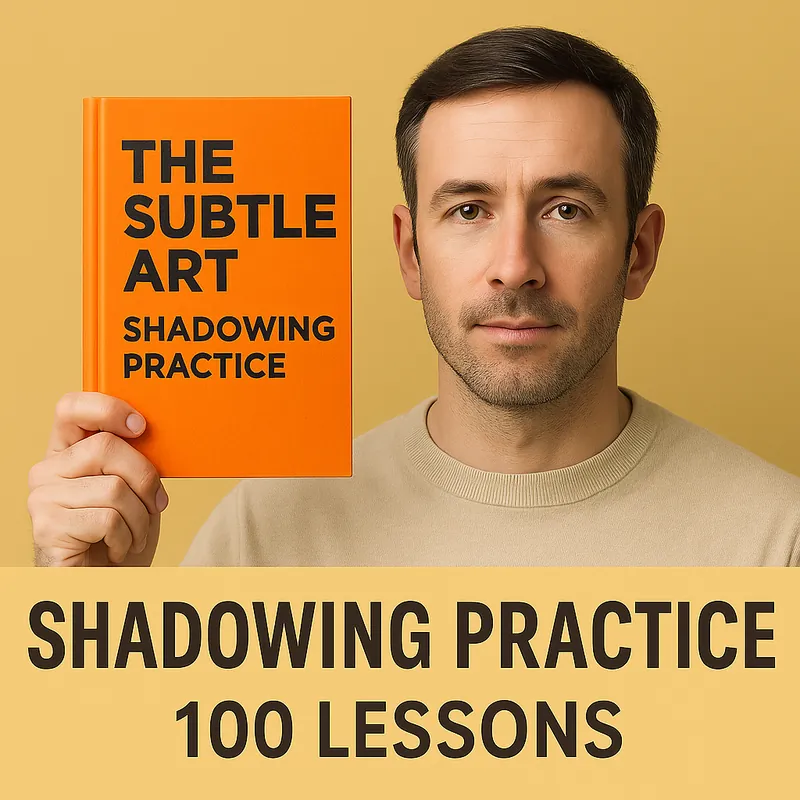
Shadowing Practice 100 Lessons
Welcome to a new episode of the Slow Listening Podcast , your space to train your ears, your voice, and your confidence.
Full episode notes on Acast ↗Find your country — or stay in English
100% English mode
ENI am Peter,
ENand today we are going to do
ENsomething very powerful.
ENWe are going to practice shadowing with 100 sentences of wisdom from Mark Manson.
ENI recommend you to listen to our previous episode where we deeply explain the content of this interesting book, The Subtle Art of Not Giving a Fuck.
ENAfter being aware of the content, today's episode is a good way to practice shadowing English, improving your listening and understanding, and at the same time going back to the powerful teachings of the book.
ENI will read 100 sentences divided into five blocks.
ENYour job is to listen
ENand then repeat exactly what I say during the silence.
ENTake a deep breath, relax your shoulders and let's begin.
ENBlock one: The feedback loop and suffering.
ENThe desire for more positive experience is itself a negative experience.
ENParadoxically, the acceptance of one's negative experience is itself a positive experience.
ENWe have become too comfortable, and that is making us weak.
ENTo not give a fuck is to stare down life's most terrifying and difficult challenges.
ENYou must care about something far more important than your adversity.
ENIf you don't find a meaningful problem, your mind will invent meaningless ones.
ENEverything worthwhile in life is won through surmounting the associated negative experience.
ENAvoiding suffering is a form of suffering.
ENThe avoidance of struggle is a struggle.
ENThe denial of failure is a failure.
ENHiding what is shameful is itself a form of shame.
ENPain is an inextricable thread in the fabric of life.
ENTo try to pull the thread of pain out is to unravel everything else with it.
ENHappiness is not a solvable equation.
ENHappiness comes from solving problems.
ENTrue happiness occurs only when you find the problems you enjoy having.
ENDon't ask yourself what you want to enjoy;
ENask yourself
ENwhat pain you want to sustain.
ENWho you are is defined by what you are willing to struggle for.
ENThis is the most simple and basic component of life.
ENReflection one: That was the first block.
ENWe learned that avoiding pain only creates more pain.
ENReal happiness is found in choosing the struggles that matter to us.
ENLet's move deeper into how we see ourselves.
ENBlock two: Values and being average.
ENThe vast majority of your life will be boring and not noteworthy.
ENThat is okay.
ENIf you feel like you must be special to be worthy, you will always feel like a failure.
ENThe ticket to emotional health involves accepting the bland and mundane truths of life.
ENOnce you accept your life as mundane, you are free to accomplish what you truly wish.
ENSelf-awareness is like an onion.
ENThere are multiple layers to it, and the more you peel them back, the more you cry.
ENValues are the fundamental component of our psychological makeup.
ENIf you have shitty values, you will have a shitty life.Pleasure is a false god.
ENPleasure is the most superficial form of life satisfaction, and therefore the easiest to obtain.
ENMaterial success is also a poor metric for self-worth.
ENOnce you are able to provide for your basic physical needs, the correlation between happiness and money is zero.
ENAlways being right is another terrible value.
ENIt prevents you from learning from your mistakes.
ENStaying positive all the time is a form of avoidance.
ENDenying negative emotions leads to deeper and more prolonged negative emotions.
ENGood values are reality-based, socially constructive, and immediate.
ENHonesty is a good value because it is something you have complete control over.
ENPopularity is a bad value because it is out of your control.
ENReflection three.
ENIn this block, we confronted the idea of being special.
ENAccepting that we are average at most things liberates us from the pressure to be perfect.
ENWe also learn to choose values that we can control, like honesty and humility.
ENlet's talk about responsibility.
ENBlock three, radical responsibility.
ENWe are responsible for experiences that aren't our fault all the time.
ENFault is past tense.
ENResponsibility is present tense.
ENFault results from choices that have already been made.
ENResponsibility results from the choices you are currently making.
ENNobody else is ever responsible for your situation but you.
ENMany people
ENmay be to blame for your unhappiness...
ENBut nobody is ever responsible for your unhappiness but you.
ENTaking responsibility for your problems is the first step to solving them.
ENThe more we choose to accept responsibility in our lives, the more power we will exercise over our lives.
ENWe do not go from wrong to right...
ENWe go from wrong to slightly less wrong.
ENUncertainty is the root of all progress and all growth.
ENThe more you try to be certain about something, the more uncertain and insecure you will feel.
ENYou should never say, "I know who I am." You should ask, "What if I am wrong?"
ENThe more something threatens your identity, the more you will avoid it.
ENLet go of who you think you are...
ENThis allows you to become who you might be.
ENDoubt is the beginning of wisdom.
ENReflection
ENthree.
ENThat was a heavy section.
ENThe distinction between fault and responsibility is crucial.
ENEven if life deals you a bad hand, it is your responsibility to play it well We must be willing to doubt ourselves.
ENBlock four, failure and action.
ENFailure is an arbitrary concept.
ENIf your metric for success is to learn, then failure is impossible.
ENWe can be truly successful only at something we're willing to fail at.
ENIf you are unwilling to fail, then you are unwilling to succeed.
ENPain is part of the processJust as physical pain strengthens bone and muscle, emotional pain strengthens your mind.
ENLife is about not knowing, and then doing something anyway.
ENDo not just sit there;
ENdo something.
ENAction isn't just the effect of motivation, it's also the cause of it.
ENMotivation is an endless loop.
ENAction leads to inspiration, which leads to motivation.
ENIf you lack the motivation to make an important change in your life, do something.
ENAnything.
ENThen harness the reaction to that action as a way to begin motivating yourself.
ENThe "do something" principle
ENcreates its own momentum.
ENYou are your own source of inspiration.
ENYou do not need to wait for permission to act.
ENSmall actions snowball into large changes.
ENProgress is born from the willingness to act without guarantees.
ENReflection garden.
ENThat block was about movement.
ENWe often wait for motivation, but action actually creates motivation.
ENDon't fear failure; use it as a tool to move forward.
ENWe are almost there.
ENLet's finish with the final block.
ENBlock five, rejection, love, and death.
ENFreedom is not the absence of commitment;
ENfreedom is the ability to choose what to commit to.
ENYou cannot value everything.
ENTo value something, you must reject what is not that thing.
ENRejection is an inherent and necessary part of maintaining our values.
ENHonesty is a natural human craving,
ENbut you cannot have honesty without the possibility of rejection.
ENEntitlement is the belief that you deserve a different set of rules than everyone else.
ENHealthy love is based on two people with their own values and their own responsibilities.
ENUnhealthy love is based on two people trying to escape their problems through their emotions for each other.
ENCommitment gives you freedom because you're no longer distracted by the unimportant.
ENBreadth of experience is necessary when you're young,
ENbut depth is where the gold is buried.
ENDeath is the light by which the shadow of all of life's meaning is measured.
ENWithout death, everything would feel inconsequential.
ENYou are going to die, and that is a good thing.
ENIt creates a sense of urgency to get your priorities straight.
ENOur projects are our way of feeling immortal,
ENbut you are not the center of the universe.
ENOnce you become comfortable with the fact of your own death, you are finally free to live.
ENReflection five.
ENWe have completed the 100 sentences.
ENWe ended with the reminder that commitment gives us depth and death gives us focus.
ENBy rejecting the trivial, we make space for the essential.
ENConclusion.
ENThank you for joining me in this intense shadowing session.
ENRepeating these sentences helps your brain internalize the grammar, the rhythm, and the philosophy of English.
ENNow, I have an important request for you.
ENIf you enjoyed this episode, please write a small comment before you go.
ENYour comments show the platforms that our community is real, active, and growing.
ENThis support is crucial for us to continue creating new episodes every week.
ENTell me which sentence
ENresonated with you the most.
ENDo you want to be part of our Slow English community?
ENWe need your comments because your voice is more important than mine.
ENYour voice and comments will show us the right path.
ENThank you for listening.
ENI am Peter,
ENand I will see you in the next episode.