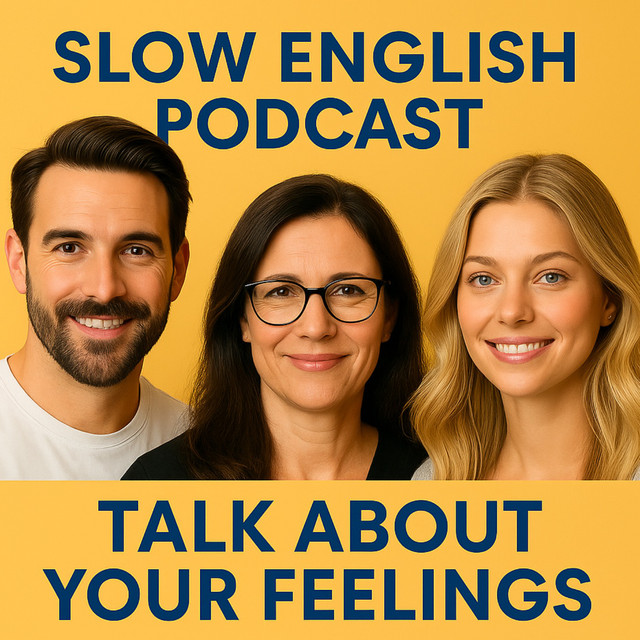
ENTalk about your feelings.
EPISODE 24 · 17 MIN · MIND & MOTIVATION
Talk About Your Feelings in English
In today’s episode, Martin and Julia explore one of the most challenging skills for English learners: talking honestly about your feelings.
Full episode notes on Acast ↗Find your country — or stay in English
100% English mode
ENWelcome to Your English Toolbox, your slow English podcast where we train your ears step-by-step.
ENI am Martin.
ENAnd I am Julia.
ENHow are you today?
ENAre you really fine?
ENWell, actually, I am a little bit tired and stressed about a project.
ENSee, that is the problem with English learners and even native speakers.
ENWe always say, "I am fine," because we are afraid to show our real emotions.
ENBut language is a tool for connection.
ENIf you cannot express sadness, frustration, or joy, you are only using half of your toolbox.
ENToday, we are going to go deep.
ENWe will learn how to talk about difficult feelings.
ENWe will learn how to confront people politely.
ENAnd we have a very special guest to help us understand why this is so important.
ENPlease welcome Rose, a psychologist who joins us today.
ENHello, Martin.
ENHello, Julia.
ENIt is wonderful to be here.
ENWe are so happy to have you, Rose.
ENRose, why is it so hard for people to say, "I am sad," or, "I am angry"?
ENIt is often because we think negative feelings are bad.
ENWe think we must be happy all the time to be accepted.
ENBut from a psychological perspective, ignoring feelings is dangerous.
ENThat is a great hook for our listeners.
ENSo, are you ready to stop saying, "I am fine," and start speaking the truth?
ENLet's open Your English Toolbox.
ENPart 1: Identifying the Feeling.
ENBefore we can talk, we must identify the word.
ENMany students only use happy, sad, or angry.
ENBut English has thousands of nuances.
ENRose, in your therapy sessions, what is the first step?
ENThe first step is to name the emotion accurately.
ENThere is a big difference between being angry and being frustrated.
ENLet's look at that difference.
ENAngry is a strong, hot feeling of displeasure.
ENFor example, if I cannot find my keys, I am frustrated.
ENIf someone steals my keys, I am angry.
ENThat is a very clear distinction.
ENRose, why does accuracy matter here?
ENWe call this, "Name it to tame it."
ENIf you say, "I am overwhelmed," you admit you have too much pressure.
ENOverwhelmed,
ENthat is a fantastic B2-level word.
ENIt means you have too much work or too much emotion to handle.
ENListeners, are you feeling overwhelmed with your English study sometimes?
ENEncouraging, speaking very slowly, it is okay to admit it.
ENAnother great word is anxious.
ENHow is that different from afraid, Julia?
ENAfraid is usually about a real danger right now, like a lion.
ENAnxious is about something in the future like a job interview.
ENExactly.
ENAnxiety lives in the future.
ENWhen you tell a friend, "I am feeling anxious about tomorrow," you invite them to help you.
ENSo rule number one is precision.
ENStop using bad, and start using frustrated, overwhelmed, or anxious.
ENPart 2: The Danger of Bottling Up.
ENNow we need some phrasal verbs.
ENRose, what happens if we do not speak about our emotions?
ENWell, if you do not speak, you tend to bottle up your feelings.
ENTo bottle up.
ENImagine a bottle of soda.
ENYou shake it and shake it, but you keep the cap on tight.
ENYou are putting the feelings inside a bottle and closing it.
ENThat is bottling up.
ENAnd when you bottle up your emotions, eventually the bottle explodes.
ENWe have a phrasal verb for that explosion, too.
ENIt is to lash out.
ENTo lash out, this means to suddenly attack someone verbally because you are angry.
ENImagine you bottled up your stress from work all day.
ENThen you come home and your husband asks, "What is for dinner?"
ENAnd you scream, "Why do you always ask me that?"
ENYou lashed out at him.
ENAnd usually, you lash out at the people you love the most.
ENThis damages relationships.
ENSo, the opposite of bottling up is to open up.
ENTo open up.
ENThis means to start talking about your inner world.
ENOpening up requires vulnerability, but it builds trust.
ENI have a question for you, Rose.
ENIs there a physical benefit to opening up?
ENAbsolutely.
ENWhen you bottle up, your cortisol levels, the stress hormone, go up.
ENWhen you open up, your brain releases oxytocin.
ENThat is the bonding chemical.
ENSo, speaking English is actually good for your health?
ENOnly if you tell the truth.
ENListeners, I want you to shadow this sentence with me to practice the phrasal verb.
ENRepeat after me.
ENI need to open up because I cannot bottle this up anymore.
ENLet's try one more time.
ENDon't lash out.
ENJust try to open up.
ENPart three, how to confront someone.
ENOkay, we know we should open up.
ENBut what if the feeling is caused by another person?
ENThis is the hard part.
ENMany learners stay silent because they are afraid to be rude.
ENRose, is there a psychological trick to confront someone without fighting?
ENYes, there is a classic tool we use.
ENIt is called the I statement.
ENThe I statement.
ENCan you explain how that works?
ENUsually when we confront someone, we use you statements.
ENWe say, "You are rude," or, "You never listen to me."
ENThat sounds like an attack.
ENAnd when I hear, "You never listen," I want to defend myself.
ENExactly.
ENInstead, you should focus on your own feeling.
ENThe formula is, "I feel when you..."
ENLet's look at the grammar of that.
ENWrite I feel followed by an adjective.
ENSpeaking very slowly, when you, followed by a verb.
ENSo instead of saying, "You are annoying," what should I say, Rose?
ENYou could say, "I feel frustrated when you interrupt me."
ENNotice the difference.
ENYou are not saying the person is bad.
ENYou are saying the action produces a feeling in you.
ENLet's practice some other examples.
ENImagine your friend is always late.
ENDo not say, "You are so disrespectful."
ENThat will start a fight.
ENInstead say, "I feel hurt when you arrive late because it feels like my time is not important."
ENYou added the because, which explains the impact.
ENThis invites the other person to understand you, not fight you.
ENIs it really that simple?
ENSimple to say, but hard to do.
ENIt requires you to know your feeling first.
ENWe also have a great expression for this moment of honesty.
ENIt is to get something off your chest.
ENImagine a heavy weight sitting on your chest.
ENYou cannot breathe well.
ENWhen you finally say the truth, the weight is gone.
ENYou got it off your chest.
ENRose, how do patients feel after they get it off their chest?
ENThey often sigh with relief, "Oh." They feel lighter.
ENThey realize the fear was in their head.
ENSo, listeners, if you are holding a heavy secret or a frustration, use the structure, "I feel X when you do Y."
ENPart four, asking about feelings.
ENWe have talked about expressing ourselves.
ENBut a conversation is a two-way street.
ENWe need to ask other people how they feel.
ENAnd, "How are you?" is not enough.
EN"How are you?" is automatic.
ENIt is a reflex, not a question.
ENRose, how can we ask a question that invites a real answer?
ENYou need to ask specific open-ended questions.
ENInstead of, "Are you okay?" which is a yes/no question,
ENtry asking, "What is on your mind?"
EN"What is on your mind?"
ENThat is a beautiful phrase.
ENIt implies that you know the person is thinking about something.
ENAnother great one is, "You seem a bit quiet today."
ENThat is an observation, not a question, but it invites an answer.
EN"You seem quiet, is everything okay?" Yes, observing body language is key.
ENIf you see someone looking down or sighing, you can say, "I notice you are sighing a lot.
ENDo you want to talk about it?"
ENThis gives the other person permission to open up.
ENOr permission to stay silent.
ENIt is very respectful.
ENRose, what if the person starts crying?
ENMany English learners panic if someone cries.
ENThey do not know what to say.
ENThe best thing to say is often very simple.
ENYou can say, "It is okay to cry," or, "I am here with you."
EN"I am here with you."
ENYou do not need to fix the problem.
ENYou just need to be present.
ENWe also use the verb 'to empathize'.
ENTo empathize means to feel what the other person is feeling.
ENIt is different from sympathize.
ENSympathy is feeling sorry for someone.
ENEmpathy
ENis feeling with someone.
ENThat is a crucial distinction.
ENConnection comes from empathy.
ENWhen you say, "I can imagine how hard that is," you are empathizing.
ENListeners, these phrases are your lifeline in deep conversations.
EN"I can imagine how hard that is."
EN"Thank you for trusting me with this."
EN"I appreciate you telling me."
ENThese are much better than just saying, "Don't worry!" Please, never say, "Don't worry," to someone in pain.
ENIt invalidates their feelings.
ENIt tells them their feeling is wrong.
ENWhite: Instead, validate them.
ENSay, "It makes sense that you are sad."
ENPart 5, The Emotional Toolbox.
ENWe have covered a lot of ground today.
ENWe moved from, "I am fine," to, "I am overwhelmed."
ENWe learned to stop bottling up and start opening up.
ENWe learned to get things off our chest using 'I' statements.
ENAnd we learned how to offer empathy.
ENRose, as we finish, what is your final advice for our listeners?
ENMy advice is to practice with small feelings first.
ENDo not wait for a big tragedy.
ENPractice telling a friend, "I felt a bit disappointed when the restaurant was closed." Practice the small muscles of vulnerability.
ENThen, when the big feelings come, you will be ready.
ENThat is excellent advice.
ENStart small to build strength.
ENLanguage learning is exactly the same.
ENYou practice small sentences so you can have big conversations.
ENRose, thank you so much for joining us and sharing your wisdom.
ENThank you for having me.
ENIt was a pleasure.
ENIt is amazing how psychology and language go hand-in-hand.
ENThey are both about understanding the human experience.
ENRemember, your English does not have to be perfect to be emotional.
ENPeople connect with your heart, not your grammar.
ENBut correct grammar helps.
ENYes, it certainly helps.
ENConclusion.
ENBefore we go, I want to ask you one quick favor.
ENIf you enjoyed this episode, please write a small comment before you go.
ENYour comments show the platforms that our community is real, active, and growing.
ENThis support is crucial for us to continue creating new episodes every week.
ENTell us how you are feeling today using one of the new words we learned.
ENAre you feeling motivated?
ENOverwhelmed?
ENOr perhaps relieved?
ENWe need your comments because your voice is more important than ours.
ENYour voice and comments will show us the right path.
ENThank you for listening.
ENSee you in the next episode.