Why Your English Doesnt Sound Like You — cover

EPISODE 32 · 17 MIN · MIND & MOTIVATION

Why Your English Doesnt Sound Like You

Full episode notes on Acast ↗

Find your country — or stay in English

100% English mode

ENStudy Guide: Understanding Your English Voice

ENThis guide is designed to review the core concepts discussed in the Slow English Podcast episode about why a speaker's voice often sounds and feels different when speaking a new language like English.

ENIt explores the physical, emotional, and psychological factors behind this common experience for language learners.

ENShort-Answer Quiz

ENInstructions: Answer the following questions in 2-3 complete sentences, drawing your information directly from the podcast discussion.

ENAccording to the speakers, what are the two primary types of reasons a person's voice feels different when speaking English?

ENWhat specific physical changes occur in the body when a speaker feels evaluated, and how do these changes affect their voice?

ENHow does the "emotional color" of a native language typically differ from that of English for many learners?

ENExplain the concept of "reading yourself, not living yourself" as it applies to speaking English.

ENDescribe the internal shift from "connection to control" that can happen when a learner switches to speaking English.

ENWhat is the "inner listener," and what is the cost of paying too much attention to it?

ENWhat is the podcast's perspective on a learner's accent, and how does it contrast with the learner's own perception?

ENInstead of feeling "fake," the podcast suggests that learners are actually what?

ENExplain this concept using the provided "new house" analogy.

ENList at least three of the practical, "human" experiments suggested to help a learner's English voice feel more familiar.

ENHow does the podcast frame the idea of having "more than one you" in different languages or contexts?

ENAnswer Key

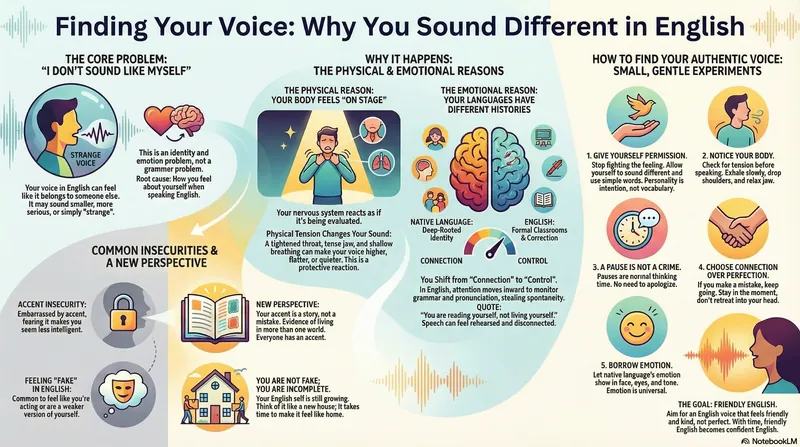
ENThe two primary reasons a person's voice feels different in English are physical and emotional.

ENThe physical answer relates to how the body reacts to feeling watched or evaluated, while the emotional answer relates to the memories and feelings attached to different languages.

ENWhen a speaker feels evaluated, their nervous system can react as if being judged.

ENThis causes the throat to tighten, breathing to become shallow, and the jaw to become tense.

ENThese small physical changes alter the sound of the voice, making it higher, flatter, or quieter.

ENA native language is described as having a warm "emotional color" because it is tied to childhood, jokes, secrets, and deep emotional memories.

ENIn contrast, English for many learners has a colder, more formal color because it was often acquired later in life, in a classroom setting associated with correction and the fear of making mistakes.

EN"Reading yourself, not living yourself" describes the feeling of an English voice that was primarily learned through written materials and tests rather than through lived, spontaneous conversation.

ENThis can make the speaker feel as though they are reciting from a script, lacking the natural, unplanned rhythm of their native tongue.

ENThe shift from "connection to control" occurs when a learner's attention moves away from the person they are talking to and focuses inward.

ENInstead of connecting with the other person, their mental energy is spent on monitoring their own grammar, pronunciation, and word choice, which takes them out of the conversational moment.

ENThe "inner listener" is a voice inside a speaker's head that is constantly listening to and judging their own speech.

ENThe cost of this self-monitoring is that it steals spontaneity, humor, warmth, and natural rhythm from the conversation, making the speaker more cautious and less present.

ENThe podcast asserts that an accent is not a mistake but a "story" and evidence that the speaker has lived in more than one world.

ENWhile learners often hear every detail of their own accent and may translate this difference as a flaw, others hear it differently.

ENThe deeper pain is often the fear that the accent signifies a lack of intelligence or belonging.

ENInstead of being "fake," the podcast suggests learners are simply "incomplete" in their new language.

ENThe "new house" analogy compares English to an empty house that initially feels unfamiliar.

ENOver time, as you fill it with your life, memories, and habits (photos, music, etc.), it gradually begins to feel like home.

ENThe practical experiments include:

ENNoticing and softening your body's tension (dropping shoulders, relaxing the jaw).

ENTaking a pause without apologizing for it.

ENChoosing connection with the other person over grammatical perfection in a conversation.

ENBorrowing the emotion (not the words) from your native language, letting it show in your face and voice.

ENThe podcast presents the idea of having "more than one you" as a form of richness, not a problem.

ENIt is normal for a person's English self to be calmer while their native self is faster, or for their work self to be more formal.

ENLanguage is just another context, and over time, these different selves integrate and form a bridge.

ENEssay Questions

ENInstructions: The following questions are designed for deeper reflection on the podcast's central themes.

ENConstruct a detailed essay-format response for each.

ENDiscuss the distinction between the "physical" and "emotional" reasons for why a learner's voice changes when speaking English.

ENHow do these two aspects interact and reinforce each other?

ENAnalyze the concept of the "inner listener." What is its function, what are its costs, and how does it relate to the speaker's shift from "connection to control"?

ENThe podcast states, "Your accent is not a mistake.

ENIt's a story." Elaborate on this idea, exploring the relationship between accent insecurity, personal identity, and the fear of "not belonging."

ENExplain the metaphor of English as a "new house." How does this analogy address the feeling of being "fake" or "incomplete," and what does it suggest about the process of language acquisition and developing authenticity?

ENOutline and evaluate the practical, "human" experiments suggested by the speakers for developing a more "friendly English." How do these specific strategies address the core issues of tension, shame, and fear discussed in the episode?

ENGlossary of Key Terms