ENWelcome back to the deep end of the pool.
EPISODE 54 · 25 MIN · ATOMIC HABITS FOR ENGLISH
Atomic Habits Deep Dive Part 2
In this second deep dive into Atomic Habits , Martin and Julia guide you through five powerful chapters in just 25 minutes.
Full episode notes on Acast ↗Find your country — or stay in English
100% English mode
ENWe are back for episode two of our deep dive into atomic habits.
ENToday we are doing something ambitious.
ENWe are covering five full chapters of the book in one single session.
ENIf you sat down to read these chapters yourself, it would take you at least two hours.
ENAnd that is if you are a fast reader.
ENBut we are going to give you the gold in just 25 minutes.
ENSo we are saving you 90 minutes of your life.
ENAnd we are saving you the headache of translating difficult vocabulary.
ENThat is a pretty good deal.
ENIf you stay with us until the end, you will learn the four invisible steps that control every habit you have.
ENYou will learn why Japanese train conductors scream at signs to save lives.
ENAnd you will discover why disciplined people are actually just lazy people with better environments.
ENSo let's not waste
ENany of that time we just saved.
ENLet's go.
ENPart one.
ENThe cat in the box.
ENImagine a hungry cat inside a puzzle box.
ENMartin, why are we putting cats in boxes?
ENIt is for science, Julia.
ENOkay, tell me about the cat.
ENThis is a famous experiment by Edward Thorndyke.
ENThe cat is stuck in the box, and there is food outside.
ENAt first, the cat is angry.
ENIt scratches the walls.
ENIt smells the corners.
ENIt is chaotic.
ENBut then, by accident, the cat presses a lever.
ENAnd the door opens.
ENThe cat escapes and eats the food.
ENHappy ending.
ENBut here is the interesting part.
ENThorndyke put the same cat back in the box.
ENDid it scratch the walls again?
ENNo. It went straight to the lever.
ENIt learned.
ENBehaviors followed by satisfying consequences tend to be repeated.
ENAnd behaviors with bad consequences are avoided.
ENThis is how a habit is born.
ENIn the last episode, we
ENlearned about the 1% rule.
ENWe learned that we are not trying to reach a goal.
ENWe are building a system.
ENToday, we are going to build that system.
ENPart 2.
ENThe Freedom Paradox.
ENMartin, many people hate the idea of habits.
ENThey say, I want to be spontaneous.
ENI don't want to be a robot.
ENThey think habits restrict their freedom.
ENBut James Clear says this is the freedom paradox.
ENActually, habits create freedom.
ENThink about it.
ENIf you
ENhave good financial habits, you have financial freedom.
ENIf you have good health habits, you have the freedom to run and play.
ENAnd there is also mental freedom.
ENThe conscious mind is slow and expensive.
ENIt takes a lot of energy to think.
ENHabits transfer the workload to the subconscious.
ENThe subconscious is fast and cheap.
ENIf you don't have to think about cooking or doing laundry, you have mental space.
ENYou have space for creativity.
ENSo building habits is
ENnot about being boring.
ENIt is about automating the basics so you can enjoy the rest of your life.
ENPart 3.
ENThe Loop.
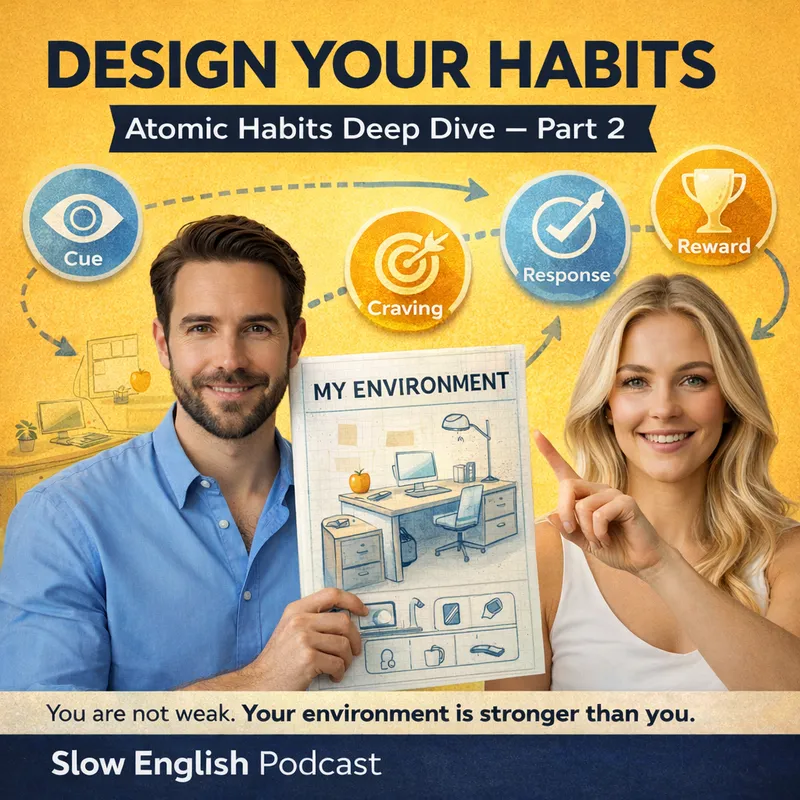
ENEvery habit follows a four-step loop.
ENIf you understand this loop, you can control your life.
ENStep 1 is the cue.
ENThis is the trigger.
ENIt predicts a reward.
ENFor example, seeing a coffee cup.
ENStep 2 is the craving.
ENThis is the motivation.
ENIt is the desire to change your internal state.
ENYou are tired and
ENyou want to feel alert.
ENStep 3 is the response.
ENThis is the action you actually take.
ENYou drink the coffee.
ENAnd step 4 is the reward.
ENThe satisfaction.
ENYou feel awake.
ENYour brain says, hey, remember this loop for next time.
ENThe cue and the craving are the problem phase.
ENAnd the response and reward are the solution phase.
ENIf you remove the cue, the habit never starts.
ENIf you reduce the craving, you won't want to do it.
ENIf the response is too hard, you won't do it.
ENAnd if the reward is bad, you won't repeat it.
ENThis creates the four laws of behavior change.
ENLaw 1, make it obvious.
ENLaw 2, make it attractive.
ENLaw 3, make it easy.
ENLaw 4, make it satisfying.
ENPart 4, pointing and calling.
ENToday we focus on the first law, make it obvious.
ENThe biggest problem with bad habits is that we don't see them.
ENWe have automation blindness.
ENWe
ENdo things without thinking.
ENLet's look at the Japanese railway system.
ENIt is one of the safest in the world.
ENWhy?
ENBecause the conductors do something very strange.
ENThey point at things and scream at them.
ENIt is called pointing and calling.
ENWhen the light is green, the conductor points at it and shouts, Signal is green.
ENWhen the train leaves, he looks at his watch and shouts, Time is 10 a.m.
ENThis looks silly.
ENBut it works.
ENIt reduces
ENerrors by 85%.
ENWhy?
ENBecause it raises a non-conscious habit to a conscious level.
ENYou are using your eyes, your mouth, and your ears.
ENYou cannot be on autopilot when you are screaming.
ENWe can use this in our own lives.
ENImagine you are about to eat a cookie.
ENYou can say out loud, I am about to eat this cookie.
ENIt is full of sugar and it will make me fat.
ENIt sounds harsh.
ENBut awareness is the first
ENstep to change.
ENSometimes, just noticing the habit is enough to stop it.
ENWe can also use the Habit Scorecard.
ENThis is an exercise for our listeners.
ENList every single thing you do in a day.
ENWake up, check phone, brush teeth, make coffee.
ENDo not criticize yourself.
ENBe a scientist.
ENJust observe.
ENLabel each habit as positive, negative, or neutral.
ENAsk the question, Does this behavior help me become the person I wish to be?
ENWe often think we
ENlack motivation.
ENBut actually, we lack awareness of what we are doing with our time.
ENPart 5 Implementation Intention Now that we see our habits, how do we start new ones?
ENMost people use vague intentions.
ENThey say, I will eat healthier.
ENOr, I will study English more.
ENThese are wishes, not plans.
ENThey live in the fog of some time.
ENAnd some time usually means never.
ENResearch on British voters showed something interesting.
ENPeople who wrote down exactly when
ENand where they would vote were much more likely to do it.
ENWe need an implementation intention.
ENThe formula is, I will behavior at time and location.
ENFor example, I will study English at 7am in the kitchen.
ENThis removes decision fatigue.
ENIf you have to decide when to work out every day, you drain energy.
ENDecide once and the robot takes over.
ENPart 8 The Diderot Effect But we can go even further.
ENWe can use the Diderot effect.
ENDenis Diderot was a French philosopher.
ENHe was very poor, but then he bought a beautiful red robe.
ENHe loved the robe.
ENBut then he looked around his house.
ENHe felt his house was too ugly for such a fancy robe.
ENSo he bought a new rug.
ENThen new chairs.
ENThen a new mirror.
ENHow it replaced everything.
ENThis is the Domino effect.
ENOne purchase leads to another.
ENAnd one habit leads to another.
ENWe can use this for habit
ENstacking.
ENYou already have strong neural pathways in your brain.
ENLike brushing your teeth or making coffee.
ENHabit stacking is grafting a new branch onto a strong trunk.
ENThe formula is, after current habit, I will new habit.
ENFor example, after I pour my coffee, I will meditate for one minute.
ENOr, after I close the dishwasher, I will learn one English word.
ENThe after is the trigger.
ENBe specific.
ENDon't say after lunch.
ENSay, after I put my plate
ENin the sink.
ENThis creates a logical flow.
ENIt creates momentum.
ENOne right action flows into the next.
ENPart 7.
ENMotivation is overrated.
ENMartin, I have a confession.
ENWhat is it?
ENI feel like I don't have enough willpower.
ENI see cookies and I eat them.
ENI see my phone and I check it.
ENI am weak.
ENYou are not weak, Julia.
ENYou are just a victim of your environment.
ENChapter 6 tells us that motivation is overrated.
ENEnvironment matters
ENmore.
ENLet's look at Anne Thorndyke.
ENShe was a doctor in a hospital.
ENShe wanted the staff to drink more water and less soda.
ENDid she give them a lecture on health?
ENNo. Did she ask them to use their willpower?
ENNo. She just changed the room.
ENShe put water bottles next to the checkout counter.
ENBefore it was only soda.
ENSuddenly, soda sales dropped and water sales went up.
ENNo willpower required.
ENThis is called choice architecture.
ENWe think
ENwe make choices.
ENBut often the environment makes the choice for us.
ENVision is our most powerful sense.
ENWe have 10 million sensory receptors in the eye.
ENThat is why visual dominance is real.
ENIf you want to play the guitar but it is inside the closet, you will never play.
ENMake it obvious.
ENBuy a stand and put the guitar in the middle of the living room.
ENIf you want to eat apples, put them on the table.
ENIf
ENthey are hidden in the fridge, they will rot.
ENIf they are on the table, they get eaten.
ENBe the architect of your world, not the victim.
ENBut Martin, my house is already full of bad triggers.
ENThat is because of context association.
ENA habit is not associated with a single object.
ENIt is associated with the whole space.
ENIf you always smoke in one specific chair, the chair becomes the trigger.
ENIf you eat, work and sleep in your
ENbed, your bed is confused.
ENYour brain doesn't know if it should be alert or asleep.
ENThat is why you have insomnia.
ENYou need to mix context less.
ENOne space, one use.
ENUse your iPad only for reading.
ENIf you install Instagram on it, the context is polluted.
ENIt is easier to change habits in a new place.
ENHave you noticed that on vacation, it is easy to quit bad habits?
ENThat is because the old cues are gone.
ENWhen
ENyou are home, you are in zombie mode.
ENYou respond to old cues automatically.
ENSo, redesign your flow.
ENPut your gym clothes out the night before.
ENPut them right in front of your door.
ENRemove the friction for good habits.
ENAnd increase friction for bad habits.
ENIf you want to stop watching TV, hide the remote.
ENUnplug the TV.
ENPut it in the closet.
ENMake yourself work for it.
ENThis leads us to the final lesson, self-control.
ENWe think disciplined
ENpeople are superheroes.
ENWe think they sit in front of a cookie and say, no.
ENBut that is a myth.
ENResearch shows that disciplined people are just better at structuring their lives.
ENThey spend less time in tempting situations.
ENThey use avoidance, not resistance.
ENLet's talk about the Vietnam heroin study.
ENIn the Vietnam War, 20% of American soldiers were addicted to heroin.
ENPeople were terrified about what would happen when they came home.
ENBut once they returned to the
ENU.S., 90% of them stopped spontaneously.
ENHow is that possible?
ENBecause addiction is contextual.
ENIn Vietnam, they had the stress of war.
ENThey had the cues of the jungle.
ENWhen you remove the cues, the addiction fades.
ENBut if you put a recovering addict back in their old neighborhood, they relapse.
ENCue-induced wanting is powerful.
ENOnce you see the cue, the dopamine starts flowing.
ENIt is hard to stop the machine once it starts.
ENSo the secret is inversion.
ENMake
ENit invisible.
ENOut of sight, out of mind is scientifically true.
ENIf you have a phone addiction, leave your phone in another room.
ENDon't just turn it over.
ENHide it.
ENWillpower is a battery.
ENIt drains throughout the day.
ENEvery time you say no to a temptation, you burn energy.
ENEventually, the battery dies and you eat the cookie.
ENSo be lazy.
ENBe lazy about self-control by removing the need for it.
ENRedesign your social circle, too.
ENIf your friends
ENdrink every night, you will drink.
ENBad habits never truly disappear from the brain.
ENThe neural pathways are always there.
ENThat is why invisibility is the only long-term solution.
ENMartin, we talked about pointing and calling.
ENBut why is it so hard to see our own habits?
ENBecause of unconscious competence.
ENLet me tell you the story of the paramedic.
ENA paramedic walked into a house and saw her father-in-law.
ENHe looked fine to everyone else.
ENBut she looked at
ENhim and instantly screamed, Call the ambulance.
ENWhy?
ENShe said, I don't like the look of his face.
ENA few minutes later he had a massive heart attack.
ENShe saved his life.
ENBut how did she know?
ENShe couldn't explain it.
ENHer brain had seen thousands of heart attacks.
ENShe recognized the pattern automatically.
ENThis is the same with the museum curator.
ENHe saw a statue and felt an intuitive repulsion.
ENHe knew it was fake, but he didn't know
ENwhy.
ENThis is the danger of habits.
ENWe become blind to what we are doing.
ENThat is why we need to point and call our mistakes.
ENEspecially in English.
ENWhen you make a mistake, don't just ignore it.
ENSay, I just used the wrong verb tense.
ENPoint at the mistake.
ENRaise it from the unconscious to the conscious.
ENNow, let's go back to habit stacking for a second.
ENWe missed something important.
ENWhy does stacking work biologically?
ENIt is because
ENof synaptic pruning.
ENYour brain is like a gardener.
ENIt strengthens connections you use often.
ENAnd it cuts away connections you don't use.
ENYou have a superhighway in your brain for brushing teeth.
ENWhen you stack a new habit on top of it, you are not building a new road.
ENYou are building an exit ramp off the superhighway.
ENYou are using the energy that already exists.
ENSo, where is the best place to put these new habits?
ENUse bookend
ENhabits.
ENYour morning and your evening are usually the same every day.
ENThe middle of the day is chaotic.
ENSo, stack your most important habits at the bookends of your day.
ENOr use social stacking.
ENUse other people as the trigger.
ENWhen my partner cooks, I will clean the dishes.
ENThe trigger is not the time.
ENThe trigger is the other person.
ENWe also need to talk about your phone.
ENWe said, make it invisible.
ENBut your phone is not
ENjust a physical object.
ENIt is a digital environment.
ENYou need to clean your digital room.
ENIf your home screen is full of social media, you will click it.
ENPut learning apps on the front page.
ENPut Instagram in a folder inside a folder on the last page.
ENAnd turn off notifications.
ENThis is crucial.
ENA notification sound initiates a habit loop even if you don't look at it.
ENIt is the notified brain.
ENJust hearing the ping releases dopamine.
ENIt creates the craving.
ENSo, silence is golden.
ENPart 12, resetting the room.
ENFinally, there is one secret tactic for self-control.
ENIt is called resetting the room.
ENImagine you finish working.
ENDon't just walk away.
ENClean your desk.
ENPlace your notebook in the center of the table.
ENIt is not just cleaning.
ENIt is designing the flow.
ENOK, now we have truly covered everything.
ENWe learned to see the invisible with pointing and calling.
ENWe learned to use our bookends
ENto stack habits.
ENWe learned to prune our digital environment.
ENAnd we learned to reset the room.
ENMotivation is good, but a designed environment is better.
ENGo be the architect of your life.
ENAnd cast your votes for your new identity.
ENThank you for listening to this deep dive.
ENWith your help, we have built the foundation.
ENWe learned the loop.
ENCue, craving, response, reward.
ENWe learned to make it obvious.
ENPoint and call your habits.
ENWe learned to make
ENit invisible.
ENAnd we learned to stack habits.
ENYour action step for today is simple.
ENLook at your room right now.
ENAnd what cues are missing for your good habits.
ENBe the architect.
ENIf you enjoyed this episode, please leave a comment.
ENTell us one change you made to your environment.
ENDid you hide the remote?
ENDid you put apples on the table?
ENLet us know.
ENThank you for listening, friends.