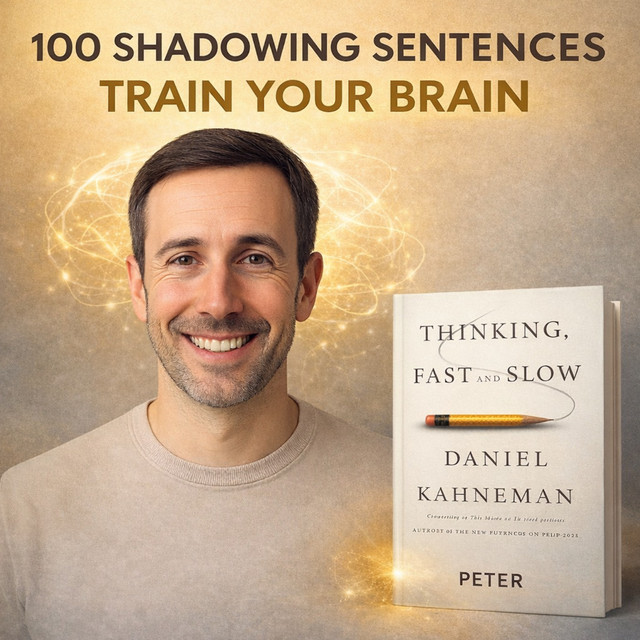
100 Shadowing Sentences to Rewire Your Brain — cover

EPISODE 66 · 25 MIN · CALM ENGLISH

100 Shadowing Sentences to Rewire Your Brain

Welcome to a special shadowing episode of Your English Toolbox.

Full episode notes on Acast ↗

Find your country — or stay in English

100% English mode

ENWelcome to your English toolbox, your Slow English podcast, where we train your ears step by step.

ENI am Peter.

ENToday we are exploring the deep wisdom found in Daniel Kahneman's book, Thinking Fast and Slow.

ENYou might remember that Martin and Julia recently had a deep conversation about the main ideas of this referential book.

ENWhile they focused on the mindset and the broad concepts, today's episode serves two very specific purposes for your training.

ENFirst, we are here to practice shadowing with intermediate vocabulary and grammar, allowing these words to settle into your muscles.

ENSecond, we want to build a truly deep understanding of these powerful ideas by repeating them slowly and with total focus.

ENThis is a special shadowing episode designed to stabilize your practice and build your auditory focus.

ENBefore we begin the drills, we must discuss the best strategy for shadowing correctly to ensure you get the maximum benefit.

ENShadowing is the act of mimicking my voice as if you were my physical shadow, following every movement and sound.

ENYou should focus on three specific things, the clarity of the sounds, the rhythm of the sentence, and the emotion in the tone.

ENDo not just repeat the words like a machine, try to feel the meaning of the psychological concept as you speak it out loud.

ENOur philosophy here is that clarity beats complexity, and emotion is what drives your memory.

ENFor this session, I will provide a short explanation of each idea followed by 20 shadowing sentences.

ENAfter every sentence, there will be a four second pause for you to speak clearly and confidently.

ENLet us start with the core concept, the two systems that manage the human brain.

ENSystem 1 is fast, instinctive and emotional.

ENIt allows you to survive and make quick choices without thinking.

ENSystem 2 is slow, logical and requires a high level of mental effort to function correctly.

ENWe often suffer from cognitive overload when we try to use System 2 for too many tasks at the same time.

ENBy training your ear with slow, calm English, we are helping your System 2 process the language without any stress.

ENNow let us begin our first set of 20 shadowing sentences.

ENListen, feel the rhythm and repeat.

ENMy brain has two very different ways of thinking.

ENSystem 1 is fast, and it always stays awake.

ENIt helps me recognize a friendly face in a crowd.

ENSystem 2 is slow, and it requires my full focus.

ENThinking deeply is a physical act of energy.

ENI can feel my brain working when I calculate numbers.

ENSystem 1 loves to jump to easy conclusions.

ENIt wants to make the world feel predictable and safe.

ENSystem 2 is often too lazy to check the facts.

ENI am learning to notice when I am on autopilot.

ENAutopilot is useful, but it can lead to many errors.

ENMy intuition is a fast reaction to a familiar pattern.

ENI must pause to let my logical mind speak.

ENPatience is a powerful tool for better mental clarity.

ENI am the master of my own mental focus today.

ENSlowing down helps me understand the deeper truth.

ENMy mind is a powerful engine of discovery.

ENI am training my brain to stay very calm today.

ENEvery deep breath helps my System 2 wake up.

ENI am moving forward with a clear purpose and peace.

ENPart 2.

ENThe Storyteller and the Halo Effect.

ENIn the second part, we look at how System 1 creates stories to make sense of the world.

ENThere is a concept called WYSIA, which means what you see is all there is.

ENOur brain takes a small amount of information and creates a complete story that feels true and coherent.

ENWe also experience the Halo Effect, where we think a person is good because they have one nice quality.

ENThese mental shortcuts are meant to make life easier, but they can blind us to the real facts.

ENIn our English journey, we must be careful not to let one small mistake define our entire identity as learners.

ENUse these next 20 sentences to train your mind to look beyond the surface of your first impressions.

ENMy brain is a natural storyteller of my life.

ENI often see only a small part of the truth.

ENWhat I see is not always the whole story.

ENI will not jump to quick conclusions.

ENThe Halo Effect can change my current perception.

ENOne good quality does not mean total perfection.

ENI am looking for the facts behind my feelings.

ENCoherence feels much better than the cold truth.

ENI am questioning my own first impressions now.

ENEveryone has layers that I cannot see yet.

ENI will wait for more evidence before I judge.

ENMy English mistakes do not define my talent.

ENI am more than the sum of my errors today.

ENConfidence grows when I see the full picture.

ENI am training my eyes to ignore the mental traps.

ENClarity comes to those who are willing to wait.

ENI am choosing to be a curious observer of life.

ENEvery story has a beginning and a clear ending.

ENI am writing a new and positive story now.

ENPart 3.

ENOverconfidence and the planning fallacy.

ENThe third part of our journey explores why we are often far too confident in our own predictions.

ENWe believe we understand the past perfectly, so we think we can predict exactly what will happen tomorrow.

ENThis leads to the planning fallacy, where we underestimate the time and effort needed for a simple task.

ENWe ignore the complications and the obstacles that always appear in a real human experience.

ENIn learning English, we must be realistic about our journey and avoid the fatigue of high expectations.

ENLet us practice these sentences to build a foundation of mental humility and steady daily progress.

ENI am aware of my own natural overconfidence.

ENPredicting the future is a very difficult challenge.

ENI often think a task will be very fast and easy.

ENThe planning fallacy is a common mental trap.

ENI will prepare for obstacles in my daily journey.

ENMy plan needs to include time for resting my mind.

ENI am looking at the real data from the past.

ENReal progress takes more time than I usually think.

ENI am comfortable with a slower pace today.

ENConsistency matters much more than high intensity.

ENI am not in a rush to reach my goals.

ENEvery small win is a victory for my brain.

ENI will be patient with my own learning process.

ENMy expectations are balanced and very realistic.

ENI am avoiding the trap of false certainty today.

ENThe future is full of surprising new turns.

ENI am ready for the challenges that will come.

ENHumility is the path to true understanding.

ENI am building a strong foundation for success.

ENMy mind is steady and my heart is calm.

ENPart 4.

ENChoices and the fear of loss.

ENNow we explore the psychology of choice and the powerful feeling of loss aversion.

ENWe feel the pain of losing something much more intensely than the joy of gaining something new.

ENThis fear often stops us from taking the risks necessary for our personal development.

ENWe stay with old habits or bad situations, because we are afraid to let go of our past investment.

ENTo reach fluency, you must risk the loss of looking imperfect in front of other people.

ENLet us shadow these sentences to train our nervous system to accept the risks of true growth.

ENLosing something hurts more than winning feels good.

ENI am aware of my fear of making mistakes.

ENMy brain wants to stay in the safety zone.

ENLoss aversion can stop my natural growth.

ENI am choosing to value the potential gains today.

ENRisk is a necessary part of learning English.

ENI will not let fear control my decisions now.

ENEvery mistake is a step toward my final goal.

ENI am letting go of my old limiting beliefs.

ENSunk costs will not determine my future path.

ENI am free to change my strategy at any time.

ENNew opportunities are worth the small risks.

ENI am brave enough to sound like a beginner.

ENMy dignity is not lost when I am learning.

ENI am gaining more than I could ever lose.

ENFear is just a signal from my System 1.

ENI am using my logic to overcome my anxiety.

ENCourage is a muscle that I train every day.

ENI am opening my mind to a world of gain.

ENMy journey is worth every single effort.

ENPart 5.

ENThe two selves and final resolution.

ENIn our final part, we look at the conflict between your experiencing self and your remembering self.

ENThe experiencing self lives in the now, while the remembering self tells the story of your life later.

ENWe often judge our whole life based on the intense moments and the final endings of our experiences.

ENBy choosing to enjoy the process of learning, you are being kind to your experiencing self today.

ENWe want to create an emotional resolution that makes you feel proud and very capable.

ENShadow these final 20 sentences to lock in your identity as a successful and calm learner.

ENI have two different versions of myself inside.

ENMy experiencing self lives in the present moment.

ENI am enjoying the sound of my voice right now.

ENMy remembering self tells the story of today.

ENI want to remember this practice with pride.

ENThe ending of a task is very important for me.

ENI am creating positive memories of English.

ENEvery moment of focus is a gift to myself.

ENI am living a story of progress and great hope.

ENMy brain is adapting to this new language now.

ENI am the hero of my own learning journey.

ENAwareness is the light that guides my mind.

ENI am grateful for the chance to think slow.

ENSlow thinking leads to a much richer life.

ENI am mastering the two systems of my brain.

ENWisdom comes from pausing and listening deeply.

ENI am calm.

ENI am focused.

ENAnd I am ready.

ENEnglish is becoming part of who I am.

ENI have finished this training with great success.

ENI am exactly where I need to be today.

ENI have reached the resolution of our practice.

ENI hope these 100 sentences give you a new perspective on your mind and your power.

ENRemember that your voice is more important than the rules you follow.

ENThank you for listening and for joining me in this calm space.

ENUntil next time, keep breathing and keep growing.