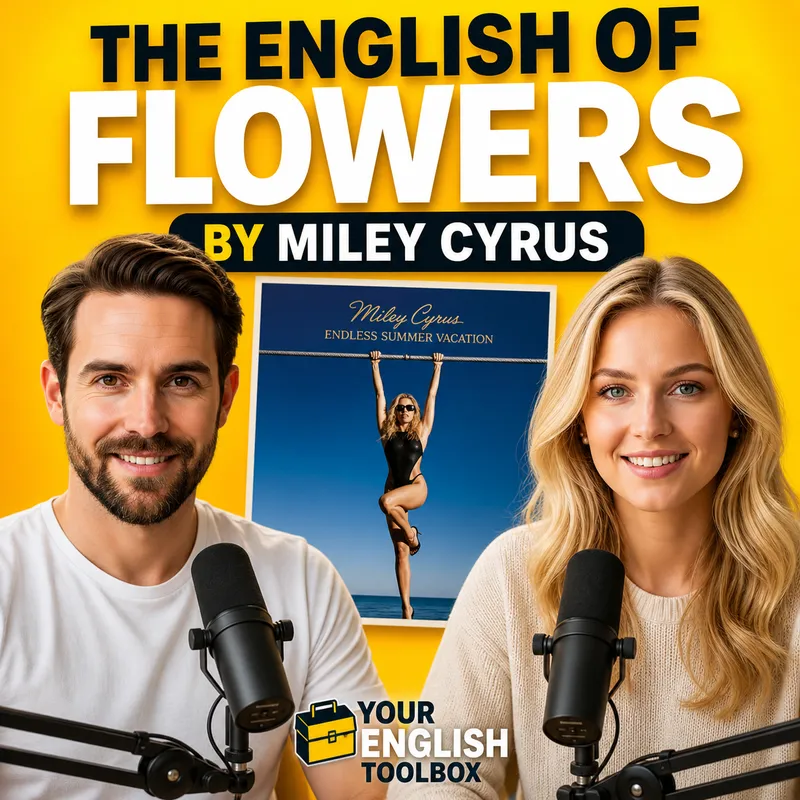
Learn English with Music — cover

EPISODE 69 · SIGNATURE · 31 MIN · SLANG & IDIOMS

Learn English with Music

Welcome to a very special episode of Your English Toolbox . SLOW ENGLISH PODCAST .

Full episode notes on Acast ↗

Find your country — or stay in English

100% English mode

ENWelcome to Your English Toolbox, the podcast that helps you build a better relationship with English, one real conversation at a time.

ENI'm Martin.

ENAnd I'm Julia.

ENAnd today, friends, we are doing something completely different and really exciting.

ENWe are going to use a song to unlock a universe of vocabulary, emotion, and self-expression.

ENNot by studying grammar rules, but by feeling the words.

ENWe're diving deep into Miley Cyrus' flowers.

ENAnd Julia, this isn't just a pop song,

ENis it?

ENNot at all.

ENIt's an anthem of self-discovery, a master class in powerful, simple language.

ENOur goal today is for you to fully feel and understand this song, to make its vocabulary your own, and to see how English can be a tool for building yourself up.

ENBy the end of this episode, you will listen to the song from beginning to end, and you won't just sing along.

ENYou'll understand the profound shift from we to me.

ENYou'll command a set of powerful verbs about growth and resilience.

ENAnd you'll feel the deep satisfaction of connecting with a global story in its original language.

ENWe'll listen to each part of the song in three steps.

ENFirst, slower than normal.

ENThen, the lyrics spoken out loud like a poem.

ENAnd finally, at full speed.

ENThis is our learning method applied to music.

ENYes, a song played slowly can sound a bit strange.

ENBut it helps you catch every

ENword clearly.

ENThat way, when you hear it at full speed, it feels like a victory, not a puzzle.

ENMusic is one of the most powerful emotional tools we have.

ENA song can express in three minutes what sometimes takes us years to articulate.

ENAnd flowers does exactly that.

ENWe are going to learn English by going deep into this song.

ENBeside, there's a fascinating story behind how it was actually written.

ENJulia, do you know what this song originally

ENsounded like?

ENI love this story, Martin.

ENMiley herself revealed in an interview with British Vogue that flowers was born in a very different way.

ENThe original chorus was not empowering at all.

ENIt was actually the saddest song she had ever written.

ENReally?

ENWhat did the original lyrics say?

ENShe said the chorus originally went, I can buy myself flowers, write my name in the sand, but I can't love me better than you can.

ENIt was a 1950s

ENstyle ballad of defeat.

ENThe message was essentially, Sure, I can be my own lover, but you're so much better.

ENWow!

ENThat is a completely different emotional universe.

ENSo how did it transform into the anthem we know today?

ENShe described it as a fake it till you make it mentality.

ENShe made a conscious decision to flip the meaning.

ENInstead of surrendering to the sadness, she chose to declare victory even if she didn't fully feel it yet.

ENThat

ENis such a powerful lesson for everyone.

ENNot just in music, but in language learning too.

ENSometimes you have to tell yourself you can do it before you truly believe it.

ENExactly.

ENAnd the song's connection to her personal life added another layer.

ENShe released it on January 13th, 2023, which happens to be Liam Hemsworth's birthday.

ENThe chorus also cleverly mirrors Bruno Mars' When I Was Your Man, a song reportedly dedicated to Miley during their relationship.

ENSo she

ENtook the words that represented a past love and reclaimed them for herself.

ENShe literally rewrote her own story.

ENThat's the beauty of it.

ENThe song started as an expression of pain and evolved into a celebration of self-sufficiency.

ENShe turned her heartbreak into something that has helped millions of people feel stronger.

ENNow it is time to deep dive into the first verse.

ENWe were good.

ENWe were gold.

ENKind of dream that can't be sold.

ENWe were right

ENtill we weren't.

ENBuilt a home and watched it burn.

ENAnd now we step back to where the story actually begins.

ENThis is verse one.

ENAnd the feeling here is a universe away from the chorus we just heard.

ENIt really is, Martin.

ENIf the chorus is standing in the sun, this verse is sifting through the ashes.

ENAnd it does something brilliant with grammar right from the first word.

ENWe.

ENThe whole verse is built on we.

ENWe were

ENgood.

ENWe were gold.

ENWe were right.

ENIt's the language of a shared identity, a joint past.

ENAnd all the verbs are in the past simple.

ENWere.

ENBuilt.

ENWatched.

ENThis isn't just memory.

ENThis is a door that has closed.

ENA reality that is finished, completed, unreachable.

ENThat creates an immediate feeling of loss, doesn't it?

ENEven before we understand the details, the grammar tells us something beautiful existed and now it doesn't.

ENAnd then she gives us that first

ENimage.

ENWe were gold.

ENGold.

ENThink about that word for a moment.

ENGold is precious.

ENIt's pure.

ENIt doesn't rust or decay.

ENIn poetry and in everyday language, a golden age means a time of perfect happiness.

ENShe's saying this relationship felt incorruptible, invaluable.

ENIt was the kind of connection people write stories about.

ENAnd then she adds.

ENKind of dream that can't be sold.

ENThis is a fascinating line.

ENA dream that can't be sold means it wasn't commercial,

ENit wasn't cheap.

ENIt was authentic.

ENYou can't put a price on it.

ENExactly.

ENAnd notice the word kind.

ENKind of dream.

ENShe doesn't say a dream.

ENKind of softens it, makes it feel like she's grasping for words still in awe of what they had.

ENIt's very conversational, very real.

ENAnd then friends comes the turning point.

ENA tiny phrase that carries enormous weight.

ENWe were right till we weren't.

ENThis line is devastating in its simplicity.

ENThree words

ENon each side of till.

ENPerfect balance, perfect symmetry, until it breaks.

ENWe were right is confident, certain.

ENAnd then we weren't just collapses.

ENNo explanation, no details.

ENJust the fact that something shifted.

ENIt's so true to how relationships actually end, isn't it?

ENOne moment you're sure, the next you're not.

ENAnd there's often no clear reason, just a feeling that the ground has changed beneath you.

ENAnd what I love about this line is that it mirrors how

ENour listeners might sometimes feel in English.

ENYou're speaking, you're confident, you're in the flow, and then suddenly you're not.

ENThe words disappear.

ENThat feeling of I was right until I wasn't is deeply human.

ENThat's a beautiful connection, Julia.

ENAnd then she delivers the final image of this verse, and it is cinematic.

ENBuilt a home and watched it burn.

ENThis is where the vocabulary becomes so powerful and so painful.

ENThe verb built is about effort, time, investment.

ENYou don't build something quickly.

ENA home is not a house.

ENA house is bricks and wood.

ENA home is memories, safety, love.

ENThe place where you are most yourself.

ENAnd she pairs built with watched.

ENWatched is a passive verb.

ENShe didn't run, she didn't try to save it, she didn't scream.

ENShe just watched.

ENThat tells us the destruction was unstoppable.

ENShe was a witness to her own loss.

ENThe fire metaphor here is so rich.

ENFire destroys

ENcompletely.

ENIt reduces everything to ash.

ENBut fire also purifies.

ENIn many traditions, fire is the beginning of something new, not just the end.

ENAnd that's why this verse, as sad as it is, plants the seed for the chorus.

ENBecause you can only watch something burn if you're standing outside it.

ENShe's already separate.

ENShe's already beginning to survive.

ENSo this is a key vocabulary our friends can take from this.

ENIt's the language of grief, but it's also

ENthe language of clarity.

ENAnd that clarity is what will carry her and us into the rest of the song.

ENLet's move on.

ENI didn't want to leave you.

ENI didn't want to lie.

ENStarted to cry, but then remembered I.

ENThis is the pre-chorus.

ENIt's the bridge between sadness and strength.

ENNotice the shift from we to I.

ENThe collective story is over.

ENNow it's just one person speaking her truth.

ENI didn't want to leave you.

ENTells us

ENthis separation was hard.

ENShe didn't walk away feeling strong.

ENAnd then the crucial line.

ENI didn't want to lie.

ENStaying would have meant lying to herself.

ENLeaving was painful.

ENBut staying was false.

ENStarted to cry, but then remembered I.

ENAnd she stops.

ENShe doesn't finish the sentence.

ENThis unfinished line is brilliant.

ENWe lean in and ask, remembered what?

ENAnd the answer is the entire chorus.

ENThat word but is the pivot of the whole song.

ENSadness was

ENcoming.

ENBut something stronger interrupted it.

ENFor our listeners, this is a useful structure.

ENI didn't want to, but then I remembered.

ENYou can use it to tell your own stories of overcoming fear.

ENIn just three lines, we move from reluctance to tears to the spark of strength.

ENAnd now that spark is about to catch fire.

ENThe chorus is coming.

ENI can buy myself flowers.

ENWrite my name in the sand.

ENTalk to myself for hours.

ENSay things

ENyou don't understand.

ENI can take myself dancing.

ENAnd I can hold my own hand.

ENYeah, I can love me better than you can.

ENHere it is, the heart of the song.

ENThe chorus is a grammatical declaration of independence.

ENEvery single line uses myself.

ENShe is both the giver and the receiver of every action.

ENThat's a reflexive pronoun.

ENAnd it means she is complete on her own.

ENI can is repeated like a heartbeat.

ENIt's not I will

ENor I should.

ENIt's I can, a statement of ability and power.

ENThe actions she chooses are deeply personal.

ENShe buys herself flowers, a symbol of love now self-given.

ENShe writes her name in the sand, accepting that identity can be fluid.

ENShe talks to herself for hours and says things you don't understand.

ENThat line isn't an insult.

ENIt's a boundary.

ENHer inner world is now hers alone.

ENTake myself dancing and hold my own hand are acts of

ENphysical self-compassion.

ENShe doesn't wait for someone else to lead or comfort her.

ENThe image of holding your own hand is especially powerful.

ENIt's a gesture usually shared between two people.

ENNow she provides it for herself.

ENIt's the physical proof that she is enough.

ENThe sand metaphor deserves a closer look.

ENWriting your name in the sand is traditionally a symbol of impermanence.

ENThe waves come and erase it.

ENBut here she doesn't need a permanent monument.

ENShe is

ENcontent with the moment itself.

ENShe doesn't need to be remembered by someone else to exist.

ENCompare this to the roses that you left in the second verse.

ENTraditional roses die in a vase.

ENBut flowers that you buy yourself are an act of ongoing self-care.

ENThe vocabulary shift from roses to flowers is intentional and beautiful.

ENRoses are a specific romantic gift.

ENFlowers are for anyone, anytime, including yourself.

ENLove me better than you can is the final strike.

ENThe comparative form, better than, is direct and complete.

ENIt's not as well as.

ENIt's better than.

ENShe has moved from comparison to victory.

ENFor our listeners, this chorus is a vocabulary toolkit for self-sufficiency.

ENYou can use I can plus any self-care action to express your own strength.

ENTry it yourself.

ENI can make myself proud.

ENI can give myself time.

ENI can build myself up.

ENThat's the gift of this chorus.

ENIt gives you the grammar of self-love.

ENWe are almost there.

ENWe only have left one piece of the puzzle to get the whole meaning of the song.

ENPaint my nails cherry red.

ENMatch the roses that you left.

ENNo remorse, no regret.

ENI forgive every word you said.

ENOoh, I didn't want to leave you, baby.

ENI didn't want to fight.

ENStarted to cry, but then remembered I.

ENNow we reach the final stage of the journey.

ENThis is the moment of aesthetic reclamation.

ENThe verbs

ENshift to the present tense.

ENPaint, match, forgive.

ENShe is no longer remembering the past.

ENShe is acting in the now.

ENPaint my nails cherry red is a bold image.

ENCherry red is the color of passion, vitality, and life.

ENRemember the gold from verse one?

ENGold was the precious past.

ENCherry red is the powerful present.

ENShe is wearing her strength visibly.

ENMatch the roses that you left is a genius line.

ENShe takes the symbol of the failed

ENrelationship and reclaims it.

ENThe roses he left are now just a color to coordinate with her nails.

ENShe has stripped them of their emotional power.

ENNo remorse, no regret is absolute.

ENThese are strong vocabulary words of finality.

ENRemorse is deep guilt for a wrong committed.

ENRegret is sadness about a past decision.

ENShe rejects both completely.

ENI forgive every word you said is the final act.

ENForgive is a performative verb.

ENSaying it performs the action of closing

ENthe chapter.

ENShe doesn't need an apology from him.

ENShe gives herself the gift of letting go.

ENThe pre-chorus returns but it feels different now.

ENI didn't want to fight replaces I didn't want to lie.

ENThe conflict is over.

ENThe war is finished.

ENAnd she still remembers who she is.

ENThis is total emotional sovereignty.

ENShe has moved from we were gold to I am enough.

ENFor our listeners the vocabulary here is about closure.

ENTo forgive, to let

ENgo, to have no regret.

ENThese are powerful phrases for ending any difficult chapter.

ENThe song has traveled from fire to flowers.

ENAnd now you have the language to describe that journey in English.

ENAnd now friends we have traveled together through every corner of this beautiful song.

ENWe started in the ashes of watched it burn.

ENWe felt the hesitation of I didn't want to leave you.

ENWe rose with the power of I can buy myself flowers.

ENAnd

ENwe ended in the triumph of paint my nails cherry red.

ENYou have learned that vocabulary is not just words on a page.

ENIt is feeling it is identity it is power.

ENGold burn forgive myself hold my own hand.

ENThese are not just lyrics anymore they are tools for your own expression.

ENYou are not someone who just listens to English.

ENYou are someone who understands English at a deeper level.

ENYou are someone who feels the poetry inside

ENthe language.

ENThank you for staying with us until the very end.

ENYour commitment to learning through emotion and music is beautiful.

ENAnd now we have a gift for you.

ENWe are going to play the whole song one last time.

ENBut this time it will be different.

ENYou will hear it with new ears.

ENYou will feel every verb every pronoun every metaphor.

ENYou will hear the journey from we to me in real time.

ENClose your eyes if

ENyou can.

ENLet the words wash over you.

ENNotice what you now understand that you didn't before.

ENThat feeling is growth.

ENThat feeling is yours.

ENWe loved creating this episode for you.

ENAnd we want to know what you thought.

ENDid you enjoy this new format of learning through music.

ENWas it helpful to hear the song slow, spoken, and then fast?

ENWhat song do you want us to analyze in a future episode?

ENPlease let us know in the

ENcomments.

ENYour voice matters in this community of friends learning together.

ENNow take a deep breath.

ENHere is Miley Cyrus with flowers.

ENOne last time.

ENListen like you have never listened before.

ENWe are Martin and Julia.

ENThank you for being here.

ENSee you in the next episode.

ENThank you for listening.