ENYou are standing at the counter.
EPISODE 79 · 7 MIN · SURVIVAL KIT
5 min Survival Kit The Bank
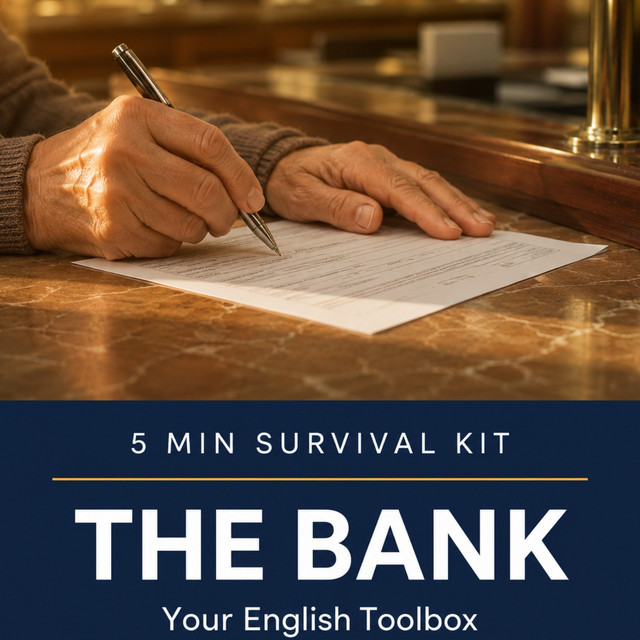
You are at the counter. The cashier says something fast. You smile — but you understood nothing.
Full episode notes on Acast ↗Find your country — or stay in English
100% English mode
ENThe cashier says something fast.
ENYou smile, but you understood nothing.
ENAnd now they are waiting for an answer.
ENBehind you, the queue is growing.
ENThis is the moment most people dread, not the bank itself, the conversation inside it.
ENWelcome to your English toolbox.
ENI am Robert, and this is the Basic Survival Kit, a short practical series designed for one specific type of person.
ENYou live in an English-speaking country, or you
ENare planning to.
ENYour English is not perfect, but your life does not wait for perfect.
ENEvery episode gives you the exact words you need for one real situation.
ENNo grammar explanations, no long lists, just the sentences that actually work, the ones you can use today.
ENThis episode is your survival kit for the bank.
ENWant to take your learning even further?
ENFind your English toolbox on YouTube to watch every episode with subtitles.
ENIt is the best way
ENto support this project, and we truly appreciate it.
ENToday's situation, you are at the bank.
ENIt could be opening an account, making a transfer, asking about a charge you do not recognise, or simply trying to understand what the cashier just asked you.
ENThe problem with banks is not the vocabulary.
ENThe problem is the formality.
ENBank English sounds official, fast and cold.
ENAnd when money is involved, the pressure is real.
ENHere are your five sentences for this
ENsituation.
ENListen carefully, and then repeat each one out loud.
ENSentence one.
ENI would like to check my account balance, please.
ENSimple, direct and immediately understood by any bank cashier in the world.
ENThis sentence opens the conversation on your terms.
ENYou are not waiting for them to ask.
ENYou are telling them why you are there.
ENThat small shift gives you control.
ENSentence two.
ENI do not recognise this transaction.
ENCould you help me understand it?
ENUnexpected charges are
ENone of the most stressful banking situations for anyone.
ENThis sentence is calm, professional and impossible to ignore.
ENIt does not accuse.
ENIt does not panic.
ENIt simply asks for an explanation, which is exactly your right.
ENSentence three.
ENI would like to transfer some money.
ENCould you walk me through the process?
ENWalk me through the process is one of the most useful phrases in everyday English.
ENIt tells the other person, I need guidance, step by step.
ENBanks
ENuse it themselves.
ENDoctors use it.
ENEmployers use it.
ENIt is natural, it is fluent and it works in dozens of situations beyond the bank.
ENSentence four.
ENI am sorry, could you write that down for me please?
ENAccount numbers, sort codes, reference numbers.
ENThese are impossible to catch at normal speaking speed.
ENAsking someone to write it down is not rude, it is responsible.
ENAnd every professional at a bank has done it a hundred times before.
ENSentence five.
ENIs there a fee for this?
ENThree words.
ENBut they could save you a great deal of money.
ENAlways ask this before you authorize any transaction you are not completely sure about.
ENBanks rely on people not asking.
ENYou are going to ask.
ENNow the rescue sentence.
ENThis is the single phrase that works when everything else disappears from your mind.
ENMemorize it, write it on your phone if you need to.
ENI am sorry, could you write that down
ENfor me?
ENSay it again, out loud, right now.
ENI am sorry, could you write that down for me?
ENThat sentence does something almost magical in a banking context.
ENIt slows the entire conversation down.
ENIt creates a written record of what was said.
ENAnd it gives you time to think without anyone noticing you needed it.
ENThat is not weakness, that is strategy.
ENLet me tell you about Daniel.
ENDaniel moved from Lagos to Birmingham two years ago.
ENHis
ENfirst visit to the bank lasted 40 minutes.
ENHe left with a form he did not fully understand, and a direct debit he had not intended to sign up for.
ENThe second time, he went prepared.
ENHe used sentence two when he saw the unexpected charge.
ENHe used the rescue sentence when the cashier started explaining the fee structure too quickly.
ENThe cashier stopped, picked up a pen, wrote it all down.
ENDaniel told me afterwards, that was the first
ENtime I felt like I belonged in that building.
ENThe right words do not just solve problems.
ENThey make you feel like you have every right to be exactly where you are.
ENLet's close with what you have today.
ENOne, I would like to check my account balance, please.
ENTwo, I do not recognize this transaction.
ENCould you help me understand it?
ENThree, I would like to transfer some money.
ENCould you walk me through the process?
ENFour, I am
ENsorry.
ENCould you write that down for me, please?
ENFive, is there a fee for this?
ENAnd your rescue sentence.
ENI am sorry.
ENCould you write that down for me?
ENYou are not someone who avoids the bank.
ENYou are someone who walks in with the right words ready.
ENThat is a completely different person.
ENAnd that person is you, starting today.
ENIf you made it this far, you are truly committed to your English.
ENPlease head over to YouTube,
ENsearch for your English toolbox and subscribe.
ENYour support there means the world to us and keeps this podcast growing.
ENI am Robert, and I will see you in the next one.