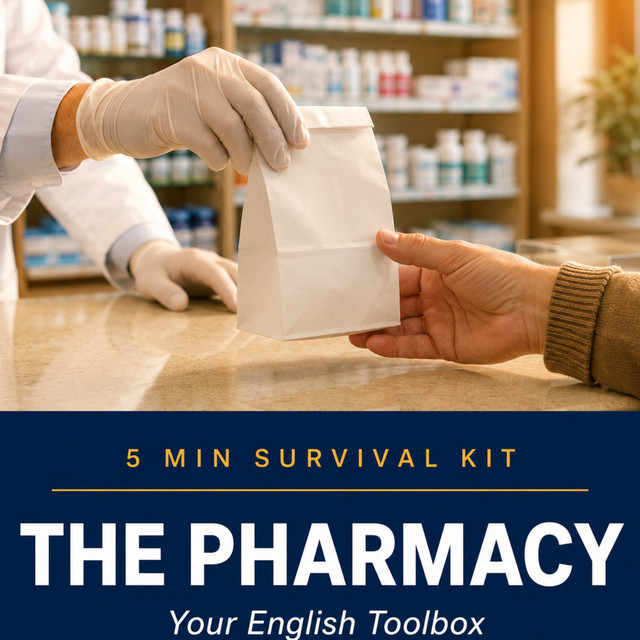
5 Min Survival Kit: The Pharmacy — cover

EPISODE 80 · 7 MIN · SURVIVAL KIT

5 Min Survival Kit: The Pharmacy

The pharmacist hands you a bag and says something about dosage. You nod — but you are not sure what you just agreed to.

Full episode notes on Acast ↗

Find your country — or stay in English

100% English mode

ENThe pharmacist hands you a bag.

ENThey say something about dosage.

ENYou nod.

ENBut you are not sure what you just agreed to.

ENThe instructions on the box are small.

ENThe words are technical.

ENAnd the person behind the counter is already looking at the next customer.

ENThis happens to almost everyone.

ENAnd today we are going to fix it.

ENWelcome to your English toolbox.

ENI am Miranda.

ENThis is the Basic Survival Kit, a slow English series designed for one specific person.

ENYou live in an English-speaking country, or you are planning to.

ENYour English is not perfect, but your health cannot wait for perfect.

ENEvery episode gives you the exact words you need for one real situation.

ENNo grammar, no pressure, just the sentences that actually work.

ENThis episode is your survival kit for the pharmacy.

ENWant to take your learning even further?

ENFind your English toolbox on YouTube to watch every episode with subtitles.

ENIt is the best way to support this project, and we truly appreciate it.

ENToday's situation.

ENYou are at the pharmacy.

ENIt could be collecting a prescription, asking about side effects, or simply trying to understand how many tablets to take and when.

ENThe problem with pharmacy English is the vocabulary.

ENWords like dosage, contraindication, prescription onlythese are not everyday words.

ENBut the sentences you need are simple.

ENHere are your five sentences for this situation.

ENListen carefully, and then repeat each one out loud.

ENSentence 1.

ENCould you explain how to take this, please?

ENSimple, direct, and it works in every pharmacy in the English-speaking world.

ENThis sentence gives the pharmacist permission to slow down and explain everything from the beginning.

ENYou are not asking a stupid question.

ENYou are asking the most important question.

ENSentence 2.

ENHow many times a day should I take this?

ENOnce a day.

ENTwice a day.

ENEvery eight hours.

ENThese are the answers you need, and this sentence gets them.

ENAlways ask this, even if you think you understood.

ENConfirmation saves mistakes.

ENSentence 3.

ENAre there any side effects I should know about?

ENThis is the question most people are too nervous to ask.

ENBut pharmacists expect it.

ENThey are trained for it.

ENA good pharmacist will never make you feel small for asking.

ENAnd the information they give you could matter a great deal.

ENSentence 4.

ENDo I need to take this with food?

ENSome medications must be taken with food.

ENOthers must not.

ENGetting this wrong can reduce the effect or cause discomfort.

ENThree seconds to ask.

ENPotentially days of difference in how you feel.

ENSentence 5.

ENIs this available without a prescription?

ENSometimes you do not have a doctor's note.

ENSometimes you need something quickly.

ENThis sentence opens that conversation professionally and clearly.

ENThe pharmacist will tell you exactly what your options are.

ENNow the rescue sentence.

ENThis is the single phrase that works when everything else disappears from your mind.

ENWrite this one down.

ENCan you explain how to take this, please?

ENMy English is still developing.

ENSay it again, out loud, right now.

ENCan you explain how to take this, please?

ENMy English is still developing.

ENThat sentence does something powerful.

ENIt asks for the most important information.

ENAnd it tells the pharmacist to slow down and be patient.

ENEvery pharmacist in the world will respond with kindness to that sentence.

ENEvery single one.

ENLet me tell you about Priya.

ENPriya moved from Mumbai to Edinburgh 18 months ago.

ENHer doctor prescribed something for her blood pressure.

ENShe collected it from the pharmacy, nodded at everything the pharmacist said, and went home.

ENThat night, she took the tablet with a glass of orange juice.

ENThe instructions said, avoid citrus.

ENShe did not know that word.

ENShe was fine, but it could have been different.

ENThe next time, she used sentence 3.

ENAre there any side effects I should know about?

ENThe pharmacist spent four minutes explaining everything.

ENPriya told me afterwards, I felt like a patient, not a problem.

ENThe right words give you back your dignity.

ENLet's close with what you have today.

EN1.

ENCould you explain how to take this, please?

EN2.

ENHow many times a day should I take this?

EN3.

ENAre there any side effects I should know about?

EN4.

ENDo I need to take this with food?

EN5.

ENIs this available without a prescription?

ENAnd your rescue sentence: Can you explain how to take this, please?

ENMy English is still developing.

ENYou are not someone who leaves the pharmacy hoping for the best.

ENYou are someone who asks the right questions and gets the right answers.

ENThat is a completely different person.

ENAnd that person is you, starting today.

ENIf you made it this far, you are truly committed to your English.

ENPlease head over to YouTube, search for your English toolbox, and subscribe.

ENI am Miranda.

ENAnd I will see you in the next one.