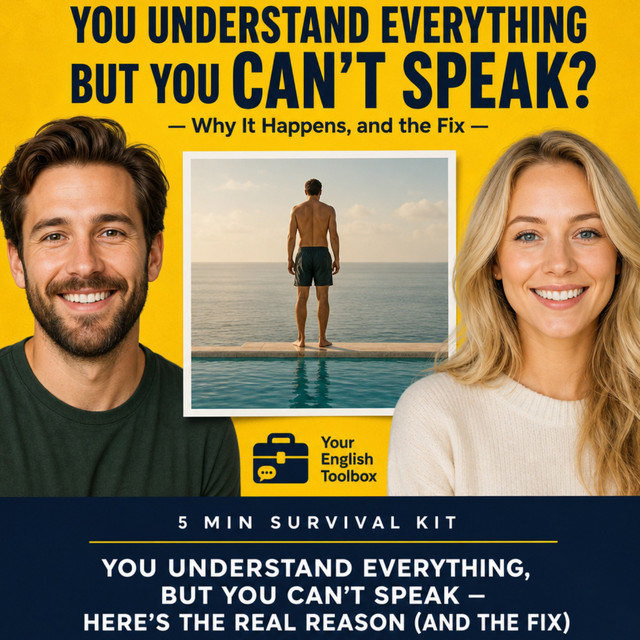
You Understand Everything But You Cant Speak — cover

EPISODE 85 · 8 MIN · MIND & MOTIVATION

You Understand Everything But You Cant Speak

Martin and Julia are back — and they are tackling the most common frustration in language learning: you understand everything, but when it is your turn to speak, nothing comes out.

Full episode notes on Acast ↗

Find your country — or stay in English

100% English mode

ENHello, everyoneand welcome back to Your English Toolbox.

ENI am Martinand it feels so good to be back with you.

EN- It really does.

ENHello, everyoneI am Julia.

EN- Martin

ENI have to say it.

ENYou are incredibly tanned.

ENWhere on earth have you been?

ENIs it that obvious?

ENLet's just say there was a lot of sunand a lot of doing absolutely nothing.

EN- The best kind of holiday.

EN- Honestly

ENI missed this.

ENI missed talking to all of you.

ENSo did I.

ENAnd we have come back with an episode that I am genuinely excited about.

ENSolet me ask you something.

ENImagine you are a brilliant swimmer.

ENYou know every technique.

ENYou have studied every movement.

ENBut the moment you stand at the edge of the wateryou freeze.

ENYou cannot jump in.

EN- And thatis exactly what happens with English.

EN- You understand everything.

ENFilms, conversations, your colleagues at work.

EN- And yetwhen it is your turn to speaknothing comes out.

ENNow

ENI know what some of you are thinking.

EN"I have heard this topic before."

EN- You probably have.

ENOn a hundred different podcasts.

EN- "Why can't I speak when I understand everything?" It is everywhere.

ENBut here is our promise to you today.

ENWe are not going to tell you what you have already heard a hundred times.

ENNo "just practice more." No "stop being shy."

EN- Our approach is completely different.

EN- So pleasestay with us until the end.

ENIt will be worth it.

ENWe promise.

ENSo let's start with the most important thing.

ENIf you understand English but cannot speak it yetit is not your fault.

EN- Let me say that again, because people need to hear it.

EN- It is not a failure.

ENIt is not a flaw.

ENIt is a completely normal stage of the brain.

ENThink about a small child.

ENA baby understands its parents for monthslong before it says a single word.

EN- The understanding always comes first.

EN- Always.

ENThe speaking follows later.

ENSo if you can understand but not yet speakyour brain is not broken.

ENIt is working exactly as it should.

ENBut here is where it gets interesting.

EN- Most people believe that understanding and speaking are the same skill.

EN- As ifthe better you understand, the better you will automatically speak.

ENAnd thatis simply not true.

ENUnderstanding and speaking are two different muscles.

EN- Two completely different muscles.

EN- You have trained one of them for yearslistening, reading, watching.

ENThat muscle is strong.

ENThat is why you understand so much.

EN- But the speaking muscleyou have almost never used it.

ENIt is like watching a thousand tennis matchesand being surprised that you cannot play.

EN- Exactly!

ENYou know the rules.

ENYou know the strategy.

EN- But your arm has never held the racket.

ENAnd nowwe need to talk about something that very few language podcasts mention.

EN- Something we feel is deeply important.

ENThere is a momenta tiny momentthat causes most of the pain.

ENIn your own language, you answer in one second.

ENBut in Englishby the time you have built the perfect sentence in your headthe conversation has already moved on.

EN- And in that small gapsomething happens in your body.

EN- Your heart beats faster.

ENYour hands feel warm.

ENYour mind goes blank.

ENThatis not shyness.

ENThat is not laziness.

ENThat is anxiety.

ENA real, physical response.

EN- And almost nobody in the language world is brave enough to name it.

EN- Because it is easier to say "speak with confidence"… than to admit your body is having a genuine reaction.

ENLanguage anxiety is so importantand so ignoredthat it does not fit into one episode.

ENSo we are going to give it the time it deservesvery soon.

EN- Do not miss it.

ENSowhat do we actually do about all this?

ENHow do we cross that gap?

EN- And this is where our approach becomes different.

EN- Imagine someone who has hurt their leg.

ENThey cannot walk yet.

ENBut they want to move.

ENThey want to live.

EN- So what do we give them?

EN- A crutch.

ENNot forever.

ENJustto start walking again.

ENA crutch is not cheating.

ENIt is support, while the muscle gets stronger.

EN- And in Englishyour crutchis a ready-made sentence.

EN- A phrase you already havesitting in your mouthbefore the conversation even begins.

ENBecause when the sentence is already thereyou skip the gap.

ENYou do not build it in real time.

ENYou already have it.

ENLet me give you a picture of how this works.

ENImagine a person who understands everything.

ENFilms.

ENMeetings.

ENTheir boss.

EN- But when it is their turn to answerthey freeze.

ENEvery time.

ENOne daybefore an important situationthey do something simple.

ENThey prepare three sentences in advance.

ENJust three.

EN- A way to start.

ENA way to ask.

ENA way to respond.

EN- And at firstthey use them almost mechanically.

ENBut thensomething beautiful happens.

ENOnce the first sentences are outthe conversation continues on its own.

EN- The crutch got them into the water.

EN- And it turned outthey could swim all along.

ENAnd thisthis is exactly why we admire the work Robert and Miranda are doing.

EN- The Basic Survival Kit series.

ENEvery single episode gives you those exact crutches.

ENFor the supermarket.

ENFor the doctor.

ENFor your neighbour.

EN- Ready-made sentences for the real moments of your life.

EN- They are doing something genuinely special.

ENSo if that series is helping yougo and leave them a comment.

ENTell them.

EN- They deserve to hear it.

ENSolet's bring it all together.

ENIf you understand but cannot speak yetit is not your fault.

ENIt is a normal stage.

EN- Understanding and speaking are two different muscles.

ENYou have only trained one.

ENThe gap between them creates a real anxietyand we will talk about that very soon.

EN- And until your speaking muscle is stronguse the crutch.

ENPrepare your sentences.

ENYou are not bad at speaking English.

ENYou are simply standing at the edge of the waterready to jump.

EN- And the moment you doyou will discover you knew how to swim all along.

ENIf you made it this far, you are truly committed to your English.

ENPlease head over to YouTube, search for "Your English Toolbox", and subscribe.

EN- Your support there means the world to usand it keeps this podcast growing.

ENIt is so good to be back.

EN- We have missed you.

ENTruly.

ENI am Martin.

EN- And I am Julia.

ENAnd we will see youin the next one.