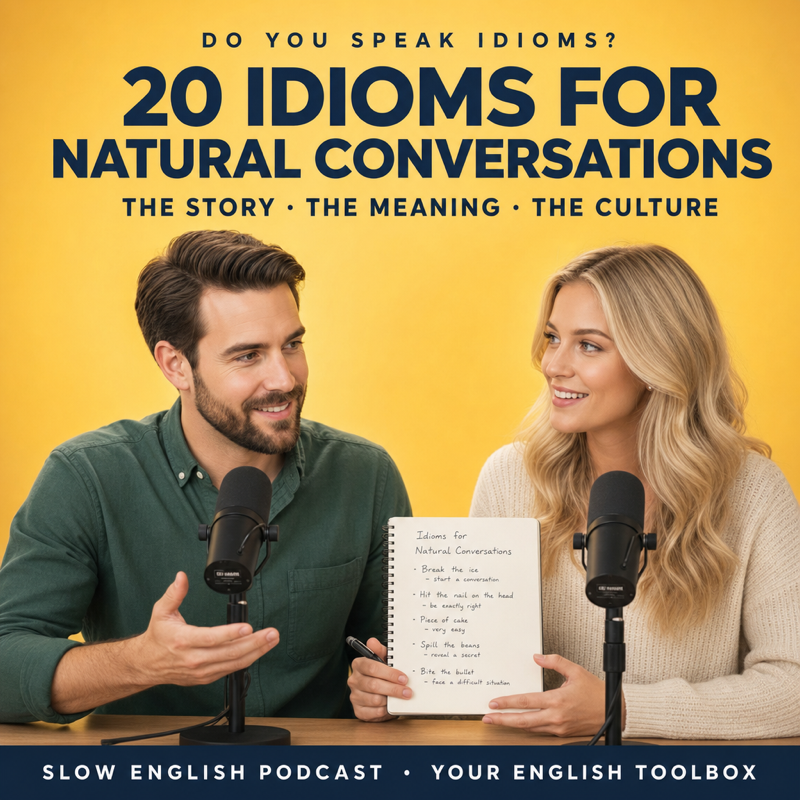
Slow English Listening Practice 20 Idioms for Natural Conversations — cover

EPISODE 89 · 24 MIN · SLANG & IDIOMS

Slow English Listening Practice 20 Idioms for Natural Conversations

https://yourenglishtoolbox.johnarthemis72.workers.dev/ Native speakers do not think about idioms — they just use them.

Full episode notes on Acast ↗

Find your country — or stay in English

100% English mode

ENWelcome to Your English Toolbox, where we train your ears step by step.

ENAnd today... we have something really special for you.

ENI am Martin.

ENAnd I am Julia.

ENWant to take your learning even further?

ENFind "Your English Toolbox" on YouTube to watch every episode with subtitles.

ENIt is the best way to support this project, and we truly appreciate it.

ENToday... we are going to work on twenty idioms.

ENTwenty expressions that native speakers use every single day.

ENNot in textbooks.

ENIn real conversations.

ENAt work... with friends... at home.

ENAnd before we start... we want to recommend a book.

ENA book we genuinely love.

ENWe use it in our in-person English classes.

ENMartin uses it with his students every single week.

ENIt is called...

ENEnglish Vocabulary in Use.

ENUpper Intermediate.

ENBy Michael McCarthy.

ENIf you do not have it... get it.

ENIt is one of the best vocabulary books ever written for learners at this level.

ENToday's twenty idioms come directly from that book.

ENUnits 78 and 82.

ENHere is what you will learn today.

ENTwenty idioms... with their meaning... their usage... and their cultural nuance.

ENA full story... using all twenty of them in natural context.

ENA role play where you get to choose the right idiom yourself.

ENAnd three practice questions at the end.

ENThe answers are in the episode description.

ENLet's go.

ENPART ONE.

ENTHE STORY.

ENI want to tell you about Daniel.

ENDaniel moved to London... from Madrid... three years ago.

ENHe had a new job at a small tech startup.

ENHe was nervous.

ENVery nervous.

ENBack home in Spain...

ENDaniel was a big fish in a small pond.

ENHe had been the best developer in his company.

ENEveryone knew him.

ENEveryone respected him.

ENBut London was different.

ENLondon was a very... very big pond.

ENOn his first day...

ENDaniel was quiet.

ENToo quiet.

ENHis new colleagues thought he was a cold fish.

ENDistant.

ENUnfriendly.

ENHard to talk to.

ENBut that was not the truth.

ENDaniel was just... adjusting.

ENHe was actually a rough diamond.

ENTalented, genuine, full of potential.

ENJust... unpolished.

ENJust finding his feet.

ENHis manager, Sarah, saw something in him immediately.

ENShe told her colleague...

EN"Daniel is a dark horse.

ENWatch him."

ENAnd she was right.

ENBut first... things had to get a lot worse... before they got better.

ENIn his second week, Daniel volunteered to lead the company's biggest project of the year.

ENHis colleague Marcuswho was, to be honest, a real pain in the necklaughed out loud.

EN"He just arrived," Marcus said.

EN"He has no idea what he is getting into."

ENAnd honestly?

ENMarcus was not entirely wrong.

ENDaniel had bitten off more than he could chew.

ENThe project was enormous.

ENThree teams, six clients, four different platforms.

ENWithin two weeks... things were getting out of hand.

ENDeadlines were missed.

ENBudgets exploded.

ENThe whole thing cost the company an arm and a leg to fix.

ENAnd Daniel... was in hot water.

ENSarah called him into her office.

ENDaniel walked in... expecting the worst.

ENBut then... something unexpected happened.

ENMarcusthe pain in the neckhad been talking.

ENHe had told the whole team that Daniel's original plan was actually brilliant.

ENHe had let the cat out of the bag... about a secret presentation Daniel had prepared.

ENA presentation that solved every single problem the project had created.

ENDaniel had never planned to show it.

ENBut now... everyone knew.

ENMarcus had also spilled the beans to the CEO.

ENDaniel was furious.

ENAt first.

EN"You had no right," he told Marcus.

ENHe was on thin ice... with the whole team.

ENHe nearly burned his bridges completely.

ENHe was about to send a very angry email.

ENBut Julia... can I just say something here?

ENOf course.

ENThis is the moment where Daniel had a choice.

ENExactly.

ENAnd he made the right one.

ENHe took a breath.

ENHe went back to square one.

ENHe looked at everything... calmly.

ENAnd he realised...

ENMarcus had actually helped him.

ENThe presentation was a hit.

ENThe CEO stood up and said...

EN"Daniel... you have hit the nail on the head."

EN"This is exactly what we needed."

ENThe room applauded.

ENMarcus leaned over and said...

EN"I told you he was a dark horse."

ENEven the CEO laughed and said...

EN"Were you pulling my leg this whole time, Daniel?"

EN"You made yourself look like a beginner for two weeks..."

EN"...and then you walked in with this?"

ENDaniel smiled.

ENHe said...

EN"The budget disaster... that was just the tip of the iceberg."

EN"There are ten more ideas where this came from."

ENThe CEO nodded... slowly.

EN"I think," she said, "that we have been looking at a very big fish in a very small pond."

EN"It is time to give you a bigger one."

ENThat evening... the team had a small celebration.

ENMarcusthe pain in the neckturned out to be the life and soul of the party.

ENHe danced on a table.

ENHe told terrible jokes.

ENHe made everyone laugh until they cried.

ENDaniel looked at him and thought...

EN"I almost burned my bridges with this man."

EN"I almost lost everything... over one angry email."

ENThere was one person in the corner, though.

ENThere is always one.

ENCarol... from accounting.

ENOh, Carol.

ENCarol was a wet blanket.

ENShe stood there saying the celebration was premature.

EN"The project is not finished," she said.

EN"We should not be celebrating yet."

ENEveryone smiled politely.

ENAnd then... everyone ignored her completely.

ENPART TWO.

ENTHE DEEP DIVE.

ENTwenty idioms. Let us go through them one by one.

ENMeaning... usage... and one cultural note for each.

ENListen carefully.

ENWe will go slowly.

ENNumber one.

ENA big fish in a small pond.

ENSomeone who is very important... or very successful...

EN...but only in a small or limited environment.

ENYou might hear this about someone who was the best student in a small town...

EN...and then moved to a big city.

ENCultural note: British and American English use this equally.

ENIt is never an insult.

ENIt is just an observation.

ENNumber two.

ENA cold fish.

ENSomeone who seems unfriendly... distant... and emotionally unavailable.

EN"He never smiles, never says hello.

ENHe is a bit of a cold fish."

ENCultural note: this is more common in British English.

ENAmericans might say "he is hard to read" instead.

ENNumber three.

ENA rough diamond.

ENSomeone who has great qualitieshonesty, talent, kindness

EN...but lacks social polish.

ENThey may not speak perfectly in formal situations.

ENThey may not dress the part.

ENBut their character is genuine... and valuable.

ENCultural note: in British English you might also hear "diamond in the rough."

ENSame meaning.

ENBoth are warm expressionsnever negative.

ENNumber four.

ENA dark horse.

ENSomeone who surprises people... with unexpected talent or ability.

ENIn politics, a dark horse candidate is someone nobody expected to win... who wins.

ENIn everyday life... it is that quiet colleague who suddenly produces brilliant work.

ENCultural note: it comes from horse racing.

ENAn unknown horse that wins unexpectedly.

ENNumber five.

ENA pain in the neck.

ENAn annoying person.

ENOr an annoying situation.

EN"This traffic is a real pain in the neck."

EN"My neighbour plays loud music every night.

ENHe is such a pain in the neck."

ENCultural note: this is the polite version.

ENThere is a much more direct version... that uses a different part of the body.

ENYou will hear that one in informal conversation.

ENNumber six.

ENBite off more than you can chew.

ENTo take on more responsibility... or more work... than you can handle.

EN"She agreed to manage three projects at the same time.

ENI think she has bitten off more than she can chew."

ENCultural note: this idiom is a warning.

ENA gentle one.

ENNative speakers use it with kindnessnot to criticise... but to show concern.

ENNumber seven.

ENGet out of hand.

ENWhen a situation becomes difficult to control.

EN"The party got out of hand.

ENTwenty people became two hundred."

EN"The argument got out of hand.

ENWhat started as a small disagreement became a serious fight."

ENCultural note: you can also use it for children.

EN"The kids are getting out of hand."

ENEvery parent in the world knows this sentence.

ENNumber eight.

ENCost an arm and a leg.

ENSomething... extremely expensive.

EN"Have you seen the prices in that restaurant?

ENIt costs an arm and a leg."

ENCultural note: this is informal and very common in everyday speech.

ENYou would not use it in a formal business report.

ENBut in conversation?

ENYou will hear it constantly.

ENNumber nine.

ENIn hot water.

ENIn a difficult situation.

ENIn trouble.

EN"He forgot his wedding anniversary.

ENHe is in hot water now."

EN"She missed the deadline again.

ENShe is seriously in hot water with the manager."

ENCultural note: the water can get hotter.

ENYou can be "in hot water"...

EN...or "in very hot water"...

EN...or "in seriously hot water."

ENThe temperature tells you... exactly how bad the situation is.

ENNumber ten.

ENOn thin ice.

ENIn a risky situation... where one wrong move could cause disaster.

EN"He has already been late three times this month.

ENHe is on very thin ice."

ENCultural note: the image is physicalwalking on ice that could break.

ENIt creates real tension when native speakers use it.

ENIt is a quiet warning.

ENNumber eleven.

ENLet the cat out of the bag.

ENTo accidentally reveal a secret.

EN"I let the cat out of the bag about the surprise party.

ENShe knows now."

ENCultural note: the origin is fascinating.

ENIn medieval markets... merchants would sometimes put a cat in a bag... instead of a pig.

ENWhen the buyer opened the bag... the secret was out.

ENToday it always means accidental disclosure.

ENNever intentional.

ENNumber twelve.

ENSpill the beans.

ENTo reveal secret or private information.

EN"Come on.

ENSpill the beans.

ENWhat did they say about me?"

ENCultural note: unlike "let the cat out of the bag"... spilling the beans can be intentional or accidental.

ENAnd it is often used in a lighter... more gossipy way.

ENNumber thirteen.

ENHit the nail on the head.

ENTo say or do... exactly the right thing.

EN"You hit the nail on the head.

ENThat is exactly the problem."

ENCultural note: it is a compliment.

ENA strong one.

ENWhen someone says this to you in a meeting... you have won the room.

ENNumber fourteen.

ENBurn your bridges.

ENTo permanently damage a relationship or situation... so you cannot return to it.

EN"He quit by shouting at his boss in front of everyone.

ENHe really burned his bridges there."

ENCultural note: this is a serious idiom.

ENIt implies... there is no going back.

ENUse it carefullyit carries real weight.

ENNumber fifteen.

ENPull someone's leg.

ENTo tease someone.

ENTo joke with them.

ENTo say something untrue... in a playful way.

EN"Are you serious?

ENOr are you pulling my leg?"

ENCultural note: this is always lighthearted.

ENIt is never used for serious deception.

ENIf someone says "I'm only pulling your leg"... relax.

ENThey are joking.

ENNumber sixteen.

ENThe tip of the iceberg.

ENThe small visible part... of a much larger problem or situation.

EN"The missing files were just the tip of the iceberg.

ENThe whole system was broken."

ENCultural note: this always implies something bigger is hidden beneath the surface.

ENAnd usually... that bigger thing... is not good news.

ENNumber seventeen.

ENGo back to square one.

ENTo start again from the beginning... after a failure.

EN"The client rejected everything.

ENWe have to go back to square one."

ENCultural note: this comes from board games.

ENLanding on square one... meant starting over.

ENToday it is used in business, relationships, and everyday problem-solving.

ENNumber eighteen.

ENOnce in a blue moon.

ENVery rarely.

ENAlmost never.

EN"He calls me once in a blue moon.

ENI never know when to expect it."

ENCultural note: a blue moon is a second full moon in a single calendar month.

ENIt happens roughly every two and a half years.

ENSo "once in a blue moon" means... almost never.

ENNumber nineteen.

ENThe life and soul of the party.

ENThe person who makes a social event... fun and energetic.

EN"You have to invite Daniel.

ENHe is the life and soul of the party."

ENCultural note: this is always a compliment.

ENBut it can carry a hint of irony in British English.

ENSometimes "the life and soul of the party" is also... exhausting.

ENJust a little.

ENNumber twenty.

ENA wet blanket.

ENSomeone who spoils the fun... or the enthusiasm... of others.

EN"Don't invite Carol.

ENShe is such a wet blanket."

ENCultural note: the image is perfect.

ENA wet blanket on a fire... puts it out.

ENA wet blanket in a social situation... does exactly the same thing.

ENPART THREE.

ENTHE ROLE PLAY.

ENNow it is your turn.

ENI will describe a situation.

ENJulia will give you three idioms to choose from.

ENYou choose the right one.

ENWe will pause... so you have time to think.

ENReady?

ENSituation one.

ENYour colleague has just agreed to manage six different projects at the same time.

ENYou are worried about him.

ENWhich idiom do you use?

ENOption A... he is on thin ice.

ENOption B... he has bitten off more than he can chew.

ENOption C... he is a dark horse.

ENThe answer is B.

ENHe has bitten off more than he can chew.

EN"On thin ice" means the situation is riskybut it implies his behaviour might get him in trouble.

EN"A dark horse" means he has hidden talent.

ENBut "bitten off more than he can chew" is exactly right here.

ENHe has taken on too much.

ENYou are concerned.

ENThat is the idiom.

ENSituation two.

ENYou are at a party.

ENOne person in the corner has been complaining all evening.

ENThe food is wrong.

ENThe music is too loud.

ENIt is too crowded.

ENWhich idiom describes this person?

ENOption A... a cold fish.

ENOption B... the life and soul of the party.

ENOption C... a wet blanket.

ENThe answer is C.

ENA wet blanket.

EN"A cold fish" means unfriendly and distantbut this person is not distant.

ENThey are actively... ruining the atmosphere.

EN"The life and soul of the party" is the opposite.

ENA wet blanket puts out the energy.

ENThat is exactly what this person is doing.

ENSituation three.

ENYour friend was supposed to keep a secret.

ENShe told everyone.

ENWhich TWO idioms could you use here?

ENOption A... she let the cat out of the bag.

ENOption B... she hit the nail on the head.

ENOption C... she spilled the beans.

ENThe answers are A and C.

ENBoth work here.

ENShe let the cat out of the bagshe revealed the secret, probably accidentally.

ENShe spilled the beansshe revealed private information.

EN"Hit the nail on the head" means saying exactly the right thing.

ENIt has nothing to do with secrets.

ENTwo correct answers.

ENDid you get both?

ENSituation four.

ENYou are at a meeting.

ENYour manager has just described the exact problem your team has been struggling to name for three months.

ENHe found the words.

ENHe got it exactly right.

ENWhich idiom do you use?

ENOption A... he pulled our leg.

ENOption B... he hit the nail on the head.

ENOption C... he went back to square one.

ENThe answer is B.

ENHe hit the nail on the head.

EN"Pulled our leg" means he was jokingthe opposite of what happened.

EN"Went back to square one" means starting againalso not relevant.

EN"Hit the nail on the head" is the compliment you give when someone gets it exactly right.

ENUse it.

ENIt will make you sound very natural.

ENPART FOUR.

ENTHREE PRACTICE QUESTIONS.

ENBefore we close... three questions.

ENWe will read them out loud.

ENThink about your answer.

ENThen check the episode description for the answers.

ENYou can also write your answers in the comments section on YouTube.

ENWe love reading them.

ENQuestion one.

ENYour friend says...

EN"Don't worryI'm only pulling your leg."

ENIs your friend being serious...

EN...or joking?

ENQuestion two.

ENYour manager says...

EN"The budget problem is just the tip of the iceberg."

ENDoes that mean the problem is small...

EN...or that it is much bigger than it appears?

ENQuestion three.

ENWhich TWO idioms from today... both mean "to reveal a secret"?

ENThink carefully.

ENYou heard both of them in the story.

ENThe answers are waiting for you in the description.

ENGo and check.

ENAnd if you want to practise more... you know what to do.

ENIf you made it this far, you are truly committed to your English.

ENPlease head over to YouTube, search for "Your English Toolbox", and subscribe.

ENYour support there means the world to us and keeps this podcast growing.

ENThank you for being here today.

ENKeep listening.

ENKeep practising.

ENAnd remember...

EN...every idiom you learn today...

EN...is one more reason a native speaker will say...

EN"You speak really natural English."

ENSee you next time.

ENSee you next time.