The audio controls above still work. Interactive translation, saving and practice need JavaScript. You can read the complete transcript and download your study materials below.
Complete English transcript
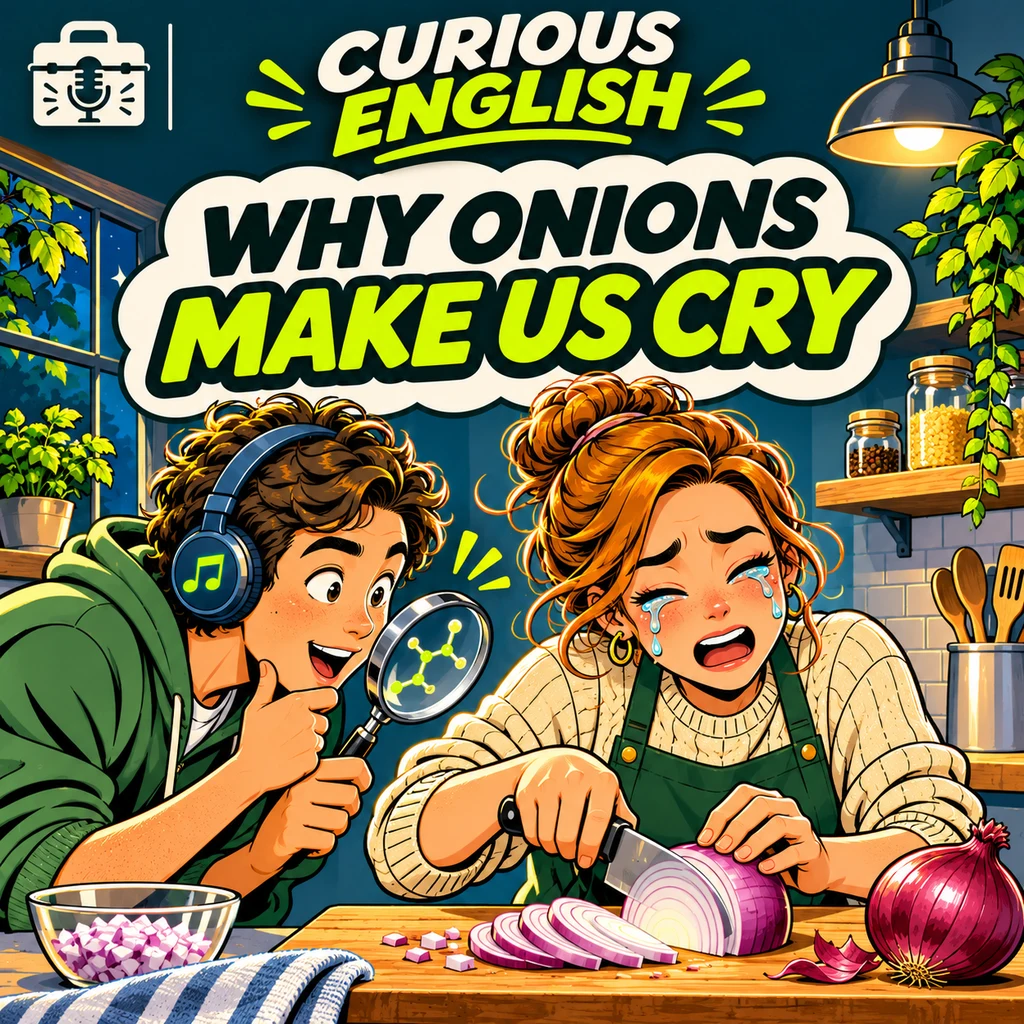
You are in the kitchen, and you start to cut an onion.
After a few seconds, your eyes begin to burn, and tears run down your face.
Why does a simple vegetable do this to us?
Welcome to Curious English.
I'm Martin.
And I'm Julia.
Today's question is: why do onions make us cry?
Before we answer, let's make a prediction.
Does the onion hurt our eyes when it is whole, or only after we cut it?
I'll say only after we cut it, because a whole onion does nothing to me.
I agree, so let's find out.
Here is the main idea.
Inside an onion, some chemicals are kept in different places in the cells.
When you cut the onion, you damage the cells, and the chemicals meet.
So the cutting starts a chain of reactions.
In simple words, cutting opens the door for the reaction.
Exactly.
Special proteins called enzymes work on a sulphur compound in the onion.
An enzyme is a protein that helps a chemical reaction happen.
Step by step, they make a chemical that irritates your eyes.
Scientists call it the lachrymatory factor.
That is a difficult name.
It is, but the idea is simple: it is a chemical that makes you cry.
The word lachrymatory is related to tears.
And how does it reach our eyes?
It spreads through the air around the onion, and it touches the surface of the eye.
Your eyes feel the irritation, and they produce tears to protect themselves.
Now, there is an interesting scientific story here.
Researchers wanted to understand exactly how the irritant is made.
Then, in 2002, a team of researchers published a study in the journal Nature.
They found an extra enzyme in the onion.
They named it lachrymatory-factor synthase.
So the irritant is made with the help of a specific enzyme.
In later experiments, reducing this enzyme changed which sulphur compounds the onion produced.
So researchers began exploring whether an onion could produce less of the tear-making chemical.
Those experiments do not tell us how every onion in your kitchen will taste.
Good point.
It is a fascinating example of how changing one part of a reaction can change its result.
Now let's learn four useful words from this topic.
First, chop.
To chop means to cut something into small pieces with a knife.
For example, "She chopped the onion and added it to the soup."
Second, irritate.
To irritate means to make a part of the body sore or uncomfortable.
For example, "The smoke irritated my eyes."
It can also mean to make someone a little angry.
Third, watery eyes.
This means your eyes are full of tears, often because of something irritating.
For example, "I had watery eyes after I chopped the onions."
Fourth, tear.
And this word has two pronunciations, so listen carefully.
The first one is a tear from your eye.
It sounds like the word ear.
For example, "A tear ran down his face."
The second one means to pull something into pieces.
It sounds like the word bear.
For example, "Please don't tear the paper."
So the spelling is the same, but the sound and the meaning are different.
Time for a challenge.
I will say a sentence with a gap, and you choose chop, irritate, watery eyes, or tear.
Number one: "Please ... the carrots into small pieces."
The answer is chop.
It means to cut into small pieces.
Number two: "The dust can ... your eyes."
The answer is irritate.
The dust makes your eyes uncomfortable.
Number three: "Be careful not to ... the page, because it is very old."
The answer is tear, and we say it like bear.
Number four: "A ... fell from her eye when she heard the happy news."
The answer is tear, and this time we say it like ear.
Number five: "After the onions, I had ... for ten minutes."
The answer is watery eyes.
Let's go back to our prediction.
A whole onion does not bother us, but cutting it starts the reactions, so we were right.
And now you can explain the science in simple English.
Remember the four words: chop, irritate, watery eyes, and the two sounds of tear.
You can read this episode in the transcript on our website, yourenglishtoolbox.com.
Follow the words while you listen, and the link is in the description.
Thanks for listening.
See you next time.