The audio controls above still work. Interactive translation, saving and practice need JavaScript. You can read the complete transcript and download your study materials below.
Complete English transcript
I want you to imagine that you are sitting in a very important, high-stakes meeting with your international team.
Everyone around the table is speaking in rapid, fluent English, and you are trying your absolute best just to follow the rhythm of the conversation.
Suddenly, the director of the company turns directly to you, says your name out loud, and asks for your professional opinion on a very complex problem.
Instantly, your heart drops and your mind goes completely, terrifyingly
blank.
You have a thousand brilliant, nuanced ideas floating around in your native language, but you cannot find a single English word to express them.
It feels like your brain has just shut down, the system has crashed, and the silence in the room becomes incredibly heavy and embarrassing.
Welcome to your English Toolbox, your slow English podcast, where we train your ears, your mind, and your communication strategy.
I am Martin, and I am Julia.
Today is episode 3
of our public speaking series.
And today, we are going to solve the terrifying problem of the blank mind.
If you stay with us for this extended masterclass, you will discover that freezing in public is almost never a vocabulary problem.
You freeze because you are trying to build a complex house without a blueprint.
We are going to teach you the ultimate structure trick that professional speakers use to ensure they never, ever run out of words.
We will
show you exactly how to buy time, how to organize your messy thoughts instantly, and how to easily pass the coherence sections of the IELTS or Cambridge oral exams.
Before we dive into this strategy, I want to ask you one quick favor.
If you learn a new technique today that makes you feel more confident and less afraid, please leave a comment on the platform where you are listening.
Your comments are the lifeblood of this project.
They help
our show grow, they help us reach more international professionals who are struggling, and they keep our community alive week after week.
Let me tell you a story about a former student of mine named Ravi.
Ravi is a brilliant, highly educated software engineer from India who is currently living and working in Berlin.
His reading and writing skills in English are absolutely excellent.
Easily a solid C1 level on paper.
He can write beautiful, complex emails without making a
single grammatical mistake.
But Ravi had a massive paralyzing problem with speaking in public or participating in spontaneous office debates.
One Tuesday morning, Ravi was sitting in a critical project planning meeting with senior management.
His director suddenly looked across the table and asked, Ravi, do you think we should delay the software launch until next month?
It was a relatively simple question, but it required a thoughtful, professional, and persuasive answer.
Ravi knew the answer perfectly well in his
head.
He knew they desperately needed to delay the launch because his team had found several dangerous bugs in the code.
But instead of answering clearly, Ravi froze completely.
He started one sentence, realized he did not know how to finish it, stopped, apologized, started a completely different sentence, and then just felt totally silent.
He felt incredibly embarrassed, and looking at the faces of his colleagues, he believed his English was just not good enough for his senior position.
After the meeting, he called me in an absolute panic.
He told me he needed to buy a new textbook and memorize 500 new advanced vocabulary words immediately.
But Martin, you told him the absolute truth about his English, didn't you?
Yes, I did.
I told him, Ravi, your English is already fantastic, and your vocabulary is huge.
Your problem is not your dictionary.
Your problem is your total lack of architecture.
Let us deeply analyze exactly what happened in
Ravi's brain in that specific meeting.
When you are asked a sudden, unexpected question, your brain produces abstract ideas at lightning speed.
But if you do not have a safe, predictable container to put those ideas into, you experience something called cognitive overload.
Cognitive overload is a fantastic psychological term for our listeners to understand.
It means your working memory is receiving too much information at once, and the mental system simply crashes.
Exactly.
Ravi was trying to translate his
entire complex technical thought process directly into English all at the exact same time.
He was frantically searching his brain for the perfect grammar, the perfect vocabulary, and the perfect tone simultaneously.
And let me be very clear, that is impossible to do in real time, even for native English speakers.
Native speakers do not speak in perfect, complex paragraphs when they are asked a sudden question.
Native speakers speak in frameworks.
They rely on invisible structures to guide their
sentences safely from the beginning to the end.
This brings us to a very important concept for anyone taking an official speaking exam, like the IELTS, TOEFL, or the Cambridge Advanced Tests.
We need to talk about the concept of coherence.
When an examiner is sitting across from you with a clipboard, they are not just counting your big vocabulary words.
They are listening for coherence.
Coherence does not mean using beautiful poetic language.
Coherence simply means that your ideas
are logically connected, well organized, and incredibly easy for the listener to follow.
Examiners and business managers do not want to hear a disorganized, chaotic genius.
They want to hear a structured, logical, and calm communicator.
When you have a structure, your brain finally relaxes.
You stop panicking about what word to say next, because the structure dictates what comes next automatically.
So, how do we actually build this structure?
How do we give our brain a reliable map so
we never get lost in the middle of a sentence again?
The absolute best solution to this terrifying cognitive overload is to memorize a universal, unbreakable framework.
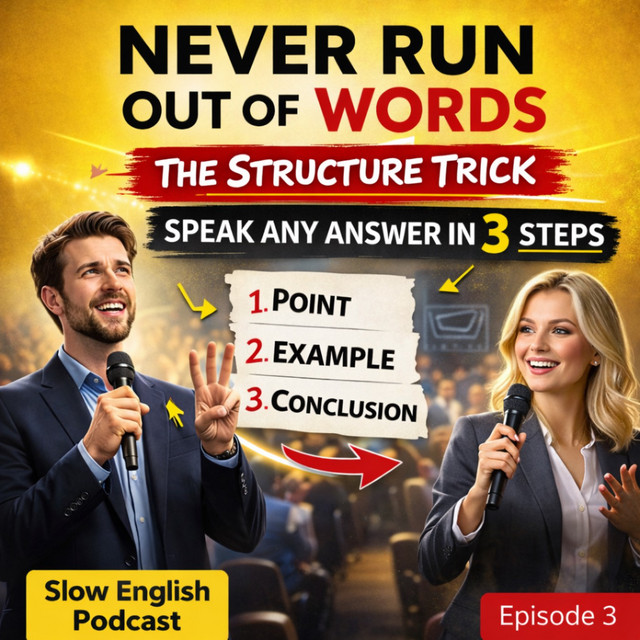
We call this powerful framework the three-part rule.
Some communication experts and exam evaluators also call it the point-example conclusion method.
Whenever someone asks you a spontaneous question, you must force your panicked brain into these three highly predictable boxes.
Step one is the point.
In this very first step, you give a
direct, incredibly simple answer to the question in one short sentence.
You do not try to explain why yet.
You just state your professional position as clearly as possible.
Step two is the example.
Here, you provide a personal story, a specific fact, or a logical reason to support that first sentence.
This is the exact place where you can safely expand your ideas and use your beautiful, descriptive C1 vocabulary.
And finally, step three is the conclusion.
You briefly
summarize what you just said, you bring the idea back to the beginning, and most importantly, you stop talking.
Knowing exactly when to stop talking is an absolute superpower in public speaking and in official Cambridge exams.
Let us look back at Ravi in that stressful boardroom meeting.
If Ravi had used this exact structure, his answer would have been effortless and highly professional.
He would look at his director, take a breath, and say, Yes, I strongly believe we
must delay the software launch.
That is his direct, uncompromising point.
Then he would say, For instance, my engineering team found three major security bugs yesterday that will completely ruin the user experience.
That is his clear, undeniable example.
And finally, he would say, Therefore, waiting one month is the safest and most responsible option for the company's reputation.
That is his confident, strong conclusion.
Notice how incredibly simple and effective that flow of information is.
There are no complex
grammatical acrobatics, just pure professional coherence.
But Martin, I can hear our listeners asking, there is always a gap between hearing the difficult question and starting the three-part rule.
That is a very sharp and realistic observation from our friends listening.
You cannot always jump instantly into your point like a programmed robot.
Sometimes your brain desperately needs three or four seconds to find the right file in the mental filing cabinet.
And dead silence in a professional conversation or
an IELTS exam feels incredibly awkward and heavy.
This is exactly why you must learn how to strategically buy time using professional fillers.
Amateurs get nervous and say, or they just stare blankly at the wall in pure panic.
Professionals use elegant linguistic bridges to delay their answer without looking foolish or unprepared.
Exactly.
If you are sitting in an IELTS Part 3 exam and the examiner asks you a weird philosophical question, you can use a filler.
You can
look at them and say, That is a fascinating perspective.
Let me consider that for a brief moment.
Or you could say, To be completely honest, I have never thought about that before, but I would probably say, These specific phrases are absolute magic because they give your brain three precious seconds of breathing room.
You are speaking confidently, your pronunciation is great, but you are not actually saying anything of substance yet.
You are just laying down the red
carpet before you walk safely on it.
You also need simple linking expressions to connect your three parts smoothly so the examiner can follow your logic.
To move gracefully from your point to your example, you should use phrases like, for instance, let me give you a clear example or my personal experience with this is, To move down to your conclusion, use phrases like, So ultimately, that is precisely why I believe, or to sum it all up.
Now,
let us do a live mini-exercise to show you exactly how powerful this structure is in real time.
I am going to put you on the spot, Martin, and ask you a random difficult question.
And I want you to answer it using the exact formula we just taught our listeners.
I am completely ready, go ahead.
Okay, here is the question for your imaginary Cambridge exam.
Do you think that remote work is ultimately better for modern society than
working in a traditional physical office?
That is an incredibly interesting question.
Let me think about the social impact of that for a second.
Yes, I strongly believe that remote work is significantly better for our modern society.
For instance, when professionals avoid commuting for two hours every single day, they invest that recovered time back into their families and their physical health.
I have seen my own colleagues become much happier and much more productive since they started working
from their living rooms. So ultimately, the flexibility and freedom of remote work creates healthier, more balanced citizens.
That was absolutely perfect, and it sounded completely natural.
Let us break down exactly what you just did for our listeners.
First, I used a strategic filler to buy myself two seconds of time to organize my thoughts.
Then you made your direct point.
Yes, remote work is better.
Then I gave my detailed example.
I used the concrete concept of commuting,
and I mentioned my colleagues to make it personal and real.
And finally, you delivered your clear conclusion, starting with the linking words, so ultimately.
It creates a beautiful, logical circle that is incredibly satisfying for any examiner or manager to listen to.
So let us quickly recap the core lesson of today's masterclass.
When you freeze in public or in an exam, it is almost never a vocabulary problem.
It is a structural and architectural problem.
You do not
need a bigger dictionary to survive a meeting or a Cambridge oral test.
You just need a much better map.
Always use the three-part rule, point, example, and conclusion.
Use strategic, professional fillers to buy yourself time gracefully.
And connect your ideas with simple, effective linking expressions.
If you enjoyed this episode, please write a small comment before you go.
Tell us, what is your absolute favorite phrase to buy time when someone asks you a difficult question?
Do you
use a specific English filler, or do you prefer to just take a deep, confident breath?
Your comments show the podcast platforms that our community is real, active and growing every single day.
We need your comments because your voice is far more important than ours.
Your voice and your comments will show us the exact right path for our future episodes.
Thank you for listening, and keep practicing your structure!