The audio controls above still work. Interactive translation, saving and practice need JavaScript. You can read the complete transcript and download your study materials below.
Complete English transcript
Welcome to Short Stories with Peter, from Your English Toolbox.
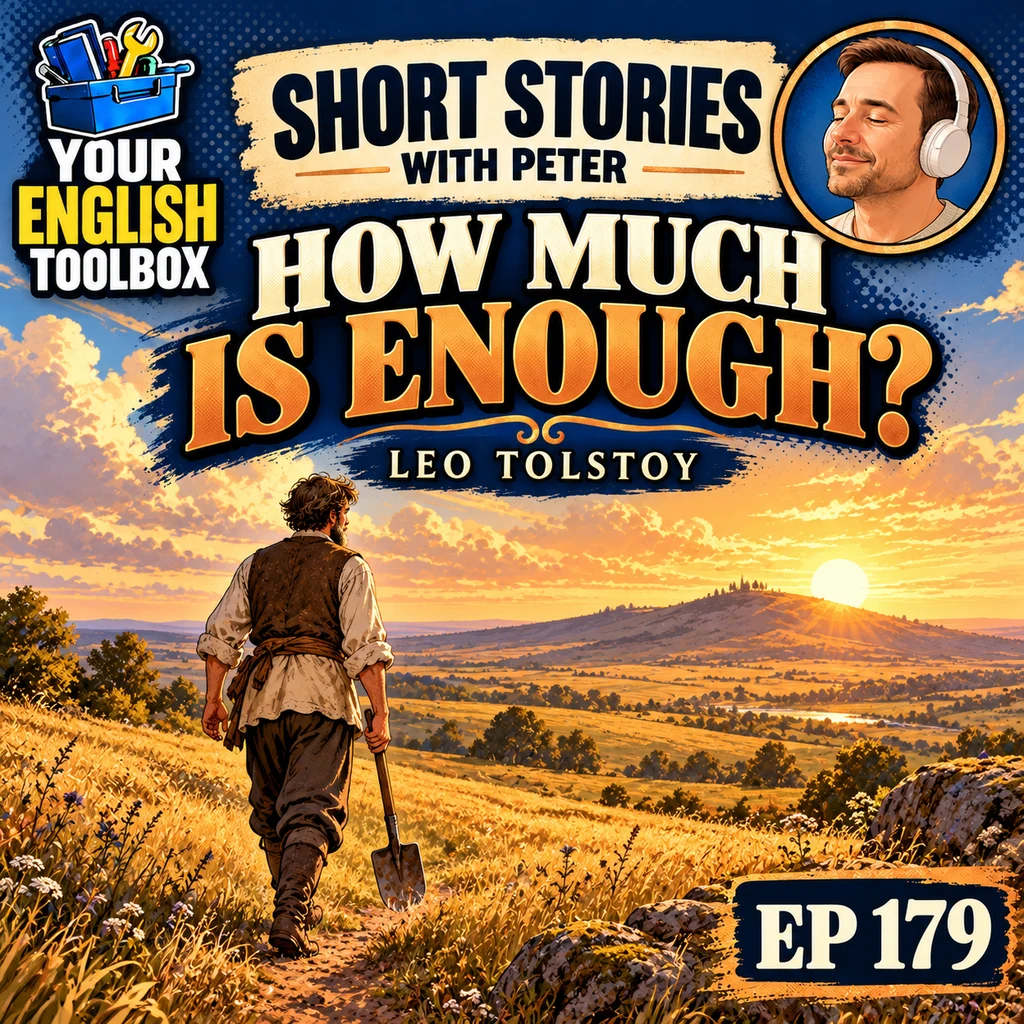
Today, an abridged adaptation of How Much Land Does a Man Need, by Leo Tolstoy.
Listen for a man who keeps moving the boundary of enough.
Pahom was a farmer who believed that one thing stood between him and happiness.
If I had enough land, I would have nothing to fear.
His family worked hard, saved what they could, and bought a small farm.
For a while, Pahom was content with it.
He loved walking through fields that belonged to him.
But neighbours' animals wandered onto his crops, and arguments followed.
I need more space, where other people cannot trouble me.
He sold his farm and moved with his family to a place with much more land.
Again, he was pleased, until he began comparing what he owned with what he might own.
The more he gained, the further away enough seemed to move.
Then a traveller told him about wide open land belonging to the Bashkir people.
Pahom set out with a servant, carrying gifts for his hosts and money for a purchase.
After several days, they arrived among tents beside a river.
The hosts welcomed them, and their chief explained an unusual offer.
Our price is one thousand roubles for a day.
How can you sell land by the day?
Walk around as much land as you can between sunrise and sunset, and it will be yours.
But you must return to your starting point before the sun goes down.
If you do not return in time, you lose your money and receive no land.
Pahom imagined a huge farm, more than his family could ever need.
That night, his excitement kept him awake, and an unsettling dream disturbed his brief sleep.
Before sunrise, the group gathered on a low hill overlooking the plain.
The chief placed his cap on the ground to mark the starting point.
Pahom put the money on it and took a spade to mark his boundary.
Remember, you must come back here before sunset.
I understand, and I will not go too far.
He set off at dawn, with cool air on his face and the grass brushing his legs.
At first, he walked steadily, stopping to cut marks in the earth.
The soil was rich, and every stretch ahead seemed better than the last.
Just a little further, and then I will turn.
But a little further became another field, another patch of grass, another promising piece of ground.
When he finally turned, the hill behind him looked very small.
By midday, the sun was hot, and his feet were sore.
He stopped for bread and water, but did not allow himself much rest.
I can rest later, when all this belongs to me.
Ahead lay a damp hollow with especially good grass, and he could not bear to leave it outside his boundary.
He made another detour, although the afternoon was slipping away.
At last, he looked towards the hill and understood how far he had come.
I have taken too much, and I am running out of time.
He abandoned his plan for a neat boundary and headed straight back.
His legs felt heavy, and the sun seemed to be sinking faster with every step.
He began to run, throwing aside the things that slowed him down.
Now he was out of breath, but still he pressed on.
I must reach the hill before the light disappears.
The waiting people waved their arms and called to him.
From below the hill, he suddenly lost sight of the sun.
Too late, after all that effort.
Then he realised that the people above him could still see it.
With his last strength, he struggled up the slope towards the cap.
He reached it with his hands and fell forward onto the ground.
You have gained a great deal of land.
But Pahom did not answer.
His servant knelt beside him and found that he was dead.
The servant took the spade and dug a grave just long enough for his body.
After a lifetime of wanting more, Pahom needed only six feet of earth.
End of the story.
Now, let's dive into the language and break down some of the key vocabulary from the story.
First, be content with something means feel satisfied with it, without needing more.
Pahom was content with his farm, but that feeling did not last.
You might say, I am content with a quiet weekend at home.
Being content does not mean that you can never have ambitions.
It describes feeling that what you have is enough.
Second, set off at dawn means begin a journey when daylight first appears.
We set off at dawn to avoid walking in the midday heat.
Set off describes the start of the journey; at dawn tells us when.
Third, run out of time means have no time left, or approach the point when it will be too late.
We are running out of time, so we need to finish the meeting.
You do not have to be physically running to use this expression.
Now choose the expression that fits.
You are satisfied with your small flat and do not want a bigger one.
You are content with your flat.
You begin a walk as the first daylight appears.
You set off at dawn.
A deadline is approaching, but your work is unfinished.
You are running out of time.
Our episode page has these expressions and more language from the story, including make a detour and out of breath.
Find it at yourenglishtoolbox.com through the link in the description.
Before you leave, consider one question: when does wanting more begin to take away what matters?
Thank you for listening, and I will see you next time.