The audio controls above still work. Interactive translation, saving and practice need JavaScript. You can read the complete transcript and download your study materials below.
Complete English transcript
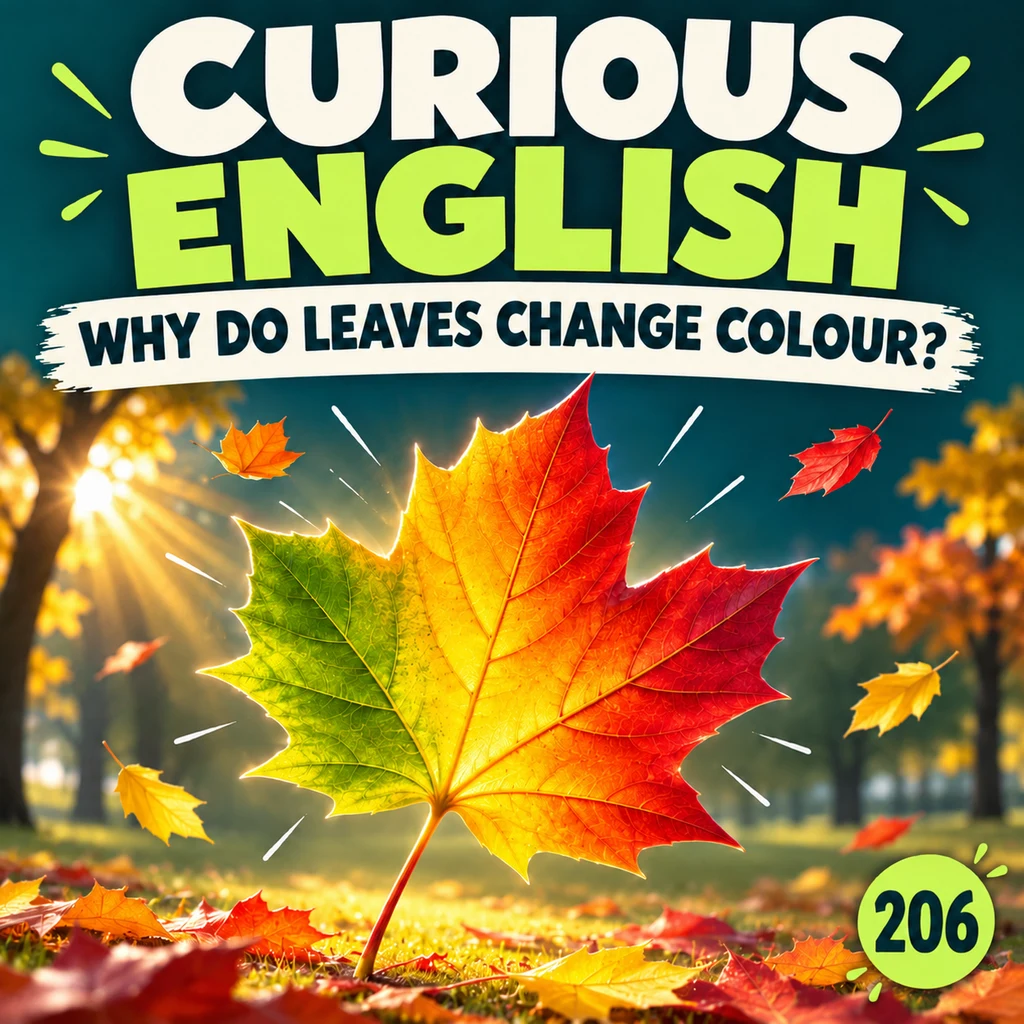
Julia, look at those trees.
Last month their leaves were green.
Now some are yellow, some are orange, and some are red.
Why do leaves change colour in autumn?
Welcome to Curious English, from Your English Toolbox.
Before we answer, imagine a green leaf turning yellow.
Was the yellow colour already there, or did the tree make it only in autumn?
In many leaves, some yellow colour was already there.
But why could we not see it before?
First, let us make three useful words clear.
A leaf is the flat part that grows on a tree or plant.
One leaf, two leaves.
Sunlight is the light that comes from the sun.
If a room gets lots of sunlight, the sun shines into it.
And a pigment is a substance that gives something its colour.
For example, different pigments can make a leaf look green or yellow.
So we have a leaf, sunlight, and pigment.
Now let us look more closely at the green leaf.
Leaves contain a green pigment called chlorophyll.
Chlorophyll helps the plant use energy from sunlight to make food.
In spring and summer, there is usually a lot of green chlorophyll in a leaf.
That strong green can hide other colours.
Think of a bright green curtain in front of a yellow wall.
The yellow is there, but the green is what you notice.
Then autumn arrives, and the days become shorter in many places.
In many deciduous trees, the green chlorophyll breaks down.
Break down means that a substance changes into simpler substances.
As the green fades, other pigments can become easier to see.
These pigments can give leaves yellow and orange colours.
So, in many cases, the yellow was already in the leaf.
It was simply hidden by the stronger green.
But what about red leaves?
Some red pigments can be produced during autumn.
Different trees have different pigments, and not every leaf follows the same pattern.
The weather and the amount of light can also affect the colours we see.
Notice the useful verb fade.
If a colour fades, it becomes less strong or less bright.
The green colour fades as chlorophyll breaks down.
You can use the same word when the colour of an old photograph becomes weaker.
The photograph has faded in the sun.
Another useful phrase is break down.
Here, we are talking about a substance changing into simpler substances.
In another context, a car can break down when it stops working.
The meaning depends on the situation.
Let us return to the picture of the green curtain and the yellow wall.
The picture helps us imagine why one colour can hide another.
But a real leaf is not made of curtains and walls.
Its colours come from substances inside the leaf.
Autumn does not make every tree produce the same colours.
Some leaves become yellow, others develop red tones, and some turn brown.
Two trees on the same street may have different colours.
That can depend on the kind of tree and its conditions.
Now it is your turn.
If green chlorophyll fades, what might become more visible in the leaf?
Yellow and orange pigments that were already there.
And does every red colour have to be there all summer?
No, some red pigments can be produced during autumn.
Before we finish, let us use these words in a different situation.
Imagine you have a bright red shirt, and you leave it in strong sunlight for many months.
Over time, the colour may fade.
That means the red becomes less bright than it was before.
Now think about an old photograph on a sunny windowsill.
Its colours can fade too.
The photograph has not turned into a leaf, but we can use the same verb.
Here is one final question about the trees.
Does the green colour simply cover the yellow like a real curtain?
No, the curtain is a comparison that helps us picture how one colour can hide another.
In the leaf, those colours come from different pigments.
Next time you see a colourful tree, remember that each leaf is telling a little story about light and change.
On our website, you can read the transcript while you listen and choose the speed that is comfortable for you.
The direct link is in the episode description.
Thanks for joining us at Your English Toolbox.
See you next time.