The audio controls above still work. Interactive translation, saving and practice need JavaScript. You can read the complete transcript and download your study materials below.
Complete English transcript
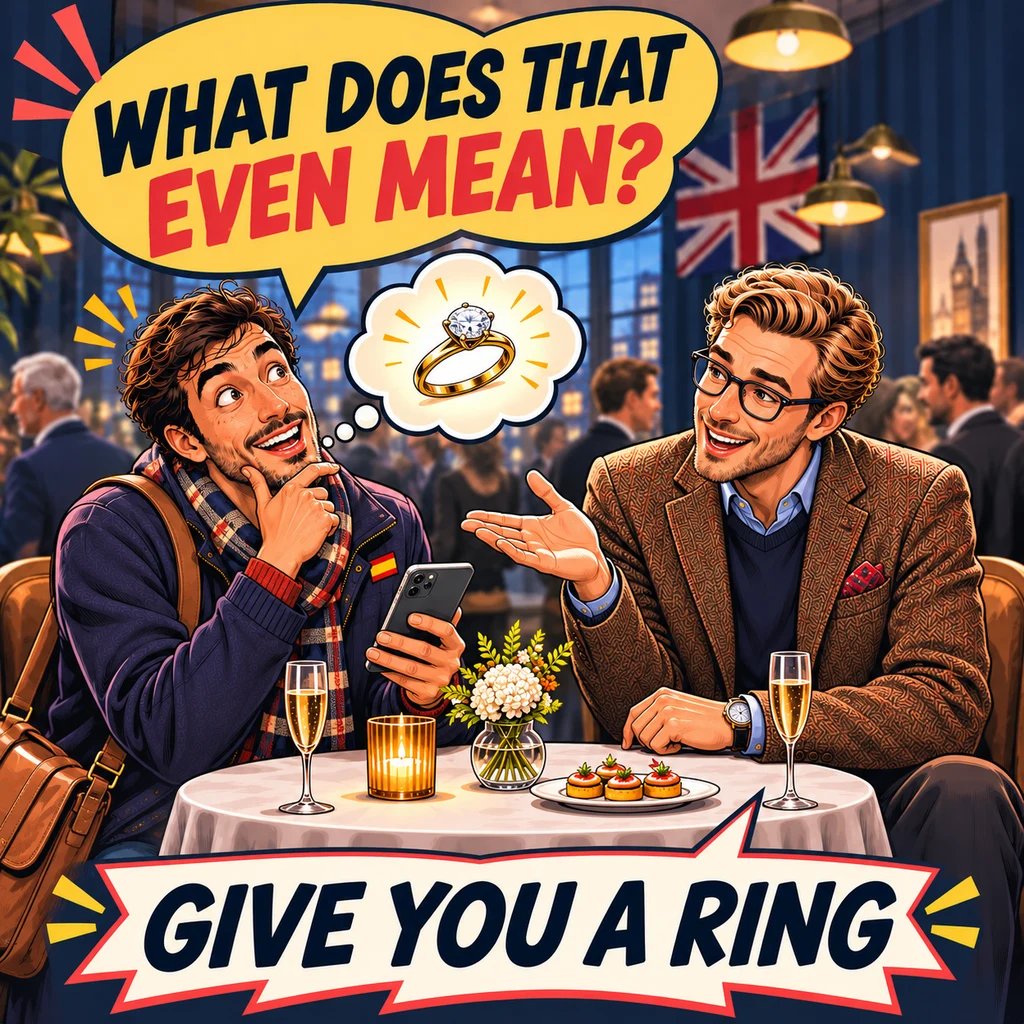
Someone promised to give me a ring tomorrow.
Did they mean a gift, or something else?
Welcome to What Does That Even Mean?
I'm Martin.
And I'm Julia.
Today Juan is here, and he has a small story for us.
Juan, go ahead.
Imagine this with me.
I am waiting for important news.
It is a long Thursday, and I keep looking at my phone.
Then a colleague walks past my desk and says, "Don't worry, I'll give you a ring tomorrow."
A ring?
I look at my hands.
I do not see a gift.
I do not see jewellery.
I only see a very confused person.
Oh, Juan, that is a great example.
Because the sentence sounds so strange if you only know the word ring as jewellery.
Exactly.
So what does it really mean?
It means "I'll phone you."
Give someone a ring is a way to say you will make a phone call to that person.
It comes from the sound of a telephone.
When you call someone, their phone rings.
So the colleague will not bring me a present.
No, only a phone call.
Let's compare three expressions.
First, give someone a ring.
Second, give someone a call.
Third, call someone back.
Give someone a ring is informal, and it is mainly British English.
In American English, people usually say give someone a call, or just call someone.
Give someone a call is very common in both varieties, and it sounds natural in almost any informal situation.
So I can use call, and I will be safe.
Yes, that is a good choice for most situations.
But now you can also understand the other one.
Now, call someone back.
This one is different, because it means to return a call.
For example, someone called you, and you were busy.
Later, you called them back.
"Sorry I missed your call, I'll call you back in ten minutes."
So back means I am answering a call I missed.
Right.
Or, it can mean you will call again later, after a short time.
Notice the difference.
"I'll give you a ring" tells you I will call.
"I'll call you back" connects that call to an earlier call or conversation.
What about register?
Register means how formal or informal the language is.
For a job interview or a formal email, we usually write, "I will contact you tomorrow."
With friends, we say, "I'll give you a call."
In British English, we can also say, "I'll give you a ring."
So the ladder goes from formal to informal.
I will contact you.
I will call you.
I'll give you a call.
I'll give you a ring.
That is a useful ladder.
Let's hear all of this in a short, natural conversation.
"Hi, Sam, it's Anna."
"Anna, sorry, I missed your call earlier."
"No problem, I only wanted to ask about Saturday."
"Can I call you back after lunch?"
"Of course.
Or I can give you a ring this evening, if that's easier."
"Lunch is fine.
Talk to you later."
I like it, because everything is short and relaxed.
That is exactly how these expressions sound in real life.
Now it's challenge time, Juan.
I will say four sentences, and you tell me which meaning of ring we have.
Is it jewellery, a sound, or a phone call?
Okay, I am ready.
Number one: "He bought her a silver ring for her birthday."
Jewellery.
Correct.
Number two: "I heard the ring of the doorbell and went to open the door."
A sound.
Yes, the sound of a bell.
Number three: "I'll give you a ring when I arrive at the station."
A phone call.
Perfect.
Number four, and it's a tricky one: "She will give me a ring tomorrow, and I will call her back if I miss it."
Which meaning is ring?
A phone call, and call back is the second call.
Excellent, Juan.
So let's remember it.
Give someone a ring means phone someone.
It is informal, and it is mainly British.
Give someone a call is similar, and it works everywhere.
Call someone back means you return a call.
And my colleague is not giving me a gift.
Not this time.
One last tip for you, the listener.
When a sentence sounds strange, do not translate each word.
Think about the whole situation, and ask what the person wants to do.
Here, the person wants to talk to you by phone.
That is the real meaning.
You can find more words like these in the vocabulary section on our website.
It has the key words from this episode, with simple definitions, and the link is in the description.
Thanks for listening.
See you next time.