The audio controls above still work. Interactive translation, saving and practice need JavaScript. You can read the complete transcript and download your study materials below.
Complete English transcript
Welcome to the Slow Listening Podcast Series, the show where we train your ears step-by-step.
Welcome back to your English toolbox, Slow English Podcast.
I'm Martin.
And I'm Julia.
Today we're talking about something that sounds small but feels huge.
It's the moment you speak English and you notice something strange.
Not only the words, the sound, your own voice, it can feel like it belongs to someone else.
Yes, and for many learners this is the secret fear.
Why do I not sound like myself? Why do I feel different when I switch languages?
I've had that feeling too. I remember hearing myself in English and thinking,
why do I sound so different for me? Sometimes I sounded smaller. Sometimes I sounded more serious.
Sometimes I sounded like I was wearing a mask.
And when that happens, people often blame grammar.
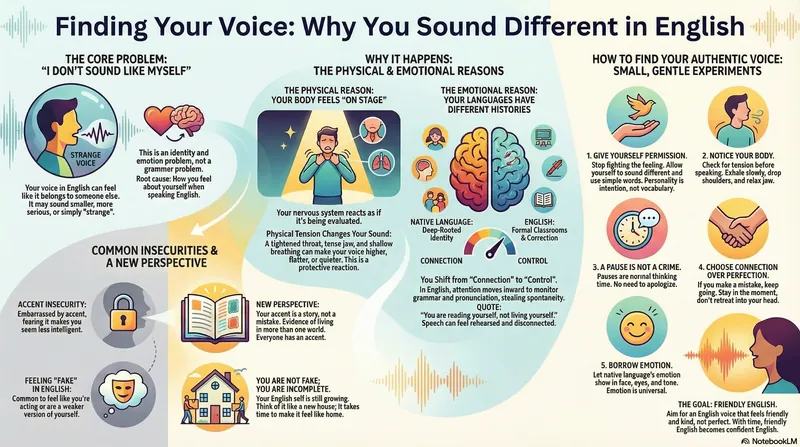
But this is rarely a grammar problem. It's an identity and emotion problem.
This episode is dedicated to a friend from our community who wrote us a thoughtful message.
The message was about personal growth, mindfulness, and learning later in life.
About rebuilding yourself slowly, step-by-step, without rushing.
That message stayed with us. Because learning a language is not only learning rules,
it's learning a new way to be seen. And that can feel vulnerable. Before we go deeper,
a small announcement and we'll keep it calm and simple. We have started a Patreon page that
you'll find the link in the description. Right now everything is free. We're building the page
slowly. That slow build is not a marketing trick. It's our philosophy. We don't rush learning
and we don't rush the project. On Patreon you'll find transcripts, study guides, videos with
subtitles, vocabulary workbooks, and extra materials in different international languages
as we build them. If you want to support early, there is an early supporter tier.
Early supporters keep their price frozen forever. No pressure. Just an open door
for friends who want to help this grow. Now let's open today's topic. So Julia,
let's begin with the basic question. Why does my voice feel different in English?
I think there are two answers. One is physical and one is emotional.
Let's start with the physical one. Okay. Your voice is connected to your body
and your body changes when you feel watched or evaluated. In your native language,
you usually feel at home. In English, you may feel like you're on stage.
Yes. Even if nobody is judging you, your nervous system can act as if they are.
Your throat tightens. Your breathing becomes shallow. Your jaw becomes tense.
And those tiny changes change your sound. You may speak higher or you may speak flatter
or you may speak too quietly. And then you hear yourself and you think,
I hate this voice. Exactly. But it's not your real voice disappearing.
It's your body protecting you. Now the emotional answer. This is my favorite part.
Mine too, because it removes shame. Your native language is not just a tool.
It's your childhood. It's your jokes. It's your anger. It's your love. It's the voice
you used when you said your first secrets. Yes. Your native language is full of emotional
memory. It has thousands of small moments inside it. English for many people arrived later.
Often in the classroom, often with correction, often with the feeling, don't make mistakes.
So English can carry a different emotional color. It can feel colder, more formal,
more controlled. And if you learned English mainly through reading or tests,
your English voice may feel written. Like you are reading yourself, not living yourself.
That is such a good way to say it. Reading yourself, not living yourself.
Let's tell a little story because many friends will recognize it.
Imagine you're with close friends in your native language.
You interrupt. You laugh. You use gestures. You don't plan the sentence. The sentence just
happens. And then someone new joins the group or you need to speak English. Suddenly you sit
up straight. Your smile becomes smaller. You choose simpler topics. You try to be correct.
And you feel like your personality shrinks. Not because you have no personality,
but because your attention moves from connection to control.
Yes. Your attention goes inside. How do I say this? Did I pronounce that?
Was my grammar wrong? And the moment you move inside,
you leave the moment. You leave the conversation. You leave your natural rhythm.
This is what I call the inner listener. Not a real person. A voice inside your head.
Listening and judging. And this inner listener is loudest when you care.
If you didn't care, you wouldn't monitor yourself so much.
True. But the monitoring has a cost. It steals spontaneity. It steals humor.
It steals warmth. It can also steal volume. People literally speak more quietly in English.
Because quiet feels safer. Quiet feels like fewer risks.
And then they think, my English is weak. But often it's not weak. It's cautious.
Let's talk about accent insecurity because this is a big part of identity.
Yes. And we need to be gentle here. Many people feel embarrassed about their accent.
They say, I hate how I sound. I want to say something very clear.
Your accent is not a mistake. It's a story. It's evidence that you have lived in more than
one world. And another important truth. You hear your accent differently than other people hear
it. You are inside the sound. So you notice every detail.
Exactly. Your brain puts a spotlight on every difference. And the brain sometimes translates
difference as danger. Which is strange because difference is normal.
Everyone has an accent. Even native speakers.
Yes. There is no no accent. There are only different accents.
I think the deeper pain is not the accent itself. It's what people think the accent means.
They think it means, I am less intelligent. Or I am less professional. Or I don't belong.
And that's identity. Belonging. Status. Safety. The fear of being the outsider.
When you speak your native language, you belong automatically. When you speak English,
you may feel you need to earn belonging. You feel you must prove yourself. And proving
yourself changes your voice. It makes you perform. And performance never sounds like home.
Now let's talk about authenticity. People often say, I feel fake in English.
Yes. Like they are acting. Like they are a weaker version of themselves.
Here's the truth. You are not fake. You are incomplete. And that is normal.
Your native language had years to grow with you. English is still growing with you.
It's like moving to a new house. At the beginning it feels empty. The walls are clean.
The rooms echo. You don't know where things belong. But slowly you bring your life into it.
Photos, music, small habits. And then the house becomes home.
English is like that. At first it's a new house. Later it becomes home. So what do we do
when the English voice feels unfamiliar? First we stop fighting the feeling.
Fighting makes it stronger. Resistance creates tension. And tension changes the voice again.
So the first step is permission. Permission to sound different. Permission to pause.
Permission to be simple. And permission to be emotional. Even with limited vocabulary.
You can be warm with simple words. You can be honest with simple words.
Many people think they need advanced words to have personality. But personality is not
vocabulary. Personality is intention. How you look at the person. How you listen.
How you respond. A simple sentence can carry a lot of soul. I'm happy to see you.
I missed you. That was hard for me. Those are simple. But they are real.
Let's make it practical but human. Here are a few small experiments you can try this week.
Notice your body before you speak English. Are your shoulders up? Is your breath high in your chest?
If yes, soften it. Exhale slowly. Drop the shoulders. Relax the jaw. Allow a pause without
apologizing. Many learners say sorry for a pause. But pauses are normal. A pause is not a crime.
It's thinking time. Choose connection over perfection in one conversation.
If you make a small grammar mistake, keep going. Stay with the person. Don't abandon the moment.
And borrow emotion from your native language. Not the words. The emotion.
Let your face show it. Let your eyes show it. Let your voice rise and fall.
One more comforting idea. You can have more than one you. That's not a problem.
That's richness. Your English self may be calmer. Your native self may be faster.
Your work self may be more formal. Your friend self may be playful. We change depending on
context. Language is a context. Over time those selves integrate. You grow a bridge.
And bridges are built slowly. Brick by brick. Conversation by conversation.
Mistake by mistake. Before we move into the final minutes we need to ask you a favor.
We truly need your comments to keep this project alive. And if you're listening on
or Apple podcast, your comments there are crucial. Paramount. Those platforms are very
quiet spaces. A comment is like a light turning on. It tells the platform, real people are here.
It tells the platform, this show matters. Every single show of support helps us continue.
It helps us build the transcripts, the study guides, the subtitles, the workbooks.
It helps us build everything slowly without rushing with quality. If you can, please write
one short comment today. Even one sentence. Tell us. My English voice feels quiet, nervous,
different, confident, or strange. We read them. And they really keep us going.
Now let's end with a small story you can carry into the night.
Imagine you're alone in your room. It's late. The day is over. And you're about to sleep.
You say a few lines in English. Not to perform. Not to prove anything. Just to
hear your English voice with kindness. You say, I did my best today. Tomorrow I'll try again.
I can grow slowly. And the voice still sounds different. But it feels less threatening.
Less foreign. More like a new room in your own home. That's the shift. Not perfect English.
Friendly English. And friendly English becomes confident English with time.
Your voice is not only sound. It's permission. It's presence. It's belonging.
And you deserve to belong in English too. Not later. Not after you are perfect.
Now while you're learning. Thank you for listening. Thank you for being part of this
as friends. And thank you again to the friend whose message inspired today's theme. One last
question for you. How does your English voice feel compared to your voice in your own language?
Write it in the comments. We'll see you in the next episode.