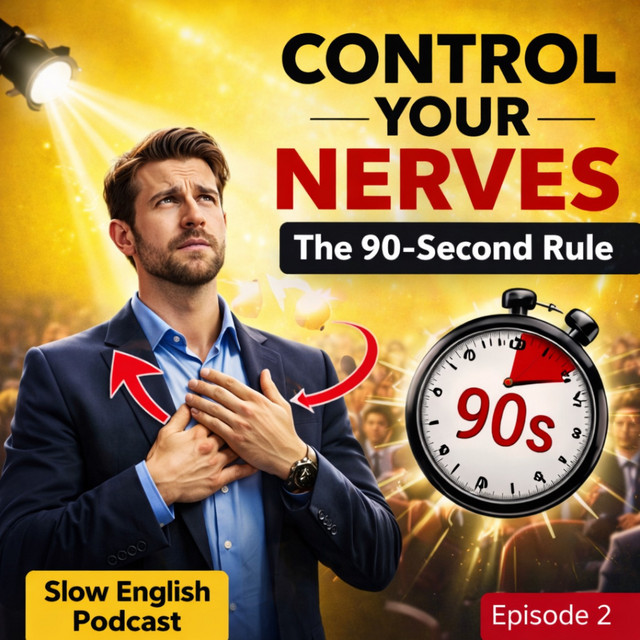
The audio controls above still work. Interactive translation, saving and practice need JavaScript. You can read the complete transcript and download your study materials below.
Complete English transcript
Have you ever stood outside a closed door, waiting to walk into an English speaking exam and felt your own heart trying to escape from your chest?
I know that feeling perfectly, and it is absolutely terrifying.
You look at the clock on the wall, and every second feels incredibly heavy.
Your hands start shaking uncontrollably.
Your mouth gets completely dry, like you have swallowed sand.
And the worst part is that your mind goes completely blank.
All the advanced
vocabulary you studied for months just disappears into the dark.
It feels like a complete disaster before you even open your mouth to say hello.
Welcome to your English Toolbox, your slow English podcast where we train your ears, your mind, and your nervous system.
I am Martin.
And I am Julia.
Today is episode two of our public speaking series.
And today we are focusing on something very different.
We are focusing on the physical body, not the intellectual
mind.
If you stay with us for this extended episode, you will learn the famous 90-second rule of human neuroscience.
You will also learn a complete toolkit of actionable, physical techniques to instantly calm your nervous system.
These are the exact tools you need before an IELTS, TOEFL, or Cambridge oral exam.
These are also the tools you need to give a speech in front of an audience.
A work presentation, a school theater play, a political speech, etc. Even
maybe you could also use these tools to propose marriage to your loved one.
Allow us this little joke, please.
Yes, a full set of powerful tools.
We will teach you exactly how to survive the most dangerous and critical part of any presentation.
Let me take you back to a specific moment a few years ago when I had to give a presentation to a very large intimidating audience.
This was the conference in London, right?
Exactly, the London
conference.
I was standing backstage hidden behind a heavy velvet curtain.
I could hear the murmur of the crowd finding their seats, and I could hear the previous speaker finishing their conclusion.
That waiting period just before you walk into the light is always the absolute worst part.
It is psychological torture.
Mentally, I was totally prepared for this day.
I knew my presentation perfectly, and I had practiced my transitions, but my body was completely betraying me.
What was
happening to you physically in that moment?
My breathing became incredibly shallow.
I was only taking tiny rapid breaths into the very top of my chest.
When you use shallow breathing, you are not getting enough oxygen to your brain.
And when the brain lacks oxygen, it triggers even more panic.
Exactly.
My hands were sweating so much that I could barely hold my index cards.
My legs felt like they were made of heavy stone.
It sounds like your
body was preparing for a physical fight, not a speech.
That is exactly what was happening.
I felt like I was going to lose control, forget all my English vocabulary, and just run out the back door of the theater.
For a very long time, I thought this kind of fear was a sign of mental weakness.
I thought I simply did not have the right personality for public speaking.
But Martin, what you were experiencing backstage was not a
mental weakness at all.
It was a physiological response.
That is a fantastic C1 vocabulary word for our listeners, Julia.
Physiological.
Yes, let us define that clearly.
Physiological means relating to the way a living body naturally functions and reacts to its environment.
Your fear was physical first and mental second.
This is a huge realization.
When you feel threatened, your brain does not know the difference between a hungry tiger and a Cambridge-speaking examiner.
To your ancient survival brain,
both of those things are deadly threats.
Exactly.
So the brain immediately floods your body with survival chemicals.
Mainly adrenaline.
We call that an adrenaline rush.
An adrenaline rush is an intense, sudden feeling of rapid energy designed to make you fight or run away.
Your heart beats faster to pump blood to your muscles.
Your mouth goes dry because your digestive system shuts down to save energy.
All of those terrible symptoms are just your body trying to protect
you.
But here is the scientific secret that changed my life as a speaker.
Neurologists have studied this chemical reaction extensively.
They found that an adrenaline rush takes exactly 90 seconds to peak and flush out of your bloodstream.
Wait, let me make sure I understand that.
You are saying the chemical wave only lasts for 90 seconds?
Yes, just 90 seconds.
From the moment the deep fear hits you to the moment it naturally leaves your body is just
one minute and a half.
If you do not fight it, the chemical reaction simply drops and fades away.
That is incredible.
So why does the fear usually last for the whole exam?
Because we panic about the panic.
When we feel our hands shaking, we think, oh no, I am ruining my exam.
That terrible thought creates a second adrenaline rush.
And then a third and a fourth, creating a continuous loop of anxiety.
The shift and application precisely.
So the major mindset shift for today is this.
You do not need to fight your fear and you do not need to feel bad about it.
You just need to manage your physical body for these 90 seconds until the wave passes.
How exactly do we do that?
Especially if an examiner is sitting across the table looking right at us.
We use a series of highly actionable micro rituals to survive that window.
The first tool is the
breathing reset.
When you sit down, breathe in slowly through your nose for four seconds.
Hold that breath in your lungs for four seconds.
And then exhale completely and slowly through your mouth for six seconds.
That long exhale is the most important part.
An extended exhale physically massages the vagus nerve, which tells your nervous system that you are completely safe.
The second tool is a physical grounding technique.
Grounding means using your physical senses to connect with reality,
pulling your attention away from your spinning thoughts.
Exactly.
While you are breathing, push your feet hard into the floor.
Feel the solid ground supporting your shoes.
Feel the wooden chair supporting your back.
You are sending your brain physical evidence of stability.
The third tool is building what I call your security system.
What is a security system in the context of public speaking?
It means you must memorize your very first sentence perfectly.
The adrenaline protocol in your
body is at its absolute highest right when you are about to start speaking.
That is when your brain goes blank.
If you have that first sentence memorized like a song, you have a safe ground to start from.
You do not have to think about grammar, you just have to press play.
It acts as a bridge over that initial 90-second wave of nervousness.
But to build this system properly, you must practice at home like a professional actor.
Actors rehearse their lines endlessly so they can rely on muscle memory when the stage lights hit them.
Rehearse your first sentence in your bedroom with your eyes open.
Then rehearse it with your eyes closed.
Visualize the exam venue.
Visualize the white walls, visualize the harsh lights, and visualize the serious examiner.
You have to make your brain feel like you have already been in that scary room a hundred times before.
Yes, familiarity destroys fear.
And when you
finally enter the real room, take a moment to read the room.
To read the room means to observe the emotional mood and connect with the people in the space.
Do not look at the floor and do not look at your shoes.
Look at the examiner as a human being.
If you can connect with them, maybe with a polite smile, a comment about the rainy weather or a quick greeting, the tension will ease immediately.
You realize they
are not tigers trying to eat you.
And finally, the most powerful and authoritative trick of all, the delayed start.
Oh, this is so crucial for time to exams like IELTS, TOEFL, or the Cambridge Advanced Tests.
When the examiner looks at you and says, Please start, do not speak immediately.
The amateur speaker rushes into the first word because silence feels uncomfortable.
But the professional speaker uses the silence.
Exactly!
Pause for three slow, deliberate seconds before you deliver
your memorized first sentence.
Look at the examiner, smile slightly, take a deep breath in, and then begin.
Those three seconds show absolute confidence.
They establish your dominance over the situation, proving that you control the time.
So, let us review our physical strategy for today.
Fear before speaking a foreign language is highly physiological, not a character flaw.
It is simply a 90-second chemical wave of adrenaline.
Do not fight the wave because fighting it makes it bigger.
Breathe
deeply with a long exhale.
Practice your grounding by feeling the floor.
Use your memorized security system to survive the opening moment.
Read the room to connect with your audience as human beings.
And always delay your first words to establish authority.
If you enjoyed this episode, please write a small comment before you go.
What is your biggest physical symptom when you get nervous before an English conversation?
Do your hands shake?
Does your heart race or does your
mind just go completely blank?
We need your comments because your voice is more important than ours.
Your voice and your comments will show us the right path for future episodes.
Thank you for listening and we will see you with the next one.
And if you are going to give a speech tomorrow, remember your uneasiness is normal.
You are human.
Breath.
Use your memorized sentence.
Wait a few seconds and go.
You will surprise you really enjoy public
speaking.
We will keep you coaching in the next episode.
See you soon.