The audio controls above still work. Interactive translation, saving and practice need JavaScript. You can read the complete transcript and download your study materials below.
Complete English transcript
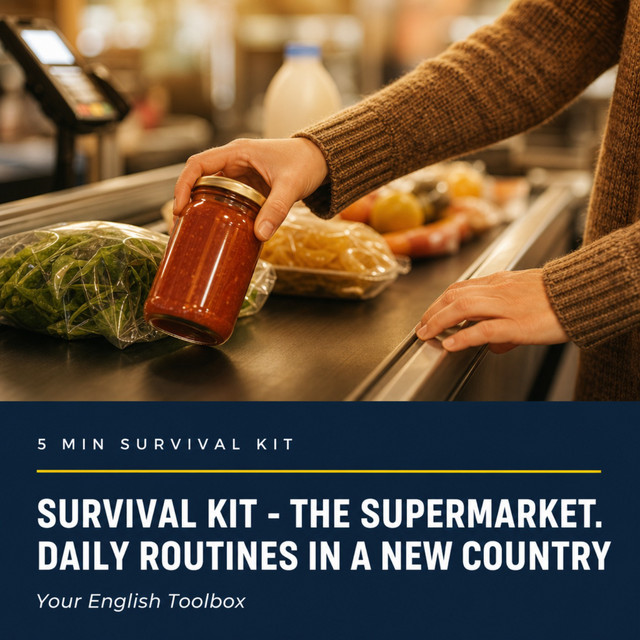
You are pushing a trolley down an aisle.
Everything looks familiar… but nothing has a label you fully understand.
You need to ask where something is.
And then — at the checkout — someone asks you something you were not expecting.
This is the supermarket.
And today… we are going to make it yours.
Welcome to Your English Toolbox, where we train your ears step by step.
Want to take your learning even further?
Find "Your English Toolbox" on YouTube to watch every episode with subtitles.
It is the best way to support this project, and we truly appreciate it.
I am Robert.
And this… is the Basic Survival Kit.
This series exists for one reason.
Living in an English-speaking country means facing real situations — every single day — where you need the right words at the right moment.
Not perfect English.
Not fluent English.
The RIGHT words.
And today, those words belong to the supermarket.
Three situations: asking staff for help, asking about a product that is out of stock, and navigating the checkout — where the unexpected question always appears.
Five sentences.
One rescue sentence.
And a story about someone who used them — and walked out feeling different.
Let's begin.
SENTENCE ONE.
You are looking for something and you cannot find it.
The natural instinct is to keep wandering the aisles rather than ask.
But here is the truth about supermarket staff.
They answer this question twenty times a day.
They are not judging your English.
They are just pointing at a shelf.
"Excuse me — could you tell me whereabouts I might find the olive oil?"
Notice the word "whereabouts."
It sounds natural, it sounds polite, and it sounds like someone who knows how to ask.
It signals that you understand the store is large — that you are simply asking for a direction.
SENTENCE TWO.
You have found the section.
But the shelf is empty.
You have two options.
Leave without it… or ask.
The people who ask get answers.
"I have been looking for your wholegrain mustard, but the shelf seems to be empty — do you know if you will be getting more in?"
This sentence does three things.
It shows you looked first.
It softens the observation — "seems to be empty" rather than "you are out of stock."
And it asks an open question — which invites a real answer.
Not a yes or no.
An answer that might tell you when, or what to try instead.
SENTENCE THREE.
Same empty shelf.
But this time, you want to know if there is something similar.
"If you do not have that one, could you recommend something similar?"
This sentence is quiet but powerful.
It shows flexibility.
It shows you are not stuck.
And it opens a conversation where the staff member can actually help you.
SENTENCE FOUR.
You are at the checkout now.
Your items are on the belt.
The cashier scans your first item and then — before you are ready — asks you something.
This is the moment most learners dread.
Not because the question is complicated — but because it arrives without warning.
A loyalty card.
Bags.
Something you did not expect.
And your brain — just for a second — goes blank.
"Sorry — could you say that once more?
I want to make sure I understood."
The key words are "once more" — not "again," not "what."
"Once more" is calm.
"Once more" is clear.
It tells the person across the counter that you care about getting it right.
SENTENCE FIVE.
You are paying.
The transaction is almost done.
And then — one last question.
Cashback.
A receipt.
Something your loyalty card is offering today.
Whatever it is — this sentence handles it.
"That sounds fine — thank you for letting me know."
This is your all-purpose closer.
It does not require you to understand every detail.
It signals that you are a confident, functional adult — not someone who froze.
Now — the rescue sentence.
The single phrase that works when everything else disappears from your mind.
"Sorry — I am still learning English.
Could you speak a little more slowly, please?"
Say it without embarrassment.
Say it like it is simply true — because it is.
Nobody in a supermarket will judge you for learning a language.
Most people — when asked kindly — will slow down immediately.
Now — a story.
Tomás had lived in Bristol for eight months.
He had been avoiding the large supermarket near his flat — going to the small corner shop instead, where he knew the layout and the man behind the counter always nodded without asking questions.
But one Saturday, the corner shop was closed.
And he needed ingredients for a dish he was making for his neighbour — the one who had helped him with his boiler, explained his council tax letter, asked about his family.
Tomás wanted to cook for her.
And he needed the right things.
He walked into the large supermarket.
He found most of what he needed.
But he could not find the smoked paprika.
He looked for four minutes.
Four minutes feels very long when you are avoiding asking for help.
And then… he asked.
"Excuse me — could you tell me whereabouts I might find the smoked paprika?"
"Oh, that's in the world food aisle — just down there on the left."
Fifteen seconds.
That was all it took.
At the checkout, the cashier asked him something about his Nectar card.
He did not fully understand.
He said: "Sorry — could you say that once more?
I want to make sure I understood."
She smiled and repeated it.
He understood the second time.
He nodded and said "That sounds fine — thank you for letting me know."
He left.
He made the dish.
His neighbour said it was the best thing she had eaten in weeks.
And Tomás realised he had spoken English to three different people in that supermarket.
He had asked for help.
He had asked for clarification.
And not one of those moments had been as difficult as the four minutes he spent avoiding them.
Let's bring it all together.
One: "Excuse me — could you tell me whereabouts I might find the olive oil?"
Two: "I have been looking for your wholegrain mustard, but the shelf seems to be empty — do you know if you will be getting more in?"
Three: "If you do not have that one, could you recommend something similar?"
Four: "Sorry — could you say that once more?
I want to make sure I understood."
Five: "That sounds fine — thank you for letting me know."
And the rescue sentence:
"Sorry — I am still learning English.
Could you speak a little more slowly, please?"
You are not a visitor in that supermarket.
You are a customer.
You have every right to ask, to clarify, to take your time.
The language is not a wall.
It is a door.
And today… you have the key.
If you made it this far, you are truly committed to your English.
Please head over to YouTube, search for "Your English Toolbox", and subscribe.
Your support there means the world to us and keeps this podcast growing.
This has been the Basic Survival Kit.
I am Robert.
And I will see you in the next one.