ENStudy Guide: Understanding Your English Voice
EspañolGuía de Estudio: Entendiendo Tu Voz en Inglés
Episode 32
Study Guide: Understanding Your English Voice
🌍 Spin the globe below to jump to a transcript in your language.
Spin the globe (hover to rotate, drag or swipe to turn it) and click a country to jump to the transcript in that language.
The full episode script in English. Real inline text, indexable by search engines.
Martin: Study Guide: Understanding Your English Voice
Julia: This guide is designed to review the core concepts discussed in the Slow English Podcast episode about why a speaker's voice often sounds and feels different when speaking a new language like English.
It explores the physical, emotional, and psychological factors behind this common experience for language learners.
Martin: Short-Answer Quiz
Julia: Instructions: Answer the following questions in 2-3 complete sentences, drawing your information directly from the podcast discussion.
Martin: According to the speakers, what are the two primary types of reasons a person's voice feels different when speaking English?
Julia: What specific physical changes occur in the body when a speaker feels evaluated, and how do these changes affect their voice?
Martin: How does the "emotional color" of a native language typically differ from that of English for many learners?
Julia: Explain the concept of "reading yourself, not living yourself" as it applies to speaking English.
Martin: Describe the internal shift from "connection to control" that can happen when a learner switches to speaking English.
Julia: What is the "inner listener," and what is the cost of paying too much attention to it?
Martin: What is the podcast's perspective on a learner's accent, and how does it contrast with the learner's own perception?
Julia: Instead of feeling "fake," the podcast suggests that learners are actually what?
Explain this concept using the provided "new house" analogy.
Martin: List at least three of the practical, "human" experiments suggested to help a learner's English voice feel more familiar.
Julia: How does the podcast frame the idea of having "more than one you" in different languages or contexts?
Answer Key
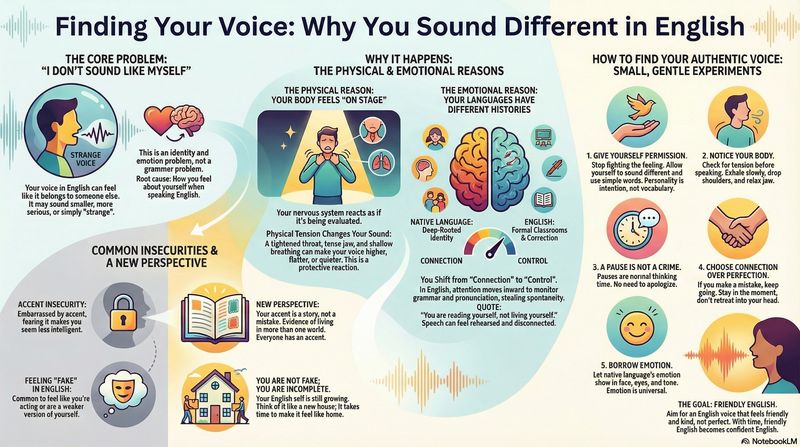
Martin: The two primary reasons a person's voice feels different in English are physical and emotional.
The physical answer relates to how the body reacts to feeling watched or evaluated, while the emotional answer relates to the memories and feelings attached to different languages.
Julia: When a speaker feels evaluated, their nervous system can react as if being judged.
This causes the throat to tighten, breathing to become shallow, and the jaw to become tense.
These small physical changes alter the sound of the voice, making it higher, flatter, or quieter.
Martin: A native language is described as having a warm "emotional color" because it is tied to childhood, jokes, secrets, and deep emotional memories.
In contrast, English for many learners has a colder, more formal color because it was often acquired later in life, in a classroom setting associated with correction and the fear of making mistakes.
Julia: "Reading yourself, not living yourself" describes the feeling of an English voice that was primarily learned through written materials and tests rather than through lived, spontaneous conversation.
This can make the speaker feel as though they are reciting from a script, lacking the natural, unplanned rhythm of their native tongue.
Martin: The shift from "connection to control" occurs when a learner's attention moves away from the person they are talking to and focuses inward.
Instead of connecting with the other person, their mental energy is spent on monitoring their own grammar, pronunciation, and word choice, which takes them out of the conversational moment.
Julia: The "inner listener" is a voice inside a speaker's head that is constantly listening to and judging their own speech.
The cost of this self-monitoring is that it steals spontaneity, humor, warmth, and natural rhythm from the conversation, making the speaker more cautious and less present.
Martin: The podcast asserts that an accent is not a mistake but a "story" and evidence that the speaker has lived in more than one world.
While learners often hear every detail of their own accent and may translate this difference as a flaw, others hear it differently.
The deeper pain is often the fear that the accent signifies a lack of intelligence or belonging.
Julia: Instead of being "fake," the podcast suggests learners are simply "incomplete" in their new language.
The "new house" analogy compares English to an empty house that initially feels unfamiliar.
Over time, as you fill it with your life, memories, and habits (photos, music, etc.), it gradually begins to feel like home.
Martin: The practical experiments include:
Julia: Noticing and softening your body's tension (dropping shoulders, relaxing the jaw).
Martin: Taking a pause without apologizing for it.
Julia: Choosing connection with the other person over grammatical perfection in a conversation.
Martin: Borrowing the emotion (not the words) from your native language, letting it show in your face and voice.
Julia: The podcast presents the idea of having "more than one you" as a form of richness, not a problem.
It is normal for a person's English self to be calmer while their native self is faster, or for their work self to be more formal.
Language is just another context, and over time, these different selves integrate and form a bridge.
Essay Questions
Martin: Instructions: The following questions are designed for deeper reflection on the podcast's central themes.
Construct a detailed essay-format response for each.
Julia: Discuss the distinction between the "physical" and "emotional" reasons for why a learner's voice changes when speaking English.
How do these two aspects interact and reinforce each other?
Martin: Analyze the concept of the "inner listener." What is its function, what are its costs, and how does it relate to the speaker's shift from "connection to control"?
Julia: The podcast states, "Your accent is not a mistake.
It's a story." Elaborate on this idea, exploring the relationship between accent insecurity, personal identity, and the fear of "not belonging."
Martin: Explain the metaphor of English as a "new house." How does this analogy address the feeling of being "fake" or "incomplete," and what does it suggest about the process of language acquisition and developing authenticity?
Julia: Outline and evaluate the practical, "human" experiments suggested by the speakers for developing a more "friendly English." How do these specific strategies address the core issues of tension, shame, and fear discussed in the episode?
Martin: Glossary of Key Terms
Line by line: one English sentence, then its Español translation —
clearly separated, each with its own lang markup.
ENStudy Guide: Understanding Your English Voice
EspañolGuía de Estudio: Entendiendo Tu Voz en Inglés
ENThis guide is designed to review the core concepts discussed in the Slow English Podcast episode about why a speaker's voice often sounds and feels different when speaking a new language like English.
EspañolEsta guía está diseñada para repasar los conceptos clave discutidos en el episodio del podcast Slow English sobre por qué la voz de un hablante a menudo suena y se siente diferente al hablar un nuevo idioma como el inglés.
ENIt explores the physical, emotional, and psychological factors behind this common experience for language learners.
EspañolExplora los factores físicos, emocionales y psicológicos detrás de esta experiencia común para los aprendices de idiomas.
ENShort-Answer Quiz
EspañolCuestionario de Respuesta Corta
ENInstructions: Answer the following questions in 2-3 complete sentences, drawing your information directly from the podcast discussion.
EspañolInstrucciones: Responde las siguientes preguntas en 2-3 oraciones completas, sacando tu información directamente de la discusión del podcast.
ENAccording to the speakers, what are the two primary types of reasons a person's voice feels different when speaking English?
EspañolSegún los hablantes, ¿cuáles son los dos tipos principales de razones por las que la voz de una persona se siente diferente al hablar inglés?
ENWhat specific physical changes occur in the body when a speaker feels evaluated, and how do these changes affect their voice?
Español¿Qué cambios físicos específicos ocurren en el cuerpo cuando un hablante se siente evaluado, y cómo afectan estos cambios su voz?
ENHow does the "emotional color" of a native language typically differ from that of English for many learners?
Español¿Cómo difiere típicamente el "color emocional" de un idioma nativo del inglés para muchos aprendices?
ENExplain the concept of "reading yourself, not living yourself" as it applies to speaking English.
EspañolExplica el concepto de "leerte a ti mismo, no vivirte a ti mismo" tal como se aplica al hablar inglés.
ENDescribe the internal shift from "connection to control" that can happen when a learner switches to speaking English.
EspañolDescribe el cambio interno de "conexión a control" que puede ocurrir cuando un aprendiz comienza a hablar inglés.
ENWhat is the "inner listener," and what is the cost of paying too much attention to it?
Español¿Qué es el "oyente interno" y cuál es el costo de prestar demasiada atención a él?
ENWhat is the podcast's perspective on a learner's accent, and how does it contrast with the learner's own perception?
Español¿Cuál es la perspectiva del podcast sobre el acento de un aprendiz y cómo contrasta con la percepción del propio aprendiz?
ENInstead of feeling "fake," the podcast suggests that learners are actually what?
EspañolEn lugar de sentirse "falso", el podcast sugiere que los aprendices son en realidad ¿qué?
ENExplain this concept using the provided "new house" analogy.
EspañolExplica este concepto utilizando la analogía de la "nueva casa" proporcionada.
ENList at least three of the practical, "human" experiments suggested to help a learner's English voice feel more familiar.
EspañolEnumera al menos tres de los experimentos prácticos y "humanos" sugeridos para ayudar a que la voz en inglés de un aprendiz se sienta más familiar.
ENHow does the podcast frame the idea of having "more than one you" in different languages or contexts?
Español¿Cómo enmarca el podcast la idea de tener "más de un tú" en diferentes idiomas o contextos?
ENAnswer Key
EspañolClave de Respuestas
ENThe two primary reasons a person's voice feels different in English are physical and emotional.
EspañolLas dos razones principales por las que la voz de una persona se siente diferente en inglés son físicas y emocionales.
ENThe physical answer relates to how the body reacts to feeling watched or evaluated, while the emotional answer relates to the memories and feelings attached to different languages.
EspañolLa respuesta física se relaciona con cómo el cuerpo reacciona al sentirse observado o evaluado, mientras que la respuesta emocional se relaciona con los recuerdos y sentimientos asociados a diferentes idiomas.
ENWhen a speaker feels evaluated, their nervous system can react as if being judged.
EspañolCuando un hablante se siente evaluado, su sistema nervioso puede reaccionar como si estuviera siendo juzgado.
ENThis causes the throat to tighten, breathing to become shallow, and the jaw to become tense.
EspañolEsto provoca que la garganta se tense, que la respiración se vuelva superficial y que la mandíbula se tense.
ENThese small physical changes alter the sound of the voice, making it higher, flatter, or quieter.
EspañolEstos pequeños cambios físicos alteran el sonido de la voz, haciéndola más alta, plana o suave.
ENA native language is described as having a warm "emotional color" because it is tied to childhood, jokes, secrets, and deep emotional memories.
EspañolUn idioma nativo se describe como teniendo un "color emocional" cálido porque está ligado a la infancia, chistes, secretos y recuerdos emocionales profundos.
ENIn contrast, English for many learners has a colder, more formal color because it was often acquired later in life, in a classroom setting associated with correction and the fear of making mistakes.
EspañolEn contraste, el inglés para muchos aprendices tiene un color más frío y formal porque a menudo se adquirió más tarde en la vida, en un entorno escolar asociado con la corrección y el miedo a cometer errores.
EN"Reading yourself, not living yourself" describes the feeling of an English voice that was primarily learned through written materials and tests rather than through lived, spontaneous conversation.
Español"Leerte a ti mismo, no vivirte a ti mismo" describe la sensación de una voz en inglés que se aprendió principalmente a través de materiales escritos y pruebas en lugar de a través de conversaciones vividas y espontáneas.
ENThis can make the speaker feel as though they are reciting from a script, lacking the natural, unplanned rhythm of their native tongue.
EspañolEsto puede hacer que el hablante sienta que está recitando de un guion, careciendo del ritmo natural y no planeado de su lengua materna.
ENThe shift from "connection to control" occurs when a learner's attention moves away from the person they are talking to and focuses inward.
EspañolEl cambio de "conexión a control" ocurre cuando la atención de un aprendiz se aleja de la persona con la que está hablando y se enfoca hacia adentro.
ENInstead of connecting with the other person, their mental energy is spent on monitoring their own grammar, pronunciation, and word choice, which takes them out of the conversational moment.
EspañolEn lugar de conectar con la otra persona, su energía mental se gasta en monitorear su propia gramática, pronunciación y elección de palabras, lo que los saca del momento conversacional.
ENThe "inner listener" is a voice inside a speaker's head that is constantly listening to and judging their own speech.
EspañolEl "oyente interno" es una voz dentro de la cabeza de un hablante que está constantemente escuchando y juzgando su propio discurso.
ENThe cost of this self-monitoring is that it steals spontaneity, humor, warmth, and natural rhythm from the conversation, making the speaker more cautious and less present.
EspañolEl costo de esta auto-monitorización es que roba espontaneidad, humor, calidez y ritmo natural de la conversación, haciendo que el hablante sea más cauteloso y menos presente.
ENThe podcast asserts that an accent is not a mistake but a "story" and evidence that the speaker has lived in more than one world.
EspañolEl podcast afirma que un acento no es un error, sino una "historia" y evidencia de que el hablante ha vivido en más de un mundo.
ENWhile learners often hear every detail of their own accent and may translate this difference as a flaw, others hear it differently.
EspañolMientras que los aprendices a menudo escuchan cada detalle de su propio acento y pueden traducir esta diferencia como un defecto, otros lo oyen de manera diferente.
ENThe deeper pain is often the fear that the accent signifies a lack of intelligence or belonging.
EspañolEl dolor más profundo suele ser el miedo a que el acento signifique una falta de inteligencia o pertenencia.
ENInstead of being "fake," the podcast suggests learners are simply "incomplete" in their new language.
EspañolEn lugar de ser "falsos", el podcast sugiere que los aprendices son simplemente "incompletos" en su nuevo idioma.
ENThe "new house" analogy compares English to an empty house that initially feels unfamiliar.
EspañolLa analogía de la "nueva casa" compara el inglés con una casa vacía que inicialmente se siente desconocida.
ENOver time, as you fill it with your life, memories, and habits (photos, music, etc.), it gradually begins to feel like home.
EspañolCon el tiempo, a medida que la llenas con tu vida, recuerdos y hábitos (fotos, música, etc.), comienza a sentirse como en casa.
ENThe practical experiments include:
EspañolLos experimentos prácticos incluyen:
ENNoticing and softening your body's tension (dropping shoulders, relaxing the jaw).
EspañolNotar y suavizar la tensión de tu cuerpo (bajar los hombros, relajar la mandíbula).
ENTaking a pause without apologizing for it.
EspañolTomar una pausa sin disculparse por ello.
ENChoosing connection with the other person over grammatical perfection in a conversation.
EspañolElegir la conexión con la otra persona sobre la perfección gramatical en una conversación.
ENBorrowing the emotion (not the words) from your native language, letting it show in your face and voice.
EspañolTomar prestada la emoción (no las palabras) de tu idioma nativo, dejándola mostrar en tu cara y voz.
ENThe podcast presents the idea of having "more than one you" as a form of richness, not a problem.
EspañolEl podcast presenta la idea de tener "más de un tú" como una forma de riqueza, no como un problema.
ENIt is normal for a person's English self to be calmer while their native self is faster, or for their work self to be more formal.
EspañolEs normal que el yo en inglés de una persona sea más calmado mientras que su yo nativo es más rápido, o que su yo en el trabajo sea más formal.
ENLanguage is just another context, and over time, these different selves integrate and form a bridge.
EspañolEl lenguaje es solo otro contexto, y con el tiempo, estos diferentes yos se integran y forman un puente.
ENEssay Questions
EspañolPreguntas de Ensayo
ENInstructions: The following questions are designed for deeper reflection on the podcast's central themes.
EspañolInstrucciones: Las siguientes preguntas están diseñadas para una reflexión más profunda sobre los temas centrales del podcast.
ENConstruct a detailed essay-format response for each.
EspañolConstruye una respuesta detallada en formato de ensayo para cada una.
ENDiscuss the distinction between the "physical" and "emotional" reasons for why a learner's voice changes when speaking English.
EspañolDiscute la distinción entre las razones "físicas" y "emocionales" por las cuales la voz de un aprendiz cambia al hablar inglés.
ENHow do these two aspects interact and reinforce each other?
Español¿Cómo interactúan y se refuerzan estos dos aspectos?
ENAnalyze the concept of the "inner listener." What is its function, what are its costs, and how does it relate to the speaker's shift from "connection to control"?
EspañolAnaliza el concepto del "oyente interno". ¿Cuál es su función, cuáles son sus costos y cómo se relaciona con el cambio del hablante de "conexión a control"?
ENThe podcast states, "Your accent is not a mistake.
EspañolEl podcast afirma: "Tu acento no es un error.
ENIt's a story." Elaborate on this idea, exploring the relationship between accent insecurity, personal identity, and the fear of "not belonging."
EspañolEs una historia." Elabora sobre esta idea, explorando la relación entre la inseguridad del acento, la identidad personal y el miedo a "no pertenecer."
ENExplain the metaphor of English as a "new house." How does this analogy address the feeling of being "fake" or "incomplete," and what does it suggest about the process of language acquisition and developing authenticity?
EspañolExplica la metáfora del inglés como una "nueva casa." ¿Cómo aborda esta analogía la sensación de ser "falso" o "incompleto," y qué sugiere sobre el proceso de adquisición del idioma y el desarrollo de la autenticidad?
ENOutline and evaluate the practical, "human" experiments suggested by the speakers for developing a more "friendly English." How do these specific strategies address the core issues of tension, shame, and fear discussed in the episode?
EspañolEsboza y evalúa los experimentos prácticos y "humanos" sugeridos por los hablantes para desarrollar un inglés más "amigable." ¿Cómo abordan estas estrategias específicas los problemas centrales de tensión, vergüenza y miedo discutidos en el episodio?
ENGlossary of Key Terms
EspañolGlosario de Términos Clave
Line by line: one English sentence, then its Deutsch translation —
clearly separated, each with its own lang markup.
ENStudy Guide: Understanding Your English Voice
DeutschStudienleitfaden: Dein englischer Stimme verstehen
ENThis guide is designed to review the core concepts discussed in the Slow English Podcast episode about why a speaker's voice often sounds and feels different when speaking a new language like English.
DeutschDieser Leitfaden ist dazu gedacht, die Kernkonzepte zu überprüfen, die in der Episode des Slow English Podcasts besprochen wurden, warum die Stimme eines Sprechers oft anders klingt und sich anders anfühlt, wenn er eine neue Sprache wie Englisch spricht.
ENIt explores the physical, emotional, and psychological factors behind this common experience for language learners.
DeutschEr untersucht die physischen, emotionalen und psychologischen Faktoren hinter dieser häufigen Erfahrung von Sprachlernern.
ENShort-Answer Quiz
DeutschKurzantwort-Quiz
ENInstructions: Answer the following questions in 2-3 complete sentences, drawing your information directly from the podcast discussion.
DeutschAnleitung: Beantworte die folgenden Fragen in 2-3 vollständigen Sätzen und ziehe deine Informationen direkt aus der Podcast-Diskussion.
ENAccording to the speakers, what are the two primary types of reasons a person's voice feels different when speaking English?
DeutschLaut den Sprechern, was sind die zwei Hauptgründe, warum sich die Stimme einer Person beim Sprechen von Englisch anders anfühlt?
ENWhat specific physical changes occur in the body when a speaker feels evaluated, and how do these changes affect their voice?
DeutschWelche spezifischen physischen Veränderungen treten im Körper auf, wenn ein Sprecher sich bewertet fühlt, und wie beeinflussen diese Veränderungen seine Stimme?
ENHow does the "emotional color" of a native language typically differ from that of English for many learners?
DeutschWie unterscheidet sich die "emotionale Farbe" einer Muttersprache typischerweise von der des Englischen für viele Lernende?
ENExplain the concept of "reading yourself, not living yourself" as it applies to speaking English.
DeutschErkläre das Konzept "sich selbst lesen, nicht sich selbst leben" im Hinblick auf das Sprechen von Englisch.
ENDescribe the internal shift from "connection to control" that can happen when a learner switches to speaking English.
DeutschBeschreibe den inneren Wechsel von "Verbindung zu Kontrolle", der auftreten kann, wenn ein Lernender zu Englisch wechselt.
ENWhat is the "inner listener," and what is the cost of paying too much attention to it?
DeutschWas ist der "innere Zuhörer" und was kostet es, ihm zu viel Aufmerksamkeit zu schenken?
ENWhat is the podcast's perspective on a learner's accent, and how does it contrast with the learner's own perception?
DeutschWie sieht der Podcast den Akzent eines Lernenden und wie steht dies im Gegensatz zur eigenen Wahrnehmung des Lernenden?
ENInstead of feeling "fake," the podcast suggests that learners are actually what?
DeutschAnstatt sich "falsch" zu fühlen, schlägt der Podcast vor, dass Lernende tatsächlich was sind?
ENExplain this concept using the provided "new house" analogy.
DeutschErkläre dieses Konzept anhand der bereitgestellten Analogie "neues Haus".
ENList at least three of the practical, "human" experiments suggested to help a learner's English voice feel more familiar.
DeutschNenne mindestens drei der praktischen, "menschlichen" Experimente, die vorgeschlagen werden, um die englische Stimme eines Lernenden vertrauter zu machen.
ENHow does the podcast frame the idea of having "more than one you" in different languages or contexts?
DeutschWie rahmt der Podcast die Idee, "mehr als ein Ich" in verschiedenen Sprachen oder Kontexten zu haben?
ENAnswer Key
DeutschAntwortschlüssel
ENThe two primary reasons a person's voice feels different in English are physical and emotional.
DeutschDie zwei Hauptgründe, warum sich die Stimme einer Person beim Sprechen von Englisch anders anfühlt, sind physisch und emotional.
ENThe physical answer relates to how the body reacts to feeling watched or evaluated, while the emotional answer relates to the memories and feelings attached to different languages.
DeutschDie physische Antwort bezieht sich darauf, wie der Körper auf das Gefühl reagiert, beobachtet oder bewertet zu werden, während die emotionale Antwort sich auf die Erinnerungen und Gefühle bezieht, die mit verschiedenen Sprachen verbunden sind.
ENWhen a speaker feels evaluated, their nervous system can react as if being judged.
DeutschWenn sich ein Sprecher bewertet fühlt, kann sein Nervensystem reagieren, als würde er beurteilt.
ENThis causes the throat to tighten, breathing to become shallow, and the jaw to become tense.
DeutschDies führt dazu, dass der Hals sich zusammenzieht, das Atmen flach wird und der Kiefer angespannt ist.
ENThese small physical changes alter the sound of the voice, making it higher, flatter, or quieter.
DeutschDiese kleinen physischen Veränderungen verändern den Klang der Stimme, wodurch sie höher, flacher oder leiser wird.
ENA native language is described as having a warm "emotional color" because it is tied to childhood, jokes, secrets, and deep emotional memories.
DeutschEine Muttersprache wird als warm in ihrer "emotionalen Farbe" beschrieben, weil sie mit Kindheit, Witzen, Geheimnissen und tiefen emotionalen Erinnerungen verbunden ist.
ENIn contrast, English for many learners has a colder, more formal color because it was often acquired later in life, in a classroom setting associated with correction and the fear of making mistakes.
DeutschIm Gegensatz dazu hat Englisch für viele Lernende eine kältere, formellere Farbe, da es oft später im Leben in einem Klassenzimmer erlernt wurde, das mit Korrektur und der Angst vor Fehlern verbunden ist.
EN"Reading yourself, not living yourself" describes the feeling of an English voice that was primarily learned through written materials and tests rather than through lived, spontaneous conversation.
Deutsch"Sich selbst lesen, nicht sich selbst leben" beschreibt das Gefühl einer englischen Stimme, die hauptsächlich durch schriftliche Materialien und Tests erlernt wurde, anstatt durch gelebte, spontane Gespräche.
ENThis can make the speaker feel as though they are reciting from a script, lacking the natural, unplanned rhythm of their native tongue.
DeutschDies kann dazu führen, dass sich der Sprecher fühlt, als würde er aus einem Skript rezitieren, und ihm der natürliche, ungeplante Rhythmus seiner Muttersprache fehlt.
ENThe shift from "connection to control" occurs when a learner's attention moves away from the person they are talking to and focuses inward.
DeutschDer Wechsel von "Verbindung zu Kontrolle" tritt auf, wenn die Aufmerksamkeit eines Lernenden von der Person, mit der er spricht, abgelenkt wird und sich nach innen richtet.
ENInstead of connecting with the other person, their mental energy is spent on monitoring their own grammar, pronunciation, and word choice, which takes them out of the conversational moment.
DeutschAnstatt sich mit der anderen Person zu verbinden, wird ihre mentale Energie darauf verwendet, ihre eigene Grammatik, Aussprache und Wortwahl zu überwachen, was sie aus dem Gesprächsmoment herausnimmt.
ENThe "inner listener" is a voice inside a speaker's head that is constantly listening to and judging their own speech.
DeutschDer "innere Zuhörer" ist eine Stimme im Kopf eines Sprechers, die ständig auf seine eigene Sprache hört und sie beurteilt.
ENThe cost of this self-monitoring is that it steals spontaneity, humor, warmth, and natural rhythm from the conversation, making the speaker more cautious and less present.
DeutschDie Kosten dieser Selbstüberwachung sind, dass sie Spontaneität, Humor, Wärme und natürlichen Rhythmus aus dem Gespräch stiehlt, wodurch der Sprecher vorsichtiger und weniger präsent wird.
ENThe podcast asserts that an accent is not a mistake but a "story" and evidence that the speaker has lived in more than one world.
DeutschDer Podcast behauptet, dass ein Akzent kein Fehler, sondern eine "Geschichte" ist und ein Beweis dafür, dass der Sprecher in mehr als einer Welt gelebt hat.
ENWhile learners often hear every detail of their own accent and may translate this difference as a flaw, others hear it differently.
DeutschWährend Lernende oft jedes Detail ihres eigenen Akzents hören und diesen Unterschied als Mangel interpretieren, hören andere es anders.
ENThe deeper pain is often the fear that the accent signifies a lack of intelligence or belonging.
DeutschDer tiefere Schmerz ist oft die Angst, dass der Akzent einen Mangel an Intelligenz oder Zugehörigkeit signalisiert.
ENInstead of being "fake," the podcast suggests learners are simply "incomplete" in their new language.
DeutschAnstatt "falsch" zu sein, schlägt der Podcast vor, dass Lernende einfach "unvollständig" in ihrer neuen Sprache sind.
ENThe "new house" analogy compares English to an empty house that initially feels unfamiliar.
DeutschDie Analogie des "neuen Hauses" vergleicht Englisch mit einem leeren Haus, das anfangs ungewohnt erscheint.
ENOver time, as you fill it with your life, memories, and habits (photos, music, etc.), it gradually begins to feel like home.
DeutschMit der Zeit, wenn du es mit deinem Leben, Erinnerungen und Gewohnheiten (Fotos, Musik usw.) füllst, beginnt es allmählich, sich wie ein Zuhause anzufühlen.
ENThe practical experiments include:
DeutschDie praktischen Experimente umfassen:
ENNoticing and softening your body's tension (dropping shoulders, relaxing the jaw).
DeutschDie Spannung deines Körpers wahrzunehmen und zu lockern (Schultern fallen lassen, Kiefer entspannen).
ENTaking a pause without apologizing for it.
DeutschEine Pause einzulegen, ohne sich dafür zu entschuldigen.
ENChoosing connection with the other person over grammatical perfection in a conversation.
DeutschDie Verbindung zur anderen Person über grammatikalische Perfektion in einem Gespräch zu wählen.
ENBorrowing the emotion (not the words) from your native language, letting it show in your face and voice.
DeutschDie Emotion (nicht die Worte) aus deiner Muttersprache zu übernehmen und sie in deinem Gesicht und deiner Stimme zeigen zu lassen.
ENThe podcast presents the idea of having "more than one you" as a form of richness, not a problem.
DeutschDer Podcast präsentiert die Idee, "mehr als ein Ich" zu haben, als eine Form von Reichtum, nicht als ein Problem.
ENIt is normal for a person's English self to be calmer while their native self is faster, or for their work self to be more formal.
DeutschEs ist normal, dass das englische Ich einer Person ruhiger ist, während ihr muttersprachliches Ich schneller ist, oder dass ihr Arbeits-Ich formeller ist.
ENLanguage is just another context, and over time, these different selves integrate and form a bridge.
DeutschSprache ist nur ein weiterer Kontext, und im Laufe der Zeit integrieren sich diese verschiedenen Ichs und bilden eine Brücke.
ENEssay Questions
DeutschEssayfragen
ENInstructions: The following questions are designed for deeper reflection on the podcast's central themes.
DeutschAnleitung: Die folgenden Fragen sind für eine tiefere Reflexion über die zentralen Themen des Podcasts gedacht.
ENConstruct a detailed essay-format response for each.
DeutschFormuliere eine detaillierte Antwort im Essay-Format für jede.
ENDiscuss the distinction between the "physical" and "emotional" reasons for why a learner's voice changes when speaking English.
DeutschDiskutiere den Unterschied zwischen den "physischen" und "emotionalen" Gründen, warum sich die Stimme eines Lernenden beim Sprechen von Englisch verändert.
ENHow do these two aspects interact and reinforce each other?
DeutschWie interagieren und verstärken sich diese beiden Aspekte?
ENAnalyze the concept of the "inner listener." What is its function, what are its costs, and how does it relate to the speaker's shift from "connection to control"?
DeutschAnalysiere das Konzept des "inneren Zuhörers." Was ist seine Funktion, was sind seine Kosten und wie steht es im Zusammenhang mit dem Wechsel des Sprechers von "Verbindung zu Kontrolle"?
ENThe podcast states, "Your accent is not a mistake.
DeutschDer Podcast sagt: "Dein Akzent ist kein Fehler.
ENIt's a story." Elaborate on this idea, exploring the relationship between accent insecurity, personal identity, and the fear of "not belonging."
DeutschEs ist eine Geschichte." Erweitere diese Idee und erkunde die Beziehung zwischen Akzentunsicherheit, persönlicher Identität und der Angst, "nicht dazuzugehören."
ENExplain the metaphor of English as a "new house." How does this analogy address the feeling of being "fake" or "incomplete," and what does it suggest about the process of language acquisition and developing authenticity?
DeutschErkläre die Metapher von Englisch als "neues Haus." Wie adressiert diese Analogie das Gefühl, "falsch" oder "unvollständig" zu sein, und was deutet sie über den Prozess des Sprachenlernens und die Entwicklung von Authentizität an?
ENOutline and evaluate the practical, "human" experiments suggested by the speakers for developing a more "friendly English." How do these specific strategies address the core issues of tension, shame, and fear discussed in the episode?
DeutschSkizziere und bewerte die praktischen, "menschlichen" Experimente, die von den Sprechern vorgeschlagen werden, um ein freundlicheres Englisch zu entwickeln. Wie sprechen diese spezifischen Strategien die Kernprobleme von Spannung, Scham und Angst an, die in der Episode diskutiert werden?
ENGlossary of Key Terms
DeutschGlossar der Schlüsselbegriffe
Line by line: one English sentence, then its فارسی translation —
clearly separated, each with its own lang markup.
ENStudy Guide: Understanding Your English Voice
فارسیراهنمای مطالعه: درک صدای انگلیسی شما
ENThis guide is designed to review the core concepts discussed in the Slow English Podcast episode about why a speaker's voice often sounds and feels different when speaking a new language like English.
فارسیاین راهنما برای مرور مفاهیم اصلی بحث شده در قسمت پادکست انگلیسی آرام درباره اینکه چرا صدای یک سخنران معمولاً هنگام صحبت کردن به یک زبان جدید مانند انگلیسی متفاوت به نظر میرسد و احساس میشود، طراحی شده است.
ENIt explores the physical, emotional, and psychological factors behind this common experience for language learners.
فارسیاین موضوع به عوامل فیزیکی، عاطفی و روانی پشت این تجربه رایج برای زبانآموزان میپردازد.
ENShort-Answer Quiz
فارسیآزمون کوتاه پاسخ
ENInstructions: Answer the following questions in 2-3 complete sentences, drawing your information directly from the podcast discussion.
فارسیدستورالعملها: به سوالات زیر در ۲-۳ جمله کامل پاسخ دهید و اطلاعات خود را مستقیماً از بحث پادکست استخراج کنید.
ENAccording to the speakers, what are the two primary types of reasons a person's voice feels different when speaking English?
فارسیبه گفته سخنرانان، دو نوع اصلی از دلایل اینکه صدای یک شخص هنگام صحبت کردن به انگلیسی متفاوت احساس میشود، چیست؟
ENWhat specific physical changes occur in the body when a speaker feels evaluated, and how do these changes affect their voice?
فارسیچه تغییرات فیزیکی خاصی در بدن رخ میدهد وقتی که یک سخنران احساس ارزیابی میکند و این تغییرات چگونه بر صدای او تأثیر میگذارد؟
ENHow does the "emotional color" of a native language typically differ from that of English for many learners?
فارسیچگونه "رنگ عاطفی" یک زبان مادری معمولاً برای بسیاری از زبانآموزان با انگلیسی متفاوت است؟
ENExplain the concept of "reading yourself, not living yourself" as it applies to speaking English.
فارسیمفهوم "خود را خواندن، نه زندگی کردن" را توضیح دهید و چگونه به صحبت کردن به انگلیسی مربوط میشود.
ENDescribe the internal shift from "connection to control" that can happen when a learner switches to speaking English.
فارسیتغییر داخلی از "ارتباط به کنترل" را توصیف کنید که میتواند هنگام تغییر به صحبت کردن به انگلیسی برای یک زبانآموز اتفاق بیفتد.
ENWhat is the "inner listener," and what is the cost of paying too much attention to it?
فارسیشنونده درونی چیست و هزینه توجه بیش از حد به آن چیست؟
ENWhat is the podcast's perspective on a learner's accent, and how does it contrast with the learner's own perception?
فارسیدیدگاه پادکست درباره لهجه یک زبانآموز چیست و چگونه با درک خود زبانآموز تضاد دارد؟
ENInstead of feeling "fake," the podcast suggests that learners are actually what?
فارسیبه جای احساس "جعلی بودن"، پادکست پیشنهاد میکند که زبانآموزان در واقع چه هستند؟
ENExplain this concept using the provided "new house" analogy.
فارسیاین مفهوم را با استفاده از تشبیه "خانه جدید" توضیح دهید.
ENList at least three of the practical, "human" experiments suggested to help a learner's English voice feel more familiar.
فارسیحداقل سه آزمایش عملی و "انسانی" که برای کمک به احساس آشنایی بیشتر صدای انگلیسی یک زبانآموز پیشنهاد شده است را فهرست کنید.
ENHow does the podcast frame the idea of having "more than one you" in different languages or contexts?
فارسیپادکست چگونه ایده داشتن "بیش از یک خود" در زبانها یا زمینههای مختلف را مطرح میکند؟
ENAnswer Key
فارسیکلید پاسخ
ENThe two primary reasons a person's voice feels different in English are physical and emotional.
فارسیدو دلیل اصلی که صدای یک شخص هنگام صحبت کردن به انگلیسی متفاوت احساس میشود، فیزیکی و عاطفی هستند.
ENThe physical answer relates to how the body reacts to feeling watched or evaluated, while the emotional answer relates to the memories and feelings attached to different languages.
فارسیپاسخ فیزیکی به نحوه واکنش بدن به احساس دیده شدن یا ارزیابی مربوط میشود، در حالی که پاسخ عاطفی به خاطرات و احساسات مرتبط با زبانهای مختلف مربوط است.
ENWhen a speaker feels evaluated, their nervous system can react as if being judged.
فارسیوقتی یک سخنران احساس ارزیابی میکند، سیستم عصبی او میتواند به گونهای واکنش نشان دهد که گویی در حال قضاوت است.
ENThis causes the throat to tighten, breathing to become shallow, and the jaw to become tense.
فارسیاین باعث میشود که گلو تنگ شود، تنفس کم عمق شود و فک منقبض شود.
ENThese small physical changes alter the sound of the voice, making it higher, flatter, or quieter.
فارسیاین تغییرات فیزیکی کوچک صدا را تغییر میدهند و آن را بالاتر، صافتر یا آرامتر میکنند.
ENA native language is described as having a warm "emotional color" because it is tied to childhood, jokes, secrets, and deep emotional memories.
فارسیزبان مادری به عنوان داشتن "رنگ عاطفی" گرم توصیف میشود زیرا به دوران کودکی، شوخیها، رازها و خاطرات عاطفی عمیق مرتبط است.
ENIn contrast, English for many learners has a colder, more formal color because it was often acquired later in life, in a classroom setting associated with correction and the fear of making mistakes.
فارسیدر مقابل، انگلیسی برای بسیاری از زبانآموزان رنگ سردتر و رسمیتری دارد زیرا معمولاً در سنین بالاتر و در محیط کلاس درس که با اصلاح و ترس از اشتباهات همراه است، یاد گرفته شده است.
EN"Reading yourself, not living yourself" describes the feeling of an English voice that was primarily learned through written materials and tests rather than through lived, spontaneous conversation.
فارسی"خود را خواندن، نه زندگی کردن" احساس صدای انگلیسی را توصیف میکند که عمدتاً از طریق مواد نوشتاری و آزمونها یاد گرفته شده است، نه از طریق مکالمات زنده و خودجوش.
ENThis can make the speaker feel as though they are reciting from a script, lacking the natural, unplanned rhythm of their native tongue.
فارسیاین میتواند باعث شود که سخنران احساس کند که از یک سناریو میخواند و ریتم طبیعی و غیرقابل پیشبینی زبان مادری خود را ندارد.
ENThe shift from "connection to control" occurs when a learner's attention moves away from the person they are talking to and focuses inward.
فارسیتغییر از "ارتباط به کنترل" زمانی اتفاق میافتد که توجه یک زبانآموز از شخصی که با او صحبت میکند دور میشود و به درون خود متمرکز میشود.
ENInstead of connecting with the other person, their mental energy is spent on monitoring their own grammar, pronunciation, and word choice, which takes them out of the conversational moment.
فارسیبه جای ارتباط با شخص دیگر، انرژی ذهنی او صرف نظارت بر گرامر، تلفظ و انتخاب کلمات خود میشود که او را از لحظه مکالمه خارج میکند.
ENThe "inner listener" is a voice inside a speaker's head that is constantly listening to and judging their own speech.
فارسیشنونده درونی صدایی در سر یک سخنران است که به طور مداوم به گفتار خود گوش میدهد و آن را قضاوت میکند.
ENThe cost of this self-monitoring is that it steals spontaneity, humor, warmth, and natural rhythm from the conversation, making the speaker more cautious and less present.
فارسیهزینه این خودنظارتی این است که خودجوشی، شوخی، گرما و ریتم طبیعی را از مکالمه میدزدد و سخنران را محتاطتر و کمتر حاضر میکند.
ENThe podcast asserts that an accent is not a mistake but a "story" and evidence that the speaker has lived in more than one world.
فارسیپادکست تأکید میکند که لهجه یک اشتباه نیست بلکه یک "داستان" و نشانهای است که سخنران در بیش از یک جهان زندگی کرده است.
ENWhile learners often hear every detail of their own accent and may translate this difference as a flaw, others hear it differently.
فارسیدر حالی که زبانآموزان معمولاً هر جزئیات لهجه خود را میشنوند و ممکن است این تفاوت را به عنوان یک نقص ترجمه کنند، دیگران آن را به گونهای متفاوت میشنوند.
ENThe deeper pain is often the fear that the accent signifies a lack of intelligence or belonging.
فارسیدرد عمیقتر معمولاً ترس از این است که لهجه نشانهای از عدم هوش یا تعلق باشد.
ENInstead of being "fake," the podcast suggests learners are simply "incomplete" in their new language.
فارسیبه جای اینکه "جعلی" باشد، پادکست پیشنهاد میکند که زبانآموزان در زبان جدید خود "ناقص" هستند.
ENThe "new house" analogy compares English to an empty house that initially feels unfamiliar.
فارسیتشبیه "خانه جدید" انگلیسی را به یک خانه خالی تشبیه میکند که در ابتدا احساس آشنایی نمیکند.
ENOver time, as you fill it with your life, memories, and habits (photos, music, etc.), it gradually begins to feel like home.
فارسیبا گذشت زمان، وقتی آن را با زندگی، خاطرات و عادات خود پر میکنید (عکسها، موسیقی و غیره)، به تدریج شروع به احساس خانه میکند.
ENThe practical experiments include:
فارسیآزمایشهای عملی شامل:
ENNoticing and softening your body's tension (dropping shoulders, relaxing the jaw).
فارسیتوجه به تنش بدن و نرم کردن آن (افتادن شانهها، آرام کردن فک).
ENTaking a pause without apologizing for it.
فارسیگرفتن یک وقفه بدون عذرخواهی برای آن.
ENChoosing connection with the other person over grammatical perfection in a conversation.
فارسیانتخاب ارتباط با شخص دیگر به جای کمال گرامری در یک مکالمه.
ENBorrowing the emotion (not the words) from your native language, letting it show in your face and voice.
فارسیقرض گرفتن احساس (نه کلمات) از زبان مادری خود و اجازه دادن به آن برای نشان دادن در چهره و صدای شما.
ENThe podcast presents the idea of having "more than one you" as a form of richness, not a problem.
فارسیپادکست ایده داشتن "بیش از یک خود" را به عنوان یک نوع غنای نه یک مشکل ارائه میدهد.
ENIt is normal for a person's English self to be calmer while their native self is faster, or for their work self to be more formal.
فارسیطبیعی است که خود انگلیسی یک شخص آرامتر باشد در حالی که خود مادری او سریعتر است، یا اینکه خود کاری او رسمیتر باشد.
ENLanguage is just another context, and over time, these different selves integrate and form a bridge.
فارسیزبان فقط یک زمینه دیگر است و با گذشت زمان، این خودهای مختلف یکپارچه میشوند و پلی را تشکیل میدهند.
ENEssay Questions
فارسیسوالات مقاله
ENInstructions: The following questions are designed for deeper reflection on the podcast's central themes.
فارسیدستورالعملها: سوالات زیر برای تأمل عمیقتر در موضوعات مرکزی پادکست طراحی شدهاند.
ENConstruct a detailed essay-format response for each.
فارسییک پاسخ مفصل به فرمت مقاله برای هر یک بسازید.
ENDiscuss the distinction between the "physical" and "emotional" reasons for why a learner's voice changes when speaking English.
فارسیتمایز بین دلایل "فیزیکی" و "عاطفی" برای اینکه صدای یک زبانآموز هنگام صحبت کردن به انگلیسی تغییر میکند را بحث کنید.
ENHow do these two aspects interact and reinforce each other?
فارسیچگونه این دو جنبه با هم تعامل و یکدیگر را تقویت میکنند؟
ENAnalyze the concept of the "inner listener." What is its function, what are its costs, and how does it relate to the speaker's shift from "connection to control"?
فارسیمفهوم "شنونده درونی" را تحلیل کنید. عملکرد آن چیست، هزینههای آن چه هستند و چگونه با تغییر سخنران از "ارتباط به کنترل" مرتبط است؟
ENThe podcast states, "Your accent is not a mistake.
فارسیپادکست بیان میکند، "لهجه شما یک اشتباه نیست.
ENIt's a story." Elaborate on this idea, exploring the relationship between accent insecurity, personal identity, and the fear of "not belonging."
فارسیاین یک داستان است." این ایده را گسترش دهید و رابطه بین عدم امنیت لهجه، هویت شخصی و ترس از "عدم تعلق" را بررسی کنید.
ENExplain the metaphor of English as a "new house." How does this analogy address the feeling of being "fake" or "incomplete," and what does it suggest about the process of language acquisition and developing authenticity?
فارسیتشبیه انگلیسی به عنوان "خانه جدید" را توضیح دهید. این تشبیه چگونه به احساس "جعلی بودن" یا "ناقص بودن" میپردازد و چه چیزی را درباره فرایند یادگیری زبان و توسعه اصالت پیشنهاد میکند؟
ENOutline and evaluate the practical, "human" experiments suggested by the speakers for developing a more "friendly English." How do these specific strategies address the core issues of tension, shame, and fear discussed in the episode?
فارسیآزمایشهای عملی و "انسانی" که توسط سخنرانان برای توسعه یک انگلیسی "دوستانهتر" پیشنهاد شدهاند را فهرست و ارزیابی کنید. این استراتژیهای خاص چگونه به مسائل اصلی تنش، شرم و ترس که در قسمت بحث شده است، میپردازند؟
ENGlossary of Key Terms
فارسیواژهنامه اصطلاحات کلیدی
Key words & phrases for Why Your English Doesnt Sound Like You, in a separate sheet for each language — with translations, usage & cultural notes, examples, and false-friend warnings shown only where they apply.
Our hand-picked, most-loved episodes — the best place to start.