ENWelcome back to the deep end of the pool.
EspañolBienvenidos de nuevo a la parte profunda de la piscina.
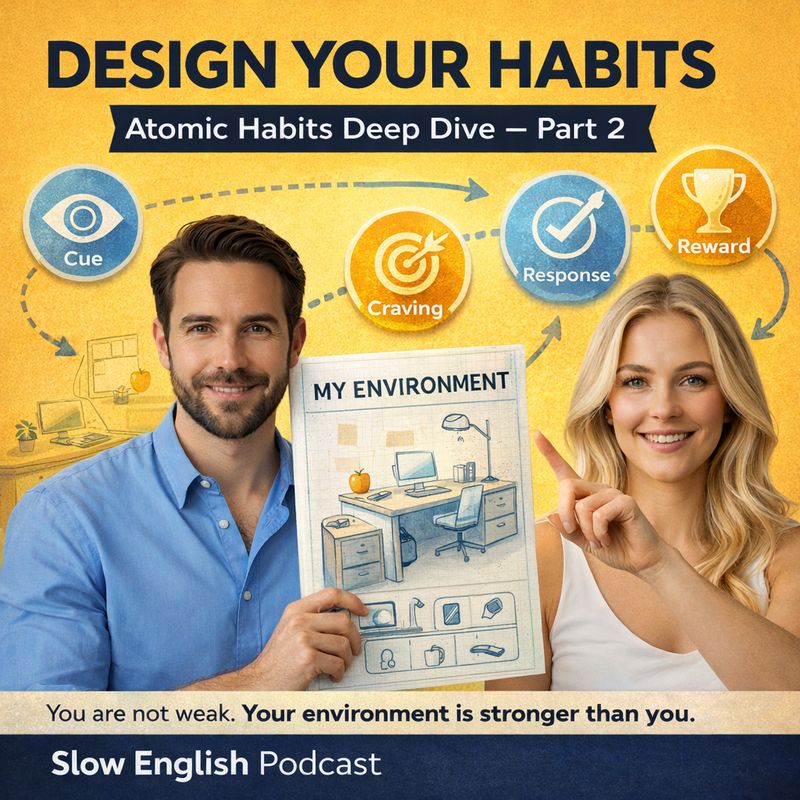
Episode 54
Welcome back to the deep end of the pool. We are back for episode two of our deep dive into atomic habits. Today we are doing something ambitious. We are covering five full chapter…
🌍 Spin the globe below to jump to a transcript in your language.
Spin the globe (hover to rotate, drag or swipe to turn it) and click a country to jump to the transcript in that language.
The full episode script in English. Real inline text, indexable by search engines.
Martin: Welcome back to the deep end of the pool.
We are back for episode two of our deep dive into atomic habits.
Today we are doing something ambitious.
We are covering five full chapters of the book in one single session.
If you sat down to read these chapters yourself, it would take you at least two hours.
And that is if you are a fast reader.
But we are going to give you the gold in just 25 minutes.
Julia: So we are saving you 90 minutes of your life.
And we are saving you the headache of translating difficult vocabulary.
That is a pretty good deal.
If you stay with us until the end, you will learn the four invisible steps that control every habit you have.
You will learn why Japanese train conductors scream at signs to save lives.
And you will discover why disciplined people are actually just lazy people with better environments.
So let's not waste
Martin: any of that time we just saved.
Let's go.
Part one.
The cat in the box.
Imagine a hungry cat inside a puzzle box.
Martin, why are we putting cats in boxes?
It is for science, Julia.
Okay, tell me about the cat.
This is a famous experiment by Edward Thorndyke.
The cat is stuck in the box, and there is food outside.
At first, the cat is angry.
It scratches the walls.
It smells the corners.
It is chaotic.
Julia: But then, by accident, the cat presses a lever.
And the door opens.
The cat escapes and eats the food.
Happy ending.
But here is the interesting part.
Thorndyke put the same cat back in the box.
Did it scratch the walls again?
No. It went straight to the lever.
It learned.
Behaviors followed by satisfying consequences tend to be repeated.
And behaviors with bad consequences are avoided.
This is how a habit is born.
In the last episode, we
Martin: learned about the 1% rule.
We learned that we are not trying to reach a goal.
We are building a system.
Today, we are going to build that system.
Part 2.
The Freedom Paradox.
Martin, many people hate the idea of habits.
They say, I want to be spontaneous.
I don't want to be a robot.
They think habits restrict their freedom.
But James Clear says this is the freedom paradox.
Actually, habits create freedom.
Think about it.
If you
Julia: have good financial habits, you have financial freedom.
If you have good health habits, you have the freedom to run and play.
And there is also mental freedom.
The conscious mind is slow and expensive.
It takes a lot of energy to think.
Habits transfer the workload to the subconscious.
The subconscious is fast and cheap.
If you don't have to think about cooking or doing laundry, you have mental space.
You have space for creativity.
So building habits is
Martin: not about being boring.
It is about automating the basics so you can enjoy the rest of your life.
Part 3.
The Loop.
Every habit follows a four-step loop.
If you understand this loop, you can control your life.
Step 1 is the cue.
This is the trigger.
It predicts a reward.
For example, seeing a coffee cup.
Step 2 is the craving.
This is the motivation.
It is the desire to change your internal state.
You are tired and
Julia: you want to feel alert.
Step 3 is the response.
This is the action you actually take.
You drink the coffee.
And step 4 is the reward.
The satisfaction.
You feel awake.
Your brain says, hey, remember this loop for next time.
The cue and the craving are the problem phase.
And the response and reward are the solution phase.
If you remove the cue, the habit never starts.
If you reduce the craving, you won't want to do it.
Martin: If the response is too hard, you won't do it.
And if the reward is bad, you won't repeat it.
This creates the four laws of behavior change.
Law 1, make it obvious.
Law 2, make it attractive.
Law 3, make it easy.
Law 4, make it satisfying.
Part 4, pointing and calling.
Today we focus on the first law, make it obvious.
The biggest problem with bad habits is that we don't see them.
We have automation blindness.
We
Julia: do things without thinking.
Let's look at the Japanese railway system.
It is one of the safest in the world.
Why?
Because the conductors do something very strange.
They point at things and scream at them.
It is called pointing and calling.
When the light is green, the conductor points at it and shouts, Signal is green.
When the train leaves, he looks at his watch and shouts, Time is 10 a.m.
This looks silly.
But it works.
It reduces
Martin: errors by 85%.
Why?
Because it raises a non-conscious habit to a conscious level.
You are using your eyes, your mouth, and your ears.
You cannot be on autopilot when you are screaming.
We can use this in our own lives.
Imagine you are about to eat a cookie.
You can say out loud, I am about to eat this cookie.
It is full of sugar and it will make me fat.
It sounds harsh.
But awareness is the first
Julia: step to change.
Sometimes, just noticing the habit is enough to stop it.
We can also use the Habit Scorecard.
This is an exercise for our listeners.
List every single thing you do in a day.
Wake up, check phone, brush teeth, make coffee.
Do not criticize yourself.
Be a scientist.
Just observe.
Label each habit as positive, negative, or neutral.
Ask the question, Does this behavior help me become the person I wish to be?
We often think we
Martin: lack motivation.
But actually, we lack awareness of what we are doing with our time.
Part 5 Implementation Intention Now that we see our habits, how do we start new ones?
Most people use vague intentions.
They say, I will eat healthier.
Or, I will study English more.
These are wishes, not plans.
They live in the fog of some time.
And some time usually means never.
Research on British voters showed something interesting.
People who wrote down exactly when
Julia: and where they would vote were much more likely to do it.
We need an implementation intention.
The formula is, I will behavior at time and location.
For example, I will study English at 7am in the kitchen.
This removes decision fatigue.
If you have to decide when to work out every day, you drain energy.
Decide once and the robot takes over.
Part 8 The Diderot Effect But we can go even further.
We can use the Diderot effect.
Martin: Denis Diderot was a French philosopher.
He was very poor, but then he bought a beautiful red robe.
He loved the robe.
But then he looked around his house.
He felt his house was too ugly for such a fancy robe.
So he bought a new rug.
Then new chairs.
Then a new mirror.
How it replaced everything.
This is the Domino effect.
One purchase leads to another.
And one habit leads to another.
We can use this for habit
Julia: stacking. You already have strong neural pathways in your brain.
Like brushing your teeth or making coffee. Habit stacking is grafting a new branch onto a strong trunk.
The formula is, after current habit, I will new habit. For example, after I pour my coffee, I will meditate for one minute.
Or, after I close the dishwasher, I will learn one English word. The after is the trigger.
Be specific. Don't say after lunch.
Say, after I put my plate
Martin: in the sink.
This creates a logical flow.
It creates momentum.
One right action flows into the next.
Part 7.
Motivation is overrated.
Martin, I have a confession.
What is it?
I feel like I don't have enough willpower.
I see cookies and I eat them.
I see my phone and I check it.
I am weak.
You are not weak, Julia.
You are just a victim of your environment.
Chapter 6 tells us that motivation is overrated.
Environment matters
Julia: more. Let's look at Anne Thorndyke.
She was a doctor in a hospital. She wanted the staff to drink more water and less soda.
Did she give them a lecture on health? No. Did she ask them to use their willpower?
No. She just changed the room. She put water bottles next to the checkout counter.
Before it was only soda. Suddenly, soda sales dropped and water sales went up.
No willpower required. This is called choice architecture.
We think
Martin: we make choices. But often the environment makes the choice for us.
Vision is our most powerful sense. We have 10 million sensory receptors in the eye.
That is why visual dominance is real. If you want to play the guitar but it is inside the closet, you will never play.
Make it obvious. Buy a stand and put the guitar in the middle of the living room.
If you want to eat apples, put them on the table. If
Julia: they are hidden in the fridge, they will rot.
If they are on the table, they get eaten.
Be the architect of your world, not the victim.
But Martin, my house is already full of bad triggers.
That is because of context association.
A habit is not associated with a single object.
It is associated with the whole space.
If you always smoke in one specific chair, the chair becomes the trigger.
If you eat, work and sleep in your
Martin: bed, your bed is confused.
Your brain doesn't know if it should be alert or asleep.
That is why you have insomnia.
You need to mix context less.
One space, one use.
Use your iPad only for reading.
If you install Instagram on it, the context is polluted.
It is easier to change habits in a new place.
Have you noticed that on vacation, it is easy to quit bad habits?
That is because the old cues are gone.
When
Julia: you are home, you are in zombie mode. You respond to old cues automatically.
So, redesign your flow. Put your gym clothes out the night before.
Put them right in front of your door. Remove the friction for good habits.
And increase friction for bad habits. If you want to stop watching TV, hide the remote.
Unplug the TV. Put it in the closet.
Make yourself work for it. This leads us to the final lesson, self-control.
We think disciplined
Martin: people are superheroes.
We think they sit in front of a cookie and say, no.
But that is a myth.
Research shows that disciplined people are just better at structuring their lives.
They spend less time in tempting situations.
They use avoidance, not resistance.
Let's talk about the Vietnam heroin study.
In the Vietnam War, 20% of American soldiers were addicted to heroin.
People were terrified about what would happen when they came home.
But once they returned to the
Julia: U.S., 90% of them stopped spontaneously. How is that possible?
Because addiction is contextual. In Vietnam, they had the stress of war.
They had the cues of the jungle. When you remove the cues, the addiction fades.
But if you put a recovering addict back in their old neighborhood, they relapse. Cue-induced wanting is powerful.
Once you see the cue, the dopamine starts flowing. It is hard to stop the machine once it starts.
So the secret is inversion. Make
Martin: it invisible. Out of sight, out of mind is scientifically true.
If you have a phone addiction, leave your phone in another room. Don't just turn it over.
Hide it. Willpower is a battery.
It drains throughout the day. Every time you say no to a temptation, you burn energy.
Eventually, the battery dies and you eat the cookie. So be lazy.
Be lazy about self-control by removing the need for it. Redesign your social circle, too.
If your friends
Julia: drink every night, you will drink.
Bad habits never truly disappear from the brain.
The neural pathways are always there.
That is why invisibility is the only long-term solution.
Martin, we talked about pointing and calling.
But why is it so hard to see our own habits?
Because of unconscious competence.
Let me tell you the story of the paramedic.
A paramedic walked into a house and saw her father-in-law.
He looked fine to everyone else.
But she looked at
Martin: him and instantly screamed, Call the ambulance.
Why?
She said, I don't like the look of his face.
A few minutes later he had a massive heart attack.
She saved his life.
But how did she know?
She couldn't explain it.
Her brain had seen thousands of heart attacks.
She recognized the pattern automatically.
This is the same with the museum curator.
He saw a statue and felt an intuitive repulsion.
He knew it was fake, but he didn't know
Julia: why. This is the danger of habits.
We become blind to what we are doing. That is why we need to point and call our mistakes.
Especially in English. When you make a mistake, don't just ignore it.
Say, I just used the wrong verb tense. Point at the mistake.
Raise it from the unconscious to the conscious. Now, let's go back to habit stacking for a second.
We missed something important. Why does stacking work biologically?
It is because
Martin: of synaptic pruning.
Your brain is like a gardener.
It strengthens connections you use often.
And it cuts away connections you don't use.
You have a superhighway in your brain for brushing teeth.
When you stack a new habit on top of it, you are not building a new road.
You are building an exit ramp off the superhighway.
You are using the energy that already exists.
So, where is the best place to put these new habits?
Use bookend
Julia: habits. Your morning and your evening are usually the same every day.
The middle of the day is chaotic. So, stack your most important habits at the bookends of your day.
Or use social stacking. Use other people as the trigger.
When my partner cooks, I will clean the dishes. The trigger is not the time.
The trigger is the other person. We also need to talk about your phone.
We said, make it invisible. But your phone is not
Martin: just a physical object. It is a digital environment.
You need to clean your digital room. If your home screen is full of social media, you will click it.
Put learning apps on the front page. Put Instagram in a folder inside a folder on the last page.
And turn off notifications. This is crucial.
A notification sound initiates a habit loop even if you don't look at it. It is the notified brain.
Just hearing the ping releases dopamine.
Julia: It creates the craving.
So, silence is golden.
Part 12, resetting the room.
Finally, there is one secret tactic for self-control.
It is called resetting the room.
Imagine you finish working.
Don't just walk away.
Clean your desk.
Place your notebook in the center of the table.
It is not just cleaning.
It is designing the flow.
OK, now we have truly covered everything.
We learned to see the invisible with pointing and calling.
We learned to use our bookends
Martin: to stack habits. We learned to prune our digital environment.
And we learned to reset the room. Motivation is good, but a designed environment is better.
Go be the architect of your life. And cast your votes for your new identity.
Thank you for listening to this deep dive. With your help, we have built the foundation.
We learned the loop. Cue, craving, response, reward.
We learned to make it obvious. Point and call your habits.
We learned to make
Julia: it invisible. And we learned to stack habits.
Your action step for today is simple. Look at your room right now.
And what cues are missing for your good habits. Be the architect.
If you enjoyed this episode, please leave a comment. Tell us one change you made to your environment.
Did you hide the remote? Did you put apples on the table?
Let us know. Thank you for listening, friends.
Line by line: one English sentence, then its Español translation —
clearly separated, each with its own lang markup.
ENWelcome back to the deep end of the pool.
EspañolBienvenidos de nuevo a la parte profunda de la piscina.
ENWe are back for episode two of our deep dive into atomic habits.
EspañolEstamos de regreso para el episodio dos de nuestra inmersión en hábitos atómicos.
ENToday we are doing something ambitious.
EspañolHoy estamos haciendo algo ambicioso.
ENWe are covering five full chapters of the book in one single session.
EspañolVamos a cubrir cinco capítulos completos del libro en una sola sesión.
ENIf you sat down to read these chapters yourself, it would take you at least two hours.
EspañolSi te sentaras a leer estos capítulos tú mismo, te llevaría al menos dos horas.
ENAnd that is if you are a fast reader.
EspañolY eso si eres un lector rápido.
ENBut we are going to give you the gold in just 25 minutes.
EspañolPero te vamos a dar lo mejor en solo 25 minutos.
ENSo we are saving you 90 minutes of your life.
EspañolAsí que te estamos ahorrando 90 minutos de tu vida.
ENAnd we are saving you the headache of translating difficult vocabulary.
EspañolY te estamos ahorrando el dolor de cabeza de traducir vocabulario difícil.
ENThat is a pretty good deal.
EspañolEso es un buen trato.
ENIf you stay with us until the end, you will learn the four invisible steps that control every habit you have.
EspañolSi te quedas con nosotros hasta el final, aprenderás los cuatro pasos invisibles que controlan cada hábito que tienes.
ENYou will learn why Japanese train conductors scream at signs to save lives.
EspañolAprenderás por qué los conductores de trenes japoneses gritan a las señales para salvar vidas.
ENAnd you will discover why disciplined people are actually just lazy people with better environments.
EspañolY descubrirás por qué las personas disciplinadas son en realidad solo personas perezosas con mejores entornos.
ENSo let's not waste
EspañolAsí que no perdamos
ENany of that time we just saved.
Españolninguno de ese tiempo que acabamos de ahorrar.
ENLet's go.
EspañolVamos.
ENPart one.
EspañolParte uno.
ENThe cat in the box.
EspañolEl gato en la caja.
ENImagine a hungry cat inside a puzzle box.
EspañolImagina un gato hambriento dentro de una caja de rompecabezas.
ENMartin, why are we putting cats in boxes?
EspañolMartín, ¿por qué estamos poniendo gatos en cajas?
ENIt is for science, Julia.
EspañolEs por ciencia, Julia.
ENOkay, tell me about the cat.
EspañolBien, cuéntame sobre el gato.
ENThis is a famous experiment by Edward Thorndyke.
EspañolEste es un experimento famoso de Edward Thorndyke.
ENThe cat is stuck in the box, and there is food outside.
EspañolEl gato está atrapado en la caja, y hay comida afuera.
ENAt first, the cat is angry.
EspañolAl principio, el gato está enojado.
ENIt scratches the walls.
EspañolAraña las paredes.
ENIt smells the corners.
EspañolHuele las esquinas.
ENIt is chaotic.
EspañolEs caótico.
ENBut then, by accident, the cat presses a lever. And the door opens.
EspañolPero luego, por accidente, el gato presiona una palanca. Y la puerta se abre.
ENThe cat escapes and eats the food. Happy ending.
EspañolEl gato escapa y come la comida. Final feliz.
ENBut here is the interesting part. Thorndyke put the same cat back in the box.
EspañolPero aquí está la parte interesante. Thorndyke volvió a poner al mismo gato en la caja. ¿Arañó las paredes otra vez?
ENDid it scratch the walls again? No. It went straight to the lever.
EspañolNo. Fue directo a la palanca.
ENIt learned. Behaviors followed by satisfying consequences tend to be repeated.
EspañolAprendió. Los comportamientos seguidos de consecuencias satisfactorias tienden a repetirse.
ENAnd behaviors with bad consequences are avoided. This is how a habit is born.
EspañolY los comportamientos con malas consecuencias se evitan. Así es como nace un hábito.
ENIn the last episode, we
EspañolEn el último episodio,
ENlearned about the 1% rule.
Españolaprendimos sobre la regla del 1%.
ENWe learned that we are not trying to reach a goal.
EspañolAprendimos que no estamos tratando de alcanzar un objetivo.
ENWe are building a system.
EspañolEstamos construyendo un sistema.
ENToday, we are going to build that system.
EspañolHoy, vamos a construir ese sistema.
ENPart 2.
EspañolParte 2.
ENThe Freedom Paradox.
EspañolLa paradoja de la libertad.
ENMartin, many people hate the idea of habits.
EspañolMartín, muchas personas odian la idea de los hábitos.
ENThey say, I want to be spontaneous.
EspañolDicen, quiero ser espontáneo.
ENI don't want to be a robot.
EspañolNo quiero ser un robot.
ENThey think habits restrict their freedom.
EspañolPiensan que los hábitos restringen su libertad.
ENBut James Clear says this is the freedom paradox.
EspañolPero James Clear dice que esta es la paradoja de la libertad.
ENActually, habits create freedom.
EspañolEn realidad, los hábitos crean libertad.
ENThink about it.
EspañolPiénsalo.
ENIf you
EspañolSi tienes
ENhave good financial habits, you have financial freedom.
Españolbuenos hábitos financieros, tienes libertad financiera.
ENIf you have good health habits, you have the freedom to run and play.
EspañolSi tienes buenos hábitos de salud, tienes la libertad de correr y jugar.
ENAnd there is also mental freedom.
EspañolY también hay libertad mental.
ENThe conscious mind is slow and expensive.
EspañolLa mente consciente es lenta y costosa.
ENIt takes a lot of energy to think.
EspañolSe necesita mucha energía para pensar.
ENHabits transfer the workload to the subconscious.
EspañolLos hábitos transfieren la carga de trabajo al subconsciente.
ENThe subconscious is fast and cheap.
EspañolEl subconsciente es rápido y barato.
ENIf you don't have to think about cooking or doing laundry, you have mental space.
EspañolSi no tienes que pensar en cocinar o hacer la colada, tienes espacio mental.
ENYou have space for creativity.
EspañolTienes espacio para la creatividad.
ENSo building habits is
EspañolAsí que construir hábitos no es
ENnot about being boring.
Españolacerca de ser aburrido.
ENIt is about automating the basics so you can enjoy the rest of your life.
EspañolSe trata de automatizar lo básico para que puedas disfrutar el resto de tu vida.
ENPart 3.
EspañolParte 3.
ENThe Loop.
EspañolEl bucle.
ENEvery habit follows a four-step loop.
EspañolCada hábito sigue un bucle de cuatro pasos.
ENIf you understand this loop, you can control your life.
EspañolSi entiendes este bucle, puedes controlar tu vida.
ENStep 1 is the cue.
EspañolEl paso 1 es la señal.
ENThis is the trigger.
EspañolEste es el desencadenante.
ENIt predicts a reward.
EspañolPredice una recompensa.
ENFor example, seeing a coffee cup.
EspañolPor ejemplo, ver una taza de café.
ENStep 2 is the craving.
EspañolEl paso 2 es el anhelo.
ENThis is the motivation.
EspañolEsta es la motivación.
ENIt is the desire to change your internal state.
EspañolEs el deseo de cambiar tu estado interno.
ENYou are tired and
EspañolEstás cansado y
ENyou want to feel alert.
Españolquieres sentirte alerta.
ENStep 3 is the response.
EspañolEl paso 3 es la respuesta.
ENThis is the action you actually take.
EspañolEsta es la acción que realmente tomas.
ENYou drink the coffee.
EspañolTomas el café.
ENAnd step 4 is the reward.
EspañolY el paso 4 es la recompensa.
ENThe satisfaction.
EspañolLa satisfacción.
ENYou feel awake.
EspañolTe sientes despierto.
ENYour brain says, hey, remember this loop for next time.
EspañolTu cerebro dice, hey, recuerda este bucle para la próxima vez.
ENThe cue and the craving are the problem phase.
EspañolLa señal y el anhelo son la fase del problema.
ENAnd the response and reward are the solution phase.
EspañolY la respuesta y la recompensa son la fase de solución.
ENIf you remove the cue, the habit never starts.
EspañolSi eliminas la señal, el hábito nunca comienza.
ENIf you reduce the craving, you won't want to do it.
EspañolSi reduces el anhelo, no querrás hacerlo.
ENIf the response is too hard, you won't do it.
EspañolSi la respuesta es demasiado difícil, no lo harás.
ENAnd if the reward is bad, you won't repeat it.
EspañolY si la recompensa es mala, no lo repetirás.
ENThis creates the four laws of behavior change. Law 1, make it obvious.
EspañolEsto crea las cuatro leyes del cambio de comportamiento. Ley 1, hazlo obvio.
ENLaw 2, make it attractive.
EspañolLey 2, hazlo atractivo.
ENLaw 3, make it easy.
EspañolLey 3, hazlo fácil.
ENLaw 4, make it satisfying.
EspañolLey 4, hazlo satisfactorio.
ENPart 4, pointing and calling.
EspañolParte 4, señalar y nombrar.
ENToday we focus on the first law, make it obvious. The biggest problem with bad habits is that we don't see them.
EspañolHoy nos centramos en la primera ley: hazlo obvio. El mayor problema con los malos hábitos es que no los vemos.
ENWe have automation blindness.
EspañolTenemos ceguera de automatización.
ENWe
EspañolHacemos
ENdo things without thinking. Let's look at the Japanese railway system.
Españolcosas sin pensar. Veamos el sistema ferroviario japonés.
ENIt is one of the safest in the world. Why?
EspañolEs uno de los más seguros del mundo. ¿Por qué?
ENBecause the conductors do something very strange. They point at things and scream at them.
EspañolPorque los conductores hacen algo muy extraño. Señalan las cosas y les gritan.
ENIt is called pointing and calling. When the light is green, the conductor points at it and shouts, Signal is green.
EspañolSe llama señalar y nombrar. Cuando el semáforo está en verde, el conductor lo señala y grita: Señal en verde.
ENWhen the train leaves, he looks at his watch and shouts, Time is 10 a.m. This looks silly.
EspañolCuando el tren parte, mira su reloj y grita: Son las 10 a.m. Parece una tontería.
ENBut it works. It reduces
EspañolPero funciona. Reduce
ENerrors by 85%. Why?
Españollos errores en un 85%. ¿Por qué?
ENBecause it raises a non-conscious habit to a conscious level. You are using your eyes, your mouth, and your ears.
EspañolPorque eleva un hábito no consciente a un nivel consciente. Estás usando tus ojos, tu boca y tus oídos.
ENYou cannot be on autopilot when you are screaming. We can use this in our own lives.
EspañolNo puedes estar en piloto automático cuando estás gritando. Podemos usar esto en nuestras propias vidas.
ENImagine you are about to eat a cookie. You can say out loud, I am about to eat this cookie.
EspañolImagina que estás a punto de comer una galleta. Puedes decir en voz alta: Estoy a punto de comer esta galleta.
ENIt is full of sugar and it will make me fat. It sounds harsh.
EspañolEstá llena de azúcar y me engordará. Suena duro.
ENBut awareness is the first
EspañolPero la conciencia es el primer
ENstep to change. Sometimes, just noticing the habit is enough to stop it.
Españolpaso hacia el cambio. A veces, solo notar el hábito es suficiente para detenerlo.
ENWe can also use the Habit Scorecard. This is an exercise for our listeners.
EspañolTambién podemos usar la Tarjeta de Puntuación de Hábitos. Este es un ejercicio para nuestros oyentes.
ENList every single thing you do in a day. Wake up, check phone, brush teeth, make coffee.
EspañolEnumera cada cosa que haces en un día. Despertar, revisar el teléfono, cepillarse los dientes, hacer café.
ENDo not criticize yourself. Be a scientist.
EspañolNo te critiques. Sé un científico.
ENJust observe. Label each habit as positive, negative, or neutral.
EspañolSolo observa. Etiqueta cada hábito como positivo, negativo o neutro.
ENAsk the question, Does this behavior help me become the person I wish to be? We often think we
EspañolHazte la pregunta: ¿Este comportamiento me ayuda a convertirme en la persona que deseo ser? A menudo pensamos que
ENlack motivation. But actually, we lack awareness of what we are doing with our time.
Españolnos falta motivación. Pero en realidad, nos falta conciencia de lo que hacemos con nuestro tiempo.
ENPart 5 Implementation Intention Now that we see our habits, how do we start new ones? Most people use vague intentions.
EspañolParte 5 Intención de Implementación Ahora que vemos nuestros hábitos, ¿cómo empezamos nuevos? La mayoría de las personas usa intenciones vagas.
ENThey say, I will eat healthier. Or, I will study English more.
EspañolDicen: Comeré más sano. O: Estudiaré más inglés.
ENThese are wishes, not plans. They live in the fog of some time.
EspañolEstos son deseos, no planes. Viven en la niebla de algún momento.
ENAnd some time usually means never. Research on British voters showed something interesting.
EspañolY algún momento generalmente significa nunca. Una investigación sobre votantes británicos mostró algo interesante.
ENPeople who wrote down exactly when
EspañolLas personas que anotaron exactamente cuándo
ENand where they would vote were much more likely to do it.
Españoly dónde votarían tenían muchas más probabilidades de hacerlo.
ENWe need an implementation intention.
EspañolNecesitamos una intención de implementación.
ENThe formula is, I will behavior at time and location.
EspañolLa fórmula es: Haré conducta en el momento y lugar.
ENFor example, I will study English at 7am in the kitchen.
EspañolPor ejemplo: Estudiaré inglés a las 7 a.m. en la cocina.
ENThis removes decision fatigue.
EspañolEsto elimina la fatiga de decisión.
ENIf you have to decide when to work out every day, you drain energy.
EspañolSi tienes que decidir cuándo hacer ejercicio todos los días, gastas energía.
ENDecide once and the robot takes over.
EspañolDecide una vez y el robot toma el control.
ENPart 8 The Diderot Effect But we can go even further.
EspañolParte 8 El Efecto Diderot Pero podemos ir incluso más lejos.
ENWe can use the Diderot effect.
EspañolPodemos usar el efecto Diderot.
ENDenis Diderot was a French philosopher. He was very poor, but then he bought a beautiful red robe.
EspañolDenis Diderot fue un filósofo francés. Era muy pobre, pero luego compró una hermosa bata roja.
ENHe loved the robe. But then he looked around his house.
EspañolAmaba la bata. Pero luego miró alrededor de su casa.
ENHe felt his house was too ugly for such a fancy robe. So he bought a new rug.
EspañolSintió que su casa era demasiado fea para una bata tan elegante. Así que compró una nueva alfombra.
ENThen new chairs. Then a new mirror.
EspañolLuego nuevas sillas. Luego un nuevo espejo.
ENHow it replaced everything. This is the Domino effect.
EspañolAsí reemplazó todo. Esto es el efecto dominó.
ENOne purchase leads to another. And one habit leads to another.
EspañolUna compra lleva a otra. Y un hábito lleva a otro.
ENWe can use this for habit
EspañolPodemos usar esto para apilar
ENstacking. You already have strong neural pathways in your brain.
Españolhábitos. Ya tienes fuertes vías neuronales en tu cerebro.
ENLike brushing your teeth or making coffee. Habit stacking is grafting a new branch onto a strong trunk.
EspañolComo cepillarte los dientes o hacer café. Apilar hábitos es injertar una nueva rama en un tronco fuerte.
ENThe formula is, after current habit, I will new habit. For example, after I pour my coffee, I will meditate for one minute.
EspañolLa fórmula es: después del hábito actual, haré el nuevo hábito. Por ejemplo, después de servirme el café, meditaré durante un minuto.
ENOr, after I close the dishwasher, I will learn one English word. The after is the trigger.
EspañolO, después de cerrar el lavavajillas, aprenderé una palabra en inglés. El "después" es el desencadenante.
ENBe specific. Don't say after lunch.
EspañolSé específico. No digas después del almuerzo.
ENSay, after I put my plate
EspañolDi, después de poner mi plato
ENin the sink. This creates a logical flow.
Españolen el fregadero. Esto crea un flujo lógico.
ENIt creates momentum. One right action flows into the next.
EspañolCrea impulso. Una acción correcta fluye hacia la siguiente.
ENPart 7. Motivation is overrated.
EspañolParte 7. La motivación está sobrevalorada.
ENMartin, I have a confession. What is it?
EspañolMartín, tengo una confesión. ¿Cuál es?
ENI feel like I don't have enough willpower. I see cookies and I eat them.
EspañolSiento que no tengo suficiente fuerza de voluntad. Veo galletas y me las como.
ENI see my phone and I check it. I am weak.
EspañolVeo mi teléfono y lo reviso. Soy débil.
ENYou are not weak, Julia. You are just a victim of your environment.
EspañolNo eres débil, Julia. Solo eres víctima de tu entorno.
ENChapter 6 tells us that motivation is overrated. Environment matters
EspañolEl capítulo 6 nos dice que la motivación está sobrevalorada. El entorno importa
ENmore. Let's look at Anne Thorndyke.
Españolmás. Veamos a Anne Thorndyke.
ENShe was a doctor in a hospital. She wanted the staff to drink more water and less soda.
EspañolEra médica en un hospital. Quería que el personal bebiera más agua y menos refresco.
ENDid she give them a lecture on health? No. Did she ask them to use their willpower?
Español¿Les dio una charla sobre salud? No. ¿Les pidió que usaran su fuerza de voluntad?
ENNo. She just changed the room. She put water bottles next to the checkout counter.
EspañolNo. Simplemente cambió la sala. Puso botellas de agua junto al mostrador de caja.
ENBefore it was only soda. Suddenly, soda sales dropped and water sales went up.
EspañolAntes solo había refrescos. De repente, las ventas de refrescos cayeron y las de agua subieron.
ENNo willpower required. This is called choice architecture.
EspañolNo se requiere fuerza de voluntad. Esto se llama arquitectura de elección.
ENWe think
EspañolPensamos
ENwe make choices.
Españolque tomamos decisiones.
ENBut often the environment makes the choice for us.
EspañolPero a menudo el entorno toma la decisión por nosotros.
ENVision is our most powerful sense.
EspañolLa visión es nuestro sentido más poderoso.
ENWe have 10 million sensory receptors in the eye.
EspañolTenemos 10 millones de receptores sensoriales en el ojo.
ENThat is why visual dominance is real.
EspañolPor eso la dominancia visual es real.
ENIf you want to play the guitar but it is inside the closet, you will never play.
EspañolSi quieres tocar la guitarra pero está dentro del armario, nunca tocarás.
ENMake it obvious.
EspañolHazlo obvio.
ENBuy a stand and put the guitar in the middle of the living room.
EspañolCompra un soporte y pon la guitarra en el centro del salón.
ENIf you want to eat apples, put them on the table.
EspañolSi quieres comer manzanas, ponlas en la mesa.
ENIf
EspañolSi
ENthey are hidden in the fridge, they will rot. If they are on the table, they get eaten.
Españolestán escondidas en la nevera, se pudrirán. Si están en la mesa, te las comerás.
ENBe the architect of your world, not the victim. But Martin, my house is already full of bad triggers.
EspañolSé el arquitecto de tu mundo, no la víctima. Pero Martín, mi casa ya está llena de malos desencadenantes.
ENThat is because of context association. A habit is not associated with a single object.
EspañolEso se debe a la asociación de contexto. Un hábito no está asociado con un solo objeto.
ENIt is associated with the whole space. If you always smoke in one specific chair, the chair becomes the trigger.
EspañolEstá asociado con todo el espacio. Si siempre fumas en una silla específica, la silla se convierte en el desencadenante.
ENIf you eat, work and sleep in your
EspañolSi comes, trabajas y duermes en tu
ENbed, your bed is confused. Your brain doesn't know if it should be alert or asleep.
Españolcama, tu cama está confundida. Tu cerebro no sabe si debe estar alerta o dormido.
ENThat is why you have insomnia. You need to mix context less.
EspañolPor eso tienes insomnio. Necesitas mezclar menos el contexto.
ENOne space, one use. Use your iPad only for reading.
EspañolUn espacio, un uso. Usa tu iPad solo para leer.
ENIf you install Instagram on it, the context is polluted. It is easier to change habits in a new place.
EspañolSi instalas Instagram en él, el contexto queda contaminado. Es más fácil cambiar hábitos en un lugar nuevo.
ENHave you noticed that on vacation, it is easy to quit bad habits? That is because the old cues are gone.
Español¿Has notado que de vacaciones es fácil dejar los malos hábitos? Es porque las antiguas señales han desaparecido.
ENWhen
EspañolCuando
ENyou are home, you are in zombie mode. You respond to old cues automatically.
Españolestás en casa, estás en modo zombi. Respondes automáticamente a las señales antiguas.
ENSo, redesign your flow. Put your gym clothes out the night before.
EspañolAsí que rediseña tu flujo. Saca tu ropa de gimnasio la noche anterior.
ENPut them right in front of your door. Remove the friction for good habits.
EspañolPonla justo delante de tu puerta. Elimina la fricción para los buenos hábitos.
ENAnd increase friction for bad habits. If you want to stop watching TV, hide the remote.
EspañolY aumenta la fricción para los malos hábitos. Si quieres dejar de ver televisión, esconde el mando.
ENUnplug the TV. Put it in the closet.
EspañolDesenchufa el televisor. Ponlo en el armario.
ENMake yourself work for it. This leads us to the final lesson, self-control.
EspañolHaz que tengas que esforzarte por ello. Esto nos lleva a la última lección: el autocontrol.
ENWe think disciplined
EspañolPensamos que las personas disciplinadas
ENpeople are superheroes. We think they sit in front of a cookie and say, no.
Españolson superhéroes. Pensamos que se sientan frente a una galleta y dicen: no.
ENBut that is a myth. Research shows that disciplined people are just better at structuring their lives.
EspañolPero eso es un mito. Las investigaciones muestran que las personas disciplinadas simplemente son mejores estructurando sus vidas.
ENThey spend less time in tempting situations. They use avoidance, not resistance.
EspañolPasan menos tiempo en situaciones tentadoras. Usan la evitación, no la resistencia.
ENLet's talk about the Vietnam heroin study. In the Vietnam War, 20% of American soldiers were addicted to heroin.
EspañolHablemos del estudio de heroína de Vietnam. En la Guerra de Vietnam, el 20% de los soldados americanos era adicto a la heroína.
ENPeople were terrified about what would happen when they came home. But once they returned to the
EspañolLa gente estaba aterrorizada por lo que pasaría cuando volvieran a casa. Pero una vez que regresaron a los
ENU.S., 90% of them stopped spontaneously.
EspañolEE. UU., el 90% de ellos lo dejó espontáneamente.
ENHow is that possible?
Español¿Cómo es eso posible?
ENBecause addiction is contextual. In Vietnam, they had the stress of war.
EspañolPorque la adicción es contextual. En Vietnam, tenían el estrés de la guerra.
ENThey had the cues of the jungle. When you remove the cues, the addiction fades.
EspañolTenían las señales de la selva. Cuando eliminas las señales, la adicción se desvanece.
ENBut if you put a recovering addict back in their old neighborhood, they relapse.
EspañolPero si llevas a un adicto en recuperación de vuelta a su antiguo barrio, recae.
ENCue-induced wanting is powerful.
EspañolEl deseo inducido por señales es poderoso.
ENOnce you see the cue, the dopamine starts flowing.
EspañolEn cuanto ves la señal, la dopamina empieza a fluir.
ENIt is hard to stop the machine once it starts.
EspañolEs difícil detener la máquina una vez que empieza.
ENSo the secret is inversion. Make
EspañolAsí que el secreto es la inversión. Hazlo
ENit invisible. Out of sight, out of mind is scientifically true.
Españolinvisible. Ojos que no ven, corazón que no siente es científicamente verdad.
ENIf you have a phone addiction, leave your phone in another room. Don't just turn it over.
EspañolSi tienes adicción al teléfono, déjalo en otra habitación. No lo voltees simplemente.
ENHide it. Willpower is a battery.
EspañolEscóndelo. La fuerza de voluntad es una batería.
ENIt drains throughout the day. Every time you say no to a temptation, you burn energy.
EspañolSe agota a lo largo del día. Cada vez que dices no a una tentación, quemas energía.
ENEventually, the battery dies and you eat the cookie. So be lazy.
EspañolAl final, la batería se agota y te comes la galleta. Así que sé perezoso.
ENBe lazy about self-control by removing the need for it. Redesign your social circle, too.
EspañolSé perezoso con el autocontrol eliminando la necesidad de él. Rediseña también tu círculo social.
ENIf your friends
EspañolSi tus amigos
ENdrink every night, you will drink.
Españolbeben todas las noches, tú beberás.
ENBad habits never truly disappear from the brain.
EspañolLos malos hábitos nunca desaparecen realmente del cerebro.
ENThe neural pathways are always there.
EspañolLas vías neuronales siempre están ahí.
ENThat is why invisibility is the only long-term solution.
EspañolPor eso la invisibilidad es la única solución a largo plazo.
ENMartin, we talked about pointing and calling. But why is it so hard to see our own habits?
EspañolMartín, hablamos de señalar y nombrar. Pero ¿por qué es tan difícil ver nuestros propios hábitos?
ENBecause of unconscious competence.
EspañolPor la competencia inconsciente.
ENLet me tell you the story of the paramedic.
EspañolDéjame contarte la historia de la paramédica.
ENA paramedic walked into a house and saw her father-in-law.
EspañolUna paramédica entró en una casa y vio a su suegro.
ENHe looked fine to everyone else.
EspañolParecía estar bien para todos los demás.
ENBut she looked at
EspañolPero ella lo miró
ENhim and instantly screamed, Call the ambulance. Why?
Españoly gritó de inmediato: Llama a la ambulancia. ¿Por qué?
ENShe said, I don't like the look of his face. A few minutes later he had a massive heart attack.
EspañolElla dijo: No me gusta el aspecto de su cara. Pocos minutos después tuvo un infarto masivo.
ENShe saved his life. But how did she know?
EspañolSalvó su vida. ¿Pero cómo lo supo?
ENShe couldn't explain it. Her brain had seen thousands of heart attacks.
EspañolNo podía explicarlo. Su cerebro había visto miles de infartos.
ENShe recognized the pattern automatically. This is the same with the museum curator.
EspañolReconoció el patrón automáticamente. Lo mismo ocurre con el curador del museo.
ENHe saw a statue and felt an intuitive repulsion. He knew it was fake, but he didn't know
EspañolVio una estatua y sintió un rechazo intuitivo. Sabía que era falsa, pero no sabía
ENwhy. This is the danger of habits.
Españolpor qué. Este es el peligro de los hábitos.
ENWe become blind to what we are doing. That is why we need to point and call our mistakes.
EspañolNos volvemos ciegos a lo que hacemos. Por eso necesitamos señalar y nombrar nuestros errores.
ENEspecially in English. When you make a mistake, don't just ignore it.
EspañolEspecialmente en inglés. Cuando cometes un error, no lo ignores simplemente.
ENSay, I just used the wrong verb tense. Point at the mistake.
EspañolDi: Acabo de usar el tiempo verbal incorrecto. Señala el error.
ENRaise it from the unconscious to the conscious. Now, let's go back to habit stacking for a second.
EspañolElévalo de lo inconsciente a lo consciente. Ahora volvamos al apilamiento de hábitos por un segundo.
ENWe missed something important. Why does stacking work biologically?
EspañolNos perdimos algo importante. ¿Por qué funciona el apilamiento biológicamente?
ENIt is because
EspañolEs por
ENof synaptic pruning. Your brain is like a gardener.
Españolla poda sináptica. Tu cerebro es como un jardinero.
ENIt strengthens connections you use often. And it cuts away connections you don't use.
EspañolFortalece las conexiones que usas a menudo. Y corta las conexiones que no usas.
ENYou have a superhighway in your brain for brushing teeth. When you stack a new habit on top of it, you are not building a new road.
EspañolTienes una autopista en tu cerebro para cepillarte los dientes. Cuando apilas un nuevo hábito encima, no estás construyendo una nueva carretera.
ENYou are building an exit ramp off the superhighway. You are using the energy that already exists.
EspañolEstás construyendo una salida de la autopista. Estás usando la energía que ya existe.
ENSo, where is the best place to put these new habits? Use bookend
EspañolEntonces, ¿cuál es el mejor lugar para poner estos nuevos hábitos? Usa hábitos de
ENhabits. Your morning and your evening are usually the same every day.
Españolmarcador. Tu mañana y tu tarde son generalmente iguales cada día.
ENThe middle of the day is chaotic. So, stack your most important habits at the bookends of your day.
EspañolEl mediodía es caótico. Así que apila tus hábitos más importantes en los extremos de tu día.
ENOr use social stacking. Use other people as the trigger.
EspañolO usa el apilamiento social. Usa a otras personas como desencadenante.
ENWhen my partner cooks, I will clean the dishes. The trigger is not the time.
EspañolCuando mi pareja cocine, lavaré los platos. El desencadenante no es el tiempo.
ENThe trigger is the other person. We also need to talk about your phone.
EspañolEl desencadenante es la otra persona. También necesitamos hablar de tu teléfono.
ENWe said, make it invisible. But your phone is not
EspañolDijimos: hazlo invisible. Pero tu teléfono no es
ENjust a physical object.
Españolsolo un objeto físico.
ENIt is a digital environment.
EspañolEs un entorno digital.
ENYou need to clean your digital room.
EspañolNecesitas limpiar tu habitación digital.
ENIf your home screen is full of social media, you will click it.
EspañolSi tu pantalla de inicio está llena de redes sociales, harás clic en ellas.
ENPut learning apps on the front page.
EspañolPon las aplicaciones de aprendizaje en la página principal.
ENPut Instagram in a folder inside a folder on the last page.
EspañolPon Instagram dentro de una carpeta, dentro de otra carpeta, en la última página.
ENAnd turn off notifications.
EspañolY desactiva las notificaciones.
ENThis is crucial.
EspañolEsto es fundamental.
ENA notification sound initiates a habit loop even if you don't look at it.
EspañolEl sonido de una notificación inicia un bucle de hábito aunque no la mires.
ENIt is the notified brain.
EspañolEs el cerebro notificado.
ENJust hearing the ping releases dopamine.
EspañolSolo escuchar el ping libera dopamina.
ENIt creates the craving. So, silence is golden.
EspañolCrea el deseo. Así que el silencio es oro.
ENPart 12, resetting the room. Finally, there is one secret tactic for self-control.
EspañolParte 12, reiniciar la habitación. Por último, hay una táctica secreta para el autocontrol: se llama reiniciar la habitación.
ENIt is called resetting the room. Imagine you finish working.
EspañolImagina que terminas de trabajar. No te vayas sin más.
ENDon't just walk away. Clean your desk.
EspañolLimpia tu escritorio.
ENPlace your notebook in the center of the table. It is not just cleaning.
EspañolColoca tu cuaderno en el centro de la mesa. No es solo limpieza.
ENIt is designing the flow. OK, now we have truly covered everything.
EspañolEs diseñar el flujo. Bien, ahora sí hemos cubierto todo.
ENWe learned to see the invisible with pointing and calling. We learned to use our bookends
EspañolAprendimos a ver lo invisible señalando y nombrando. Aprendimos a usar nuestros libretos
ENto stack habits. We learned to prune our digital environment.
Españolpara apilar hábitos. Aprendimos a podar nuestro entorno digital.
ENAnd we learned to reset the room. Motivation is good, but a designed environment is better.
EspañolY aprendimos a reiniciar la habitación. La motivación es buena, pero un entorno diseñado es mejor.
ENGo be the architect of your life. And cast your votes for your new identity.
EspañolVe y sé el arquitecto de tu vida. Y emite tus votos por tu nueva identidad.
ENThank you for listening to this deep dive. With your help, we have built the foundation.
EspañolGracias por escuchar esta inmersión profunda.
ENWe learned the loop. Cue, craving, response, reward.
EspañolCon tu ayuda, hemos construido los cimientos. Aprendimos el bucle: señal, deseo, respuesta, recompensa.
ENWe learned to make it obvious. Point and call your habits.
EspañolAprendimos a hacerlo obvio. Señala y nombra tus hábitos.
ENWe learned to make
EspañolAprendimos a hacerlo
ENit invisible. And we learned to stack habits.
Españolinvisible.
ENYour action step for today is simple. Look at your room right now.
EspañolY aprendimos a apilar hábitos. Tu acción de hoy es sencilla: mira tu habitación ahora mismo. ¿Qué señales faltan para tus buenos hábitos?
ENAnd what cues are missing for your good habits. Be the architect.
EspañolSé el arquitecto.
ENIf you enjoyed this episode, please leave a comment. Tell us one change you made to your environment.
EspañolSi disfrutaste de este episodio, por favor deja un comentario.
ENDid you hide the remote? Did you put apples on the table?
EspañolCuéntanos qué cambio hiciste en tu entorno. ¿Escondiste el mando a distancia? ¿Pusiste manzanas en la mesa? Haznos saber.
ENLet us know. Thank you for listening, friends.
EspañolGracias por escucharnos, amigos.
Line by line: one English sentence, then its Deutsch translation —
clearly separated, each with its own lang markup.
ENWelcome back to the deep end of the pool.
DeutschWillkommen zurück im tiefen Ende des Schwimmbeckens.
ENWe are back for episode two of our deep dive into atomic habits.
DeutschWir sind zurück für die zweite Episode unseres tiefen Eintauchens in atomare Gewohnheiten.
ENToday we are doing something ambitious.
DeutschHeute machen wir etwas Ambitioniertes.
ENWe are covering five full chapters of the book in one single session.
DeutschWir behandeln fünf ganze Kapitel des Buches in einer einzigen Sitzung.
ENIf you sat down to read these chapters yourself, it would take you at least two hours.
DeutschWenn du dich hinsetzt, um diese Kapitel selbst zu lesen, würde es mindestens zwei Stunden dauern.
ENAnd that is if you are a fast reader.
DeutschUnd das ist, wenn du ein schneller Leser bist.
ENBut we are going to give you the gold in just 25 minutes.
DeutschAber wir werden dir das Gold in nur 25 Minuten geben.
ENSo we are saving you 90 minutes of your life.
DeutschWir sparen dir also 90 Minuten deines Lebens.
ENAnd we are saving you the headache of translating difficult vocabulary.
DeutschUnd wir ersparen dir den Kopfzerbrechen, schwierige Vokabeln zu übersetzen.
ENThat is a pretty good deal.
DeutschDas ist ein ziemlich gutes Angebot.
ENIf you stay with us until the end, you will learn the four invisible steps that control every habit you have.
DeutschWenn du bis zum Ende bei uns bleibst, wirst du die vier unsichtbaren Schritte lernen, die jede Gewohnheit, die du hast, kontrollieren.
ENYou will learn why Japanese train conductors scream at signs to save lives.
DeutschDu wirst lernen, warum japanische Zugführer an Schilder schreien, um Leben zu retten.
ENAnd you will discover why disciplined people are actually just lazy people with better environments.
DeutschUnd du wirst entdecken, warum disziplinierte Menschen eigentlich nur faule Menschen mit besseren Umgebungen sind.
ENSo let's not waste
DeutschAlso lass uns keine Zeit verschwenden.
ENany of that time we just saved. Let's go.
DeutschLass uns gehen. Teil eins.
ENPart one. The cat in the box.
DeutschDie Katze in der Box. Stell dir eine hungrige Katze in einer Puzzlebox vor.
ENImagine a hungry cat inside a puzzle box. Martin, why are we putting cats in boxes?
DeutschMartin, warum stecken wir Katzen in Boxen? Es ist für die Wissenschaft, Julia.
ENIt is for science, Julia. Okay, tell me about the cat.
DeutschOkay, erzähl mir von der Katze.
ENThis is a famous experiment by Edward Thorndyke. The cat is stuck in the box, and there is food outside.
DeutschDas ist ein berühmtes Experiment von Edward Thorndyke. Die Katze ist in der Box gefangen, und draußen ist Futter.
ENAt first, the cat is angry. It scratches the walls.
DeutschZuerst ist die Katze wütend. Sie kratzt an den Wänden.
ENIt smells the corners. It is chaotic.
DeutschSie schnüffelt in die Ecken. Es ist chaotisch.
ENBut then, by accident, the cat presses a lever. And the door opens.
DeutschAber dann drückt die Katze zufällig einen Hebel. Und die Tür öffnet sich.
ENThe cat escapes and eats the food. Happy ending.
DeutschDie Katze entkommt und frisst das Futter. Happy End.
ENBut here is the interesting part. Thorndyke put the same cat back in the box.
DeutschAber hier ist der interessante Teil. Thorndyke setzte die gleiche Katze wieder in die Box.
ENDid it scratch the walls again? No. It went straight to the lever.
DeutschHat sie wieder an den Wänden gekratzt? Nein. Sie ging direkt zum Hebel.
ENIt learned. Behaviors followed by satisfying consequences tend to be repeated.
DeutschSie hat gelernt. Verhalten, das mit befriedigenden Konsequenzen gefolgt wird, wird tendenziell wiederholt.
ENAnd behaviors with bad consequences are avoided. This is how a habit is born.
DeutschUnd Verhalten mit schlechten Konsequenzen wird vermieden. So entsteht eine Gewohnheit.
ENIn the last episode, we
DeutschIn der letzten Episode haben wir
ENlearned about the 1% rule.
Deutschüber die 1%-Regel gelernt.
ENWe learned that we are not trying to reach a goal.
DeutschWir haben gelernt, dass wir nicht versuchen, ein Ziel zu erreichen.
ENWe are building a system.
DeutschWir bauen ein System auf.
ENToday, we are going to build that system.
DeutschHeute werden wir dieses System aufbauen.
ENPart 2.
DeutschTeil 2.
ENThe Freedom Paradox.
DeutschDas Freiheit-Paradoxon.
ENMartin, many people hate the idea of habits.
DeutschMartin, viele Menschen hassen die Idee von Gewohnheiten.
ENThey say, I want to be spontaneous.
DeutschSie sagen, ich möchte spontan sein.
ENI don't want to be a robot.
DeutschIch möchte kein Roboter sein.
ENThey think habits restrict their freedom.
DeutschSie denken, Gewohnheiten schränken ihre Freiheit ein.
ENBut James Clear says this is the freedom paradox.
DeutschAber James Clear sagt, das ist das Freiheit-Paradoxon.
ENActually, habits create freedom.
DeutschTatsächlich schaffen Gewohnheiten Freiheit.
ENThink about it.
DeutschDenk darüber nach.
ENIf you
DeutschWenn du
ENhave good financial habits, you have financial freedom.
Deutschgute finanzielle Gewohnheiten hast, hast du finanzielle Freiheit.
ENIf you have good health habits, you have the freedom to run and play.
DeutschWenn du gute Gesundheitsgewohnheiten hast, hast du die Freiheit, zu rennen und zu spielen.
ENAnd there is also mental freedom.
DeutschUnd es gibt auch mentale Freiheit.
ENThe conscious mind is slow and expensive.
DeutschDer bewusste Verstand ist langsam und teuer.
ENIt takes a lot of energy to think.
DeutschEs kostet viel Energie, nachzudenken.
ENHabits transfer the workload to the subconscious.
DeutschGewohnheiten übertragen die Arbeitslast auf das Unterbewusstsein.
ENThe subconscious is fast and cheap.
DeutschDas Unterbewusstsein ist schnell und günstig.
ENIf you don't have to think about cooking or doing laundry, you have mental space.
DeutschWenn du nicht über das Kochen oder Wäschewaschen nachdenken musst, hast du mentalen Raum.
ENYou have space for creativity.
DeutschDu hast Raum für Kreativität.
ENSo building habits is
DeutschAlso geht es beim Aufbau von Gewohnheiten
ENnot about being boring.
Deutschnicht darum, langweilig zu sein.
ENIt is about automating the basics so you can enjoy the rest of your life.
DeutschEs geht darum, die Grundlagen zu automatisieren, damit du den Rest deines Lebens genießen kannst.
ENPart 3.
DeutschTeil 3.
ENThe Loop.
DeutschDer Loop.
ENEvery habit follows a four-step loop.
DeutschJede Gewohnheit folgt einem vierstufigen Loop.
ENIf you understand this loop, you can control your life.
DeutschWenn du diesen Loop verstehst, kannst du dein Leben kontrollieren.
ENStep 1 is the cue.
DeutschSchritt 1 ist der Hinweis.
ENThis is the trigger.
DeutschDas ist der Auslöser.
ENIt predicts a reward.
DeutschEr sagt eine Belohnung voraus.
ENFor example, seeing a coffee cup.
DeutschZum Beispiel, einen Kaffeebecher sehen.
ENStep 2 is the craving.
DeutschSchritt 2 ist das Verlangen.
ENThis is the motivation.
DeutschDas ist die Motivation.
ENIt is the desire to change your internal state.
DeutschEs ist der Wunsch, deinen inneren Zustand zu ändern.
ENYou are tired and
DeutschDu bist müde und
ENyou want to feel alert.
Deutschdu möchtest wachsam sein.
ENStep 3 is the response.
DeutschSchritt 3 ist die Reaktion.
ENThis is the action you actually take.
DeutschDas ist die Handlung, die du tatsächlich unternimmst.
ENYou drink the coffee.
DeutschDu trinkst den Kaffee.
ENAnd step 4 is the reward.
DeutschUnd Schritt 4 ist die Belohnung.
ENThe satisfaction.
DeutschDie Zufriedenheit.
ENYou feel awake.
DeutschDu fühlst dich wach.
ENYour brain says, hey, remember this loop for next time.
DeutschDein Gehirn sagt, hey, merk dir diesen Loop für das nächste Mal.
ENThe cue and the craving are the problem phase.
DeutschDer Hinweis und das Verlangen sind die Problemphase.
ENAnd the response and reward are the solution phase.
DeutschUnd die Reaktion und die Belohnung sind die Lösungsphase.
ENIf you remove the cue, the habit never starts.
DeutschWenn du den Hinweis entfernst, beginnt die Gewohnheit nie.
ENIf you reduce the craving, you won't want to do it.
DeutschWenn du das Verlangen reduzierst, wirst du es nicht tun.
ENIf the response is too hard, you won't do it.
DeutschWenn die Reaktion zu schwer ist, wirst du es nicht tun.
ENAnd if the reward is bad, you won't repeat it.
DeutschUnd wenn die Belohnung schlecht ist, wirst du es nicht wiederholen.
ENThis creates the four laws of behavior change.
DeutschDas schafft die vier Gesetze der Verhaltensänderung.
ENLaw 1, make it obvious.
DeutschGesetz 1, mach es offensichtlich.
ENLaw 2, make it attractive.
DeutschGesetz 2, mach es attraktiv.
ENLaw 3, make it easy.
DeutschGesetz 3, mach es einfach.
ENLaw 4, make it satisfying.
DeutschGesetz 4, mach es befriedigend.
ENPart 4, pointing and calling.
DeutschTeil 4, zeigen und rufen.
ENToday we focus on the first law, make it obvious.
DeutschHeute konzentrieren wir uns auf das erste Gesetz, mach es offensichtlich.
ENThe biggest problem with bad habits is that we don't see them.
DeutschDas größte Problem mit schlechten Gewohnheiten ist, dass wir sie nicht sehen.
ENWe have automation blindness.
DeutschWir haben Automatisierungsblindheit.
ENWe
DeutschWir
ENdo things without thinking.
Deutschtun Dinge, ohne nachzudenken.
ENLet's look at the Japanese railway system.
DeutschLass uns das japanische Eisenbahnsystem betrachten.
ENIt is one of the safest in the world.
DeutschEs ist eines der sichersten der Welt.
ENWhy?
DeutschWarum?
ENBecause the conductors do something very strange.
DeutschWeil die Zugführer etwas sehr Seltsames tun.
ENThey point at things and scream at them.
DeutschSie zeigen auf Dinge und schreien sie an.
ENIt is called pointing and calling.
DeutschEs wird zeigen und rufen genannt.
ENWhen the light is green, the conductor points at it and shouts, Signal is green.
DeutschWenn das Licht grün ist, zeigt der Zugführer darauf und ruft, Signal ist grün.
ENWhen the train leaves, he looks at his watch and shouts, Time is 10 a.m.
DeutschWenn der Zug abfährt, schaut er auf seine Uhr und ruft, Zeit ist 10 Uhr.
ENThis looks silly.
DeutschDas sieht albern aus.
ENBut it works.
DeutschAber es funktioniert.
ENIt reduces
DeutschEs reduziert
ENerrors by 85%.
DeutschFehler um 85%.
ENWhy?
DeutschWarum?
ENBecause it raises a non-conscious habit to a conscious level.
DeutschWeil es eine unbewusste Gewohnheit auf ein bewusstes Niveau hebt.
ENYou are using your eyes, your mouth, and your ears.
DeutschDu benutzt deine Augen, deinen Mund und deine Ohren.
ENYou cannot be on autopilot when you are screaming.
DeutschDu kannst nicht im Autopilot sein, wenn du schreist.
ENWe can use this in our own lives.
DeutschWir können das in unserem eigenen Leben nutzen.
ENImagine you are about to eat a cookie.
DeutschStell dir vor, du bist kurz davor, einen Keks zu essen.
ENYou can say out loud, I am about to eat this cookie.
DeutschDu kannst laut sagen, ich bin kurz davor, diesen Keks zu essen.
ENIt is full of sugar and it will make me fat.
DeutschEr ist voller Zucker und wird mich dick machen.
ENIt sounds harsh.
DeutschEs klingt hart.
ENBut awareness is the first
DeutschAber Bewusstsein ist der erste
ENstep to change.
DeutschSchritt zur Veränderung.
ENSometimes, just noticing the habit is enough to stop it.
DeutschManchmal reicht es aus, die Gewohnheit nur zu bemerken, um sie zu stoppen.
ENWe can also use the Habit Scorecard.
DeutschWir können auch die Gewohnheitsbewertung verwenden.
ENThis is an exercise for our listeners.
DeutschDas ist eine Übung für unsere Zuhörer.
ENList every single thing you do in a day.
DeutschListe alles auf, was du an einem Tag tust.
ENWake up, check phone, brush teeth, make coffee.
DeutschAufstehen, Handy checken, Zähne putzen, Kaffee machen.
ENDo not criticize yourself.
DeutschKritisiere dich nicht.
ENBe a scientist.
DeutschSei ein Wissenschaftler.
ENJust observe.
DeutschBeobachte einfach.
ENLabel each habit as positive, negative, or neutral.
DeutschKennzeichne jede Gewohnheit als positiv, negativ oder neutral.
ENAsk the question, Does this behavior help me become the person I wish to be?
DeutschStelle die Frage, hilft mir dieses Verhalten, die Person zu werden, die ich sein möchte?
ENWe often think we
DeutschWir denken oft, wir
ENlack motivation.
Deutschmangel an Motivation.
ENBut actually, we lack awareness of what we are doing with our time.
DeutschAber tatsächlich fehlt uns das Bewusstsein dafür, was wir mit unserer Zeit tun.
ENPart 5 Implementation Intention Now that we see our habits, how do we start new ones?
DeutschTeil 5 Implementierungsabsicht Jetzt, da wir unsere Gewohnheiten sehen, wie fangen wir neue an?
ENMost people use vague intentions.
DeutschDie meisten Menschen verwenden vage Absichten.
ENThey say, I will eat healthier.
DeutschSie sagen, ich werde gesünder essen.
ENOr, I will study English more.
DeutschOder, ich werde mehr Englisch lernen.
ENThese are wishes, not plans.
DeutschDas sind Wünsche, keine Pläne.
ENThey live in the fog of some time.
DeutschSie leben im Nebel von irgendwann.
ENAnd some time usually means never.
DeutschUnd irgendwann bedeutet normalerweise nie.
ENResearch on British voters showed something interesting.
DeutschForschungen zu britischen Wählern zeigten etwas Interessantes.
ENPeople who wrote down exactly when
DeutschMenschen, die genau aufschrieben, wann
ENand where they would vote were much more likely to do it.
Deutschund wo sie wählen würden, waren viel wahrscheinlicher, es zu tun.
ENWe need an implementation intention.
DeutschWir brauchen eine Implementierungsabsicht.
ENThe formula is, I will behavior at time and location.
DeutschDie Formel lautet, ich werde Verhalten zu Zeit und Ort.
ENFor example, I will study English at 7am in the kitchen.
DeutschZum Beispiel, ich werde um 7 Uhr morgens in der Küche Englisch lernen.
ENThis removes decision fatigue.
DeutschDas entfernt die Entscheidungserschöpfung.
ENIf you have to decide when to work out every day, you drain energy.
DeutschWenn du jeden Tag entscheiden musst, wann du trainierst, verbrauchst du Energie.
ENDecide once and the robot takes over.
DeutschEntscheide einmal und der Roboter übernimmt.
ENPart 8 The Diderot Effect But we can go even further.
DeutschTeil 8 Der Diderot-Effekt Aber wir können noch weiter gehen.
ENWe can use the Diderot effect.
DeutschWir können den Diderot-Effekt nutzen.
ENDenis Diderot was a French philosopher.
DeutschDenis Diderot war ein französischer Philosoph.
ENHe was very poor, but then he bought a beautiful red robe.
DeutschEr war sehr arm, aber dann kaufte er einen schönen roten Morgenmantel.
ENHe loved the robe.
DeutschEr liebte den Morgenmantel.
ENBut then he looked around his house.
DeutschAber dann schaute er sich in seinem Haus um.
ENHe felt his house was too ugly for such a fancy robe.
DeutschEr fühlte, dass sein Haus zu hässlich für einen so schicken Morgenmantel war.
ENSo he bought a new rug.
DeutschAlso kaufte er einen neuen Teppich.
ENThen new chairs.
DeutschDann neue Stühle.
ENThen a new mirror.
DeutschDann einen neuen Spiegel.
ENHow it replaced everything.
DeutschWie er alles ersetzte.
ENThis is the Domino effect.
DeutschDas ist der Domino-Effekt.
ENOne purchase leads to another.
DeutschEin Kauf führt zu einem anderen.
ENAnd one habit leads to another.
DeutschUnd eine Gewohnheit führt zu einer anderen.
ENWe can use this for habit
DeutschWir können das für Gewohnheiten
ENstacking.
Deutschstapeln nutzen.
ENYou already have strong neural pathways in your brain.
DeutschDu hast bereits starke neuronale Verbindungen in deinem Gehirn.
ENLike brushing your teeth or making coffee.
DeutschWie Zähneputzen oder Kaffee machen.
ENHabit stacking is grafting a new branch onto a strong trunk.
DeutschGewohnheiten stapeln bedeutet, einen neuen Zweig auf einen starken Stamm zu graften.
ENThe formula is, after current habit, I will new habit.
DeutschDie Formel lautet, nach aktueller Gewohnheit werde ich neue Gewohnheit.
ENFor example, after I pour my coffee, I will meditate for one minute.
DeutschZum Beispiel, nachdem ich meinen Kaffee eingeschenkt habe, werde ich eine Minute meditieren.
ENOr, after I close the dishwasher, I will learn one English word.
DeutschOder, nachdem ich die Geschirrspülmaschine geschlossen habe, werde ich ein englisches Wort lernen.
ENThe after is the trigger.
DeutschDas Nachher ist der Auslöser.
ENBe specific.
DeutschSei spezifisch.
ENDon't say after lunch.
DeutschSag nicht nach dem Mittagessen.
ENSay, after I put my plate
DeutschSag, nachdem ich meinen Teller
ENin the sink.
Deutschin die Spüle gestellt habe.
ENThis creates a logical flow.
DeutschDas schafft einen logischen Fluss.
ENIt creates momentum.
DeutschEs erzeugt Momentum.
ENOne right action flows into the next.
DeutschEine richtige Handlung fließt in die nächste.
ENPart 7.
DeutschTeil 7.
ENMotivation is overrated.
DeutschMotivation ist überbewertet.
ENMartin, I have a confession.
DeutschMartin, ich habe ein Geständnis.
ENWhat is it?
DeutschWas ist es?
ENI feel like I don't have enough willpower.
DeutschIch habe das Gefühl, dass ich nicht genug Willenskraft habe.
ENI see cookies and I eat them.
DeutschIch sehe Kekse und esse sie.
ENI see my phone and I check it.
DeutschIch sehe mein Handy und schaue es an.
ENI am weak.
DeutschIch bin schwach.
ENYou are not weak, Julia.
DeutschDu bist nicht schwach, Julia.
ENYou are just a victim of your environment.
DeutschDu bist nur ein Opfer deiner Umgebung.
ENChapter 6 tells us that motivation is overrated.
DeutschKapitel 6 sagt uns, dass Motivation überbewertet ist.
ENEnvironment matters
DeutschDie Umgebung zählt
ENmore. Let's look at Anne Thorndyke.
Deutschmehr. Lass uns Anne Thorndyke betrachten.
ENShe was a doctor in a hospital. She wanted the staff to drink more water and less soda.
DeutschSie war Ärztin in einem Krankenhaus. Sie wollte, dass das Personal mehr Wasser und weniger Limonade trinkt. Hat sie ihnen einen Vortrag über Gesundheit gehalten?
ENDid she give them a lecture on health? No. Did she ask them to use their willpower?
DeutschNein. Hat sie sie gebeten, ihren Willen zu benutzen?
ENNo. She just changed the room. She put water bottles next to the checkout counter.
DeutschNein. Sie hat einfach den Raum verändert.
ENBefore it was only soda. Suddenly, soda sales dropped and water sales went up.
DeutschSie stellte Wasserflaschen neben die Kasse. Davor gab es nur Limonade. Plötzlich fielen die Limonadeverkäufe und die Wasserverkäufe stiegen.
ENNo willpower required. This is called choice architecture.
DeutschKeine Willenskraft erforderlich. Das nennt man Wahlarchitektur.
ENWe think
DeutschWir denken,
ENwe make choices.
Deutschwir treffen Entscheidungen.
ENBut often the environment makes the choice for us.
DeutschAber oft trifft die Umgebung die Entscheidung für uns.
ENVision is our most powerful sense. We have 10 million sensory receptors in the eye.
DeutschSehen ist unser mächtigster Sinn. Wir haben 10 Millionen Sinnesrezeptoren im Auge.
ENThat is why visual dominance is real.
DeutschDeshalb ist visuelle Dominanz real.
ENIf you want to play the guitar but it is inside the closet, you will never play.
DeutschWenn du Gitarre spielen möchtest, sie aber im Schrank ist, wirst du nie spielen.
ENMake it obvious. Buy a stand and put the guitar in the middle of the living room.
DeutschMach es offensichtlich. Kaufe einen Ständer und stelle die Gitarre in die Mitte des Wohnzimmers.
ENIf you want to eat apples, put them on the table.
DeutschWenn du Äpfel essen möchtest, stelle sie auf den Tisch.
ENIf
DeutschWenn
ENthey are hidden in the fridge, they will rot. If they are on the table, they get eaten.
Deutschsie im Kühlschrank versteckt sind, werden sie schlecht. Wenn sie auf dem Tisch stehen, werden sie gegessen.
ENBe the architect of your world, not the victim. But Martin, my house is already full of bad triggers.
DeutschSei der Architekt deiner Welt, nicht das Opfer. Aber Martin, mein Haus ist schon voller schlechter Auslöser.
ENThat is because of context association. A habit is not associated with a single object.
DeutschDas liegt an der Kontextassoziation. Eine Gewohnheit ist nicht mit einem einzigen Objekt verbunden.
ENIt is associated with the whole space. If you always smoke in one specific chair, the chair becomes the trigger.
DeutschSie ist mit dem gesamten Raum verbunden. Wenn du immer auf einem bestimmten Stuhl rauchst, wird der Stuhl zum Auslöser.
ENIf you eat, work and sleep in your
DeutschWenn du in deinem
ENbed, your bed is confused. Your brain doesn't know if it should be alert or asleep.
DeutschBett isst, arbeitest und schläfst, ist dein Bett verwirrt. Dein Gehirn weiß nicht, ob es wach oder schläfrig sein soll.
ENThat is why you have insomnia. You need to mix context less.
DeutschDeshalb hast du Schlaflosigkeit. Du musst den Kontext weniger mischen.
ENOne space, one use. Use your iPad only for reading.
DeutschEin Raum, eine Verwendung. Benutze dein iPad nur zum Lesen.
ENIf you install Instagram on it, the context is polluted. It is easier to change habits in a new place.
DeutschWenn du Instagram darauf installierst, ist der Kontext verunreinigt. Es ist einfacher, Gewohnheiten an einem neuen Ort zu ändern.
ENHave you noticed that on vacation, it is easy to quit bad habits? That is because the old cues are gone.
DeutschHast du bemerkt, dass es im Urlaub einfach ist, schlechte Gewohnheiten aufzugeben? Das liegt daran, dass die alten Hinweise verschwunden sind.
ENWhen
DeutschWenn
ENyou are home, you are in zombie mode. You respond to old cues automatically.
Deutschdu zu Hause bist, bist du im Zombie-Modus. Du reagierst automatisch auf alte Hinweise.
ENSo, redesign your flow. Put your gym clothes out the night before.
DeutschAlso gestalte deinen Fluss neu. Lege deine Sportkleidung am Abend vorher heraus.
ENPut them right in front of your door. Remove the friction for good habits.
DeutschStelle sie direkt vor deine Tür. Entferne die Reibung für gute Gewohnheiten.
ENAnd increase friction for bad habits. If you want to stop watching TV, hide the remote.
DeutschUnd erhöhe die Reibung für schlechte Gewohnheiten. Wenn du aufhören möchtest, fernzusehen, verstecke die Fernbedienung.
ENUnplug the TV. Put it in the closet.
DeutschTrenne den Fernseher vom Strom. Stelle ihn in den Schrank.
ENMake yourself work for it. This leads us to the final lesson, self-control.
DeutschLass dich dafür arbeiten. Das führt uns zur letzten Lektion: Selbstkontrolle.
ENWe think disciplined
DeutschWir denken, disziplinierte
ENpeople are superheroes. We think they sit in front of a cookie and say, no.
DeutschMenschen sind Superhelden. Wir denken, sie sitzen vor einem Keks und sagen: Nein.
ENBut that is a myth. Research shows that disciplined people are just better at structuring their lives.
DeutschAber das ist ein Mythos. Forschungen zeigen, dass disziplinierte Menschen einfach besser darin sind, ihr Leben zu strukturieren.
ENThey spend less time in tempting situations. They use avoidance, not resistance.
DeutschSie verbringen weniger Zeit in verlockenden Situationen. Sie nutzen Vermeidung, nicht Widerstand.
ENLet's talk about the Vietnam heroin study. In the Vietnam War, 20% of American soldiers were addicted to heroin.
DeutschLass uns über die Vietnam-Heroin-Studie sprechen. Im Vietnamkrieg waren 20% der amerikanischen Soldaten heroinabhängig.
ENPeople were terrified about what would happen when they came home. But once they returned to the
DeutschDie Menschen hatten Angst, was passieren würde, wenn sie nach Hause kämen. Aber sobald sie in die
ENU.S., 90% of them stopped spontaneously. How is that possible?
DeutschUSA zurückkehrten, hörten 90% von ihnen spontan auf. Wie ist das möglich?
ENBecause addiction is contextual. In Vietnam, they had the stress of war.
DeutschWeil Sucht kontextabhängig ist. In Vietnam hatten sie den Stress des Krieges.
ENThey had the cues of the jungle. When you remove the cues, the addiction fades.
DeutschSie hatten die Hinweise des Dschungels. Wenn du die Hinweise entfernst, verblasst die Sucht.
ENBut if you put a recovering addict back in their old neighborhood, they relapse. Cue-induced wanting is powerful.
DeutschAber wenn du einen sich erholenden Süchtigen in seine alte Nachbarschaft zurückbringst, erleidet er einen Rückfall. Hinweis-induziertes Verlangen ist mächtig.
ENOnce you see the cue, the dopamine starts flowing. It is hard to stop the machine once it starts.
DeutschSobald du den Hinweis siehst, beginnt das Dopamin zu fließen. Es ist schwer, die Maschine zu stoppen, sobald sie läuft.
ENSo the secret is inversion. Make
DeutschAlso ist das Geheimnis die Umkehrung. Mach
ENit invisible. Out of sight, out of mind is scientifically true.
Deutsches unsichtbar. Aus den Augen, aus dem Sinn ist wissenschaftlich wahr.
ENIf you have a phone addiction, leave your phone in another room. Don't just turn it over.
DeutschWenn du eine Handysucht hast, lass dein Handy in einem anderen Zimmer. Drehe es nicht einfach um.
ENHide it. Willpower is a battery.
DeutschVerstecke es. Willenskraft ist eine Batterie.
ENIt drains throughout the day. Every time you say no to a temptation, you burn energy.
DeutschSie entlädt sich im Laufe des Tages. Jedes Mal, wenn du zu einer Versuchung Nein sagst, verbrauchst du Energie.
ENEventually, the battery dies and you eat the cookie. So be lazy.
DeutschIrgendwann ist die Batterie leer und du isst den Keks. Also sei faul.
ENBe lazy about self-control by removing the need for it. Redesign your social circle, too.
DeutschSei faul in Bezug auf Selbstkontrolle, indem du den Bedarf dafür entfernst. Gestalte auch deinen Freundeskreis neu.
ENIf your friends
DeutschWenn deine Freunde
ENdrink every night, you will drink. Bad habits never truly disappear from the brain.
Deutschjede Nacht trinken, wirst du trinken. Schlechte Gewohnheiten verschwinden nie wirklich aus dem Gehirn.
ENThe neural pathways are always there. That is why invisibility is the only long-term solution.
DeutschDie neuronalen Verbindungen sind immer da. Deshalb ist Unsichtbarkeit die einzige langfristige Lösung.
ENMartin, we talked about pointing and calling. But why is it so hard to see our own habits?
DeutschMartin, wir haben über Zeigen und Benennen gesprochen. Aber warum ist es so schwer, unsere eigenen Gewohnheiten zu sehen?
ENBecause of unconscious competence. Let me tell you the story of the paramedic.
DeutschWegen unbewusster Kompetenz. Lass mich dir die Geschichte der Sanitäterin erzählen.
ENA paramedic walked into a house and saw her father-in-law. He looked fine to everyone else.
DeutschEine Sanitäterin betrat ein Haus und sah ihren Schwiegervater. Er wirkte auf alle anderen gut.
ENBut she looked at
DeutschAber sie sah ihn an
ENhim and instantly screamed, Call the ambulance. Why?
Deutschund schrie sofort: Ruf den Krankenwagen. Warum?
ENShe said, I don't like the look of his face. A few minutes later he had a massive heart attack.
DeutschSie sagte: Ich mag den Ausdruck in seinem Gesicht nicht. Wenige Minuten später hatte er einen massiven Herzinfarkt.
ENShe saved his life. But how did she know?
DeutschSie rettete sein Leben. Aber wie wusste sie das?
ENShe couldn't explain it. Her brain had seen thousands of heart attacks.
DeutschSie konnte es nicht erklären. Ihr Gehirn hatte Tausende von Herzinfarkten gesehen.
ENShe recognized the pattern automatically. This is the same with the museum curator.
DeutschSie erkannte das Muster automatisch. Das ist dasselbe mit dem Museumsdirektor.
ENHe saw a statue and felt an intuitive repulsion. He knew it was fake, but he didn't know
DeutschEr sah eine Statue und spürte eine intuitive Abneigung. Er wusste, dass sie gefälscht war, aber er wusste nicht
ENwhy. This is the danger of habits.
Deutschwarum. Das ist die Gefahr von Gewohnheiten.
ENWe become blind to what we are doing. That is why we need to point and call our mistakes.
DeutschWir werden blind für das, was wir tun. Deshalb müssen wir auf unsere Fehler zeigen und sie benennen.
ENEspecially in English.
DeutschBesonders im Englischen.
ENWhen you make a mistake, don't just ignore it.
DeutschWenn du einen Fehler machst, ignoriere ihn nicht einfach.
ENSay, I just used the wrong verb tense. Point at the mistake.
DeutschSag: Ich habe gerade die falsche Zeitform verwendet. Zeige auf den Fehler.
ENRaise it from the unconscious to the conscious. Now, let's go back to habit stacking for a second.
DeutschHebe ihn vom Unbewussten ins Bewusste. Jetzt lass uns für einen Moment zum Gewohnheitsstapeln zurückgehen.
ENWe missed something important. Why does stacking work biologically?
DeutschWir haben etwas Wichtiges verpasst. Warum funktioniert Stapeln biologisch?
ENIt is because
DeutschEs liegt an
ENof synaptic pruning. Your brain is like a gardener.
Deutschder synaptischen Ausdünnung. Dein Gehirn ist wie ein Gärtner.
ENIt strengthens connections you use often. And it cuts away connections you don't use.
DeutschEs stärkt Verbindungen, die du oft nutzt. Und es schneidet Verbindungen ab, die du nicht nutzt.
ENYou have a superhighway in your brain for brushing teeth. When you stack a new habit on top of it, you are not building a new road.
DeutschDu hast eine Autobahn in deinem Gehirn für das Zähneputzen. Wenn du eine neue Gewohnheit darauf stapelst, baust du keine neue Straße.
ENYou are building an exit ramp off the superhighway. You are using the energy that already exists.
DeutschDu baust eine Ausfahrt von der Autobahn. Du nutzt die Energie, die bereits existiert.
ENSo, where is the best place to put these new habits? Use bookend
DeutschAlso, wo ist der beste Ort, um diese neuen Gewohnheiten zu platzieren? Nutze Buch-End-
ENhabits. Your morning and your evening are usually the same every day.
DeutschGewohnheiten. Dein Morgen und dein Abend sind normalerweise jeden Tag gleich.
ENThe middle of the day is chaotic. So, stack your most important habits at the bookends of your day.
DeutschDie Tagesmitte ist chaotisch. Also stapele deine wichtigsten Gewohnheiten an den Buch-Enden deines Tages.
ENOr use social stacking. Use other people as the trigger.
DeutschOder nutze soziales Stapeln. Nutze andere Menschen als Auslöser.
ENWhen my partner cooks, I will clean the dishes. The trigger is not the time.
DeutschWenn mein Partner kocht, werde ich das Geschirr spülen. Der Auslöser ist nicht die Zeit.
ENThe trigger is the other person. We also need to talk about your phone.
DeutschDer Auslöser ist die andere Person. Wir müssen auch über dein Handy sprechen.
ENWe said, make it invisible. But your phone is not
DeutschWir haben gesagt: Mach es unsichtbar. Aber dein Handy ist nicht
ENjust a physical object. It is a digital environment.
Deutschnur ein physisches Objekt. Es ist eine digitale Umgebung.
ENYou need to clean your digital room. If your home screen is full of social media, you will click it.
DeutschDu musst deinen digitalen Raum aufräumen. Wenn dein Startbildschirm voller sozialer Medien ist, wirst du darauf klicken.
ENPut learning apps on the front page. Put Instagram in a folder inside a folder on the last page.
DeutschLege Lern-Apps auf die erste Seite. Lege Instagram in einen Ordner innerhalb eines Ordners auf der letzten Seite.
ENAnd turn off notifications. This is crucial.
DeutschUnd schalte Benachrichtigungen aus. Das ist entscheidend.
ENA notification sound initiates a habit loop even if you don't look at it. It is the notified brain.
DeutschEin Benachrichtigungston initiiert eine Gewohnheitsschleife, auch wenn du nicht darauf schaust. Es ist das benachrichtigte Gehirn.
ENJust hearing the ping releases dopamine.
DeutschNur das Hören des Piepstons setzt Dopamin frei.
ENIt creates the craving. So, silence is golden.
DeutschEs erzeugt das Verlangen. Also ist Stille Gold wert.
ENPart 12, resetting the room. Finally, there is one secret tactic for self-control.
DeutschTeil 12: Den Raum zurücksetzen. Schließlich gibt es eine geheime Taktik für Selbstkontrolle.
ENIt is called resetting the room. Imagine you finish working.
DeutschSie heißt Den Raum zurücksetzen. Stell dir vor, du bist mit der Arbeit fertig.
ENDon't just walk away. Clean your desk.
DeutschGeh nicht einfach weg. Räume deinen Schreibtisch auf.
ENPlace your notebook in the center of the table. It is not just cleaning.
DeutschStelle dein Notizbuch in die Mitte des Tisches. Es ist nicht nur Aufräumen.
ENIt is designing the flow. OK, now we have truly covered everything.
DeutschEs ist das Gestalten des Flusses. Ok, jetzt haben wir wirklich alles abgedeckt.
ENWe learned to see the invisible with pointing and calling. We learned to use our bookends
DeutschWir haben gelernt, das Unsichtbare mit Zeigen und Benennen zu sehen. Wir haben gelernt, unsere Buch-Enden zu nutzen
ENto stack habits. We learned to prune our digital environment.
DeutschGewohnheiten zu stapeln. Wir lernten, unsere digitale Umgebung zu beschneiden.
ENAnd we learned to reset the room. Motivation is good, but a designed environment is better.
DeutschUnd wir lernten, den Raum zurückzusetzen. Motivation ist gut, aber eine gestaltete Umgebung ist besser.
ENGo be the architect of your life. And cast your votes for your new identity.
DeutschGeh und sei der Architekt deines Lebens. Und gib deine Stimmen für deine neue Identität ab.
ENThank you for listening to this deep dive. With your help, we have built the foundation.
DeutschDanke fürs Zuhören bei diesem Tiefen-Tauchgang. Mit deiner Hilfe haben wir das Fundament gelegt.
ENWe learned the loop. Cue, craving, response, reward.
DeutschWir haben die Schleife gelernt. Hinweis, Verlangen, Reaktion, Belohnung.
ENWe learned to make it obvious. Point and call your habits.
DeutschWir lernten, es offensichtlich zu machen. Zeige und benenne deine Gewohnheiten.
ENWe learned to make
DeutschWir lernten,
ENit invisible. And we learned to stack habits.
Deutsches unsichtbar zu machen. Und wir lernten, Gewohnheiten zu stapeln.
ENYour action step for today is simple. Look at your room right now.
DeutschDein Handlungsschritt für heute ist einfach: Sieh dir jetzt deinen Raum an. Und welche Hinweisreize fehlen für deine guten Gewohnheiten?
ENAnd what cues are missing for your good habits. Be the architect.
DeutschUnd welche Hinweise fehlen für deine guten Gewohnheiten. Sei der Architekt.
ENIf you enjoyed this episode, please leave a comment. Tell us one change you made to your environment.
DeutschWenn dir diese Episode gefallen hat, hinterlasse bitte einen Kommentar. Erzähl uns eine Veränderung, die du in deiner Umgebung vorgenommen hast.
ENDid you hide the remote? Did you put apples on the table?
DeutschHast du die Fernbedienung versteckt? Hast du Äpfel auf den Tisch gelegt?
ENLet us know. Thank you for listening, friends.
DeutschLass es uns wissen. Danke fürs Zuhören, Freunde.
Line by line: one English sentence, then its فارسی translation —
clearly separated, each with its own lang markup.
ENWelcome back to the deep end of the pool.
فارسیبه قسمت عمیق استخر خوش آمدید.
ENWe are back for episode two of our deep dive into atomic habits.
فارسیما برای قسمت دوم از بررسی عمیق عادات اتمی برگشتیم.
ENToday we are doing something ambitious.
فارسیامروز کار جسورانهای انجام میدهیم.
ENWe are covering five full chapters of the book in one single session.
فارسیما پنج فصل کامل از کتاب را در یک جلسه پوشش میدهیم.
ENIf you sat down to read these chapters yourself, it would take you at least two hours.
فارسیاگر خودتان بخواهید این فصلها را بخوانید، حداقل دو ساعت زمان میبرد.
ENAnd that is if you are a fast reader.
فارسیو این اگر شما یک خواننده سریع باشید.
ENBut we are going to give you the gold in just 25 minutes.
فارسیاما ما قرار است در فقط ۲۵ دقیقه طلا را به شما بدهیم.
ENSo we are saving you 90 minutes of your life.
فارسیپس ما ۹۰ دقیقه از زندگی شما را نجات میدهیم.
ENAnd we are saving you the headache of translating difficult vocabulary.
فارسیو ما سردرد ترجمه واژگان دشوار را از شما دور میکنیم.
ENThat is a pretty good deal.
فارسیاین یک معامله خوب است.
ENIf you stay with us until the end, you will learn the four invisible steps that control every habit you have.
فارسیاگر تا پایان با ما بمانید، چهار مرحله نامرئی که هر عادت شما را کنترل میکند یاد خواهید گرفت.
ENYou will learn why Japanese train conductors scream at signs to save lives.
فارسیخواهید فهمید چرا رانندگان قطار ژاپنی به تابلوها فریاد میزنند تا جانها را نجات دهند.
ENAnd you will discover why disciplined people are actually just lazy people with better environments.
فارسیو کشف خواهید کرد که چرا افراد منضبط در واقع فقط افراد تنبلی هستند که در محیطهای بهتری قرار دارند.
ENSo let's not waste
فارسیپس بیایید وقت را هدر ندهیم.
ENany of that time we just saved.
فارسیهیچکدام از آن زمانی که تازه نجات دادیم را هدر ندهیم.
ENLet's go.
فارسیبیایید برویم.
ENPart one.
فارسیبخش اول.
ENThe cat in the box.
فارسیگربه در جعبه.
ENImagine a hungry cat inside a puzzle box.
فارسیتصور کنید یک گربه گرسنه درون یک جعبه معما.
ENMartin, why are we putting cats in boxes?
فارسیمارتین، چرا گربهها را در جعبه میگذاریم؟
ENIt is for science, Julia.
فارسیاین برای علم است، جولیا.
ENOkay, tell me about the cat.
فارسیخوب، درباره گربه بگو.
ENThis is a famous experiment by Edward Thorndyke.
فارسیاین یک آزمایش معروف از ادوارد ثورندایک است.
ENThe cat is stuck in the box, and there is food outside.
فارسیگربه در جعبه گیر کرده و غذا در بیرون است.
ENAt first, the cat is angry.
فارسیدر ابتدا، گربه عصبانی است.
ENIt scratches the walls.
فارسیبه دیوارها خراش میزند.
ENIt smells the corners.
فارسیگوشهها را بو میکند.
ENIt is chaotic.
فارسیاوضاع آشفته است.
ENBut then, by accident, the cat presses a lever.
فارسیاما سپس، به طور تصادفی، گربه یک اهرم را فشار میدهد.
ENAnd the door opens.
فارسیو در باز میشود.
ENThe cat escapes and eats the food.
فارسیگربه فرار میکند و غذا را میخورد.
ENHappy ending.
فارسیپایان خوش.
ENBut here is the interesting part.
فارسیاما اینجا قسمت جالب است.
ENThorndyke put the same cat back in the box.
فارسیثورندایک همان گربه را دوباره در جعبه گذاشت.
ENDid it scratch the walls again?
فارسیآیا دوباره به دیوارها خراش زد؟ نه.
ENNo. It went straight to the lever.
فارسیاو مستقیم به سمت اهرم رفت.
ENIt learned.
فارسیاو یاد گرفت.
ENBehaviors followed by satisfying consequences tend to be repeated.
فارسیرفتارهایی که با عواقب رضایتبخش دنبال میشوند، تمایل به تکرار دارند.
ENAnd behaviors with bad consequences are avoided.
فارسیو رفتارهایی که عواقب بد دارند، اجتناب میشوند.
ENThis is how a habit is born.
فارسیاینگونه یک عادت متولد میشود.
ENIn the last episode, we
فارسیدر قسمت قبلی، ما
ENlearned about the 1% rule.
فارسیدرباره قانون ۱٪ یاد گرفتیم.
ENWe learned that we are not trying to reach a goal.
فارسییاد گرفتیم که ما در تلاش برای رسیدن به یک هدف نیستیم.
ENWe are building a system.
فارسیما در حال ساخت یک سیستم هستیم.
ENToday, we are going to build that system.
فارسیامروز، ما قرار است آن سیستم را بسازیم.
ENPart 2.
فارسیبخش ۲.
ENThe Freedom Paradox.
فارسیپارادوکس آزادی.
ENMartin, many people hate the idea of habits.
فارسیمارتین، بسیاری از مردم از ایده عادتها متنفرند.
ENThey say, I want to be spontaneous.
فارسیآنها میگویند، من میخواهم خودجوش باشم.
ENI don't want to be a robot.
فارسینمیخواهم یک ربات باشم.
ENThey think habits restrict their freedom.
فارسیآنها فکر میکنند عادتها آزادی آنها را محدود میکنند.
ENBut James Clear says this is the freedom paradox.
فارسیاما جیمز کلیر میگوید این پارادوکس آزادی است.
ENActually, habits create freedom.
فارسیدر واقع، عادتها آزادی ایجاد میکنند.
ENThink about it.
فارسیبه آن فکر کنید.
ENIf you
فارسیاگر شما
ENhave good financial habits, you have financial freedom.
فارسیعادتهای مالی خوبی داشته باشید، آزادی مالی دارید.
ENIf you have good health habits, you have the freedom to run and play.
فارسیاگر عادتهای سلامتی خوبی داشته باشید، آزادی دویدن و بازی کردن دارید.
ENAnd there is also mental freedom.
فارسیو همچنین آزادی ذهنی وجود دارد.
ENThe conscious mind is slow and expensive.
فارسیذهن آگاه کند و پرهزینه است.
ENIt takes a lot of energy to think.
فارسیفکر کردن انرژی زیادی میطلبد.
ENHabits transfer the workload to the subconscious.
فارسیعادتها بار کاری را به ناخودآگاه منتقل میکنند.
ENThe subconscious is fast and cheap.
فارسیناخودآگاه سریع و ارزان است.
ENIf you don't have to think about cooking or doing laundry, you have mental space.
فارسیاگر لازم نباشد درباره پخت و پز یا شستن لباسها فکر کنید، فضای ذهنی دارید.
ENYou have space for creativity.
فارسیفضای خلاقیت دارید.
ENSo building habits is
فارسیبنابراین ساخت عادتها
ENnot about being boring.
فارسیدرباره کسلکننده بودن نیست.
ENIt is about automating the basics so you can enjoy the rest of your life.
فارسیبلکه درباره خودکار کردن اصول اولیه است تا بتوانید از بقیه زندگیتان لذت ببرید.
ENPart 3.
فارسیبخش ۳.
ENThe Loop.
فارسیحلقه.
ENEvery habit follows a four-step loop.
فارسیهر عادت یک حلقه چهار مرحلهای را دنبال میکند.
ENIf you understand this loop, you can control your life.
فارسیاگر این حلقه را درک کنید، میتوانید زندگیتان را کنترل کنید.
ENStep 1 is the cue.
فارسیمرحله ۱ نشانه است.
ENThis is the trigger.
فارسیاین محرک است.
ENIt predicts a reward.
فارسیپیشبینی یک پاداش میکند.
ENFor example, seeing a coffee cup.
فارسیبه عنوان مثال، دیدن یک فنجان قهوه.
ENStep 2 is the craving.
فارسیمرحله ۲ اشتیاق است.
ENThis is the motivation.
فارسیاین انگیزه است.
ENIt is the desire to change your internal state.
فارسیاین میل به تغییر حالت درونی شماست.
ENYou are tired and
فارسیشما خستهاید و
ENyou want to feel alert.
فارسیمیخواهید هوشیار باشید.
ENStep 3 is the response.
فارسیمرحله ۳ پاسخ است.
ENThis is the action you actually take.
فارسیاین عمل واقعی است که شما انجام میدهید.
ENYou drink the coffee.
فارسیشما قهوه مینوشید.
ENAnd step 4 is the reward.
فارسیو مرحله ۴ پاداش است.
ENThe satisfaction.
فارسیرضایت.
ENYou feel awake.
فارسیشما احساس بیداری میکنید.
ENYour brain says, hey, remember this loop for next time.
فارسیمغز شما میگوید، هی، این حلقه را برای دفعه بعد به یاد داشته باش.
ENThe cue and the craving are the problem phase.
فارسینشانه و اشتیاق مرحله مشکل هستند.
ENAnd the response and reward are the solution phase.
فارسیو پاسخ و پاداش مرحله حل هستند.
ENIf you remove the cue, the habit never starts.
فارسیاگر نشانه را حذف کنید، عادت هرگز شروع نمیشود.
ENIf you reduce the craving, you won't want to do it.
فارسیاگر اشتیاق را کاهش دهید، نمیخواهید آن را انجام دهید.
ENIf the response is too hard, you won't do it.
فارسیاگر پاسخ خیلی سخت باشد، آن را انجام نمیدهید.
ENAnd if the reward is bad, you won't repeat it.
فارسیو اگر پاداش بد باشد، آن را تکرار نمیکنید.
ENThis creates the four laws of behavior change.
فارسیاین چهار قانون تغییر رفتار را ایجاد میکند.
ENLaw 1, make it obvious.
فارسیقانون ۱، آن را واضح کنید.
ENLaw 2, make it attractive.
فارسیقانون ۲، آن را جذاب کنید.
ENLaw 3, make it easy.
فارسیقانون ۳، آن را آسان کنید.
ENLaw 4, make it satisfying.
فارسیقانون ۴، آن را رضایتبخش کنید.
ENPart 4, pointing and calling.
فارسیبخش ۴، اشاره و فریاد زدن.
ENToday we focus on the first law, make it obvious.
فارسیامروز بر روی قانون اول تمرکز میکنیم، آن را واضح کنید.
ENThe biggest problem with bad habits is that we don't see them.
فارسیبزرگترین مشکل عادتهای بد این است که ما آنها را نمیبینیم.
ENWe have automation blindness.
فارسیما کوری خودکار داریم.
ENWe
فارسیما
ENdo things without thinking.
فارسیکارهایی را بدون فکر کردن انجام میدهیم.
ENLet's look at the Japanese railway system.
فارسیبیایید به سیستم راهآهن ژاپن نگاه کنیم.
ENIt is one of the safest in the world.
فارسیاین یکی از امنترین سیستمها در جهان است.
ENWhy?
فارسیچرا؟
ENBecause the conductors do something very strange.
فارسیزیرا رانندگان کارهای بسیار عجیبی انجام میدهند.
ENThey point at things and scream at them.
فارسیآنها به چیزها اشاره میکنند و به آنها فریاد میزنند.
ENIt is called pointing and calling.
فارسیاین به نام اشاره و فریاد زدن است.
ENWhen the light is green, the conductor points at it and shouts, Signal is green.
فارسیوقتی چراغ سبز است، راننده به آن اشاره میکند و فریاد میزند، سیگنال سبز است.
ENWhen the train leaves, he looks at his watch and shouts, Time is 10 a.m.
فارسیوقتی قطار حرکت میکند، به ساعتش نگاه میکند و فریاد میزند، ساعت ۱۰ صبح است.
ENThis looks silly.
فارسیاین به نظر احمقانه میرسد.
ENBut it works.
فارسیاما کار میکند.
ENIt reduces
فارسیاین
ENerrors by 85%.
فارسیخطاها را ۸۵٪ کاهش میدهد.
ENWhy?
فارسیچرا؟
ENBecause it raises a non-conscious habit to a conscious level.
فارسیزیرا عادت ناخودآگاه را به سطح آگاهانه میآورد.
ENYou are using your eyes, your mouth, and your ears.
فارسیشما از چشمان، دهان و گوشهایتان استفاده میکنید.
ENYou cannot be on autopilot when you are screaming.
فارسیوقتی فریاد میزنید، نمیتوانید در حالت خودکار باشید.
ENWe can use this in our own lives.
فارسیما میتوانیم از این در زندگی خود استفاده کنیم.
ENImagine you are about to eat a cookie.
فارسیتصور کنید که قرار است یک بیسکویت بخورید.
ENYou can say out loud, I am about to eat this cookie.
فارسیمیتوانید با صدای بلند بگویید، من قرار است این بیسکویت را بخورم.
ENIt is full of sugar and it will make me fat.
فارسیاین پر از شکر است و من را چاق میکند.
ENIt sounds harsh.
فارسیاین به نظر سخت میرسد.
ENBut awareness is the first
فارسیاما آگاهی اولین
ENstep to change.
فارسیگام برای تغییر است.
ENSometimes, just noticing the habit is enough to stop it.
فارسیگاهی اوقات، فقط متوجه شدن عادت کافی است تا آن را متوقف کند.
ENWe can also use the Habit Scorecard.
فارسیما همچنین میتوانیم از کارت امتیاز عادت استفاده کنیم.
ENThis is an exercise for our listeners.
فارسیاین یک تمرین برای شنوندگان ماست.
ENList every single thing you do in a day.
فارسیهر چیزی که در یک روز انجام میدهید را لیست کنید.
ENWake up, check phone, brush teeth, make coffee.
فارسیبیدار شوید، تلفن را چک کنید، دندانها را مسواک بزنید، قهوه درست کنید.
ENDo not criticize yourself.
فارسیخودتان را نقد نکنید.
ENBe a scientist.
فارسییک دانشمند باشید.
ENJust observe.
فارسیفقط مشاهده کنید.
ENLabel each habit as positive, negative, or neutral.
فارسیهر عادت را به عنوان مثبت، منفی یا خنثی برچسب بزنید.
ENAsk the question, Does this behavior help me become the person I wish to be?
فارسیاز خود بپرسید، آیا این رفتار به من کمک میکند تا به شخصی که میخواهم تبدیل شوم؟
ENWe often think we
فارسیما اغلب فکر میکنیم که
ENlack motivation.
فارسیانگیزه نداریم.
ENBut actually, we lack awareness of what we are doing with our time.
فارسیاما در واقع، ما از آنچه با زمان خود انجام میدهیم آگاه نیستیم.
ENPart 5 Implementation Intention Now that we see our habits, how do we start new ones?
فارسیبخش ۵ نیت اجرایی حالا که عادتهای خود را میبینیم، چگونه عادتهای جدیدی شروع کنیم؟
ENMost people use vague intentions.
فارسیبیشتر مردم از نیتهای مبهم استفاده میکنند.
ENThey say, I will eat healthier.
فارسیآنها میگویند، من میخواهم سالمتر غذا بخورم.
ENOr, I will study English more.
فارسییا، من میخواهم بیشتر انگلیسی بخوانم.
ENThese are wishes, not plans.
فارسیاینها آرزوها هستند، نه برنامهها.
ENThey live in the fog of some time.
فارسیآنها در مه زمانی زندگی میکنند.
ENAnd some time usually means never.
فارسیو زمان معمولاً به معنای هرگز است.
ENResearch on British voters showed something interesting.
فارسیتحقیق بر روی رأیدهندگان بریتانیایی چیز جالبی را نشان داد.
ENPeople who wrote down exactly when
فارسیافرادی که دقیقاً نوشتند چه زمانی
ENand where they would vote were much more likely to do it.
فارسیو کجا رأی خواهند داد، بسیار بیشتر احتمال داشت که این کار را انجام دهند.
ENWe need an implementation intention.
فارسیما به یک نیت اجرایی نیاز داریم.
ENThe formula is, I will behavior at time and location.
فارسیفرمول این است، من در زمان و مکان رفتار خواهم کرد.
ENFor example, I will study English at 7am in the kitchen.
فارسیبه عنوان مثال، من ساعت ۷ صبح در آشپزخانه انگلیسی مطالعه خواهم کرد.
ENThis removes decision fatigue.
فارسیاین خستگی تصمیمگیری را از بین میبرد.
ENIf you have to decide when to work out every day, you drain energy.
فارسیاگر هر روز مجبور باشید تصمیم بگیرید که چه زمانی ورزش کنید، انرژی شما تخلیه میشود.
ENDecide once and the robot takes over.
فارسییک بار تصمیم بگیرید و ربات کنترل را به دست بگیرید.
ENPart 8 The Diderot Effect But we can go even further.
فارسیبخش ۸ اثر دیدرو اما ما میتوانیم حتی فراتر برویم.
ENWe can use the Diderot effect.
فارسیمیتوانیم از اثر دیدرو استفاده کنیم.
ENDenis Diderot was a French philosopher.
فارسیدنیش دیدرو یک فیلسوف فرانسوی بود.
ENHe was very poor, but then he bought a beautiful red robe.
فارسیاو بسیار فقیر بود، اما سپس یک ربع قرمز زیبا خرید.
ENHe loved the robe.
فارسیاو عاشق آن ربع بود.
ENBut then he looked around his house.
فارسیاما سپس به اطراف خانهاش نگاه کرد.
ENHe felt his house was too ugly for such a fancy robe.
فارسیاو احساس کرد که خانهاش برای چنین ربع شیکی خیلی زشت است.
ENSo he bought a new rug.
فارسیبنابراین او یک فرش جدید خرید.
ENThen new chairs.
فارسیسپس صندلیهای جدید.
ENThen a new mirror.
فارسیسپس یک آینه جدید.
ENHow it replaced everything.
فارسیچگونه همه چیز را جایگزین کرد.
ENThis is the Domino effect.
فارسیاین اثر دومینو است.
ENOne purchase leads to another.
فارسییک خرید به خرید دیگری منجر میشود.
ENAnd one habit leads to another.
فارسیو یک عادت به عادت دیگری منجر میشود.
ENWe can use this for habit
فارسیما میتوانیم از این برای انباشت عادتها استفاده کنیم.
ENstacking. You already have strong neural pathways in your brain.
فارسیشما قبلاً مسیرهای عصبی قوی در مغزتان دارید. مانند مسواک زدن یا درست کردن قهوه.
ENLike brushing your teeth or making coffee. Habit stacking is grafting a new branch onto a strong trunk.
فارسیانباشت عادتها به معنای پیوند یک شاخه جدید به یک تنه قوی است. فرمول این است، بعد از عادت فعلی، من عادت جدیدی خواهم داشت.
ENThe formula is, after current habit, I will new habit. For example, after I pour my coffee, I will meditate for one minute.
فارسیبه عنوان مثال، بعد از اینکه قهوهام را ریختم، یک دقیقه مدیتیشن میکنم.
ENOr, after I close the dishwasher, I will learn one English word. The after is the trigger.
فارسییا، بعد از اینکه ماشین ظرفشویی را بستم، یک کلمه انگلیسی یاد میگیرم. بعد، محرک است.
ENBe specific. Don't say after lunch.
فارسیمشخص باشید. نگویید بعد از ناهار.
ENSay, after I put my plate
فارسیبگویید،
ENin the sink.
فارسیبعد از اینکه بشقابم را در سینک گذاشتم.
ENThis creates a logical flow.
فارسیاین یک جریان منطقی ایجاد میکند.
ENIt creates momentum.
فارسیاین شتاب ایجاد میکند.
ENOne right action flows into the next.
فارسییک عمل درست به عمل بعدی متصل میشود.
ENPart 7.
فارسیبخش ۷.
ENMotivation is overrated.
فارسیانگیزه بیش از حد ارزیابی شده است.
ENMartin, I have a confession.
فارسیمارتین، من یک اعتراف دارم.
ENWhat is it?
فارسیچیست؟
ENI feel like I don't have enough willpower.
فارسیاحساس میکنم که اراده کافی ندارم.
ENI see cookies and I eat them.
فارسیبیسکویتها را میبینم و آنها را میخورم.
ENI see my phone and I check it.
فارسیتلفنام را میبینم و آن را چک میکنم.
ENI am weak.
فارسیمن ضعیف هستم.
ENYou are not weak, Julia.
فارسیتو ضعیف نیستی، جولیا.
ENYou are just a victim of your environment.
فارسیتو فقط قربانی محیط خود هستی.
ENChapter 6 tells us that motivation is overrated.
فارسیفصل ۶ به ما میگوید که انگیزه بیش از حد ارزیابی شده است.
ENEnvironment matters
فارسیمحیط اهمیت دارد.
ENmore. Let's look at Anne Thorndyke.
فارسیبیشتر. بیایید به آن ثورندایک نگاه کنیم.
ENShe was a doctor in a hospital. She wanted the staff to drink more water and less soda.
فارسیاو یک پزشک در یک بیمارستان بود. او میخواست کارکنان بیشتر آب بنوشند و کمتر نوشابه.
ENDid she give them a lecture on health? No. Did she ask them to use their willpower?
فارسیآیا به آنها سخنرانی درباره سلامتی داد؟ نه. آیا از آنها خواست که از اراده خود استفاده کنند؟
ENNo. She just changed the room. She put water bottles next to the checkout counter.
فارسینه. او فقط اتاق را تغییر داد. بطریهای آب را در کنار پیشخوان قرار داد.
ENBefore it was only soda. Suddenly, soda sales dropped and water sales went up.
فارسیقبل از آن فقط نوشابه بود. ناگهان، فروش نوشابه کاهش یافت و فروش آب افزایش یافت.
ENNo willpower required. This is called choice architecture.
فارسینیازی به اراده نبود. این به نام معماری انتخاب است.
ENWe think
فارسیما فکر میکنیم
ENwe make choices. But often the environment makes the choice for us.
فارسیکه انتخاب میکنیم. اما اغلب محیط برای ما انتخاب میکند.
ENVision is our most powerful sense. We have 10 million sensory receptors in the eye.
فارسیبینایی قویترین حس ماست. ما ۱۰ میلیون گیرنده حسی در چشم داریم.
ENThat is why visual dominance is real. If you want to play the guitar but it is inside the closet, you will never play.
فارسیبه همین دلیل است که تسلط بصری واقعی است.
ENMake it obvious. Buy a stand and put the guitar in the middle of the living room.
فارسیاگر میخواهید گیتار بزنید اما آن در کمد است، هرگز نخواهید زد. آن را واضح کنید.
ENIf you want to eat apples, put them on the table. If
فارسییک پایه بخرید و گیتار را در وسط اتاق نشیمن قرار دهید. اگر میخواهید سیب بخورید، آنها را روی میز بگذارید.
ENthey are hidden in the fridge, they will rot.
فارسیاگر در یخچال پنهان شدهاند، خراب میشوند.
ENIf they are on the table, they get eaten.
فارسیاگر روی میز باشند، خورده میشوند.
ENBe the architect of your world, not the victim.
فارسیمعمار دنیای خود باشید، نه قربانی.
ENBut Martin, my house is already full of bad triggers.
فارسیاما مارتین، خانه من قبلاً پر از محرکهای بد است.
ENThat is because of context association.
فارسیاین به خاطر ارتباط زمینهای است.
ENA habit is not associated with a single object.
فارسییک عادت با یک شیء خاص مرتبط نیست.
ENIt is associated with the whole space.
فارسیبلکه با کل فضا مرتبط است.
ENIf you always smoke in one specific chair, the chair becomes the trigger.
فارسیاگر همیشه در یک صندلی خاص سیگار بکشید، آن صندلی محرک میشود.
ENIf you eat, work and sleep in your
فارسیاگر در تخت خود بخورید، کار کنید و بخوابید،
ENbed, your bed is confused.
فارسیتخت شما گیج میشود.
ENYour brain doesn't know if it should be alert or asleep.
فارسیمغز شما نمیداند که آیا باید بیدار باشد یا بخوابد.
ENThat is why you have insomnia.
فارسیبه همین دلیل است که شما بیخوابی دارید.
ENYou need to mix context less.
فارسیشما باید زمینهها را کمتر مخلوط کنید.
ENOne space, one use.
فارسییک فضا، یک استفاده.
ENUse your iPad only for reading.
فارسیاز آیپد خود فقط برای خواندن استفاده کنید.
ENIf you install Instagram on it, the context is polluted.
فارسیاگر اینستاگرام را روی آن نصب کنید، زمینه آلوده میشود.
ENIt is easier to change habits in a new place.
فارسیتغییر عادتها در یک مکان جدید آسانتر است.
ENHave you noticed that on vacation, it is easy to quit bad habits?
فارسیآیا متوجه شدهاید که در تعطیلات، ترک عادتهای بد آسان است؟
ENThat is because the old cues are gone.
فارسیاین به این دلیل است که نشانههای قدیمی رفتهاند.
ENWhen
فارسیوقتی
ENyou are home, you are in zombie mode. You respond to old cues automatically.
فارسیشما در خانه هستید، در حالت زامبی هستید. شما به نشانههای قدیمی به طور خودکار پاسخ میدهید.
ENSo, redesign your flow. Put your gym clothes out the night before.
فارسیبنابراین، جریان خود را دوباره طراحی کنید. لباسهای ورزشی خود را شب قبل آماده کنید.
ENPut them right in front of your door. Remove the friction for good habits.
فارسیآنها را درست جلوی درب بگذارید. اصطکاک عادتهای خوب را کاهش دهید.
ENAnd increase friction for bad habits. If you want to stop watching TV, hide the remote.
فارسیو اصطکاک عادتهای بد را افزایش دهید. اگر میخواهید تماشای تلویزیون را متوقف کنید، کنترل از راه دور را پنهان کنید.
ENUnplug the TV. Put it in the closet.
فارسیتلویزیون را از برق بکشید. آن را در کمد بگذارید.
ENMake yourself work for it. This leads us to the final lesson, self-control.
فارسیخود را مجبور کنید برای آن تلاش کنید. این ما را به درس نهایی میرساند، خودکنترلی.
ENWe think disciplined
فارسیما فکر میکنیم که افراد منضبط
ENpeople are superheroes.
فارسیسوپرقهرمان هستند.
ENWe think they sit in front of a cookie and say, no.
فارسیما فکر میکنیم که آنها در مقابل یک بیسکویت نشسته و میگویند، نه.
ENBut that is a myth.
فارسیاما این یک افسانه است.
ENResearch shows that disciplined people are just better at structuring their lives.
فارسیتحقیقات نشان میدهد که افراد منضبط فقط بهتر از دیگران زندگی خود را سازماندهی میکنند.
ENThey spend less time in tempting situations.
فارسیآنها زمان کمتری را در موقعیتهای وسوسهانگیز میگذرانند.
ENThey use avoidance, not resistance.
فارسیآنها از اجتناب استفاده میکنند، نه مقاومت.
ENLet's talk about the Vietnam heroin study.
فارسیبیایید درباره مطالعه هروئین ویتنام صحبت کنیم.
ENIn the Vietnam War, 20% of American soldiers were addicted to heroin.
فارسیدر جنگ ویتنام، ۲۰٪ از سربازان آمریکایی به هروئین معتاد بودند.
ENPeople were terrified about what would happen when they came home.
فارسیمردم از آنچه که وقتی به خانه برمیگردند اتفاق میافتد، ترسیده بودند.
ENBut once they returned to the
فارسیاما وقتی آنها به
ENU.S., 90% of them stopped spontaneously. How is that possible?
فارسیآمریکا برگشتند، ۹۰٪ از آنها به طور خودجوش متوقف شدند. این چگونه ممکن است؟ زیرا اعتیاد زمینهای است.
ENBecause addiction is contextual. In Vietnam, they had the stress of war.
فارسیدر ویتنام، آنها استرس جنگ را داشتند.
ENThey had the cues of the jungle. When you remove the cues, the addiction fades.
فارسیآنها نشانههای جنگل را داشتند. وقتی نشانهها را حذف کنید، اعتیاد محو میشود.
ENBut if you put a recovering addict back in their old neighborhood, they relapse. Cue-induced wanting is powerful.
فارسیاما اگر یک معتاد در حال بهبودی را به محله قدیمیاش برگردانید، او دوباره به اعتیاد برمیگردد. میل ناشی از نشانهها قوی است.
ENOnce you see the cue, the dopamine starts flowing. It is hard to stop the machine once it starts.
فارسیبه محض اینکه نشانه را ببینید، دوپامین شروع به جریان میکند.
ENSo the secret is inversion. Make
فارسیمتوقف کردن ماشین وقتی که شروع میشود سخت است. بنابراین راز معکوس کردن است.
ENit invisible. Out of sight, out of mind is scientifically true.
فارسیآن را نامرئی کنید. دور از چشم، دور از ذهن از نظر علمی درست است.
ENIf you have a phone addiction, leave your phone in another room. Don't just turn it over.
فارسیاگر شما به اعتیاد به تلفن مبتلا هستید، تلفن خود را در اتاق دیگری بگذارید. فقط آن را برعکس نکنید.
ENHide it. Willpower is a battery.
فارسیآن را پنهان کنید. اراده یک باتری است.
ENIt drains throughout the day. Every time you say no to a temptation, you burn energy.
فارسیدر طول روز تخلیه میشود.
ENEventually, the battery dies and you eat the cookie. So be lazy.
فارسیهر بار که به وسوسهای نه میگویید، انرژی میسوزانید. در نهایت، باتری تمام میشود و شما بیسکویت را میخورید.
ENBe lazy about self-control by removing the need for it. Redesign your social circle, too.
فارسیبنابراین تنبل باشید. در مورد خودکنترلی تنبل باشید با حذف نیاز به آن.
ENIf your friends
فارسیدایره اجتماعی خود را نیز دوباره طراحی کنید.
ENdrink every night, you will drink.
فارسیاگر دوستان شما هر شب نوشیدنی مینوشند، شما هم نوشیدنی مینوشید.
ENBad habits never truly disappear from the brain.
فارسیعادتهای بد هرگز به طور واقعی از مغز ناپدید نمیشوند.
ENThe neural pathways are always there.
فارسیمسیرهای عصبی همیشه آنجا هستند.
ENThat is why invisibility is the only long-term solution.
فارسیبه همین دلیل است که نامرئی بودن تنها راهحل بلندمدت است.
ENMartin, we talked about pointing and calling.
فارسیمارتین، ما درباره اشاره و فریاد زدن صحبت کردیم.
ENBut why is it so hard to see our own habits?
فارسیاما چرا دیدن عادتهای خودمان اینقدر سخت است؟
ENBecause of unconscious competence.
فارسیبه خاطر شایستگی ناخودآگاه.
ENLet me tell you the story of the paramedic.
فارسیاجازه دهید داستان پارامدیک را برایتان بگویم.
ENA paramedic walked into a house and saw her father-in-law.
فارسییک پارامدیک وارد یک خانه شد و پدر شوهرش را دید.
ENHe looked fine to everyone else.
فارسیاو برای همه دیگران خوب به نظر میرسید.
ENBut she looked at
فارسیاما
ENhim and instantly screamed, Call the ambulance.
فارسیاو به او نگاه کرد و بلافاصله فریاد زد، آمبولانس را صدا کنید.
ENWhy?
فارسیچرا؟
ENShe said, I don't like the look of his face.
فارسیاو گفت، من از ظاهر صورتش خوشم نمیآید.
ENA few minutes later he had a massive heart attack.
فارسیچند دقیقه بعد او دچار حمله قلبی شد.
ENShe saved his life.
فارسیاو جانش را نجات داد.
ENBut how did she know?
فارسیاما چگونه او این را میدانست؟
ENShe couldn't explain it.
فارسیاو نمیتوانست توضیح دهد.
ENHer brain had seen thousands of heart attacks.
فارسیمغز او هزاران حمله قلبی را دیده بود.
ENShe recognized the pattern automatically.
فارسیاو الگو را به طور خودکار شناسایی کرد.
ENThis is the same with the museum curator.
فارسیاین همان چیزی است که برای نگهدارنده موزه اتفاق میافتد.
ENHe saw a statue and felt an intuitive repulsion.
فارسیاو یک مجسمه را دید و احساس انزجار شهودی کرد.
ENHe knew it was fake, but he didn't know
فارسیاو میدانست که این جعلی است، اما نمیدانست چرا.
ENwhy. This is the danger of habits.
فارسیاین خطر عادتهاست. ما نسبت به آنچه انجام میدهیم کور میشویم.
ENWe become blind to what we are doing. That is why we need to point and call our mistakes.
فارسیبه همین دلیل است که ما نیاز داریم اشتباهات خود را اشاره و فریاد بزنیم.
ENEspecially in English. When you make a mistake, don't just ignore it.
فارسیبه ویژه در زبان انگلیسی. وقتی اشتباهی میکنید، فقط آن را نادیده نگیرید.
ENSay, I just used the wrong verb tense. Point at the mistake.
فارسیبگویید، من به تازگی زمان فعل اشتباهی را استفاده کردم. به اشتباه اشاره کنید.
ENRaise it from the unconscious to the conscious. Now, let's go back to habit stacking for a second.
فارسیآن را از ناخودآگاه به آگاهانه بیاورید.
ENWe missed something important. Why does stacking work biologically?
فارسیحالا، بیایید دوباره به انباشت عادتها برگردیم. ما چیزی مهم را از دست دادیم.
ENIt is because
فارسیچرا انباشت از نظر بیولوژیکی کار میکند؟
ENof synaptic pruning.
فارسیبه خاطر هرس سیناپسی.
ENYour brain is like a gardener.
فارسیمغز شما مانند یک باغبان است.
ENIt strengthens connections you use often.
فارسیاتصالاتی را که اغلب استفاده میکنید تقویت میکند.
ENAnd it cuts away connections you don't use.
فارسیو اتصالاتی را که استفاده نمیکنید قطع میکند.
ENYou have a superhighway in your brain for brushing teeth.
فارسیشما یک بزرگراه در مغزتان برای مسواک زدن دارید.
ENWhen you stack a new habit on top of it, you are not building a new road.
فارسیوقتی یک عادت جدید را بر روی آن انباشته میکنید، شما در حال ساخت یک جاده جدید نیستید.
ENYou are building an exit ramp off the superhighway.
فارسیشما در حال ساخت یک رمپ خروجی از بزرگراه هستید.
ENYou are using the energy that already exists.
فارسیشما از انرژی که قبلاً وجود دارد استفاده میکنید.
ENSo, where is the best place to put these new habits?
فارسیپس، بهترین مکان برای قرار دادن این عادتهای جدید کجاست؟
ENUse bookend
فارسیاز عادتهای کتابپایانی استفاده کنید.
ENhabits. Your morning and your evening are usually the same every day.
فارسیصبح و عصر شما معمولاً هر روز یکسان است.
ENThe middle of the day is chaotic. So, stack your most important habits at the bookends of your day.
فارسیوسط روز آشفته است. بنابراین، عادتهای مهمترین خود را در انتهای روزتان انباشته کنید.
ENOr use social stacking. Use other people as the trigger.
فارسییا از انباشت اجتماعی استفاده کنید.
ENWhen my partner cooks, I will clean the dishes. The trigger is not the time.
فارسیاز دیگران به عنوان محرک استفاده کنید.
ENThe trigger is the other person. We also need to talk about your phone.
فارسیوقتی شریک من غذا میپزد، من ظرفها را تمیز میکنم. محرک زمان نیست.
ENWe said, make it invisible. But your phone is not
فارسیمحرک شخص دیگر است.
ENjust a physical object. It is a digital environment.
فارسیما همچنین باید درباره تلفن شما صحبت کنیم. ما گفتیم، آن را نامرئی کنید.
ENYou need to clean your digital room. If your home screen is full of social media, you will click it.
فارسیاما تلفن شما فقط یک شیء فیزیکی نیست. این یک محیط دیجیتال است. شما باید اتاق دیجیتال خود را تمیز کنید.
ENPut learning apps on the front page. Put Instagram in a folder inside a folder on the last page.
فارسیاگر صفحه اصلی شما پر از رسانههای اجتماعی باشد، شما روی آن کلیک میکنید. برنامههای یادگیری را در صفحه اول قرار دهید.
ENAnd turn off notifications. This is crucial.
فارسیاینستاگرام را در یک پوشه درون یک پوشه در صفحه آخر قرار دهید. و اعلانها را خاموش کنید.
ENA notification sound initiates a habit loop even if you don't look at it. It is the notified brain.
فارسیاین بسیار مهم است. صدای اعلان یک حلقه عادت را آغاز میکند حتی اگر به آن نگاه نکنید. این مغز مطلع شده است.
ENJust hearing the ping releases dopamine.
فارسیفقط شنیدن صدای زنگ دوپامین را آزاد میکند.
ENIt creates the craving.
فارسیاین اشتیاق ایجاد میکند.
ENSo, silence is golden.
فارسیبنابراین، سکوت طلاست.
ENPart 12, resetting the room.
فارسیبخش ۱۲، بازتنظیم اتاق.
ENFinally, there is one secret tactic for self-control.
فارسیدر نهایت، یک تاکتیک مخفی برای خودکنترلی وجود دارد.
ENIt is called resetting the room.
فارسیاین به نام بازتنظیم اتاق است.
ENImagine you finish working.
فارسیتصور کنید که کارتان را تمام کردهاید.
ENDon't just walk away.
فارسیفقط دور نشوید.
ENClean your desk.
فارسیمیز خود را تمیز کنید.
ENPlace your notebook in the center of the table.
فارسیدفترچه یادداشت خود را در وسط میز قرار دهید.
ENIt is not just cleaning.
فارسیاین فقط تمیز کردن نیست.
ENIt is designing the flow.
فارسیاین طراحی جریان است.
ENOK, now we have truly covered everything.
فارسیخوب، حالا ما واقعاً همه چیز را پوشش دادهایم.
ENWe learned to see the invisible with pointing and calling.
فارسیما یاد گرفتیم که نامرئی را با اشاره و فریاد زدن ببینیم.
ENWe learned to use our bookends
فارسیما یاد گرفتیم از انتهای روزمان برای انباشت عادتها استفاده کنیم.
ENto stack habits. We learned to prune our digital environment.
فارسیما یاد گرفتیم که محیط دیجیتال خود را هرس کنیم. و ما یاد گرفتیم که اتاق را بازتنظیم کنیم.
ENAnd we learned to reset the room. Motivation is good, but a designed environment is better.
فارسیانگیزه خوب است، اما یک محیط طراحیشده بهتر است. بروید معمار زندگی خود باشید.
ENGo be the architect of your life. And cast your votes for your new identity.
فارسیو رأی خود را برای هویت جدیدتان بدهید. از اینکه به این بررسی عمیق گوش دادید، متشکرم.
ENThank you for listening to this deep dive. With your help, we have built the foundation.
فارسیبا کمک شما، ما پایهگذاری کردهایم.
ENWe learned the loop. Cue, craving, response, reward.
فارسیما حلقه را یاد گرفتیم. نشانه، اشتیاق، پاسخ، پاداش.
ENWe learned to make it obvious. Point and call your habits.
فارسیما یاد گرفتیم که آن را واضح کنیم. عادتهای خود را اشاره و فریاد بزنید.
ENWe learned to make
فارسیما یاد گرفتیم که آن را
ENit invisible. And we learned to stack habits.
فارسینامرئی کنیم. و ما یاد گرفتیم که عادتها را انباشته کنیم.
ENYour action step for today is simple. Look at your room right now.
فارسیگام عملی شما برای امروز ساده است. به اتاق خود در حال حاضر نگاه کنید.
ENAnd what cues are missing for your good habits. Be the architect.
فارسیو چه نشانههایی برای عادتهای خوب شما کمبود دارد. معمار باشید.
ENIf you enjoyed this episode, please leave a comment. Tell us one change you made to your environment.
فارسیاگر از این قسمت لذت بردید، لطفاً یک نظر بگذارید. به ما بگویید یک تغییر که در محیط خود ایجاد کردهاید.
ENDid you hide the remote? Did you put apples on the table?
فارسیآیا کنترل از راه دور را پنهان کردید؟ آیا سیبها را روی میز گذاشتید؟
ENLet us know. Thank you for listening, friends.
فارسیبه ما اطلاع دهید. از اینکه گوش دادید، دوستان، متشکرم.
Key words & phrases for Atomic Habits Deep Dive Part 2, in a separate sheet for each language — with translations, usage & cultural notes, examples, and false-friend warnings shown only where they apply.
Our hand-picked, most-loved episodes — the best place to start.