ENWhat is the most powerful word in the English language?
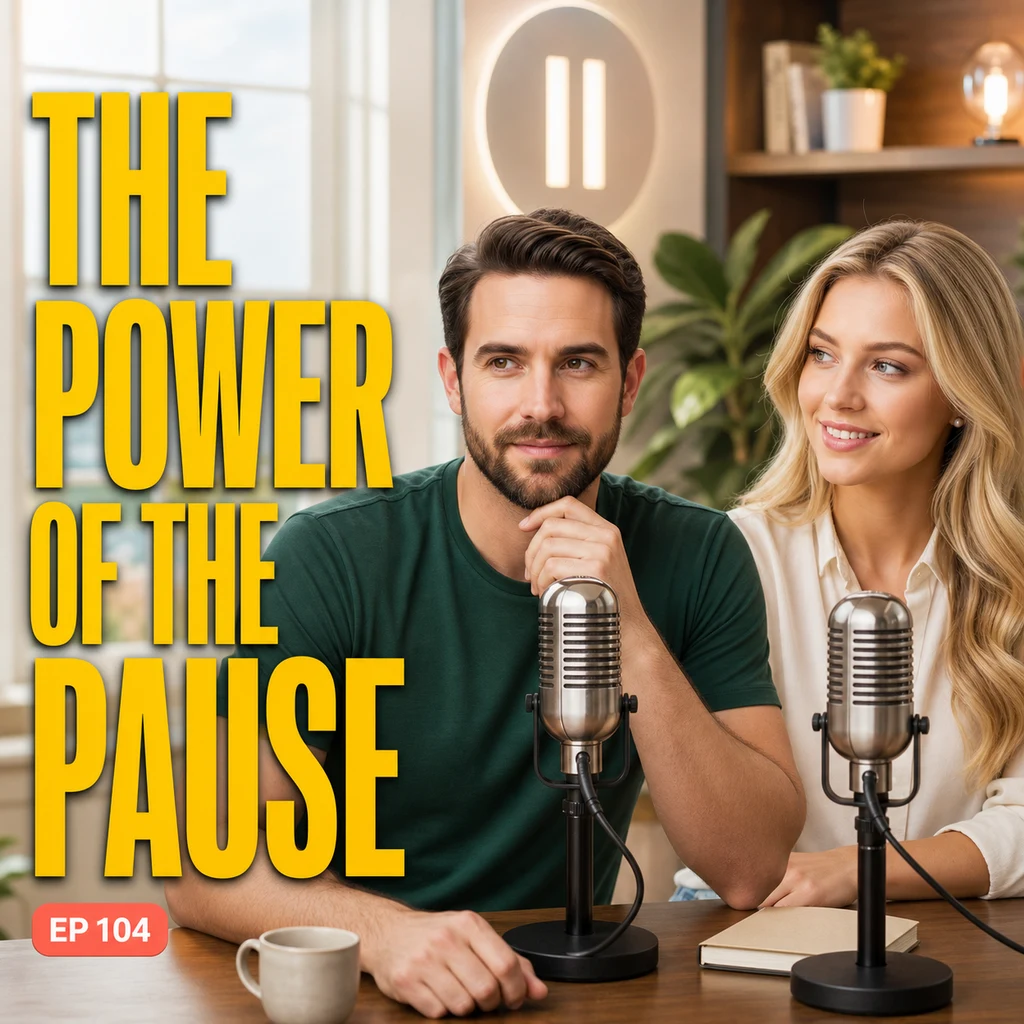
EPISODE 104 · 18 MIN · FAST ENGLISH
The Power of the Pause: Why Slow English Sounds Confident
What is one of the most powerful tools in spoken English? It isn't a word at all — it's silence.
Full episode notes on Acast ↗Slow Listening · voice pitch stays natural · 1.00×
Find your country — or stay in English
100% English mode
ENGo on... guess.
ENBigger than "love".
ENStronger than "yes".
ENMore persuasive than any adjective you have ever learned.
ENHere is the answer, friends.
ENIt is not a word at all.
ENIt is silence.
ENThe best speakers in the world... do not talk faster than everyone else.
ENThey pause more than everyone else.
ENAnd today, we are going to demonstrate it... and hand you a practical technique.
ENWelcome to Your English Toolbox, where we train your ears step by step.
ENI am Martin.
ENAnd I am Julia.
ENFriends, we are so happy you are here today.
ENBefore we begin, remember this episode has a home online.
ENyourenglishtoolbox.com.
ENThe interactive transcript, translations in Farsi, Spanish, German and French, vocabulary cards, flashcards, games and PDFs.
ENAll completely free.
ENToday's topic is one that many learners secretly worry about.
ENSounding fluent.
ENSounding confident.
ENSounding... good.
ENAnd we have some news that is going to surprise you.
ENIf you stay with us to the end, you will walk away with three things.
ENOne — a pause technique that can make your speech sound more confident... at your current level.
ENTwo — the two secrets that turn a small vocabulary into powerful speech.
ENThree — a practical formula behind many stories that people remember.
ENAnd a flexible method for memorizing the structure, so you are less likely to freeze in front of an audience.
ENLet's begin with a question, Julia.
ENGo on.
ENWhy do we think fast talkers sound impressive?
ENHonestly?
ENI think we confuse speed with intelligence.
ENFast, smooth, no gaps... it feels like the words are just... flowing from a full mind.
ENExactly what most learners believe.
ENSo they rush.
ENThey panic if there is a silence.
ENThey fill every gap with "um"...
EN"uh"...
EN"like"...
ENAnd here is the twist, friends.
ENConfident speakers often do the opposite.
ENThey pause.
ENOn purpose.
ENBefore the important word.
ENWatch what a pause does to a sentence.
ENListen to this: "The answer is yes."
ENNow listen to this: "The answer is... yes."
ENDo you feel the difference?
ENThe second one has weight.
ENGravity.
ENThe silence before the word tells your brain: pay attention, this matters.
ENIt is not a gap in your speech.
ENIt is a spotlight.
ENAnd here is the beautiful part for every learner listening right now.
ENThis technique does not need advanced grammar.
ENIt does not need a big vocabulary.
ENIt needs exactly one thing: comfort with silence.
ENWhich... funnily enough... is something slow English speakers already have plenty of practice with.
ENFriends, if you have ever felt embarrassed about speaking slowly in English... this is the moment to let that feeling go.
ENBecause the pause you thought was a weakness... is a tool that confident speakers deliberately develop.
ENYou already own it.
ENYou just need to use it on purpose.
ENSo let's talk about the enemy of the pause.
ENThe filler word.
EN"Um."
EN"Uh."
EN"Like."
EN"You know."
ENThese little sounds feel harmless.
ENBut they do real damage.
ENToo many filler words can tell the listener: I am not sure...
ENI am not ready...
ENI am searching.
ENThey can dilute the message around them.
ENSo here is a simple technique to reduce them.
ENIt has two parts.
ENPart one — slow down at the end of your sentence.
ENMost fillers appear at the exact moment we rush the last few words, searching for what comes next.
ENSlow those final words down on purpose.
ENIt buys your brain the half-second it needs.
ENPart two — close your mouth.
ENSounds strange, we know.
ENBut an open mouth invites a sound to escape... even before the word is ready.
ENClose it.
ENThink.
ENThen open it again when the word is formed.
ENSilence... then the word.
ENNever sound... then the word.
ENTry it with us right now, friends.
ENThink of your favorite food.
ENDon't say it yet.
ENClose your mouth.
ENFind the word completely, in your mind.
ENNow say it.
ENSee?
ENNo "um".
ENJust... a small silence, and then a clear word.
ENThat tiny pause... is your new best friend.
ENNow, let's talk about your vocabulary.
ENBecause here is a strange fact about the human brain.
ENYou may already recognize... thousands of English words.
ENWhen you read them, when you hear them, you understand.
ENBut when you speak?
ENYou probably use... one thousand, five hundred words.
ENMaybe three thousand, on a good day.
ENOne useful way to picture this is as the gap between your receptive vocabulary and your active vocabulary.
ENYour receptive vocabulary is the ocean: all the words you understand when you hear or read them.
ENYour active vocabulary is the small cup you actually drink from every day: the words you can retrieve when you speak.
ENAnd here is the secret that changes everything.
ENYou don't need more words in the ocean.
ENYou need to move a few words... from the ocean, into the cup.
ENAnd there is no single magic number attached to this.
ENResearch gives different answers because words, learners, and contexts are different.
ENBut the principle is clear: one encounter is rarely enough.
ENYou need repeated, meaningful contact with a word... and you need to retrieve it actively.
ENNot once in a textbook.
ENNot once in a quiz.
ENAgain and again, in different real sentences.
ENAnd Julia... doesn't that principle sound familiar?
ENIt should!
ENBecause it is exactly why this podcast does not give you fifty new words in one episode.
ENFive to eight expressions.
ENReal context.
ENRepeated, reused, practiced until they move house... from the ocean, into your cup.
ENSo here is a small mission for this week, friends.
ENPick just one word you already recognize but never use.
ENMaybe it's "genuinely".
ENOr "overwhelmed".
ENOr "I'd argue that..."
ENAnd use it.
ENOn purpose.
ENAgain and again, this week, until it feels like yours.
ENThat one word... is worth more than fifty words you only recognize.
ENLet's talk about your voice now — the instrument itself.
ENPitch, volume, rhythm.
ENMost people speak in one flat line.
ENSame pitch, same volume, same speed, from the first word to the last.
ENAnd a flat voice, in any language, is tiring to listen to.
ENA voice with movement... is magnetic.
ENHere is a wonderful, slightly strange exercise.
ENRead a children's story out loud tonight.
ENWith drama.
ENMake the wolf's voice deep and dangerous.
ENMake the little pig's voice high and worried.
ENIt feels silly.
ENIt feels ridiculous, honestly.
ENBut it trains something real: your range.
ENYour ability to move your pitch and your volume on purpose, instead of staying flat out of fear.
ENAnd friends, this connects directly to something you already do on this podcast.
ENShadowing.
ENWhen you repeat a sentence after us... don't just copy the words.
ENCopy the music.
ENCopy where our voice goes up... where it slows down... where it pauses.
ENThe words teach you English.
ENThe music teaches you to sound human.
ENNow, the part I love most.
ENStorytelling.
ENBecause here is a truth, friends: facts alone can fade quickly.
ENStories often stay with us.
ENSo what makes a story actually work?
ENThere is a formula.
ENA real one.
ENRule number one — something must change.
ENIf nothing changes from the beginning to the end, it's not a story.
ENIt's just a list of events.
ENSomeone wants something... and something gets in the way.
ENThat's it.
ENThat's the engine.
ENRule number two — start in the action.
ENDon't say: "So, let me give you some background first..."
ENToo much background can delay the moment that matters.
ENDrop your listener right into the moment.
EN"I was standing at the door, and my hands were shaking."
ENNow we're in it.
ENNow we care.
ENRule number three — use your senses.
ENDon't say "I was nervous."
ENSay: "My mouth went dry, and I could hear my own heartbeat."
ENLet people feel it, not just hear about it.
ENAnd rule number four — trust your audience.
ENDon't explain the meaning of your own story.
ENLet the ending speak for itself, and let people feel it in their own way.
ENSetup.
ENConflict.
ENResolution.
ENChange.
ENThat is a simple, reliable architecture.
ENLet us tell you about Farah.
ENFarah is a nurse from Sudan, living in Manchester.
ENShe had an interview for a hospital job she wanted desperately.
ENAnd she knew the first question would be: "So, tell me about yourself."
ENThe old Farah would have frozen.
ENToo many memories, too much English, no idea where to start.
ENBut this time, she did something different.
ENShe didn't write a script and memorize it word for word.
ENShe built one sixty-second story... using exactly the formula we just gave you.
ENSetup: a girl in Khartoum, twelve years old, holding her grandmother's hand in a busy hospital corridor.
ENConflict: no doctor had time to explain what was happening, and the fear on every face in that waiting room.
ENResolution: a young nurse crouched down, looked her directly in the eyes, and explained everything slowly, in words a child could understand.
ENAnd the change: "That is the nurse I decided, that day, I would become.
ENAnd that is the nurse I still try to be, every single shift."
ENShe didn't memorize those exact words.
ENShe memorized the four beats.
ENThe girl.
ENThe fear.
ENThe nurse.
ENThe promise.
ENAnd in the interview, the story came out naturally... a little different each time she told it, but always true, always hers.
ENShe got the job.
ENAnd the interviewer told her, weeks later, that her story was the moment they knew.
ENNot her English level.
ENHer story.
ENAnd that brings us to the final tool of the day.
ENHow do you actually remember something like that... under pressure?
ENLet us compare two ways to memorize.
ENOne is often more resilient under stress.
ENWord-for-word memorization can be fragile.
ENIf you forget one single word in the middle... the whole thing can collapse.
ENYour brain panics, searching for the exact missing piece.
ENAnother method is much more flexible.
ENThink of it as memorizing beat by beat.
ENYou don't memorize sentences.
ENYou memorize a sequence of images... like beats in a story.
ENPicture a simple journey through a place you know well — your own house, for example.
ENAt the front door: the girl in Khartoum.
ENIn the hallway: the fear in the waiting room.
ENIn the kitchen: the nurse who crouched down.
ENAt the back door: the promise.
ENWalk through your house in your mind... and the story walks with you, beat by beat.
ENIf you forget one exact word... it doesn't matter.
ENYou know where you are in the house.
ENYou know what happens next.
ENMany speakers use this kind of visual route to remember the structure of a presentation without memorizing every sentence.
ENAnd you can use a tiny version for one sixty-second story about yourself.
ENFour rooms.
ENFour beats.
ENOne story you can return to without depending on exact sentences.
ENSo, let's bring all of this home... and point it directly at your English.
ENBecause everything today has one target: helping you sound like yourself, only clearer.
ENHere is your plan for this week — four small actions.
ENAction one: claim the pause.
ENStop treating silence as a mistake.
ENBefore your next important sentence, pause on purpose.
ENLet it land.
ENAction two: catch one filler word.
ENThis week, notice every time "um" or "uh" tries to escape.
ENClose your mouth, find the word, then speak.
ENOne less filler this week is a real, measurable win.
ENAction three: move one word from the ocean to the cup.
ENChoose a word you recognize but never use, and use it on purpose, again and again, until it's yours.
ENAction four: build your own sixty-second story.
ENThe one for "tell me about yourself" — for interviews, for new friends, for that first real conversation in English.
ENSetup, conflict, resolution, change.
ENFour beats, not four hundred words.
ENWalk it through your mental house until it's simply... part of you.
ENSay the sentence of the day with us, friends.
ENConfidence is not about talking fast — it is about pausing on purpose.
ENOne more time.
ENConfidence is not about talking fast — it is about pausing on purpose.
ENQuick recap, friends.
ENThe pause is a spotlight, not a gap — use it before your important words.
ENRemove filler words by slowing your endings and closing your mouth until the word is ready.
ENMove words from your receptive vocabulary to your active vocabulary through repeated, meaningful use.
ENTrain your voice like an instrument — read with drama, and shadow the music, not just the words.
ENA strong personal story can follow a simple formula: setup, conflict, resolution, change.
ENAnd when you need to remember it under pressure, walk it through your mental house, beat by beat.
ENEverything from today — the vocabulary, the transcript, the practice tools — is waiting for you at yourenglishtoolbox.com.
ENAll completely free.
ENSo here is your mission this week, friends.
ENOne pause, used on purpose.
ENOne filler word, caught and replaced with silence.
ENOne old word from your ocean, brought into your cup.
ENAnd if you're brave... one sixty-second story, ready for the next person who asks who you are.
ENBecause from today, you don't need more words to sound confident.
ENYou need better silence.
ENThank you for being here with us.
ENAnd... friends... notice that pause before we said goodbye.
ENVery good.
ENTake care, friends.
ENBye for now.