ENKnight.
EPISODE 111 · 14 MIN · PRONUNCIATION WORKOUTS
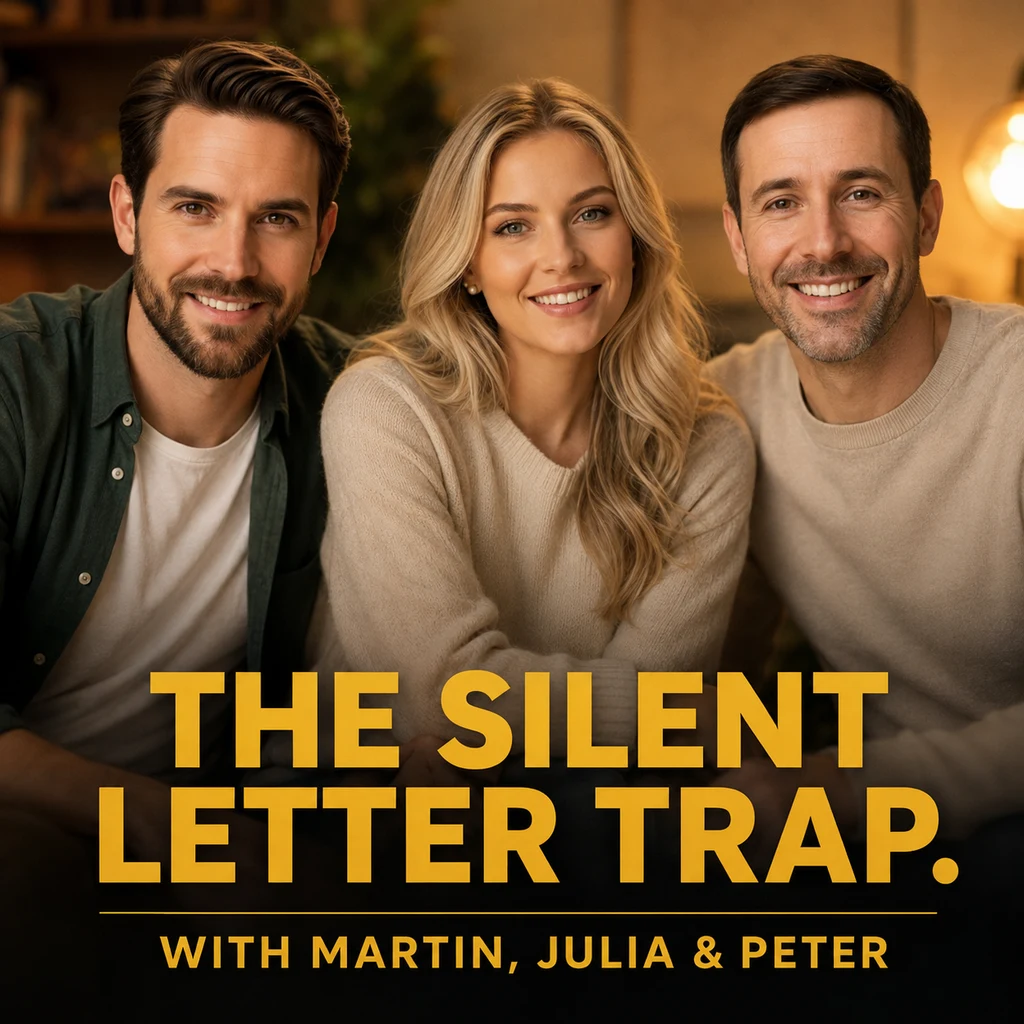
The Silent Letter Trap: Why Knight, Wrong and Psychology Scare Everyone
Knight. Wrong.
Full episode notes on Acast ↗Slow Listening · voice pitch stays natural · 1.00×
Find your country — or stay in English
100% English mode
ENWrong.
ENPsychology.
ENThree words.
ENAnd if you just tried to say them out loud in your head, your brain probably fought you the whole way.
ENBecause English has a secret family of letters that refuse to make a sound.
ENThey just sit there.
ENSilent.
ENWatching you struggle.
ENWelcome to Your English Toolbox, where we train your ears step by step.
ENEverything we talk about today is also waiting for you at yourenglishtoolbox.com, completely free — transcripts, translations, and vocabulary cards for every episode.
ENI am Martin.
ENAnd I am Julia.
ENAnd today I am joining them.
ENI am Peter.
ENFriends, Peter does not usually sit with us in this format.
ENBut today is different, because today is not really about grammar, or vocabulary, or stories.
ENToday is about your mouth.
ENAbout the exact muscles you use, and the exact letters your brain tries to force out, even when English does not want them there.
ENAnd here is the strange thing about silent letters, friends.
ENEnglish did not remove them just to confuse you.
ENCenturies ago, people actually pronounced that K in "knight." Every single letter was spoken out loud.
ENThe sound simply faded away over hundreds of years.
ENThe spelling never caught up with the changing pronunciation.
ENSo when your mouth fights to say that K today, it is fighting a version of English that stopped existing five hundred years ago.
ENWhich means it was never your fault.
ENNot once.
ENSo here is our promise for today.
ENBy the end of this episode, three families of silent letters that used to terrify you — the ones hiding in "know," in "wrong," and in "psychology" — are going to feel completely normal in your mouth.
ENAnd we are going to prove it with a real practice round at the end, with Peter, out loud, together.
ENLet's start with the first family.
ENK-N.
ENThe K is silent, always, no exceptions.
ENOur anchor word for today is "know."
ENKnow.
ENOne more time, slowly.
ENKnow.
ENGood.
ENNow here's something embarrassing.
ENWhen I was learning Spanish years ago, I tried to impress some local friends by saying I "conocía" the city perfectly.
ENWait, this is a Spanish story inside an English lesson?
ENStay with me.
ENThe point is, I did not know the city at all.
ENI got lost twice in one afternoon.
ENAnd "know" is exactly the word we needed there.
ENNot "meet." Not "recognize." Know.
ENSame family: "knight." A medieval soldier.
ENK-N-I-G-H-T.
ENFour silent letters hiding inside one small word.
ENKnight.
ENAnd "knee." The part of your leg that bends.
ENKnee.
ENOne more from this family: "knife."
ENKnife.
ENKnow, knight, knee, knife.
ENEvery single one starts with that silent K.
ENNow, family number two.
ENW-R.
ENThis one is sneaky, because the W just disappears completely.
ENOur anchor word here is "wrong."
ENWrong.
ENJulia, tell them about the text message.
ENOh no. Okay.
ENLast year I sent a message to my sister meant for someone else entirely.
ENCompletely wrong person.
ENShe still brings it up at every family dinner.
ENIt was the wrong chat.
ENOne tap.
ENTotal disaster.
ENAnd that is a perfect example, because "wrong" is not just about mistakes in grammar, it is about real, human, slightly humiliating moments.
ENNext in this family: "write." The action of putting words on paper.
ENWrite.
ENAnd "wrist." The joint between your hand and your arm.
ENWrist.
ENOne more: "wrap." Like wrapping a gift.
ENWrap.
ENWrong, write, wrist, wrap.
ENThe W simply vanishes every time.
ENNow for the family that scares almost everyone.
ENP-S.
ENThis one looks intimidating on paper, but it is actually the easiest rule of the three, because it only ever appears at the beginning of certain words.
ENThe P disappears completely.
EN"Psychology."
ENPsychology.
ENOne more time, a little slower.
ENPsychology.
ENI studied psychology for two years before I switched to teaching English.
ENAnd you still mispronounced it for the first six months.
ENPainfully true.
ENI kept saying the P out loud, like "puh-sychology."
ENOne more word from this family: "pseudonym." A fake name a writer uses.
ENPseudonym.
ENPsychology, pseudonym.
ENSilent P, every time, no exceptions.
ENAnd here's the useful part, friends: this family is actually small.
ENYou will not meet many more silent-P words in everyday English, so once you have these two, you have basically covered the whole family.
ENWhich is very different from the KN and WR families, where new words keep showing up for years.
ENNow, here is the trap we promised you.
ENTwo words that sound almost identical, but mean something completely different.
EN"Knack" and "knock."
ENKnack.
ENKnock.
ENA "knack" is a natural talent for something.
EN"She has a real knack for languages."
ENA "knock" is the sound you make hitting a door.
EN"Someone is knocking at the door."
ENOne vowel sound is the only difference between "I have a knack for this" and "I heard a knock at the door," and in fast conversation, native speakers rely completely on context to tell them apart.
ENSo listen for the sentence around the word, not just the word itself.
ENThat is the real skill.
ENI actually mixed these up once, in front of a whole classroom.
ENOh, I remember this story.
ENI meant to say a student had "a real knack for grammar." Instead I said she had "a real knock for grammar." The class went completely silent.
ENAnd then someone asked if grammar had physically hit her.
ENIt did.
ENApparently.
ENThe lesson here is simple.
ENThese small vowel differences are exactly why slow, careful listening matters so much more than fast listening when you are still building the sound in your ear.
ENQuick recap before we practice.
ENThree silent families: K-N in "know," W-R in "wrong," and P-S in "psychology." And one trap: "knack" versus "knock."
ENEvery single one of these words is written down for you at yourenglishtoolbox.com, with audio you can slow down and repeat as many times as you need.
ENAnd notice something, friends: none of these rules were complicated.
ENK-N, silent K.
ENW-R, silent W.
ENP-S, silent P.
ENThree simple patterns, and suddenly a whole category of scary words stops being scary.
ENThat is really the whole philosophy of this podcast. Complexity is not the goal.
ENClarity is.
ENNow, the part you have been waiting for.
ENThe practice round.
ENI am going to say ten words.
ENSlowly.
ENOne at a time.
ENAfter each word, there will be a short silence.
ENThat silence is for you.
ENSay the word out loud, exactly as you heard it.
ENReady?
ENLet's begin.
ENKnow.
ENKnight.
ENKnee.
ENKnife.
ENWrong.
ENWrite.
ENWrist.
ENWrap.
ENPsychology.
ENPseudonym.
ENWell done, friends.
ENTen words, ten silent letters defeated.
ENNow for the harder version.
ENPeter is going to say five full sentences.
ENEach one combines several of today's words.
ENThis time, you get a little more silence, because a sentence takes longer to repeat than a single word.
ENHere we go.
ENListen first. Then repeat the whole sentence.
ENI know it's wrong to write with a knife.
ENKnock on my knee if you have a knack for psychology.
ENWrite down what you know about your wrist.
ENWrap the knife carefully.
ENI know it's sharp.
ENThe knight had a knack for psychology, not war.
ENThat is the practice round complete, friends.
ENTen words, five sentences, and every silent letter from today's episode.
ENAnd if that felt useful, here is something you should know about.
ENOn yourenglishtoolbox.com, we have a full learning path built exactly for this: pronunciation, one sound at a time, episode by episode.
ENAnd inside that path, every single audio has seven different speed levels you can choose from, so you can slow a word down as much as you need, listen again, and only speed it back up once your mouth actually agrees with your ears.
ENSo if silent letters, or word stress, or any tricky sound has ever made you feel embarrassed to speak, that path was built for exactly that moment.
ENYou already did the hard part today.
ENYou said the words out loud.
ENAnd that is the only way this ever actually changes.
ENNot by reading silently.
ENNot by understanding the rule in your head.
ENBy moving your mouth, again and again, until the shape feels normal.
ENPeter, any final word for the friends listening right now?
ENJust this.
ENIf a word felt strange in your mouth today, that is not a sign you are bad at English.
ENIt is a sign you are actually learning it.
ENBeautifully said.
ENAnd a genuinely good one to end on.
ENThank you for practicing with us today, friends.
ENIt was a pleasure being here.
ENSee you at yourenglishtoolbox.com.
ENTake care, friends.