The audio controls above still work. Interactive translation, saving and practice need JavaScript. You can read the complete transcript and download your study materials below.
Complete English transcript
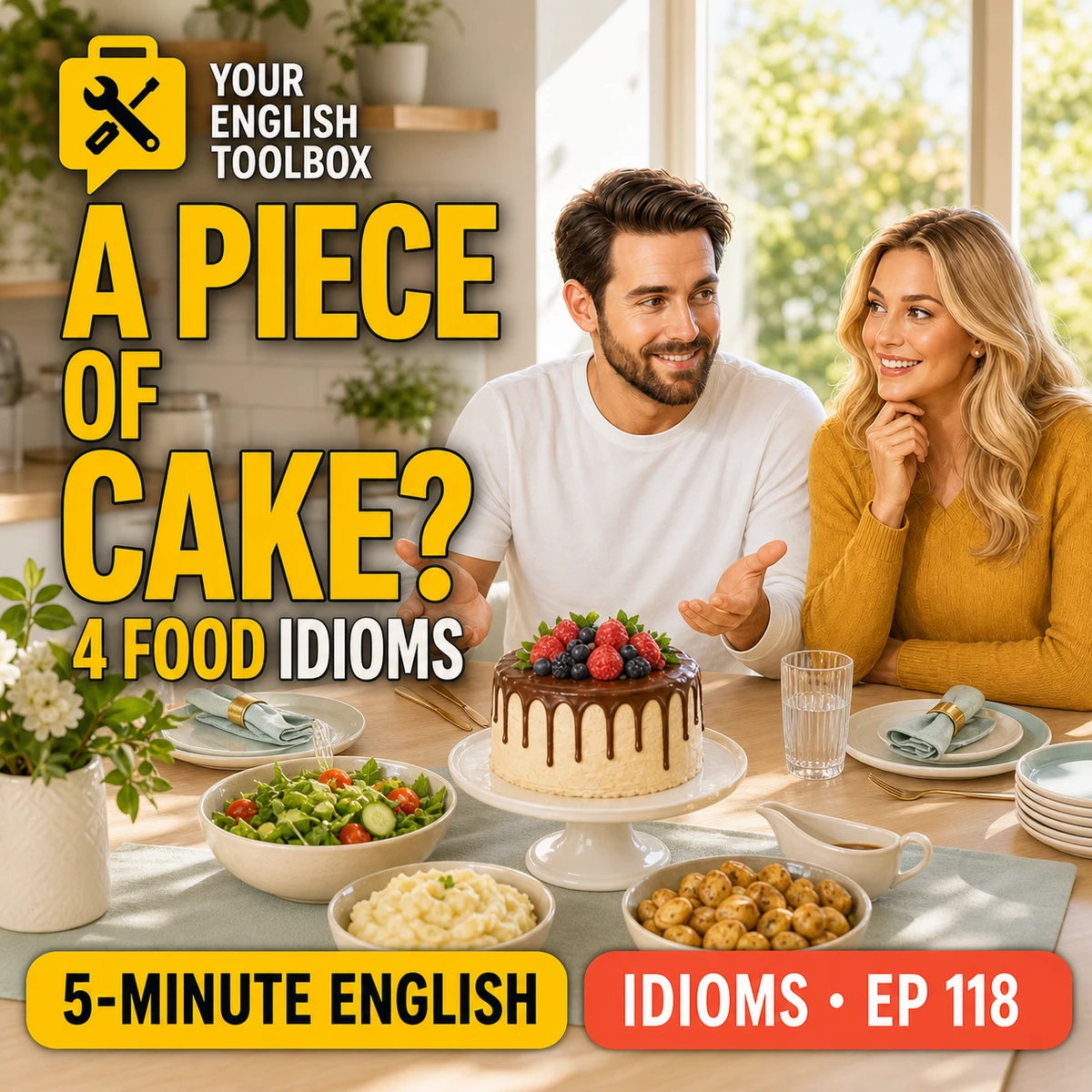
Martin, why are there twelve plates on your kitchen table?
Because I am cooking dinner for twelve people tonight.
Twelve people?
And you are testing a new dessert at the same time?
Yes.
It will be a piece of cake.
Martin...
I think you may have bitten off more than you can chew.
That sounds worrying.
And strangely appropriate for dinner.
It is very appropriate, because today we are learning four food idioms that are useful far beyond the kitchen.
Welcome to Your English Toolbox.
I am Martin.
And I am Julia.
This is lesson four of our free Idiom Toolbox course: Food.
The complete course is available at yourenglishtoolbox.com.
Open the Idioms section and choose lesson four.
There you can study the dialogue, meanings, examples, grammar notes, listening practice and interactive activities.
The direct link to the free lesson will also be in this episode description.
Let us begin with the expression I used: a piece of cake.
If something is a piece of cake, it is very easy to do.
For example: The online form looked complicated, but it was a piece of cake.
Or: Once you know the steps, this recipe is a piece of cake.
Notice the usual pattern: something is a piece of cake.
And of course, we are not talking about real cake.
Martin, do you truly think dinner for twelve will be easy?
The cooking will be a piece of cake.
Organising everything may be different.
That brings us to our second idiom: bite off more than you can chew.
It means to accept more work or responsibility than you can manage.
You can say: I bit off more than I could chew when I agreed to organise two events in the same week.
Listen to that past form: bit off, not bited off.
Here is another example: Be careful not to bite off more than you can chew.
So, Julia, are you saying dinner for twelve is too much for me?
I am saying that dinner, a new dessert and a complete kitchen reorganisation on the same evening may be too much.
When you put it like that... perhaps I have bitten off more than I can chew.
Good.
Now, is the dinner a surprise?
Yes.
Nobody knows why we are meeting.
Please do not spill the beans.
Our third idiom is spill the beans.
It means to reveal a secret, often before the right moment.
For example: Who spilled the beans about the surprise party?
Or: Do not spill the beans before Friday.
You can also spill the beans about something: He spilled the beans about their new project.
This expression is conversational and playful.
It is perfect for surprises, secret plans and information that was not supposed to come out yet.
Julia, you are very good at keeping secrets, right?
Absolutely.
But you have just announced your secret dinner to everyone listening.
Ah.
I may have spilled my own beans.
Almost. We normally say spilled the beans.
Now let us finish with in a nutshell.
In a nutshell means in very few words, or as a short summary.
You can place it at the beginning: In a nutshell, we need more time.
Or ask: Can you explain the plan in a nutshell?
It is useful when a story or explanation is becoming too long.
Julia, can you describe my evening in a nutshell?
In a nutshell, you invited too many people, promised too much food and revealed the surprise on a podcast.
That is accurate... and efficient.
Time for a quick challenge.
We will give you a situation.
Choose the best idiom.
Situation one.
The exam was much easier than you expected.
It was a piece of cake.
Situation two.
You accepted three major projects and now you cannot finish them.
You bit off more than you could chew.
Situation three.
A friend reveals the destination of a secret trip.
Your friend spilled the beans.
Situation four.
You want someone to explain a complicated idea very briefly.
You say: Explain it in a nutshell.
Excellent.
Today we learned a piece of cake, bite off more than you can chew, spill the beans and in a nutshell.
Try using one of them today in a sentence about your own life.
Personal examples make new language easier to remember.
And continue with lesson four in the free Idiom Toolbox course at yourenglishtoolbox.com.
The direct link is waiting for you in the episode description.
See you next time.
Bye for now.