The audio controls above still work. Interactive translation, saving and practice need JavaScript. You can read the complete transcript and download your study materials below.
Complete English transcript
Julia, I have bad news.
What happened?
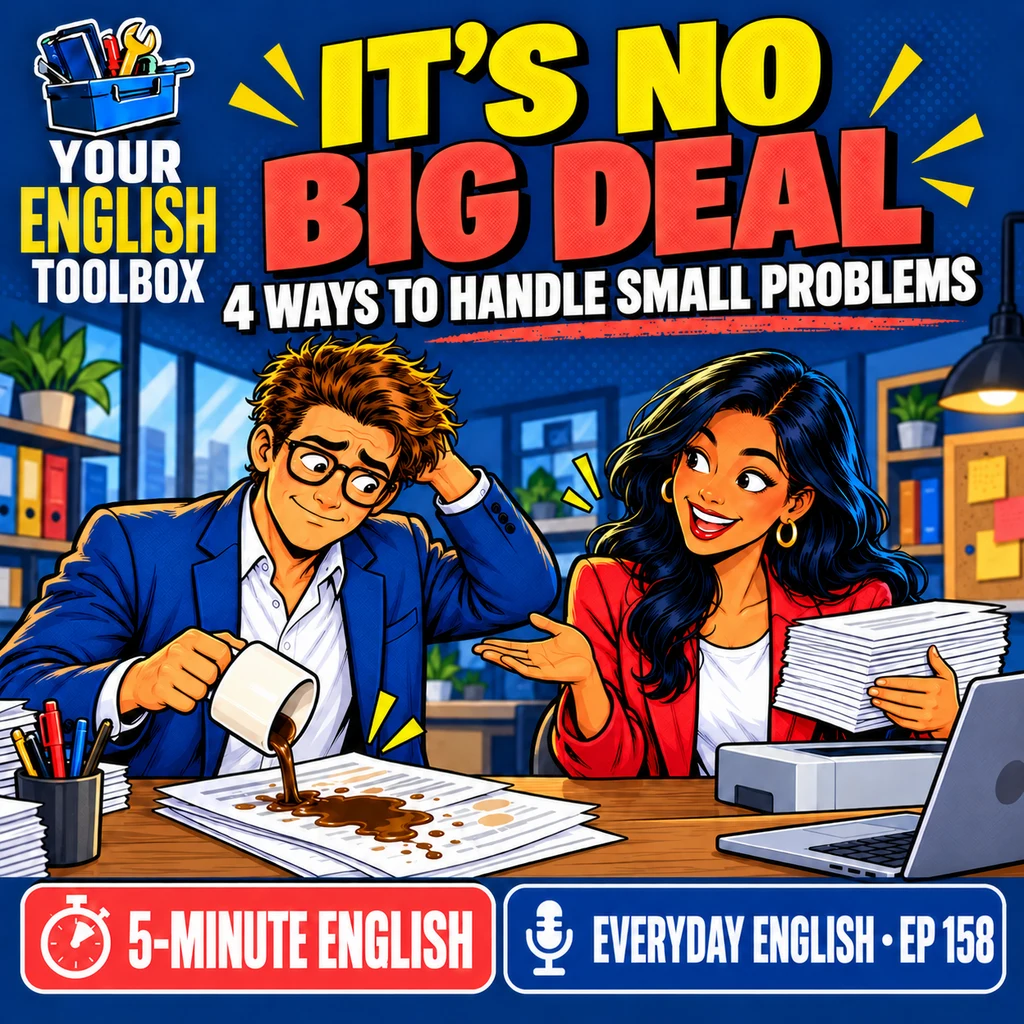
I knocked a cup of coffee onto the handouts for our workshop.
Is anyone hurt?
No.
Is the computer damaged?
No. Only six pages are wet.
Then it is no big deal.
We can print them again.
You made that problem feel smaller in one sentence.
That is exactly what today’s expressions can do.
Welcome to Your English Toolbox.
I am Martin.
And I am Julia.
This is episode nine of Everyday Useful Expressions, our series of ready-made English for real situations.
Today we are learning four natural ways to respond calmly to small problems and move towards a solution.
Our first expression is: It is no big deal.
It is no big deal.
Use this to say that a problem is not very serious or difficult.
For example: I am sorry I arrived five minutes late.
It is no big deal.
We have not started yet.
Or: I printed the old version by mistake.
It is no big deal.
We can print the new one.
This expression reassures the other person and reduces tension.
But be careful.
If somebody is genuinely upset or the problem is serious, it can sound dismissive.
Do not call a major loss or a painful experience no big deal.
Use it for genuinely small problems.
Our second expression is: These things happen.
These things happen.
Use it when a mistake or accident is understandable and you do not want to blame the person.
For example: I am sorry I sent the message to the wrong group.
These things happen.
Or: We missed the turning because the sign was hidden.
These things happen.
The expression means that ordinary people sometimes make ordinary mistakes.
It can sound warmer if you add support afterwards.
These things happen.
We will send a correction.
That leads to our third expression: We will figure it out.
We will figure it out.
Use this when you do not have the solution yet, but you are confident that you can find one together.
For example: The booking system is not working, but we will figure it out.
Or: We do not have enough chairs.
We will figure it out before the guests arrive.
Notice the word we.
It turns the problem into something shared.
If the responsibility is mine alone, I can say: I will figure it out.
Our fourth expression is: Let me take care of it.
Let me take care of it.
Use this when you are offering to handle the problem or task yourself.
For example: The printer needs more paper.
Let me take care of it.
Or: Somebody needs to call the hotel.
Let me take care of it.
A natural reply is: Thank you.
I appreciate it.
The expression sounds calm and confident.
It tells the other person that they do not need to manage the issue now.
But make sure you can actually do what you have promised.
Otherwise, it creates a second problem.
Let us compare the four expressions.
It is no big deal says the problem is small.
These things happen removes unnecessary blame.
We will figure it out expresses confidence in a shared solution.
And let me take care of it means that you will handle the problem yourself.
Time for a quick challenge.
Choose the most natural expression before we answer.
Situation one.
A friend apologises for spilling a little water on an empty table.
It is no big deal.
Situation two.
A colleague makes a small, understandable mistake and feels embarrassed.
These things happen.
Situation three.
Your group has lost the room booking, and nobody knows the solution yet.
We will figure it out.
Situation four.
The event organiser is busy, and you can call the delivery company yourself.
Let me take care of it.
Now build a complete response.
Your colleague says: I attached the wrong document to the email.
You could say: These things happen.
We will figure it out.
Let us send the correct document now.
That response reduces blame and moves towards action.
On the episode page at yourenglishtoolbox.com, you will find five additional expressions for handling small problems calmly.
Each one includes its meaning, tone, two examples and active practice.
The direct link is in the episode description.
Martin, what happened to the wet handouts?
I printed six new pages.
Good.
Problem solved.
There is one more issue.
What is it?
I put your coffee beside the printer, and now I cannot remember which cup is yours.
These things happen.
Will we figure it out?
No. Let me take care of it.
I will make fresh coffee.
You really do have a solution for everything.
Only for small problems.
See you next time, friends.
Goodbye.