The audio controls above still work. Interactive translation, saving and practice need JavaScript. You can read the complete transcript and download your study materials below.
Complete English transcript
Martin, why are you carrying a bag of dog treats?
My new neighbours invited me for coffee, and they have a dog.
You bought a present for the dog, but nothing for the neighbours?
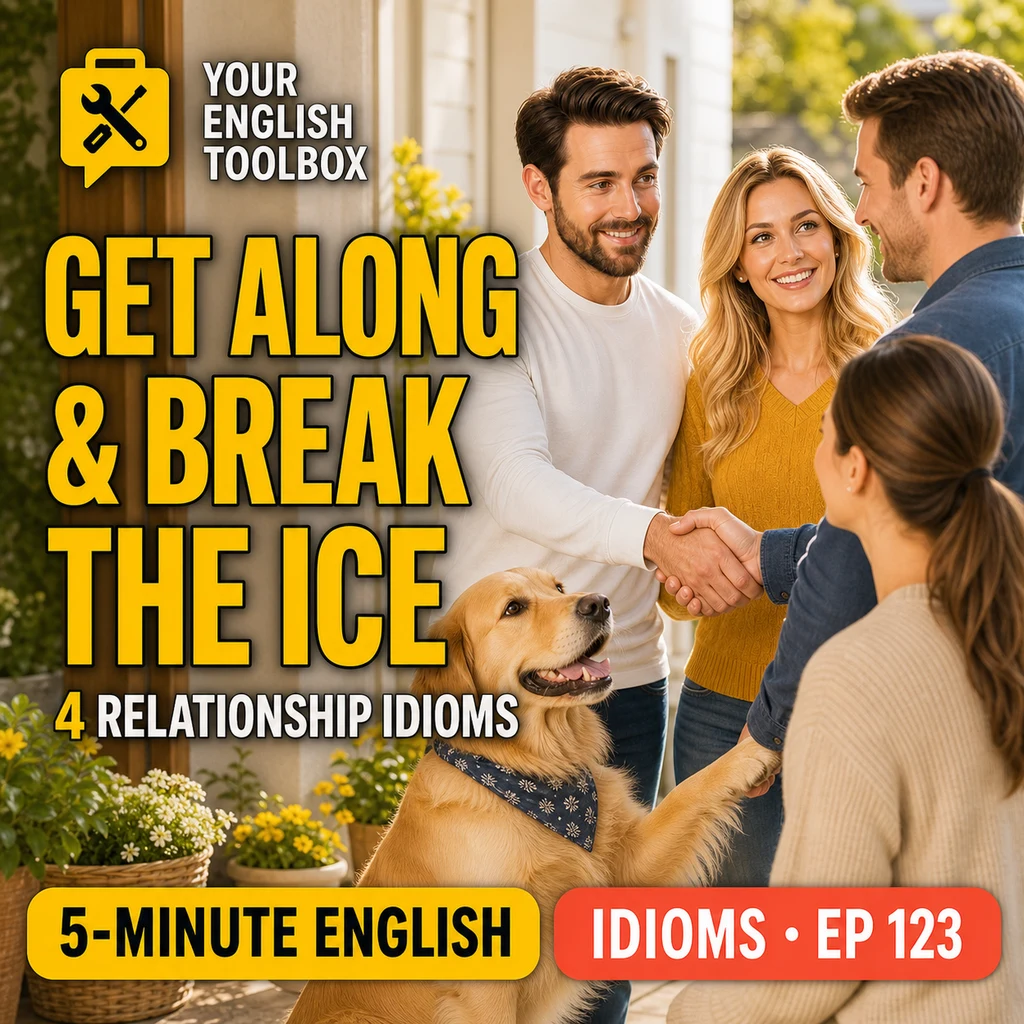
The dog helped us become friends.
Ah.
It helped you break the ice.
Exactly.
And I may have a soft spot for dogs.
Then today’s lesson is perfect for you.
Welcome to Your English Toolbox.
I am Martin.
And I am Julia.
Today we are exploring lesson five of our free Idiom Toolbox course: Relationships.
You can find the course at yourenglishtoolbox.com.
Open the Idioms section and choose lesson five, Relationships.
You will find a slow dialogue, clear meanings, multilingual support, examples and interactive retrieval practice.
The direct link to this free lesson is also in the episode description.
Let us begin with get along.
If two people get along, they have a friendly relationship.
You can say: I get along really well with my new neighbours.
Or ask: Do you get along with your colleagues?
Notice the preposition: get along with someone.
Can two people get along even if they are very different?
Of course.
A good relationship does not require identical personalities.
That leads us to our second expression: see eye to eye.
If two people see eye to eye, they agree completely about something.
For example: My neighbours and I do not always see eye to eye on music.
Perhaps because you play music late at night?
I play it very quietly.
That was not a confident answer.
Here is another example: The two managers finally saw eye to eye on the new schedule.
The past form is saw eye to eye.
And we often add the subject: We do not see eye to eye on money.
Or: They see eye to eye about most important decisions.
So, you can get along with someone without seeing eye to eye on everything.
Exactly.
One expression describes the relationship.
The other describes agreement.
Now let us return to the dog.
The dog helped break the ice.
To break the ice means to make people feel more relaxed when they first meet.
A friendly question can break the ice.
A small joke can break the ice.
And apparently, a very enthusiastic dog can break the ice.
When I arrived, the conversation felt slightly awkward.
Then the dog brought you a toy.
Yes.
We started playing with it, everyone laughed, and the conversation became natural.
The dog did all the social work.
It is a very talented dog.
Our final expression is have a soft spot for.
If you have a soft spot for someone or something, you feel special affection for them.
Martin clearly has a soft spot for dogs.
Especially friendly dogs.
You could also say: I have always had a soft spot for my old school.
Or: She has a soft spot for rescue dogs.
The usual pattern is have a soft spot for someone or something.
It describes warm affection.
It is not the same as being weak.
Let us compare all four expressions.
Get along means to have a friendly relationship.
See eye to eye means to agree completely.
Break the ice means to make a first meeting feel more relaxed.
And have a soft spot for means to feel special affection.
Time for a quick challenge.
Listen to each situation and choose the best expression.
Situation one.
You and your new colleague have a friendly, comfortable relationship.
You get along well.
Situation two.
Two friends completely agree about where to go on holiday.
They see eye to eye.
Situation three.
Everyone is quiet at the beginning of a meeting, so someone asks a friendly question.
The question breaks the ice.
Situation four.
Your grandfather’s old chair is not valuable, but you feel special affection for it.
You have a soft spot for it.
Now complete this sentence about your own life.
I get along well with...
And one more.
I have a soft spot for...
Personal examples make expressions easier to remember.
Continue with lesson five in the free Idiom Toolbox course at yourenglishtoolbox.com.
The interactive practice helps you retrieve the expressions instead of simply reading them again.
The direct lesson link is in the episode description.
Now, what did you buy for your neighbours?
A box of chocolates.
Good.
And the dog treats?
A much larger box.
You definitely have a soft spot for that dog.
We already see eye to eye on that.
See you next time, friends.
Goodbye.