The audio controls above still work. Interactive translation, saving and practice need JavaScript. You can read the complete transcript and download your study materials below.
Complete English transcript
Martin, have you decided whether to accept the new project?
Not yet.
It is difficult.
Difficult because the work is complicated?
Not exactly.
Difficult because the choice is emotionally hard?
Yes.
That is closer.
Then you need a more precise word.
I suspected you might say that.
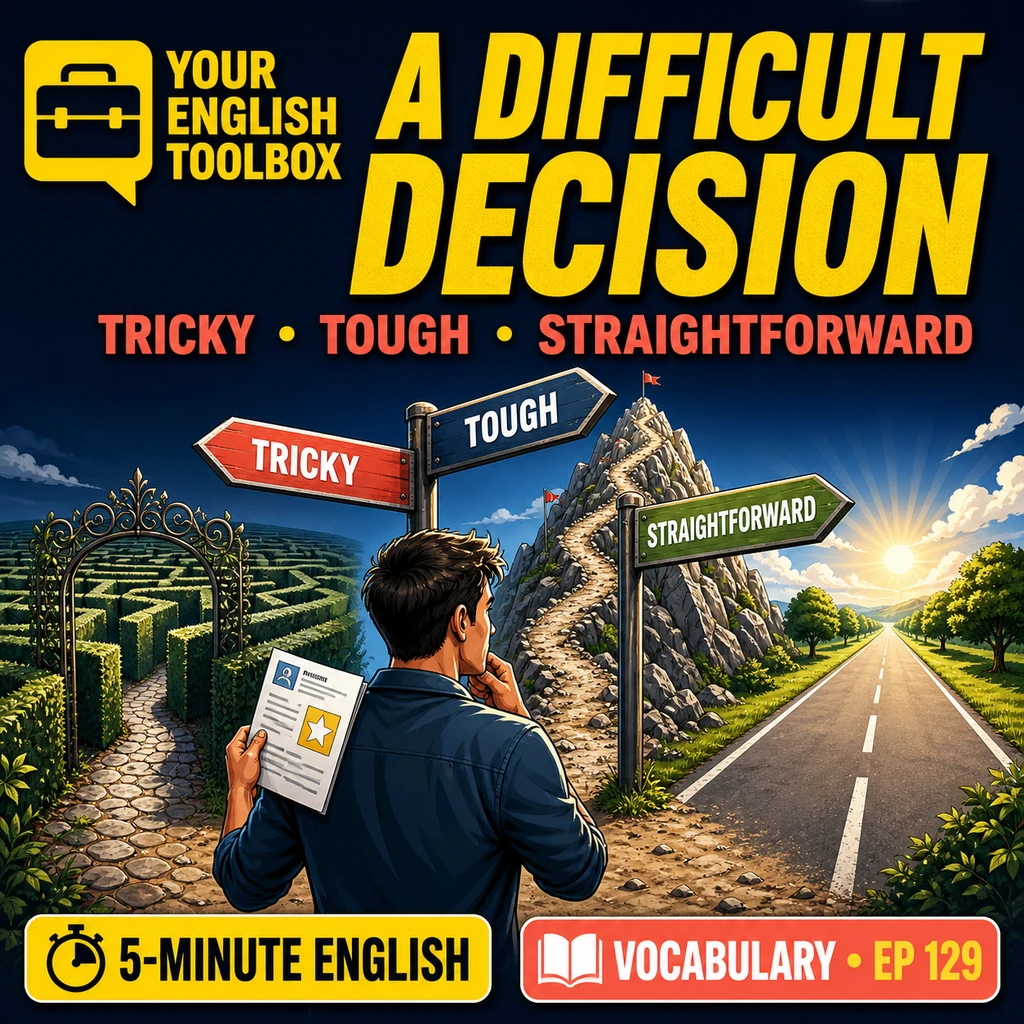
Today we will compare tricky, tough and straightforward.
Welcome to Your English Toolbox and Practice Arena Five-Minute English.
I am Martin.
And I am Julia.
Today we are moving beyond the general word difficult and choosing a word that explains what kind of difficulty we mean.
Let us begin with tricky.
Tricky means difficult because something requires care, skill or careful thought.
A tricky question may look simple, but the answer is not obvious.
A tricky problem may have several possible solutions and hidden risks.
For example: This part of the installation is tricky.
Or: It was a tricky conversation because I did not want to offend anyone.
So tricky can describe a technical problem and a social situation.
Yes.
It often suggests complexity, uncertainty or the possibility of making a mistake.
Could my project decision be tricky?
It could be, if there are many details to balance.
The salary is good, but the schedule is uncertain, and the role may change.
That is definitely tricky.
Now let us look at tough.
Tough means difficult to do, endure or decide, often because it demands strength or involves an unpleasant choice.
A tough decision can affect people you care about.
A tough week can leave you tired.
And a tough exam demands a lot of effort.
For example: Turning down the offer was a tough decision.
Or: We had a tough conversation about the budget.
In your case, accepting the project would mean less time with your family and friends.
Exactly.
That is why it feels tough.
Tricky describes the complexity.
Tough describes the emotional or practical weight.
Can one situation be both tricky and tough?
Absolutely.
The details can be tricky, and the final choice can be tough.
Now for our third word: straightforward.
Straightforward means clear, simple and easy to understand or complete.
So it is almost the opposite of tricky.
Often, yes.
A straightforward process has clear steps and few surprises.
For example: The online application was quick and straightforward.
Or: Her instructions were straightforward and easy to follow.
Does straightforward mean that something requires no effort?
Not always.
A task can take time but still be straightforward if you know exactly what to do.
Editing one hundred files may be slow, but the process can be straightforward.
Good example.
The opposite would be a confusing process with hidden steps.
Let us compare our three words.
Tricky: difficult because it needs care, skill or careful thought.
Tough: difficult because it demands strength or involves a hard choice.
Straightforward: clear, direct and not complicated.
Time for a quick challenge.
Choose tricky, tough or straightforward before we answer.
Situation one.
A form has three clear steps and takes two minutes.
It is straightforward.
Situation two.
You must answer a question carefully because the wrong words could upset someone.
It is a tricky question.
Situation three.
You must choose between a better salary and more time with your family.
It is a tough decision.
Situation four.
The instructions are short, but one small mistake can damage the machine.
The task is tricky, not necessarily tough.
Now improve this sentence: The meeting was difficult.
Was it complicated and delicate?
Then it was tricky.
Was it emotionally demanding?
Then it was tough.
Was it clear and easy to follow?
Then it was straightforward, not difficult at all.
On the episode page at yourenglishtoolbox.com, Cinema Mode lets you follow every example as you hear it.
Seeing the word in context while listening can make these small differences much easier to remember.
The direct link is in the episode description.
So, Martin, describe your project decision again.
The contract is tricky because some details may change.
Good.
The decision is tough because the new schedule would affect my personal life.
Exactly.
And is the application process difficult?
No. That part is completely straightforward.
Now your answer tells us something useful.
See you next time, friends.
Goodbye.