The audio controls above still work. Interactive translation, saving and practice need JavaScript. You can read the complete transcript and download your study materials below.
Complete English transcript
Before anything else.
Before the music, before the welcome, before any of it.
I know what you are going to ask.
Did he answer?
He answered.
When?
Six days later.
Six days.
Six days, during which I checked my phone approximately four hundred times and told myself that the silence was the answer.
And what did he say?
He did not say it is so good to hear from you.
He did not say I have missed you.
What did he say?
He said, I thought you had forgotten about me.
Eleven years.
And that was the sentence waiting at the other end.
That was the sentence waiting at the other end.
So he had been thinking about you too.
The whole time, apparently.
Each of us sitting in a different country, certain that the other one had moved on.
And you are seeing him?
Sunday evening.
He is going to cook, badly, and I am going to pretend it is fine.
Six days.
And you were completely sure it was too late.
And that is the trap.
That is the whole conversation today.
Because the thing we call too late is almost never a fact.
It is a feeling, wearing the clothes of a fact.
Welcome to Your English Toolbox, the podcast that trains your English while you live your real life.
I am Martin.
And I am Julia.
And this is the fourth and final conversation in our series about how to live a good life.
Four conversations about happiness, relationships, purpose, and the small choices that improve our quality of life.
We began with an eighty-year study and what it discovered.
Then how to start a relationship with a stranger in thirty seconds.
Then how to keep the people you already have.
And today, the question underneath all of them.
How much of a good life can you still build, when the life you planned has already changed?
I want to start with a fantasy, because I think most of us carry it.
Go on.
The fantasy is that a good life belongs to a certain kind of person.
Somebody who chose the right career at twenty-two.
Who kept all their childhood friends.
Who met the right person early.
Who never had to move country.
Who had a stable job for thirty years.
Who avoided the big losses.
And how many people actually live that life?
Almost nobody.
Almost nobody.
And yet we measure ourselves against it every day.
Because if that is the recipe, and you did not follow it.
Then you are behind.
And if you are behind, you start to write yourself off.
To write somebody off.
To decide that a person, or a situation, has no future.
And the strangest thing is how early we do it to ourselves.
I have had listeners tell me they are too old to learn English properly.
How old?
Thirty-four.
Right.
I want to do something painful.
I love painful.
Ask me why I nearly did not write to Tomás.
Why did you nearly not write to Tomás?
Because it had been too long.
Too long for what?
Is there an expiry date on friendship that nobody told me about?
Next reason.
He has moved on.
He has a whole life now, and I am not in it.
You had a whole life too, and he was not in it, and he wrote back in six days.
Next reason.
I would have to explain eleven years.
You would have to explain nothing.
Nobody wants a report.
They want a Sunday evening.
Next reason.
What if he has changed?
Then you meet a new person with old stories.
That is not a tragedy, that is a bonus.
Last reason, and this is the real one.
What if I have changed?
What if the person he liked does not exist anymore?
I am not going to answer that one.
No?
No, because I think you already know.
I do.
What if he is the one who has been waiting?
There it is.
Every single reason I had was a story about him, and every single one of them was actually about me.
And the sixth day proved all five of them wrong at once.
Now, we have to be careful in this episode.
We do.
Because there is a version of this conversation that is dishonest, and it goes like this.
Everything happens for a reason.
What does not kill you makes you stronger.
Your crisis was a gift.
We are not going to say any of that.
Good.
The study we have been following watched people go through the worst things that happen to human beings.
Losing a job at fifty-five.
Losing a husband, a wife, a child.
Divorce.
Illness.
Leaving a country and starting again from zero.
And what they found was not that suffering improves people.
No.
Some experiences do not make us stronger.
Sometimes they simply hurt.
And resilience is not pretending otherwise.
Resilience is finding a way to continue without denying what happened.
But they did find something, and it is one of the most practical findings in the whole study.
Tell them.
When researchers compared how people adapted to major crises, one of the clearest differences was the support they had around them.
Who was standing next to them.
Relationships do not remove the pain.
They do four things.
They can help calm your stress response, so you are not carrying it alone all night.
They solve practical problems.
Somebody drives you to the hospital.
Somebody lends you money.
They help you make sense of what happened, by listening while you say it out loud for the fifth time.
And they remind you who you are, when a big part of your identity has just disappeared.
That last one is the one nobody expects.
Because when you lose a job, you do not only lose money.
You lose the answer to what do you do.
Let me tell you about Miriam.
Real or invented?
Invented from several real people, as always.
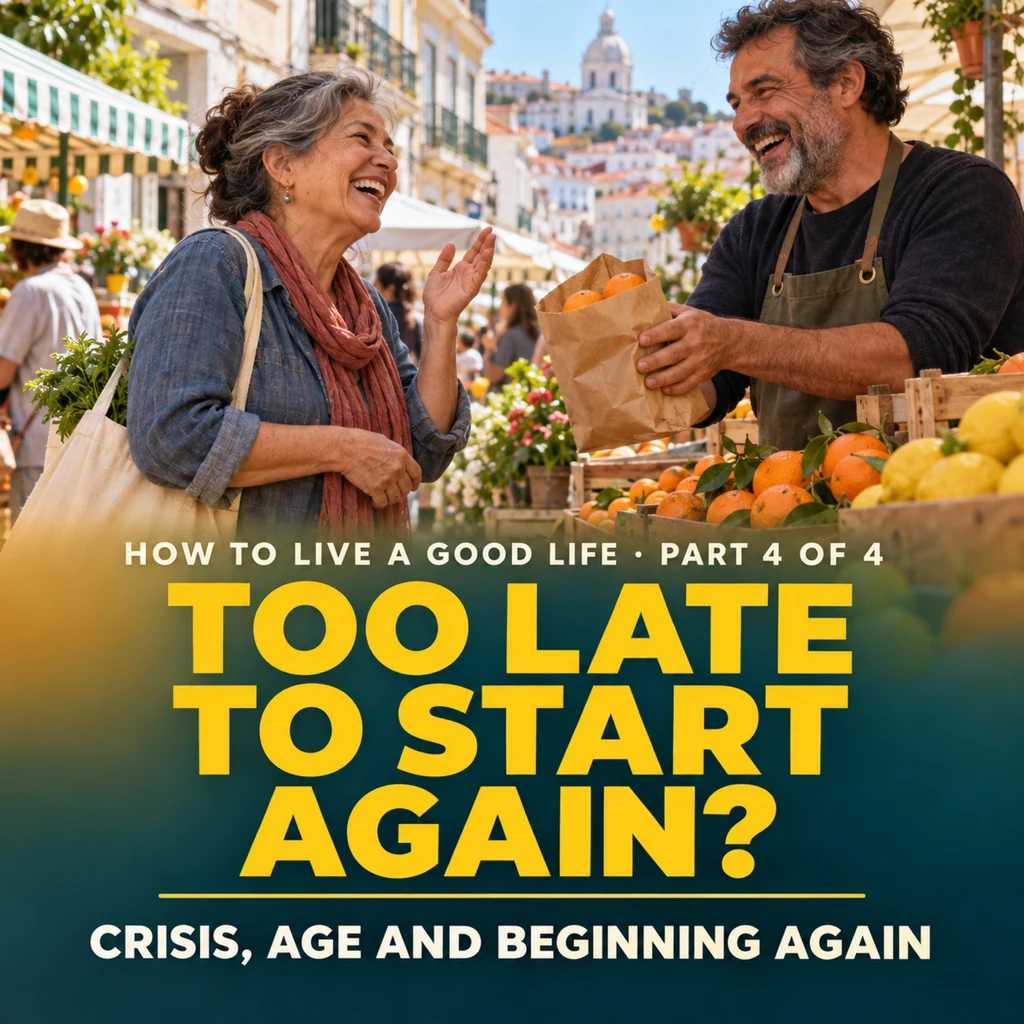
Miriam is from Bogotá, in Colombia.
She worked for the same company for twenty-one years.
And?
And at fifty-two, the company closed.
Not a bad year, not a difficult month.
Closed.
Fifty-two is a terrible age for that.
It is the worst age for that.
Too old to be a junior, too young to stop.
Her daughter was already living in Lisbon, in Portugal, and said, come.
And she went?
She went.
With two suitcases and a certainty.
What certainty?
That she was too late for everything.
Too late to learn the language properly.
Too late to make real friends.
Too late to be hired by anybody.
Too late to belong to a place.
So what actually happened?
Four things, over five years, and none of them is dramatic.
Tell me the first.
The Portuguese class.
She was the oldest person in the room by nineteen years.
Oh no.
And she hated it for about a month.
And then she noticed that she was the first to arrive every week, because she liked the ten minutes before the class started, when people talked about their week.
So she was not there for the grammar.
She was there for the ten minutes.
And so was everybody else, they just did not know it.
Second thing.
The Saturday market.
Same stall, every Saturday, for eight months, buying fruit from the same man.
A third place.
A third place.
And she counted the moment it changed.
In month nine, he stopped calling her senhora and started calling her Miriam.
That is it?
That is the whole event?
That is the whole event.
She told her daughter she felt like she had been given a passport.
Third thing.
A job.
Administrative work, part time, and she got it because a woman from the Portuguese class knew somebody.
Of course she did.
Not because Miriam was the best candidate.
Because she was in the room where somebody heard about it.
And the fourth?
The fourth is my favourite.
Dona Alice, the neighbour on the floor below, who is eighty-one, and who could not carry her shopping up the stairs.
So Miriam started carrying it.
Every week.
And then, two winters later, at eleven o'clock at night, Dona Alice fell in her kitchen.
And who did she call?
She did not call her son in Porto.
She called the woman upstairs.
I want to point at something in that story, because it is easy to miss.
Point at it.
Miriam did not build a new life.
She built a Tuesday, and a Saturday, and a neighbour.
And five years of Tuesdays is a life.
There was no moment where it changed.
There was no moment.
That is exactly why people give up at month three.
They are waiting for a moment, and what actually arrives is a man at a fruit stall learning your name.
And if you think Miriam was simply lucky, this is where the research becomes surprising.
Now, the age question, properly.
Yes, because there is real research here and it is genuinely surprising.
Surprise me.
In many large international studies, average life satisfaction does not follow a straight line down as people age.
What does it do?
It often shows a U-shaped pattern.
A U.
Life satisfaction tends to fall towards midlife.
In some major studies, the average low point appears somewhere in the late forties.
And then?
On average, it gradually rises again.
So forty-seven is the worst year.
No. That is an average pattern in some large studies, not a prediction for every person or every country.
So the important point is not a birthday.
Exactly.
The important point is that a low point in midlife does not mean the rest of the line keeps going down.
Why does it go up?
There is a good explanation, from a researcher called Laura Carstensen.
When we are young, time feels unlimited, so we collect.
We collect people, contacts, options, experiences.
Everything might be useful one day.
And when time starts to feel limited?
We stop collecting and we start choosing.
Not necessarily better people.
More emotionally meaningful relationships.
Fewer plans, better plans.
Less time with people who drain you.
So the good news is not that you get wiser.
No.
I want to be careful here.
Age does not automatically give you wisdom, and it certainly does not guarantee happiness.
Plenty of people get older and more bitter.
Plenty.
What age can do is change what you think deserves your attention.
And that is available at fifty-two, in a Portuguese class, at the front, ten minutes early.
There is one more thing I want to give our listener, and it is about work.
Go on.
Because in episode one we said the job is not the enemy.
It is not.
For a lot of people, work is where the relationships are.
The colleague you eat lunch with.
The person who trains you.
And then it stops.
Retirement, redundancy, illness, a move to another country where your qualifications mean nothing.
And people describe that as losing their purpose.
But purpose is not only a job title.
There is a word psychologists use.
Generativity.
Explain it.
It is the desire to guide, support, or create something useful for the people who come after you, a form of purpose often studied in midlife and later life.
Teaching somebody.
Mentoring somebody at work.
Volunteering.
Looking after grandchildren.
Running the football team on a Sunday.
And the important part is this.
Your legacy is not what you leave when you die.
It is what you are leaving inside other people, right now, this week.
And Miriam?
Miriam teaches Spanish to Dona Alice's two great-grandchildren on Wednesday afternoons.
Badly?
Extremely badly.
She says they correct her Portuguese and she corrects their Spanish and everybody shouts.
Right.
Three sentences, for starting again.
And these are the bravest sentences in the whole series.
Listen, and repeat in the pause.
Sentence one, for a person you let go.
It has been a long time, and I would still like to hear from you.
Sentence two, for a room where you know nobody.
I am new here.
Do you mind if I join you?
Sentence three, for anything you think you are too old for.
I have never done this before.
Where do I start?
All three again.
It has been a long time, and I would still like to hear from you.
I am new here.
Do you mind if I join you?
I have never done this before.
Where do I start?
Notice that the third one is not an apology.
It is not.
I have never done this before is a fact.
Where do I start is a request.
And between them there is no sorry, and no I am probably too old for this.
Because you are not applying for permission.
And our sentence of the day.
Ready?
It is late.
It is not too late.
It is late.
It is not too late.
One more time, with us.
It is late.
It is not too late.
So we come to the photograph.
We do.
We have carried it through four conversations.
In the first, a photograph of your life twenty years from now, and who is standing in it.
In the second, the people at the edges of the frame, who already like you more than you think.
In the third, an old photo of two friends at a wedding in Valencia.
And today?
Today, the one that matters.
Imagine a photograph of your life, ten years from now.
Not the house.
Not the job title.
Not the money.
Who do you hope is standing beside you?
And now the real question.
What do you need to begin doing this week, so that they are still there?
Because that photograph is not going to arrive by itself.
It is being taken now.
Every Sunday call, every coffee with a date on it, every message you nearly did not send.
So here is your task, and it is the last one of the series.
One step, this week, towards a relationship, a community, or a purpose you want to still have in ten years.
Not a plan.
A step.
Send the message.
Walk into the room.
Ask, where do I start?
And if a voice in your head says it is too late.
Ask it a question.
Too late compared to what?
That is the end of the series.
Four conversations about how to live a good life.
And the answer, after eighty years of research and four episodes, is almost embarrassing.
It is people.
It was always people.
But there is one more thing, and we have been honest with you all the way through, so we will be honest now.
For four episodes, we have told you that relationships are the foundation of a good life.
And that is true.
But you also live in a body.
So next time, a bonus conversation.
Ten habits associated with a longer, healthier life.
Movement, food, sleep, rest, purpose, and the relationships that connect all four conversations in this series.
Everything from today, the transcript, the vocabulary, and the three sentences, is waiting for you at yourenglishtoolbox.com.
You can listen and read without registering, and a free student account gives you the downloadable study PDFs and progress tools.
Thank you for spending this time with us.
And whoever you are thinking about right now.
Write to them.
See you in the next one.