The audio controls above still work. Interactive translation, saving and practice need JavaScript. You can read the complete transcript and download your study materials below.
Complete English transcript
Julia, we have been saying goodbye for five minutes.
I am trying to end the conversation naturally.
You have said, “Well...” three times, but you are still here.
I do not want to sound rude.
Then you need an exit expression, not another “well”.
Can English really make leaving easier?
Yes.
Today we are learning four natural ways to close a conversation warmly and clearly.
Good.
Because I should leave before the introduction becomes the whole episode.
Welcome to Your English Toolbox.
I am Martin.
And I am Julia.
This is episode seven of Everyday Useful Expressions, our series of ready-made English for real situations.
Today we are learning how to end a conversation without disappearing suddenly or continuing forever.
Our first expression is: I should let you go.
I should let you go.
Use this when you want to end the conversation while showing consideration for the other person’s time.
For example: I know you have an early meeting, so I should let you go.
Or: It has been lovely talking, but I should let you go.
The expression sounds as if you are releasing the other person, but it is really a polite signal that the conversation is ending.
A common reply is: Yes, I should get going.
It is especially natural near the end of a friendly phone call.
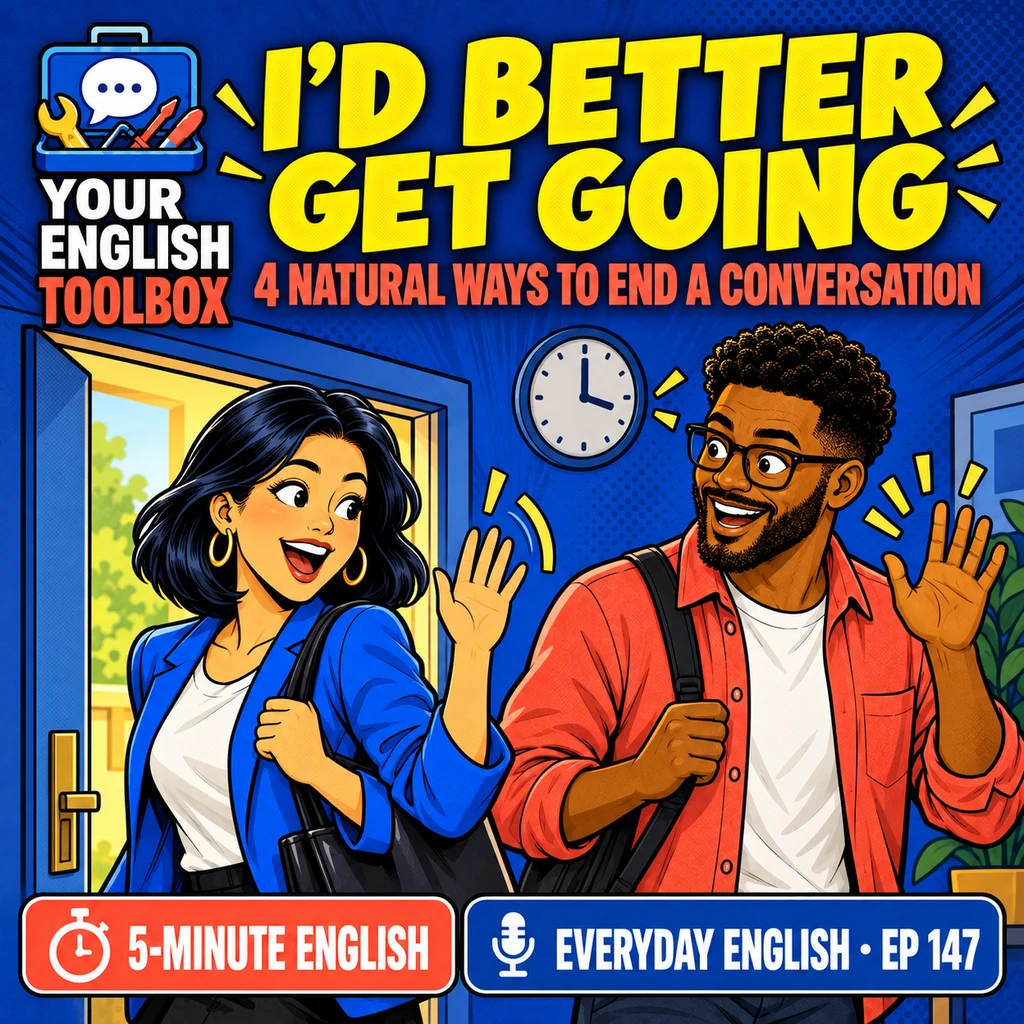
Our second expression is: I’d better get going.
I’d better get going.
This focuses on your own need to leave or stop talking.
For example: I’d better get going.
My train leaves in twenty minutes.
The full form is I had better get going, but the contraction I’d better is very common in speech.
Does it sound urgent?
Not necessarily.
It creates a clear, friendly transition towards leaving.
It is more natural than suddenly saying, “I go now.”
Much more natural.
Our third expression is: Let’s catch up soon.
Let’s catch up soon.
To catch up means to talk and share news after some time apart.
We often use this expression near the end of a conversation to show that we want to stay connected.
For example: I’d better get going, but let’s catch up soon.
Or: It was great seeing you.
Let’s catch up again next week.
Be careful with the meaning of soon.
Yes.
Let’s catch up soon can be a warm general intention, not a fixed appointment.
If you truly want to arrange something, add a concrete next step.
For example: Let’s catch up soon.
Are you free next Tuesday?
Our fourth expression is: It was good talking to you.
It was good talking to you.
This is a warm closing line after a useful or enjoyable conversation.
For example: It was good talking to you.
Give my regards to your family.
A natural reply is: You too.
Or: It was good talking to you too.
Why do we use was if we are still speaking?
Because we are treating the conversation as almost complete.
The past form signals that we are closing it.
That is a small piece of grammar doing an important social job.
Exactly.
Together, the expressions can open the exit, give a reason to leave, point towards future contact and close warmly.
You do not need all four every time.
Usually one or two are enough.
Time for a quick challenge.
Choose the most natural expression before we answer.
Situation one.
Your friend has an early meeting, and you want to respect their time.
I should let you go.
Situation two.
You need to leave because your bus arrives soon.
I’d better get going.
Situation three.
You want to suggest another friendly conversation in the future.
Let’s catch up soon.
Situation four.
You want a warm final sentence after a long phone call.
It was good talking to you.
Now practise a complete ending aloud.
Your friend says: I have to prepare dinner now.
You could say: Of course.
I should let you go.
It was good talking to you.
That sounds warm, clear and complete.
On the episode page at yourenglishtoolbox.com, you will find five additional expressions for ending conversations naturally.
Each one includes its meaning, tone, two examples and active practice.
The direct link is in the episode description.
Martin, I think I am ready to end our conversation now.
Go ahead.
I’d better get going.
Very natural.
Let’s catch up soon.
We record together every week.
Then I can be more specific.
Let’s catch up on Tuesday at ten.
Perfect.
It was good talking to you.
You too.
See you next time, friends.
Goodbye.