The audio controls above still work. Interactive translation, saving and practice need JavaScript. You can read the complete transcript and download your study materials below.
Complete English transcript
Martin, did the workshop organisers finally confirm your place?
They sent me a very long email.
What did it say?
First they thanked everyone.
Then they explained how popular the workshop is.
After that, they described the building.
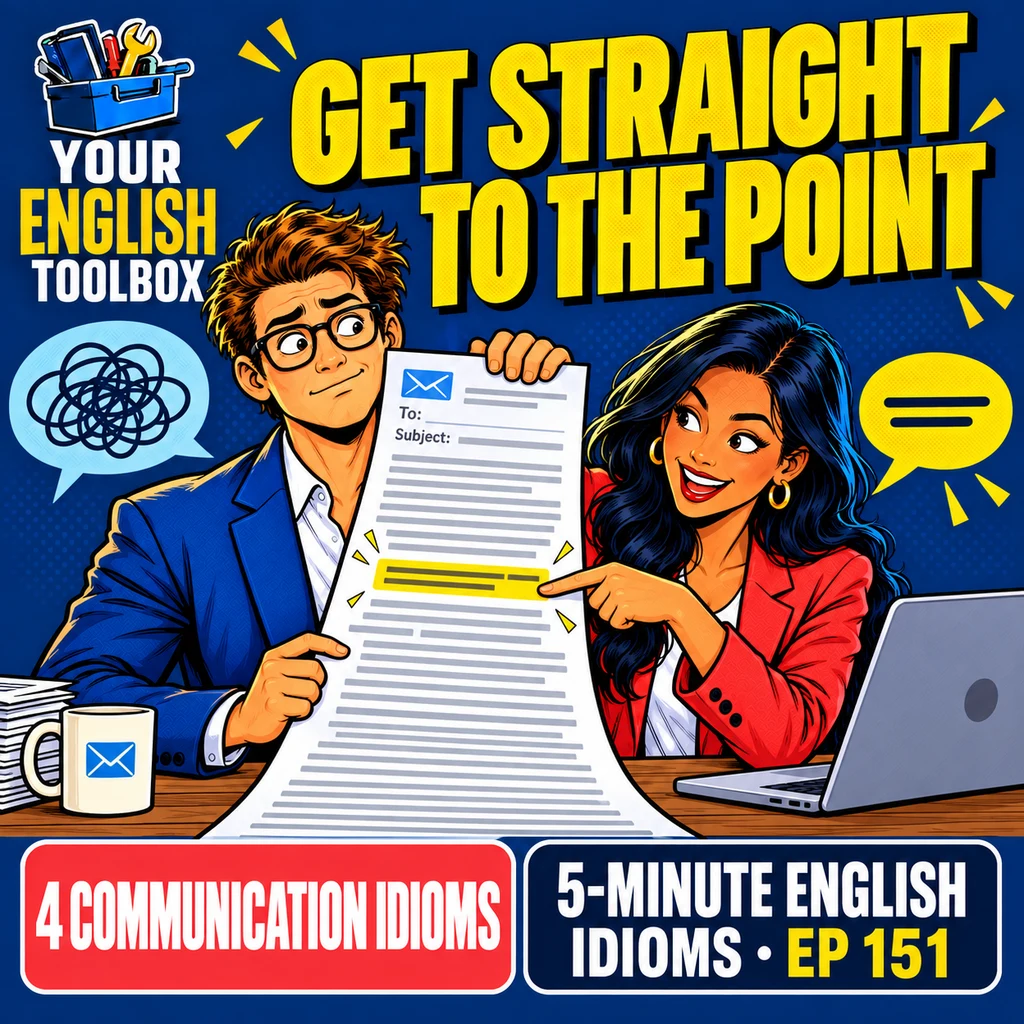
Martin, get straight to the point.
Fine.
My place is not confirmed.
They were beating around the bush.
Yes.
If I read between the lines, someone may have cancelled and I am next on the waiting list.
Did they promise another update?
Yes.
They said they would keep me posted.
Excellent.
Four expressions before the introduction.
Welcome to Your English Toolbox.
I am Martin.
And I am Julia.
Today we are exploring lesson ten of our free Idiom Toolbox course: Communication.
Find the course at yourenglishtoolbox.com.
Open the Idioms section and choose lesson ten, Communication.
You will find a slow dialogue, clear meanings, examples and interactive practice.
The direct link is also in the episode description.
Let us begin with get straight to the point.
To get straight to the point means to say the important thing immediately.
For example: Let us get straight to the point.
We cannot finish the project today.
Or: She got straight to the point and asked whether I wanted the job.
This expression values clarity.
It is direct, but your tone determines whether it sounds helpful or rude.
And learn the full expression: get straight to the point.
Our second idiom is beat around the bush.
To beat around the bush means to avoid saying something directly, usually because the subject is uncomfortable.
For example: Stop beating around the bush and tell me what happened.
Or: He beat around the bush before admitting that he had lost the keys.
It is often critical.
You are saying that someone is taking too long to reach the real subject.
So get straight to the point and beat around the bush are almost opposites.
One moves directly to the main message.
The other avoids it.
Our third expression is read between the lines.
To read between the lines means to find a meaning that is suggested but not stated directly.
The workshop email sounded positive, but it did not promise Martin a place.
He noticed what the organisers did not say.
For example: If you read between the lines, her polite reply is actually a refusal.
We can read between the lines of an email, message, conversation or tone.
We use real clues; we do not simply invent a meaning.
Our fourth expression is keep someone posted.
To keep someone posted means to continue giving that person the latest information.
For example: I will keep you posted about the interview.
Or: Please keep us posted on any changes.
Notice the pattern: keep someone posted about or on something.
We can also simply say: Keep me posted.
Let us compare all four idioms.
Get straight to the point means say the important thing immediately.
Beat around the bush means avoid saying something directly.
Read between the lines means understand a meaning that is suggested but not stated.
And keep someone posted means continue giving someone the latest information.
Time for a quick challenge.
Choose the best expression before we answer.
Situation one.
Your colleague gives a long introduction, but you need the main message now.
Ask them to get straight to the point.
Situation two.
A friend avoids explaining why they missed the meeting.
They are beating around the bush.
Situation three.
A polite message suggests disappointment without stating it.
You need to read between the lines.
Situation four.
A technician promises to tell you whenever there is progress.
The technician will keep you posted.
Now complete this sentence about your own life.
Please keep me posted about...
Continue with lesson ten in the free Idiom Toolbox course at yourenglishtoolbox.com.
Use the retrieval practice to recall the four idioms without looking at the answers.
The direct link is in the episode description.
So, will the organisers keep you posted?
They promised to email tomorrow.
And what will you do until then?
I will try not to read between every possible line.
That sounds wise.
But if they send another five-paragraph email, I am starting at the final sentence.
You are learning to get straight to the point.
See you next time, friends.
Goodbye.