The audio controls above still work. Interactive translation, saving and practice need JavaScript. You can read the complete transcript and download your study materials below.
Complete English transcript
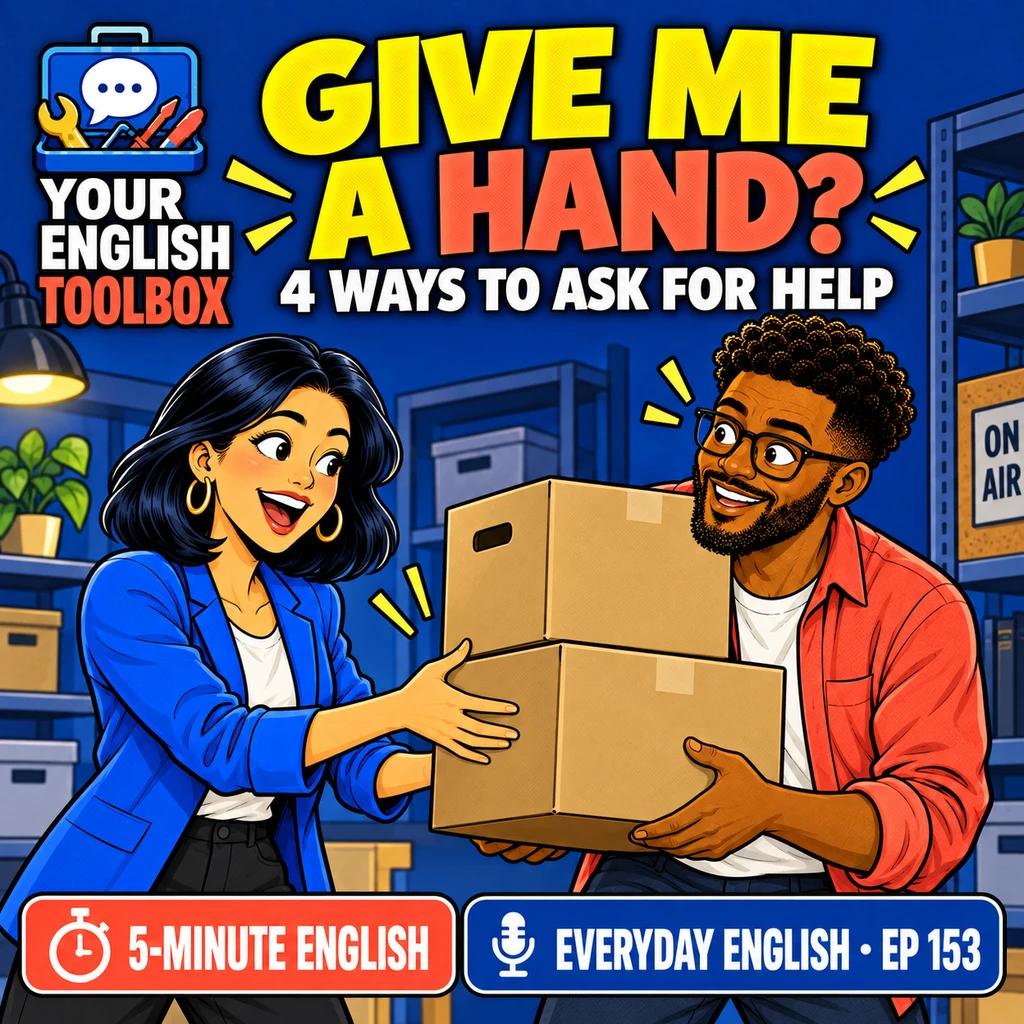
Julia, could you help me with these boxes?
I could, but you are carrying four at once.
Why did you not ask before you disappeared behind them?
I said, “Help me with these boxes.”
That sounds more like a command than a polite request.
Then could you give me a hand?
Much better.
Put the boxes down first, and we can teach the expression properly.
Welcome to Your English Toolbox.
I am Martin.
And I am Julia.
This is episode eight of Everyday Useful Expressions, our series of ready-made English for real situations.
Today we are learning four natural ways to ask for help politely.
Our first expression is: Could you give me a hand?
Could you give me a hand?
It means: Could you help me?
It is friendly and very natural for practical tasks.
For example: Could you give me a hand with these boxes?
Or: Could you give me a hand moving this table?
Notice the pattern: give someone a hand with a noun or with an action ending in ing.
And no, nobody is asking for a separate hand.
Usually, no.
Our second expression is: Would you mind...?
Would you mind...?
Use would you mind plus an action ending in ing.
For example: Would you mind holding the door for me?
Or: Would you mind helping me move this chair?
Do not say, “Would you mind to hold the door?” After mind, use the ing form.
There is also a small trap in the answer.
If someone asks, “Would you mind helping me?”, the reply “Not at all” means you are happy to help.
You can also avoid confusion and say: Of course.
I can help.
Our third expression is: I could use some help with...
I could use some help with...
This is an indirect, gentle way to say that help would be useful.
For example: I could use some help with this report.
Or: I could use some help carrying these bags.
It works well when the situation is clear and the other person can offer to help.
If you need a direct answer, you can follow it with a request: I could use some help with the chairs.
Could you give me a hand?
Our fourth expression is: I’d appreciate it if you could...
I’d appreciate it if you could...
This is polite and slightly more formal.
It is useful at work, in emails or when the request requires extra effort.
For example: I’d appreciate it if you could send me the figures before lunch.
Or: I’d appreciate it if you could check the booking one more time.
Notice the complete pattern: I’d appreciate it if you could, followed by the base form of the verb.
So: if you could send, check or help.
Let us compare the four expressions.
Could you give me a hand? is friendly and practical.
Would you mind plus ing is a polite request that focuses on whether the action is a problem.
I could use some help with something is gentle and indirect.
And I’d appreciate it if you could is polite and more formal.
Time for a quick challenge.
Choose the most natural expression before we answer.
Situation one.
You want a friend to help you carry a heavy table.
Could you give me a hand with this table?
Situation two.
You want to ask the person beside you to close the window.
Would you mind closing the window?
Situation three.
You want to signal gently that a difficult spreadsheet is too much for one person.
I could use some help with this spreadsheet.
Situation four.
You are writing to a colleague and need the final document before a meeting.
I’d appreciate it if you could send me the final document before the meeting.
Now turn this command into a polite request: Check these numbers.
You could say: Would you mind checking these numbers?
Or: I’d appreciate it if you could check these numbers.
On the episode page at yourenglishtoolbox.com, you will find five additional expressions for asking for help politely.
Each one includes its meaning, tone, two examples and active practice.
The direct link is in the episode description.
Julia, could you give me a hand with the boxes now?
Of course.
Which one should I take?
The smallest one.
You carried four boxes over here, and you are giving me the smallest one?
I am practising polite requests, not poor decisions.
I’d appreciate it if you could reconsider.
That expression is very effective.
See you next time, friends.
Goodbye.