The audio controls above still work. Interactive translation, saving and practice need JavaScript. You can read the complete transcript and download your study materials below.
Complete English transcript
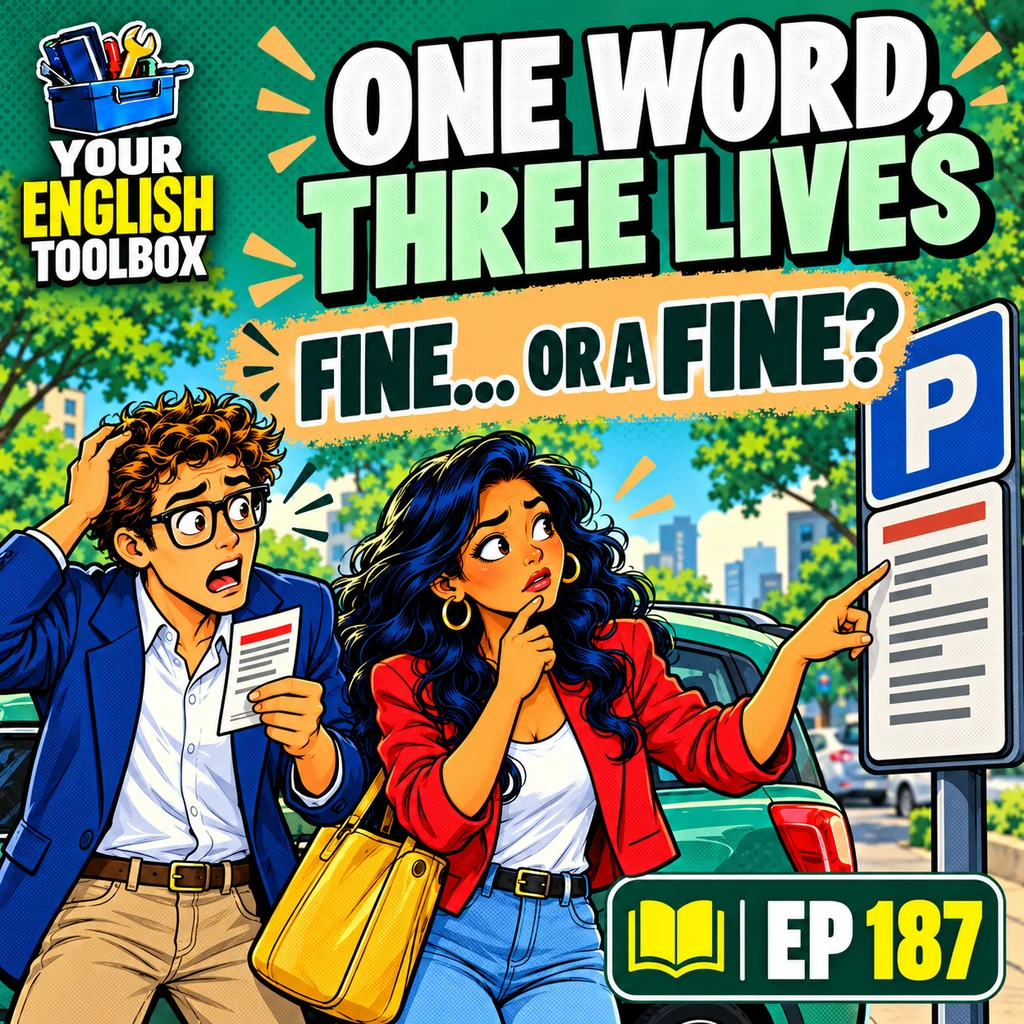
Julia, I said the parking was fine, but now I have a fine.
That sounds like one word having a very expensive conversation with itself.
Welcome to One Word, Three Lives, from Your English Toolbox.
I am Martin, and Julia is here to help me understand my parking ticket.
Today's word is fine.
We will follow it through three scenes, because the words around it change the meaning.
Scene one: we are making a plan.
Shall we meet outside the cinema at six?
Six is fine with me.
Here, fine means acceptable or satisfactory.
Julia is saying that the time works for her.
Notice the pattern: something is fine with someone.
Tomorrow is fine with me, or that arrangement is fine with our team.
It does not automatically mean wonderful or exciting.
And tone can make a difference, but the word alone cannot tell you what someone secretly feels.
If I am unsure, I can ask whether the plan really works for you.
Exactly, rather than trying to read your friend's mind.
Now scene two: I return to my car.
There is a notice on the windscreen, and it says I must pay a fine.
A fine is money you have to pay as a punishment for breaking a rule or law.
In this scene, it is a parking fine.
The little word a helps us notice the change.
This is a noun, not the adjective.
We say get a fine or pay a fine.
You might hear: he got a fine for parking in the wrong place.
That example teaches the language, not the parking rules of any particular city.
Now for scene three: we read the sign more carefully.
The large letters say parking, but the conditions underneath are tiny.
We need to read the fine print.
Fine print means small printed writing, especially details or conditions that are easy to overlook.
So fine can also refer to something very small or thin.
Here, it describes the size of the writing, not whether the conditions are good.
You may also hear small print, especially in British English.
Read the fine print before you accept an offer.
Let us play a quick interpretation game.
I say: Friday afternoon is fine with me.
Am I accepting a plan, receiving a penalty, or checking tiny writing?
Accepting a plan.
Now: she had to pay a fine.
A financial penalty.
The fine print.
The small writing containing the details.
Now complete this sentence with a time that works for you: meeting at... is fine with me.
One word, three lives: acceptable, a penalty, and small writing.
Look at the grammar and the situation, not just the familiar spelling.
Our episode page has a three-way practice activity and examples you can download.
Follow the link in the description.
And next time, I will read the sign before the film, not after it!