The audio controls above still work. Interactive translation, saving and practice need JavaScript. You can read the complete transcript and download your study materials below.
Complete English transcript
Welcome to Your English Toolbox,
your slow English podcast where we train your ears step-by-step.
I'm Martin.
And I'm Julia.
Before we begin, I want to ask you for a small but very important favor.
If you learn even one helpful idea today, please write a short comment after listening.
Comments tell the platforms that our community is real and active.
They help more learners find the podcast and help us continue creating new episodes.
Thank you for supporting this show with your voice.
Part One: The Opening Message.
Today, we explore an idea that sounds simple but is difficult to live.
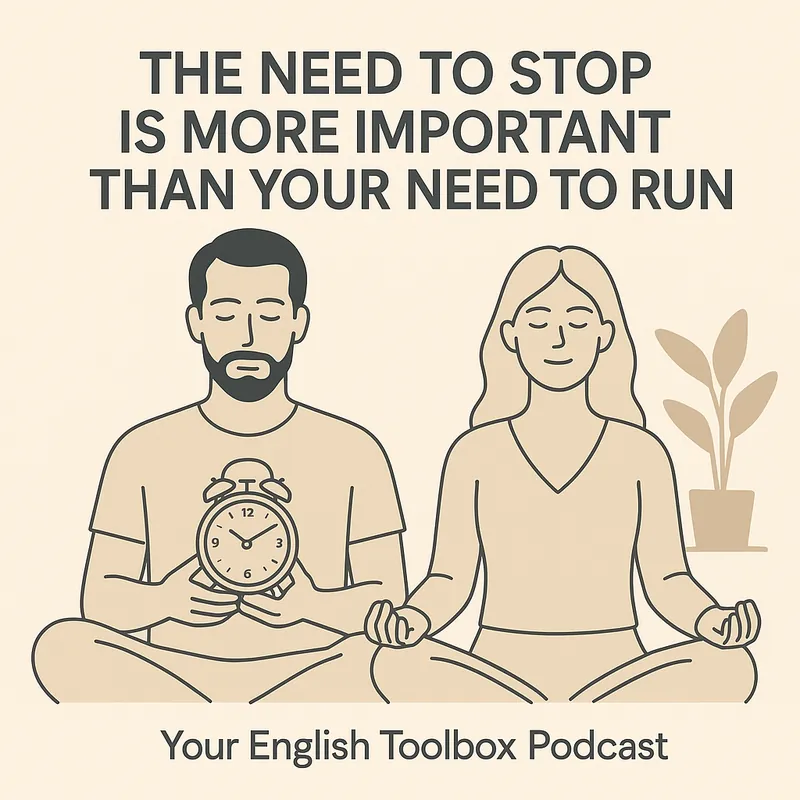
The need to stop is more important than your need to run.
We live in a world that tells us to move faster and do more.
Learning to pause almost feels like breaking the rules.
And yet slowing down changes everything.
It changes how you think, how you learn, and how you feel.
Part Two: The Illusion of Speed.
Many of us live with the feeling that we are behind, behind our goals and behind the people around us.
That pressure makes us run even when we have no energy.
We jump from task to task and call it productivity.
But what if running faster is not the solution?
What if real progress begins when you stop?
The mind is like a lake.
When the wind moves the surface, everything becomes cloudy.
But when the wind stops, the water becomes still and clear.
The same happens inside us when we stop rushing.
Stopping is not laziness.
It is intentional stillness.
It is the moment when you reconnect with what matters.
Part Three.
Story One: Arianna Huffington.
Let's begin with a powerful real story.
Arianna Huffington believed success meant constant motion.
She worked almost 18 hours a day and slept very little.
Until one morning, she collapsed at her desk.
She broke her cheekbone and woke up in a pool of blood.
That moment changed her life completely.
She began asking a new question, "What is the point of running if the race destroys you?"
She started studying sleep, balance, and mindfulness.
Later, she left the company she had built and created Thrive Global.
And she became more effective and more creative than before, because real productivity comes from presence, not pressure.
Part Four.
Story
Two: Keanu Reeves.
The second story comes from actor Keanu Reeves.
He is known for being calm, humble, and kind, but he has lived through enormous personal loss.
He lost his closest friend, his partner, and even his child.
Instead of running from pain, he slowed down.
He lived quietly, reading in cafes and riding the subway.
That quietness became his strength.
When someone asked how he stayed grounded, he gave a simple answer.
"Sometimes simple things are the most difficult to achieve, simplicity, silence, and a smile."
Slowing down did not reduce his success.
It made him more respected, more admired, and more human.
When he stopped chasing the world, the world came to him.
Part Five: What Mindfulness Really Means.
Many people imagine mindfulness as something complicated, but it is simple.
Mindfulness is the art of noticing.
Noticing your breath, your thoughts, your emotions, and your reactions.
Jon Kabat-Zinn defines it as paying attention on purpose in the present moment without judgment.
That small pause creates space, and in that space, you find freedom.
You realize you don't need to react automatically.
You don't need to push through exhaustion.
You can choose the next step instead of repeating old habits.
Mindfulness transforms life from a race into a practice.
Part Six: The Cost of Constant Running.
Most of us are addicted to running mentally.
We run toward goals, deadlines, and pressure.
We believe slowing down means falling behind.
But when you never rest, your attention becomes scattered.
You lose clarity, depth, and joy.
Learning becomes mechanical instead of meaningful.
It is like trying to fill a shaking glass with water; most of the water spills out.
The same happens with knowledge.
Nothing stays when the mind is shaking.
That is why stopping is essential.
Stopping is not failure.
Stopping is where understanding begins.
Part 7:
Mindfulness and English Learning.
Now, let's connect this philosophy to English learning.
Many learners want fast results.
But language learning is not a sprint; it is a long walk through a forest.
If you run, you miss the details that matter.
This is why we teach slow English.
Real fluency comes from mindful repetition.
When you slow down, your brain finally absorbs what you hear.
Mindfulness helps at every stage.
When you listen, listen fully.
When you speak, notice your pronunciation.
When you study vocabulary, feel the rhythm of the words.
It is not about studying more; it is about studying with awareness.
Part 8: Practical Mindful English Habits.
Here are simple ways to apply mindfulness to English.
Mindful listening means focusing on the sound of each word.
Notice pauses, tone, and emotion.
Mindful speaking means taking a breath before you speak; say the sentence slowly and clearly.
Mindful reading means stopping after a paragraph;
let the meaning settle.
Mindful writing means writing slowly and enjoying the process; feel your ideas turning into language.
Part 9: Final Reflection.
When we stop running, something magical appears; we start hearing life again.
Learning becomes lighter and more joyful.
Thich Nhat Hanh said, "Smile, breathe, and go slowly."
That sentence contains everything.
When you learn slowly, you understand deeply.
When you speak slowly, you connect honestly.
When you live slowly, you live more completely.
So take a breath.
Your need to stop is more important than your need to run.
If you enjoyed this episode, please write a short comment before you go.
Comments tell the platforms that our community is real and active.
Your support helps us continue creating new mindful episodes every week.
Tell us how slowing down has helped your English or what topic you want next.
Thank you for listening.