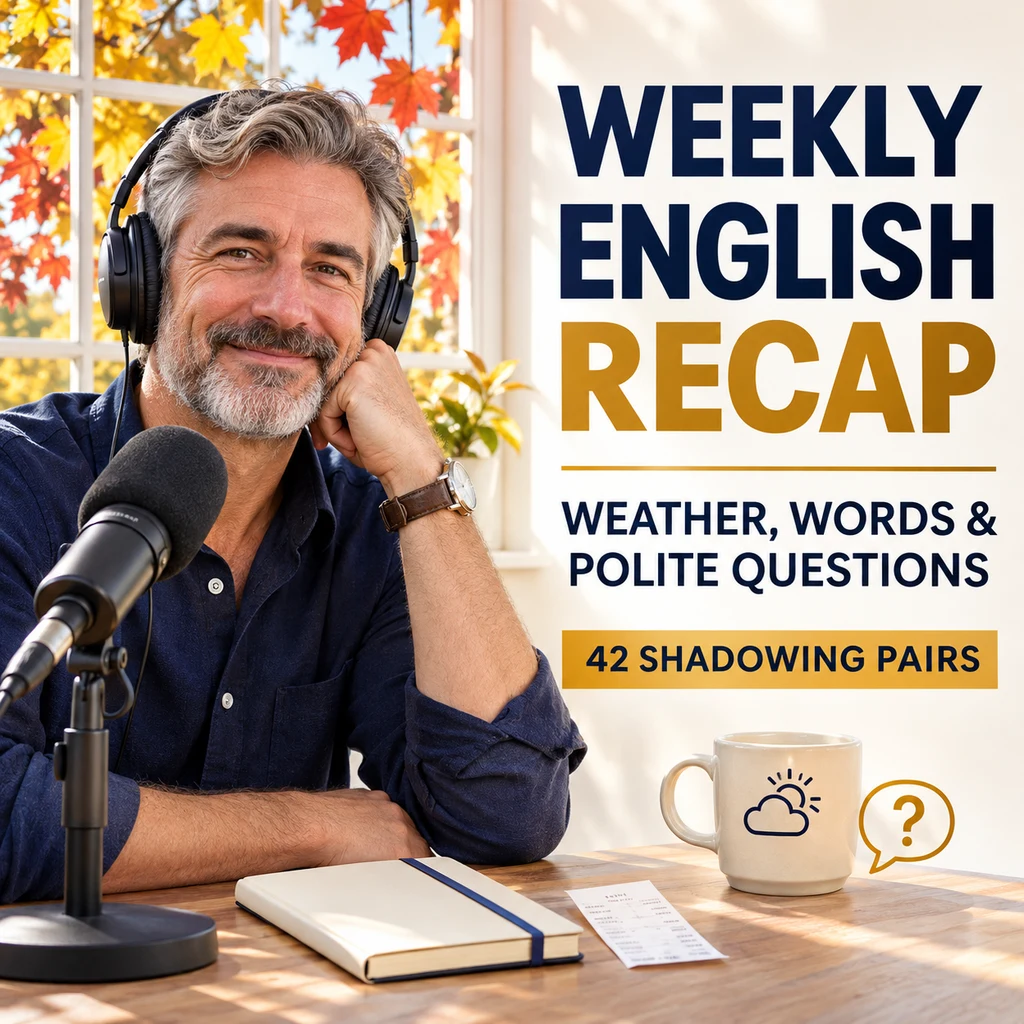
The audio controls above still work. Interactive translation, saving and practice need JavaScript. You can read the complete transcript and download your study materials below.
Complete English transcript
Welcome back to Your English Toolbox.
I am Peter, and this is your weekly English recap.
Today we will practise forty-two pairs from this week's seven episodes, including two examples from one study page.
After each original sentence, use four seconds to repeat it.
Then I will say the same idea in different words.
Use the next three seconds to try that new version.
If a sentence is long, repeat just the part you can.
Let us begin with autumn leaves and the language of change.
Now some are yellow, some are orange, and some are red.
The leaves have changed from green to different autumn colours.
For example, different pigments can make a leaf look green or yellow.
Different colouring substances can make leaves appear green or yellow.
Leaves contain a green pigment called chlorophyll.
The green colour in leaves comes from a substance called chlorophyll.
As the green fades, other pigments can become easier to see.
When the green grows weaker, the other colours are more visible.
Some red pigments can be produced during autumn.
A leaf can make some of its red colour in the autumn.
The photograph has faded in the sun.
Sunlight has made the colours in the photograph less bright.
Next, we will use weather expressions with care.
It is raining cats and dogs.
The rain is coming down very heavily.
That is disappointing, but every cloud has a silver lining.
That is a setback, but there may be something good in it.
That sounds like a storm in a teacup.
That sounds like a great deal of fuss about a small issue.
A hopeful expression can sound dismissive if the other person needs us to listen first.
Words meant to encourage someone may feel unkind when they first need to be heard.
The free sample might be a silver lining to the delay.
The extra sample could be one good thing about having to wait.
One final weather idiom is under a cloud, which points to suspicion.
For example, a manager left the company under a cloud after questions about missing money.
A manager left amid suspicion after people asked about missing money.
You have finished our first two topics.
Now let us order ice cream more clearly.
What arrived was a tray with five or six scoops.
The server brought a tray holding several portions of ice cream.
How many scoops come in a bowl?
How many portions of ice cream are served in one bowl?
A bowl is a deep, round dish that can hold food.
A bowl is a rounded container used for serving food.
Could I have one scoop of chocolate ice cream in a bowl, please?
May I have one serving of chocolate ice cream in a bowl?
You can have two scoops in one bowl.
A single bowl can hold two portions of ice cream.
If the menu is unclear, asking is often the easiest solution.
When the menu does not explain it, a simple question can help.
Listen for three very different meanings of run.
I ran to the station because I was late.
I moved quickly on foot to the station because I was behind schedule.
The washing machine is running.
The washing machine is switched on and working.
My sister runs a small café.
My sister manages a little café.
Maya owns the café, but her brother runs it.
The café belongs to Maya, while her brother manages its daily work.
The words around run help you find the meaning.
The surrounding words show which sense of run is intended.
Your computer can be running, and an engine can be running too.
Both a computer and an engine can be operating.
You have passed the halfway point.
Our next sentences come from The Last Train Home.
Her train had already left.
The train departed before she arrived.
Her phone battery was almost empty, and she did not know what to do.
She was unsure of her next step, and her phone was nearly out of power.
Anna carried the bag to the station office.
Anna took the bag to the office at the station.
These belong to my father.
My father is the owner of these things.
I missed the last train home.
I arrived too late to catch the final train home.
She had missed her train, but she had found another way home.
Although her train was gone, she discovered another route back.
Now practise asking polite questions about a problem.
The final two expressions in this section come from the extra practice on our website.
I think there might be a mistake on my receipt.
It looks as if my receipt may contain an error.
I ordered one sandwich, but the receipt shows two.
I asked for one sandwich, although I have been charged for two.
Could you check that for me?
Would you please take a look at that?
What can we do about it?
What would be a good way to solve this?
Could you take another look?
Would you please check it once more?
Could you confirm what happens next?
Would you please tell me what the next step will be?
Finally, let us talk about a parasocial connection.
This is a feeling of knowing a creator who does not know you personally.
It is often described as one-sided.
People often say the connection is felt mainly by one person.
You might feel connected to a creator because their stories are meaningful to you.
A creator’s stories may matter to you and make you feel close to them.
That does not mean listening to a podcast is a bad thing.
Enjoying a podcast is not automatically a problem.
Mutual means shared by both people or sides.
If something is mutual, both sides share it.
That feeling can be meaningful, even if the host does not know the listener personally.
The listener’s feeling may matter, although the host has never met them.
The context matters, and we should avoid using the word to judge someone too quickly.
Look at the situation before you use the word as a quick judgement.
You have practised forty-two pairs from our seven episodes this week.
Choose one useful phrase about weather and one polite question.
Make a sentence about your own life with each of them.
If you want another round, try to say the alternative sentence before I do.
Visit Your English Toolbox for the transcript, vocabulary and downloadable practice.
Thank you for practising with me.
This is Peter, and I will see you next time.