The audio controls above still work. Interactive translation, saving and practice need JavaScript. You can read the complete transcript and download your study materials below.
Complete English transcript
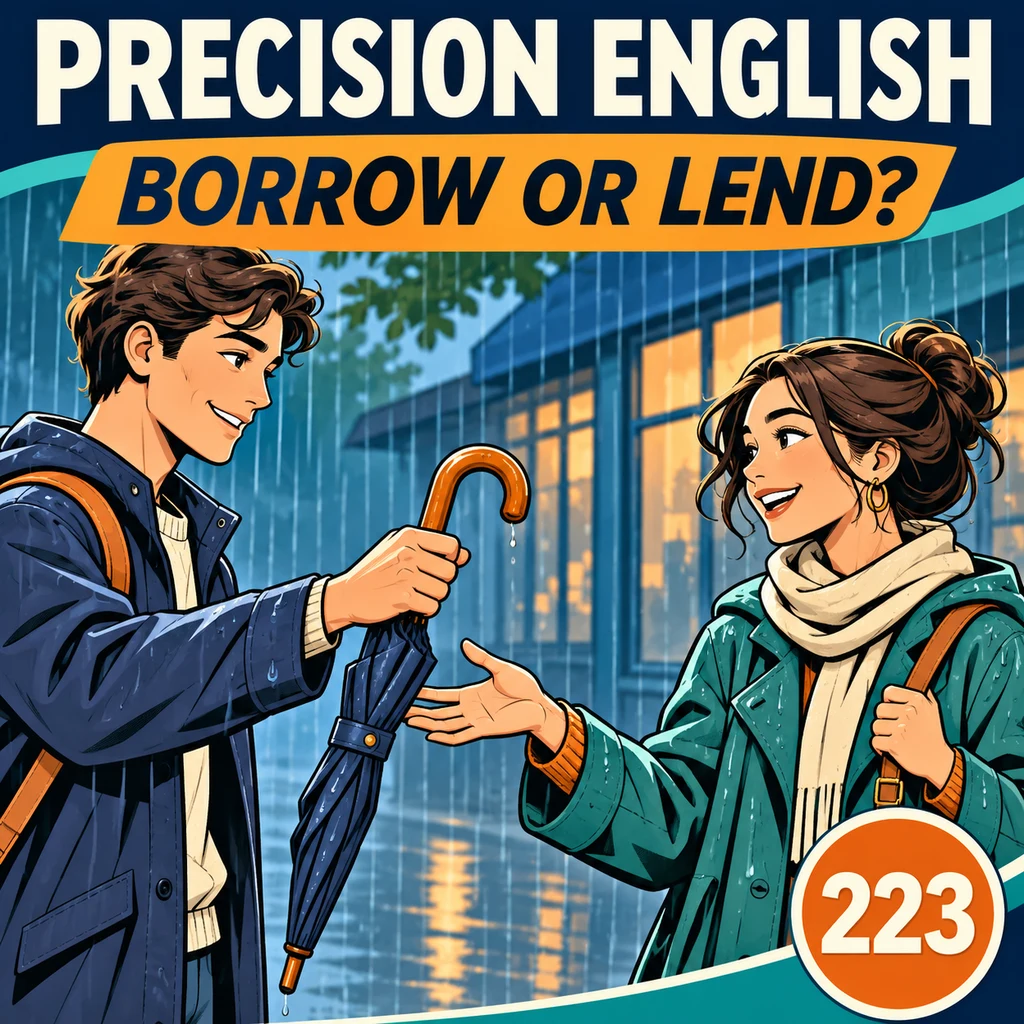
Martin, can I borrow your umbrella?
Of course.
And can you lend it to me until tomorrow?
Yes, but are borrow and lend two different actions?
They describe the same exchange from two different sides.
Today we will make those two sides clear.
Welcome to Precision English, from Your English Toolbox.
Imagine that the umbrella belongs to me.
It is raining, and I do not have one.
I give you my umbrella for a short time.
I take it and plan to return it tomorrow.
From my side, I lend you the umbrella.
From my side, I borrow the umbrella from you.
Lend focuses on the person giving something temporarily.
Borrow focuses on the person receiving something temporarily.
The object stays the same.
The direction changes because the speaker's position changes.
Listen to this question.
Can I borrow your umbrella?
Julia wants to receive it from me.
Now listen to a different question.
Can you lend me your umbrella?
This time, Julia is asking me to give her the umbrella temporarily.
Both questions can describe the same situation.
The subject of the sentence tells us which side to choose.
I borrow.
You lend.
Now let us add the useful little words.
You borrow something from someone.
I borrowed a book from Julia.
You lend something to someone.
Julia lent a book to me.
Notice the past forms.
Borrow becomes borrowed.
Lend becomes lent.
Yesterday, I borrowed a book from Julia.
Yesterday, I lent a book to Martin.
We can also leave out to in another common structure.
Julia lent Martin a book.
That means the same as, Julia lent a book to Martin.
Let us try a situation involving money.
I have forgotten my wallet, and Julia gives me ten pounds until tomorrow.
Martin borrows ten pounds from me.
Julia lends ten pounds to me.
The expectation is that Martin will give the money back.
Borrowing or lending is not the same as giving a gift.
What if the person who receives the money does not ask for it?
The words still depend on who gives and who receives it temporarily.
Julia offers to lend Martin ten pounds.
Martin can choose whether to borrow the money from Julia.
The offer and the decision are different, but the direction remains clear.
You may also hear someone say, can you lend a hand?
That expression means, can you help?
It is a useful figurative expression, not a request to borrow an actual hand.
For example, can you lend me a hand with these boxes?
The answer could be, of course, I can help you carry them.
In everyday conversation, lend can therefore refer to help as well as an object.
There is one more distinction when you ask for something.
Can I borrow your pen asks for permission to use it temporarily.
Could you lend me your pen asks the owner to give it to you temporarily.
Both can be polite, depending on your tone and the situation.
If the answer is no, you can say, no problem, I will ask someone else.
And when you return the pen, you might say, thanks for lending it to me.
That sentence looks back at the other person's action.
You can also say, thanks for letting me borrow it.
Now the focus is on your own action as the person who received the pen.
Either way, the pen goes back to its owner.
Now it is your turn.
Your friend lets you use her bicycle for the afternoon.
Complete the sentence: I borrowed a bicycle from my friend, or I lent a bicycle from my friend?
I borrowed a bicycle from my friend.
You received it temporarily.
Now speak from your friend's side.
She lent me her bicycle.
She gave it to you for a short time.
One last challenge.
Can you complete this question with lend or borrow?
Could you, blank, me a pen?
Could you lend me a pen?
You are asking the other person to give you the pen temporarily.
And you could also ask, could I borrow your pen?
Before you leave, remember the umbrella.
Did you borrow it from me?
Yes, and I will return it tomorrow.
On our website, you can explore the vocabulary guide and see the examples in your preferred language.
The link is in the description.
Thanks for listening to Precision English.
See you next time.