The audio controls above still work. Interactive translation, saving and practice need JavaScript. You can read the complete transcript and download your study materials below.
Complete English transcript
Welcome to Short Stories with Peter.
Today's story is a traditional tale, collected by the Brothers Grimm.
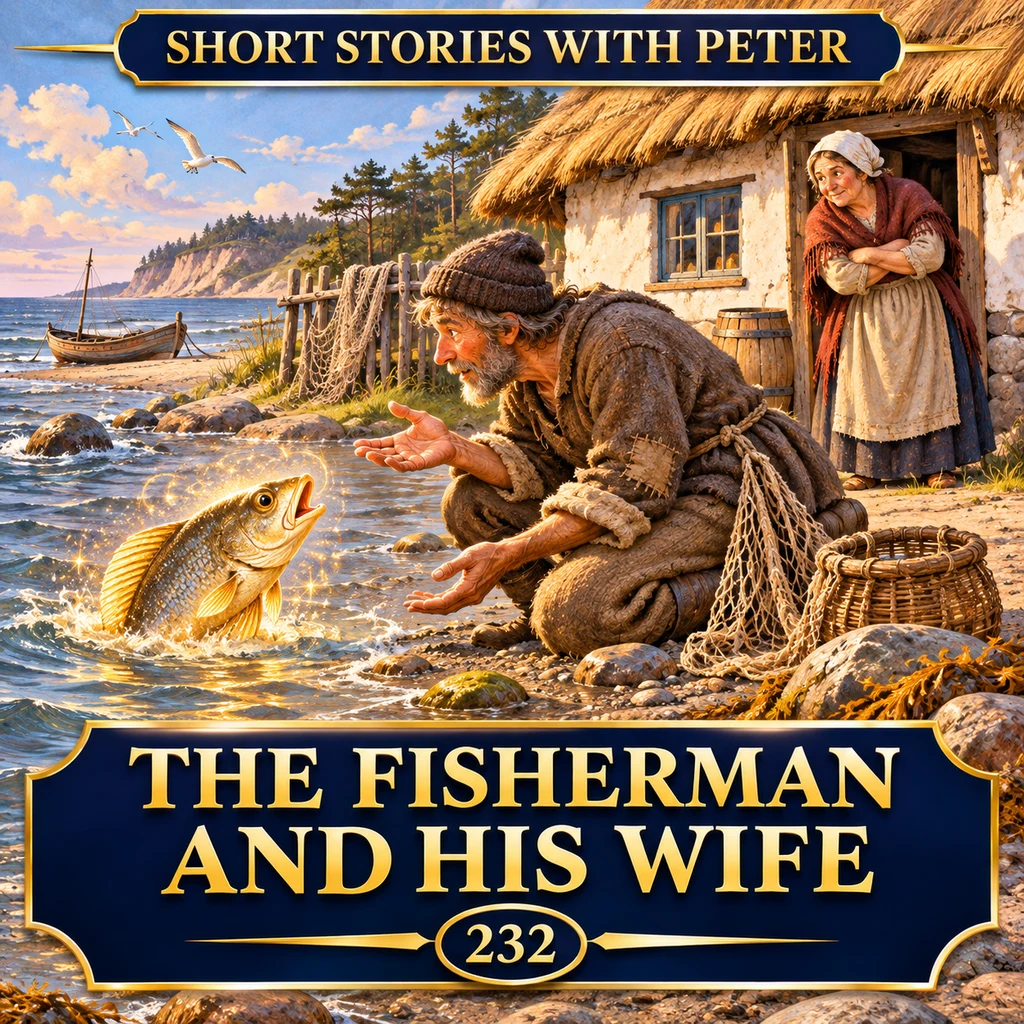
It is called The Fisherman and His Wife.
Listen to how the sea changes with each new wish.
And notice the moment when a wish becomes a demand.
Long ago, a fisherman and his wife lived in a small old hut by the sea.
Every day, the fisherman sat on the shore and fished.
The morning was quiet, and the sea was calm.
One day, he caught a very big fish.
To his surprise, the fish began to speak.
Please, let me go.
I am not an ordinary fish.
I am a prince under a spell.
The fisherman was a kind man.
A fish that can talk?
Of course, I will let you go.
He put the fish back into the water, and the fish swam away.
That evening, the fisherman told his wife everything.
You helped a magic fish, and you asked for nothing?
Go back to the sea, and ask for a nice cottage.
We cannot live in this small hut forever.
The fisherman felt uncomfortable, but he walked to the shore.
The water was a little green, and it was not clear.
He called out.
Fish, fish, in the sea, please come and talk to me.
The fish came to the surface.
What does your wife want?
She would like a cottage.
Go home.
She has it now.
The hut was gone.
In its place was a pretty cottage with a garden.
For a few weeks, the wife was happy.
Then she wanted more.
This cottage is too small.
I want to live in a big stone castle.
Again, the fisherman went to the shore.
This time, the water was yellow, and the wind was stronger.
The fish granted the wish, and the fisherman went home to a huge castle.
But the wife was still not happy.
I want to be queen of the whole country!
The fisherman did not want to ask.
But he went, and the sea was now dark purple.
Go home.
She is a queen.
So the wife became a queen, and she lived in a golden palace with many servants.
Yet one morning, she looked at the sky, and she wanted even more.
I want to decide when the sun and the moon rise!
Go to the fish, now!
The fisherman was afraid, but he obeyed.
When he reached the shore, the sky was black.
The wind was loud, and the waves were very high.
Fish, fish, in the sea, please come and talk to me.
My wife wants to control the sun and the moon.
No more.
Go home.
You will find her in the hut where you began.
The fisherman walked home slowly.
In the small old hut, his wife was waiting.
The sea was calm again.
And there they lived, in the same small hut, for the rest of their lives.
End of the story.
Now, let's dive into the language and break down some of the key vocabulary from the story.
Today we look at four words: wish, shore, grant, and enough.
First, wish.
A wish is something you want very much, often something hard to get.
We also use wish as a verb.
For example, "I wish I had more time."
In the story, the wife always has a new wish.
We also say make a wish.
For example, "She made a wish on her birthday."
Second, shore.
The shore is the land next to the sea or a lake.
For example, "The fisherman sat on the shore."
Third, grant.
To grant a wish means to give someone what they ask for.
For example, "The fish granted the wish."
We also say, "The manager granted my request."
Fourth, enough.
Enough means as much as you need.
For example, "One cottage was not enough for her."
In enough, the letters g and h together sound like f.
Say it slowly with me: enough.
Now a short challenge.
Which word means the land next to the sea?
The answer is shore.
Which word means to give someone what they ask for?
The answer is grant.
Complete this sentence: "I have a house, but it is not ... for me."
The answer is enough.
The wife had a castle and a palace, but nothing felt like enough.
That is why the story still makes us think.
You can find the key words from this story on our website, yourenglishtoolbox.com.
There you can review the vocabulary, and the link is in the description.
Thanks for listening to Short Stories with Peter.