The audio controls above still work. Interactive translation, saving and practice need JavaScript. You can read the complete transcript and download your study materials below.
Complete English transcript
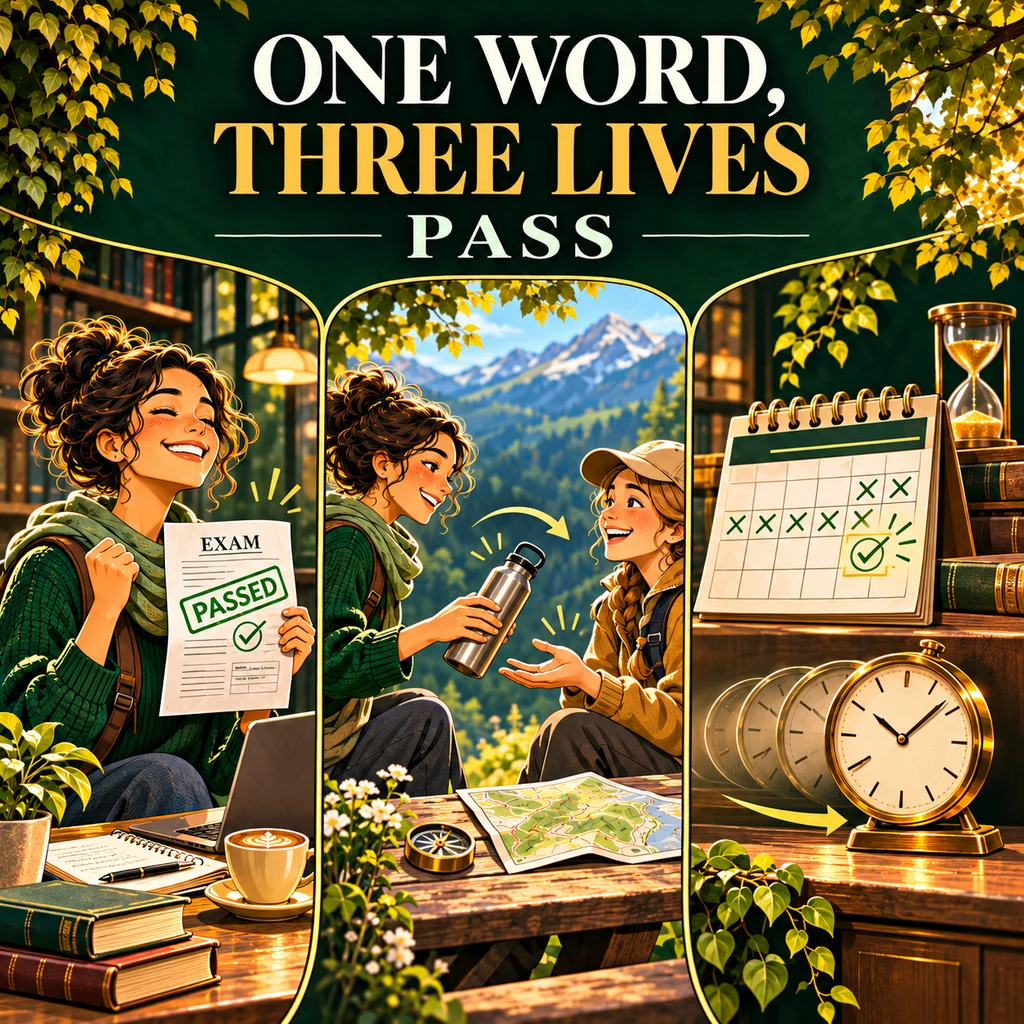
One small word appears at the exam centre, at the dinner table, and on a delayed train.
That word is pass.
Can you tell its three meanings apart?
Welcome to One Word, Three Lives.
I'm Martin.
And I'm Julia.
Today's word is pass, and we will follow it through one very long day.
Scene one: results day.
Martin, the results are online!
I passed!
Congratulations!
You passed the exam.
Thank you.
I was so nervous on Monday.
Did you study with a friend?
Yes, with my sister, and we practised every evening.
That is our first life of pass.
To pass an exam or a test means to succeed, because you get enough points.
The opposite is fail.
We can pass a test, pass a course, or pass a driving test.
Be careful with take.
To take an exam means to do it, and to pass it means to succeed.
For example, "I took the exam on Monday, and I passed."
In this life, you usually pass something official, like a test, a course, or an exam.
In British English, we can also say sit an exam, instead of take an exam.
Scene two: the celebration dinner.
Martin, could you pass me the salt, please?
Of course.
Here you are.
Would you like the water jug too?
Yes, please.
And please pass the bread to Anna.
Sure.
Also, please pass the good news on to your parents.
I will call them tomorrow.
That is our second life of pass.
To pass something means to give it to another person by hand.
In requests, we often say, "Could you pass me ...?", and it sounds polite.
We can say pass someone something: "Pass me the salt."
Or we can say pass something to someone: "Pass the bread to Anna."
And there is a useful phrasal verb: pass on.
To pass something on means to give information or a message to another person.
For example, "Please pass on my thanks to your teacher."
Scene three: the train home.
Oh, no.
The announcement says the train is delayed for two hours.
Then we need a plan.
Let's play cards to pass the time.
Good idea.
I also have a puzzle game on my phone.
Perfect.
Time can seem to pass more slowly when you wait.
That is our third life of pass.
To pass the time means to do something so that waiting feels shorter.
For example, "We read magazines to pass the time."
And notice a small difference.
We can also say that time passes, with time as the subject.
For example, "The hours passed slowly."
So, let's compare the three lives.
With an exam, pass means succeed.
With an object, pass means give it to someone.
With time, pass means spend time, or let time go by.
And here is a clue.
If you see exam, test, or course, think succeed.
If you see a person and a thing, think give.
If you see the time, think waiting or spending time.
Time for a challenge.
Listen to each sentence, and decide: exam, object, or time?
Number one: "I passed my driving test on the first try."
Exam.
She succeeded in the test.
Number two: "Can you pass me that pen?"
Object.
You give the pen to the speaker.
Number three: "We told jokes to pass the time."
Time.
The jokes made the waiting feel shorter.
Number four, a tricky one: "Please pass on the news to Lucas."
Object, in a way, but here the object is information.
You give the news to Lucas, usually by telling him.
Number five: "She worked hard, and she passed."
Exam.
Without context, passed could mean several things.
If we already know she was taking a test, it means she succeeded.
Number six: "While we waited for the bus, I listened to music to pass the time."
Time.
The music makes the waiting feel shorter.
Number seven: "Please pass the water."
Object.
You give the water to another person.
Excellent.
One word, three lives, and now you can tell them apart.
Remember: pass an exam means succeed, pass something means give it, and pass the time means fill the waiting time.
Before you answer, ask yourself one question: is it an exam, an object, or the time?
If you want more practice, visit yourenglishtoolbox.com.
There you can find exercises to review these three meanings, and the link is in the description.
Thanks for listening.
See you next time.