The audio controls above still work. Interactive translation, saving and practice need JavaScript. You can read the complete transcript and download your study materials below.
Complete English transcript
Welcome to your English toolbox, where we build your confidence, one sound at a time.
I'm Julia.
And I'm Martin.
Julia, what are we going to talk about today?
Today we are entering the gym to train the most famous and perhaps the most hated sound in the English language.
Oh, I know exactly which one!
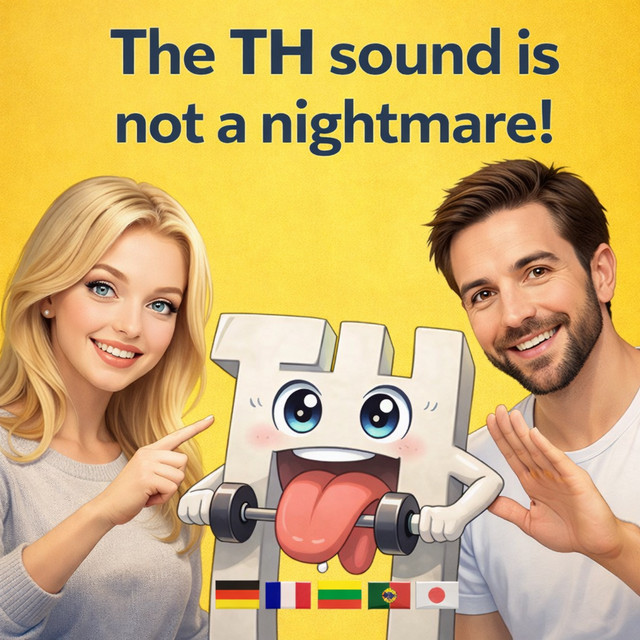
We are talking about the TH sound.
Martin, this sound is a nightmare for so many of us.
It creates so much hesitation, doesn't
it?
Absolutely.
I remember once ordering three coffees, but I was so nervous it sounded like free coffees.
The waiter looked very confused.
That is the classic trap!
If you master this sound, you stop sounding like a beginner and start sounding like a pro.
So, if you stay with us until the end, you will learn the two variations of this sound.
You will practice them with us in real time.
And you will learn why your own brain
tries to stop you from making this sound.
Let's be honest, Julia.
Who is the victim of this sound?
Almost everyone, Martin.
Exactly.
If you are a German speaker, you probably turn this sound into an S.
You might say, I am sinking instead of I am thinking.
If you speak French, you might turn it into a Z.
Z car instead of the car.
And if you speak Russian, Lithuanian or Portuguese or Japanese, you might turn it into
a T or even an F.
Why is it so hard for everyone?
Because it feels physically weird.
To make this sound, you have to stick your tongue out between your teeth.
It feels rude.
It feels like I am lisping.
That is the mental barrier.
Your brain screams, don't do it, you look silly.
But today, we are going to ignore your brain and train your tongue.
The anchor.
We need an anchor.
We need a simple concept to
hold onto.
The TH actually has two personalities.
Two?
Yes.
First, there is the unvoiced.
TH.
Think of this as simply the air.
Put your tongue between your teeth and just blow air.
Shhh.
Like a snake?
Exactly.
No voice.
Just air.
Think, thank, three.
Okay, I can feel the air on my hand.
Good.
The second personality is the voiced TH.
This is the buzzing bee.
Same position, tongue between teeth, but now, turn on your throat.
Zzz.
That
tickles.
It should tickle.
If your tongue doesn't vibrate, you aren't doing it right.
This, that, other.
Okay, so we have the air and the vibration.
Quick reminder.
If you want to see the full list of words we are practicing today, check our Patreon.
There you can find the transcripts, the vocabulary lists, and the practice guides for every episode.
We also have cheat sheets that group these pronunciation patterns for you.
It is a great way to support
the show and speed up your learning.
Check the link in the description.
Now, how do we know which one to use?
English spelling is tricky, but there is a pattern hack.
We can group these words into families.
Tell me about the first family.
Family A is the function family.
These are the small grammar words that hold sentences together.
The, this, that, these, those, them, they.
I use these words in every single sentence.
Exactly, and almost all
of them use the vibration sound.
The voiced TH.
So when I see a small grammar word starting with TH, I should vibrate?
Yes.
This, this, this, that, that, that, they.
They, they.
Okay.
What is the second family?
Family B is the thinking family.
Verbs like think, thank, throw, and numbers like three, thirty.
These usually use the air sound, no vibration.
Think, think, think, thank you.
Thank you, thank you.
Three, three, three.
Perfect.
Part five, the gym.
Now, let's go to the gym.
We are going to play ping pong.
I say the word.
You have two seconds to repeat it, and then Julia will repeat it to confirm.
Are you ready?
Stick your tongue out.
Don't be shy.
Let's start with the vibration family.
This, this, that, that, other, other, brother, brother, mother, mother, father, father, weather, weather, together, together.
Those, those.
Good vibration.
Now, switch to the air family.
Just blow, think, think, three, three.
Author, author, healthy, healthy.
Month, month.
Mouth, mouth.
Birthday, birthday.
Thursday, Thursday.
Nothing, nothing.
Good.
Now, level two.
We glue them together.
Don't separate the sounds, this and that.
This and that.
My mother's brother, my mother's brother.
Three thousand things, three thousand things.
Excellent.
Now, level three.
The shadowing challenge.
I will set the scene.
Imagine you are telling a friend about a family secret.
I will say the sentence at natural speed, then Julia will say it slowly.
You repeat in the silence, and then I say it one last time.
I think my brother knows the truth.
I think my brother knows the truth.
I think my brother knows the truth.
Did you feel the vibration on brother and the air on truth?
Part six.
The trap.
Before we finish, I have to warn you.
There is a trap.
There is always a trap in English.
Sometimes you will see a TH, but it is a disguise.
It is actually just a T.
Like the name Thomas?
Exactly.
We don't say Thomas.
We say Thomas.
Or the country, Thailand.
Or the river in London, the Thames.
So, if it's a name or a place, I should be careful.
Yes, but for 99% of normal words, trust the pattern.
Vibrate for grammar words.
Blow air for content words.
Part seven.
The identity shift.
So, Julia, how does your mouth feel?
It feels like I've been to the gym.
My tongue is tired.
That is good.
That means you are building the muscle.
Remember, friends, sticking your tongue out is not rude in English.
It is necessary.
You are not lisping.
You are speaking clearly.
If you enjoyed this episode, please write a small comment before you go.
Tell us which word is the hardest for you.
Is it three?
Is it clothes?
Is it month?
We read every single comment, and we might use your suggestion for the
next episode.
Do you want to be part of our slow English community?
We need your comments because your voice is more important than ours.
Your voice and comments will show us the right path.
Thank you for listening.
See you in the next workout.
Bye-bye.