The audio controls above still work. Interactive translation, saving and practice need JavaScript. You can read the complete transcript and download your study materials below.
Complete English transcript
One week ago, 22 players walked out onto a stage in New Jersey.
80,000 people in the stadium, hundreds of millions watching around the world.
And for almost the entire match, nothing happened.
No goals, no chaos, just patience.
Then, in the 106th minute, the very last moment anyone was still watching the clock,
a young forward named Ferran Torres scored.
MetLife Stadium, completely silent and then completely deafening all in the same second.
Spain became world champions and for the second time in history.
Their first title since 2010.
Now, here's the twist, friends.
The real story of that goal did not start on that stage.
Started 15 years earlier.
In a small park with a group of children who could barely reach the crossbar.
And today's episode is not really about football, friends.
Football is just tonight's example.
Welcome to your English toolbox where we train your ears step by step.
I am Martin.
And I am Julia, friends.
We are so happy you are here today.
Before we begin, remember this episode has a home online.
YourEnglishToolbox.com
The interactive transcript of this episode.
Translations in Farsi, Spanish, German, and French.
Vocabulary cards, flashcards, games, and downloadable PDFs.
All completely free.
So Julia, one week ago, Spain won the World Cup.
And I have to say, Martin, even people who don't follow football have been talking about this one.
It's true.
Not just the result, the way they won it and who they are as a team.
And that's exactly our topic today.
Because if you stay with us until the end, you will walk away with four things.
One, the real story behind that trophy.
A story that started with children, not superstars.
Two, the values a room full of journalists keep using to describe this team again and again.
Three, a training secret this squad shares with a very famous book.
One we've actually talked about on this podcast before.
And four, your own personal method for winning something much smaller,
but just as real.
Your own English.
Let's start with the result itself because the numbers are almost hard to believe.
Go on.
Spain played eight matches at this World Cup.
And across all eight, they conceded exactly one goal.
One.
One goal in an entire World Cup.
That's not luck, Julia.
That's not luck at all.
Seven clean sheets on a new World Cup record.
And in the final, against a team built around one of the greatest players
in the history of the sport, Spain simply did not lose control.
20 shots to two.
The other side didn't manage a single shot on target in the entire match.
And here's the part I love.
Spain never even fell behind, not in one single match of the whole tournament.
No panic.
No chaos.
Just calm, patient, relentless control.
So naturally, everyone wants to know the same thing.
How?
How does a team play with that much composure on the biggest stage in the world?
And the answer, friends, is not what you might expect.
It has almost nothing to do with what happened this summer.
Exactly.
It has everything to do with what happened 15 years before it.
Let's talk about where this really begins.
The academies.
In Spain, there is a football idea that goes back decades.
The youth teams and the senior national team are not two separate worlds.
They are one single system.
One philosophy taught to seven-year-olds
and still being used by the players who lifted that trophy last Sunday.
Seven years old, Martin.
Seven.
And he grew up in a modest neighborhood, nothing glamorous, nothing easy.
He is the son of an immigrant family himself, with roots outside of Spain.
And by 19, he was lifting the World Cup.
Players like Pau Cubarsí and Rodri came through that exact same footballing family
together.
Not as strangers who met at a training camp two months before the tournament.
As teammates who had already spent years
learning the same patterns, trusting the same teammates again and again.
Rodri, their captain, was the one who finally lifted that trophy.
And here's a detail that proves this isn't a lucky accident, friends.
Go on.
Spain's women's national team
trained inside that exact same footballing philosophy
from the exact same academies
became world champions themselves back in 2023.
Same system, different generation, same result.
That is not a golden generation that fell from the sky, friends.
That is a system that has been quietly building the same kind of player
and the same kind of person for a very long time.
And that brings us to the values, because this is the part
that has genuinely surprised people outside of football.
It has.
I've read so many articles this week that aren't even about tactics.
Their manager Luis de la Fuente didn't talk about tactics after the final either.
He talked about unity.
About solidarity, about a group of footballers who grew up together
inside one philosophy and simply never abandoned it.
And his own record backs that up perfectly.
Under his guidance, this team barely ever loses.
He is now the oldest manager in history to win a World Cup.
Not a young genius with one lucky season, friends.
A patient man who trusted a slow process for years.
And compare that for a moment to the team they beat.
A team built carefully around one single brilliant superstar.
Brilliant, yes.
But in this final, it was the team without one obvious superstar
that controlled the entire match.
Several football writers put it almost exactly this way this week.
In a tournament full of individual stars,
it was a team's shared identity that actually won it.
Not one player, one idea shared by 23 people.
And the reaction outside the stadium has been extraordinary.
Over one million people came out onto the streets of Madrid
to welcome this team home.
A basketball legend and a world-famous actor, both from Spain,
publicly praised the same things.
Not the goals, not the trophy.
The unity.
The diversity of the squad.
The example of people from very different backgrounds.
Playing as one family.
And funnily enough, a priest in another country used this exact tournament.
This exact team in his weekend reflection.
Talking about humility, resilience, teamwork, respect.
Lessons, he said, that matter just as much in ordinary life
as they do on a football pitch.
Friends, when a priest, a basketball legend,
and a sports journalist all land on the same four words,
it's worth paying attention.
Now, let's talk about how they actually played.
Because even the style itself carries the same message.
Control, not chaos.
Spain, for almost this entire tournament, kept the ball.
Patient, short passes, constant movement, never rushing the moment.
And when the other team, out of frustration, started playing rough,
committing foul after foul, trying to break the rhythm.
One of their own midfielders was even sent off in the final minutes for a rough challenge.
Spain didn't panic, they didn't retaliate.
They simply kept their shape.
Kept passing, kept waiting.
And eventually, deep into extra time,
when almost everyone in that stadium had stopped believing a goal was coming,
it came.
Because patience, when it's trained for years, doesn't feel like patience anymore.
It feels like inevitability.
That's a beautiful way to put it, Julia.
Friends, hold on to that idea.
We are about to connect it to something much bigger than football.
So here's the real question, friends.
What actually built all of this?
Was it one golden generation of natural talent?
No, and this is where our story connects to something we've talked about before,
on this very podcast.
Remember our episode on atomic habits?
Of course.
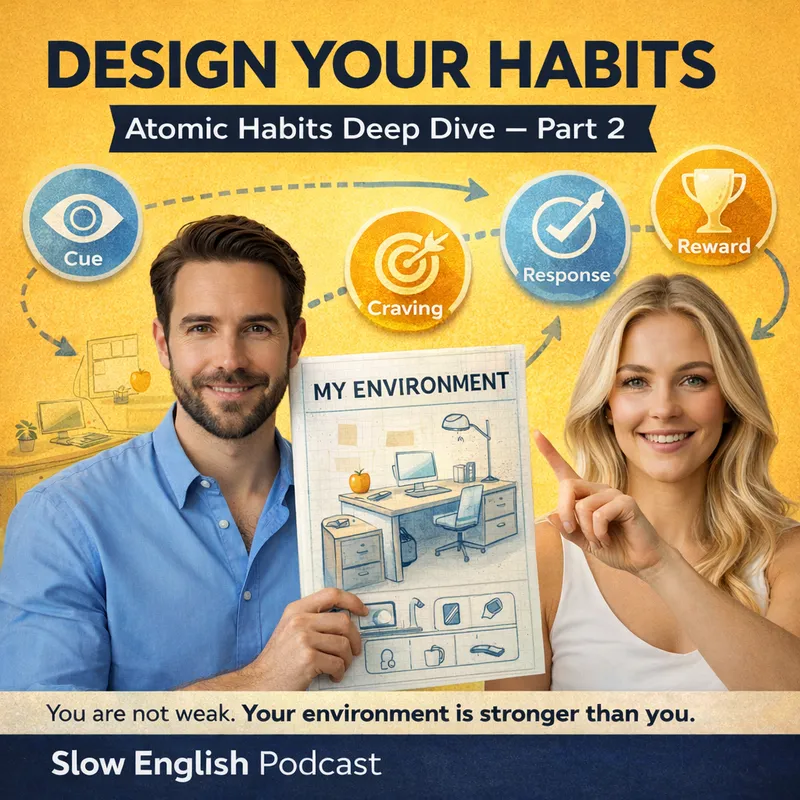
Small habits, repeated consistently, compound into something enormous over time.
That is, almost word for word, the story of this Spanish team.
These players didn't train for one summer to win a World Cup.
They trained for 15 years inside one small, repeated habit.
The same passing pattern again and again and again.
There's a training exercise at the heart of Spanish football, friends, called a rondo.
A small circle, a handful of players in the middle trying to win the ball,
everyone else just passing.
It looks almost too simple to matter.
Like nothing at all.
And yet, according to Spanish football's own coaching program,
this one small drill is where the identity of their entire national team actually begins.
Not in the gym, not lifting heavier and heavier weights.
In a small circle, practiced since childhood.
Master the pattern first.
The heavy weights can come later, if they're even needed at all.
That's a systems mindset, Martin.
It really is.
James Clear in that book has a line we love.
You don't rise to the level of your goals.
You fall to the level of your systems.
Spain's goal one week ago was the World Cup.
But their system was a small circle of passing, repeated for 15 years.
The goal was the celebration.
The system was the actual trophy.
Let us tell you about Boubacar.
Boubacar moved from Senegal to Dublin two years ago to work in a warehouse.
His English when he arrived was almost nothing.
A handful of words.
Enough to survive.
Barely.
And Boubacar heard a piece of advice early on that he almost ignored.
Someone told him, don't try to learn everything.
Just do one small thing every single day.
So he chose his own rondo.
Ten minutes.
Every single morning before his shift.
Shadowing one short recording out loud in his kitchen.
Not perfect.
Not exciting.
Just the same small circle repeated.
Some mornings he skipped grammar books completely.
He didn't have the energy for grammar books.
He had ten minutes and he used them on his circle.
Two years later, Boubacar leads a small team at that warehouse.
In English.
And when people ask him how he learned so fast,
he tells them exactly what our Spanish players would say.
I didn't.
I just never missed my ten minutes.
Fifteen years for a national team.
Two years for Boubacar.
Different timelines.
The exact same idea.
So now let's build your own rondo, friends.
Your own small circle for English.
Because here is an uncomfortable truth many learners never hear.
Not every English activity gives you the same return.
Some activities are your gym.
Long hours.
A lot of effort.
Very little transfer to real conversation.
Endless grammar worksheets, for instance, memorized in isolation with no real context.
Hours spent on a huge list of words you'll never actually use in a sentence.
That's not wasted, exactly.
But it's not your rondo either.
Your rondo, your small repeated circle, looks much simpler.
Ten minutes of real listening.
Every day.
Shadowing one short passage out loud.
Copying the rhythm, not just the words.
Five to eight real expressions, in real context, repeated until they're truly yours.
Not 50 words you'll forget by Friday.
That is quite literally the three-pass method we've described on this podcast before.
Blind listening.
Listen and read.
Then shadow out loud.
It is not flashy.
It will not feel like a World Cup final.
But neither did a rondo in a small park 15 years ago.
And look what it became.
So here's your plan for this week, friends.
Four simple actions.
Action one.
Choose your own rondo.
One small English activity.
Ten minutes maximum.
Action two.
Protect it like Spain protects their passing circle.
Every day.
Not when you feel motivated.
Every day, motivated or not.
Action three.
Trust the system over the goal.
Stop asking, will I be fluent by December?
Start asking, did I do my ten minutes today?
And action four.
Give it time.
Real time.
Not two weeks.
Think in months and let it compound quietly.
The way it did for Boubacar.
And the way it did for 23 footballers who started as children in a park.
Say the sentence of the day with us, friends.
Champions are not born in one tournament.
They are built one small repetition at a time.
One more time, friends.
Champions are not born in one tournament.
They are built one small repetition at a time.
Quick recap, friends.
One goal, seven clean sheets and a team that never once panicked.
The result of a system built over 15 years, not one summer.
The academies, the shared philosophy from youth level to the senior team.
And players who grew up together long before they became champions together.
The values the whole world has been talking about this week.
Unity, humility, diversity and respect.
And the training secret hiding in plain sight.
A small passing circle repeated since childhood.
Echoing the exact same idea from atomic habits.
Systems beat goals every single time.
So find your own rondo.
Ten minutes every day.
And trust it.
Everything from today, the vocabulary, the transcript, the practice tools
is waiting for you at your EnglishToolbox.com.
All completely free.
So here's your mission this week, friends.
Choose your ten minutes.
And show up for them tomorrow, whether you feel like a champion or not.
Because from today, you're not waiting for one golden day when your English suddenly arrives.
You're building it.
One small circle at a time.
Thank you for being here with us.
See you in our own small circle very soon.
Take care, friends.
Bye for now.