The audio controls above still work. Interactive translation, saving and practice need JavaScript. You can read the complete transcript and download your study materials below.
Complete English transcript
Have you ever looked at a big goal... and felt so overwhelmed that you didn't even start?
Every single time I think about learning to drive, honestly.
The whole idea feels enormous, like some impossible mountain.
And yet, somehow, people do learn to drive.
People do move to new countries, learn new languages, build entire new lives.
So how?
Welcome to Your English Toolbox, the podcast that trains your English while you live your real life.
I am Martin.
And I am Julia.
Friends, this is our last episode in this little series about time.
We've eaten our frogs, we've said no to the wrong things, we've found our three real priorities.
Today, we finish with something bigger: how you actually keep going, day after day, until the impossible thing is done.
And by the end of this episode, you'll have a simple way to make any huge goal feel manageable, a method for building a habit that actually sticks, and a small trick to turn wasted time into real progress.
Let's start with a story about a desert.
Go on.
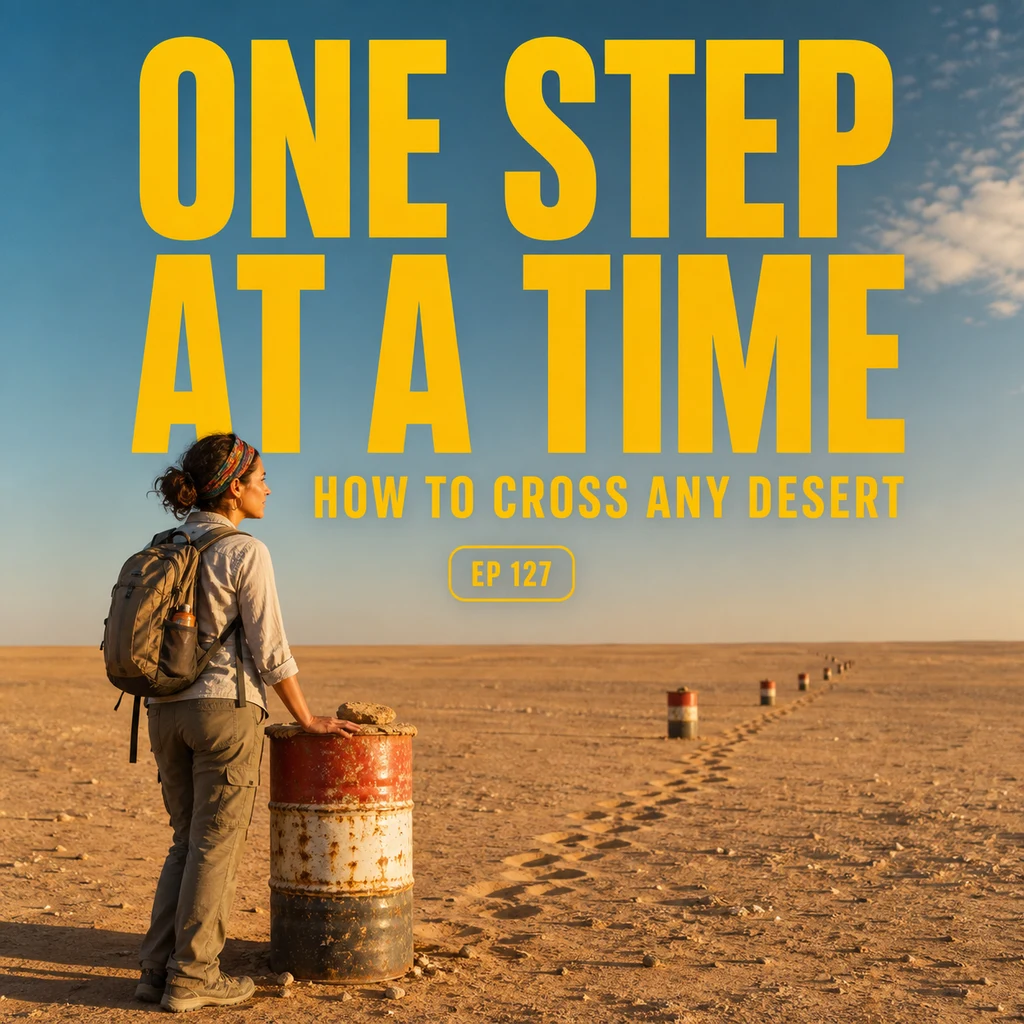
So, imagine one of the old trans-Saharan routes through the Tanezrouft, decades ago — hundreds of miles across a vast, almost featureless landscape.
No paved road, and very few natural landmarks to guide you.
In that environment, losing the track could be deadly.
During the French colonial period, sections of the route were marked with oil drums.
What did they do?
They placed the drums at regular intervals, close enough that, in clear conditions, travelers could often see the next marker ahead.
A simple point of reference in an enormous, empty landscape.
So instead of trying to navigate the whole of the world's largest hot desert at once, they could focus on one visible marker.
Just one marker at a time.
And that is where our metaphor begins.
Not by seeing the whole route.
Just by traveling toward the next drum, then the next, then the next.
I think about that story a lot, actually, especially with my driving lessons.
Tell them, Julia.
So, when I moved here, I decided I finally needed to learn to drive as an adult.
And every time I thought about it as a whole... passing the theory exam, learning to parallel park, driving on the motorway... it felt genuinely impossible.
Everyone else on the road seemed to already know exactly what they were doing.
And I'd sit in the car, hands on the wheel, feeling like the only adult in the world who hadn't figured this out yet.
That feeling alone was almost enough to make me quit before the first lesson.
So what changed?
My instructor said something simple in my first lesson: "Don't think about driving.
Just think about starting the car safely today."
That was the only goal for lesson one.
Just starting the car.
Lesson two, the only goal was moving forward in a straight line for ten meters.
Lesson three, turning a corner, slowly, in an empty car park.
One oil drum at a time.
Exactly.
And twelve lessons later, without ever once thinking about the motorway, I was suddenly driving on the motorway.
Because you never had to see the whole desert.
Just the next visible marker.
And here's what's strange — the day I actually drove on the motorway for the first time, it wasn't even scary anymore.
Why not?
Because by then, I'd already built eleven small successes behind me.
Starting the car, turning corners, parking, changing lanes — each one small, but each one real.
So the motorway wasn't really one giant step.
It was just the twelfth oil drum, and I could already see it clearly from where I was standing.
So, friends, whatever your desert is right now — maybe it's a huge project at work, learning this language fluently, or building a completely new life somewhere unfamiliar — stop trying to see the whole route.
Find your next oil drum.
One small, visible step, close enough that you can actually walk toward it today.
Now, here's the thing about walking toward that step consistently: it has to become a habit, or you'll stop after a few days.
Which is exactly what happens to most New Year's resolutions, by early February.
Exactly.
So let's talk about how habits actually form, because most people get this part wrong.
Tell them about your reading habit, Martin.
So, a few years ago, I decided I wanted to read for thirty minutes every morning.
And for about a week, it worked perfectly.
What happened after that?
Life happened.
One busy morning, I skipped it.
Then the next morning felt easier to skip too.
Within three weeks, the habit was completely gone.
So what did you do differently the second time you tried?
I used a trick I'd heard about: instead of committing to thirty minutes forever, I told myself, "just for today."
Just today, I'll read for five minutes.
Only today.
Exactly, no promises about tomorrow, no pressure about next month.
Just this one morning, five minutes, nothing more.
And because "just today" feels so small, it's almost impossible to say no to yourself.
Right, and here's what happened: because it felt so easy, I usually kept reading past five minutes anyway.
But even on the mornings you didn't?
Even then, I still said, "well, I did it today." And the next morning, I just said "just for today" again.
Small, one day at a time, like walking toward one oil drum.
After a while, it felt less and less like a decision.
It had started to feel like part of my morning, the same as brushing my teeth.
There's actually a nice trick that makes this even easier, and it's not complicated at all.
What's that?
You anchor the new habit to something you already do every single day, without thinking.
This technique is often called habit stacking.
So instead of trying to remember "read for five minutes" as a completely separate task...
You say: "after I pour my morning coffee, I read for five minutes."
The existing habit becomes the reminder for the new one.
I actually did that with my driving practice too, in a way.
Tell them.
Every evening, right after I put my keys in the bowl by the door, I'd spend two minutes reviewing one thing from that day's lesson.
Two minutes, anchored to something you already did automatically.
It sounds almost too simple to matter.
It is simple.
But simple things, repeated daily, are exactly what build real change.
Now, there's one more piece to this, and it's about the road ahead, once the habit is formed.
Continuing to grow.
Because whatever skill got you here won't necessarily get you to where you want to go next.
Which sounds a little intimidating, honestly.
It's actually the opposite, once you see it clearly.
Because it doesn't mean starting over from zero.
Not at all — it just means adding small, steady deposits on top of what you've already built.
Like putting a little money aside every month, except it's knowledge instead of savings.
And just like savings, it barely feels like anything on any single day.
But after a year, you're standing somewhere completely different.
There are basically three simple ways to keep improving, and none of them require huge extra time.
What's the first one?
Read a little, in your field, most days.
Doesn't have to be an hour.
Even fifteen minutes, consistently, adds up to an enormous amount over a year.
What's the second?
Take courses or lessons when they're available, and actually pay attention, rather than just attending.
Sit near the front, take notes, ask questions.
Treat it like it actually matters, because it does.
And the third one is probably the easiest to add, because it uses time you're already spending.
Which is?
Turn overlooked time into learning time.
Time on the bus, walking to work, waiting for an appointment, or doing a safe, familiar routine at home.
Think about it: while you fold laundry, take a familiar walk, or sit on public transport, you may be able to listen without adding another block to your day.
Those moments don't have to feel empty.
A single episode like this one, playing while you fold laundry or sit on the bus, adds real English into a day that already existed.
You're not finding new time.
You're just filling time you already have, with something that moves you forward.
That's actually exactly what a lot of our listeners are doing right now, isn't it?
It really is — listening to English while doing something else completely.
Commuting on public transport, cooking, walking the dog — and, if you listen in a car, only when it is safe and without touching the screen.
Dead time, quietly becoming useful time, without taking anything extra away from your day.
Which brings us right back to the desert.
How so?
You don't need a huge block of new time to grow.
You just need your next visible step, wherever you happen to already be walking.
And friends, this actually applies directly to you, right now, listening to this.
How so?
Your English itself is a desert crossing.
You don't need to suddenly become fluent tomorrow, or memorize every rule this month.
You just need today's oil drum: one episode, one new expression, one small conversation.
Repeated, day after day, until one morning you realize you're already speaking with people you couldn't have understood a year ago.
And you won't even remember the exact day it happened.
Because it never happens in one giant leap.
It happens one visible marker at a time.
So, let's bring together everything from this whole series, actually, since this is our final episode on time.
Let's do it.
First, eat your frog: do the hardest, most important thing first, before anything else steals your morning.
Second, say no to the wrong things, so your yes actually means something.
Third, find your three: the small number of tasks that carry almost all your real value.
And fourth, today: walk one step at a time, build it into a daily habit, and use the dead time you already have.
Four ideas, but really, just one message underneath all of them.
Which is?
Stop trying to see the whole desert.
Just find your next oil drum, and walk toward it.
Now, let's gather the useful English from today's conversation.
Let's do it.
First: "an oil drum," used here to mean a small, visible next step toward a bigger goal.
"Don't think about the whole project, just find your next oil drum."
Next: "just for today," a phrase for committing to something small, only for the present day.
"I'm not promising forever, just for today, I'll go for a walk."
Next: "to anchor a habit," meaning to connect a new habit to something you already do automatically.
You may also hear this called "habit stacking."
Martin used this when he anchored reading to his morning coffee.
"She anchored her stretching routine to brushing her teeth."
Next: "dead time," meaning time that feels wasted or unproductive, like commuting or waiting.
"He turned his dead time on the train into study time."
Next: "to fall off track," meaning to stop following a plan or habit.
"I fell off track with my exercise for about two weeks."
And finally: "to add up," meaning small amounts combine into something significant over time.
Fifteen minutes a day really does add up over a year.
One more: "a fresh start," meaning a new beginning, often after a setback.
"Monday always feels like a fresh start."
Seven useful expressions, straight from a real conversation.
Now, here's your sentence of the day, and it's a nice one to end our series on.
Listen carefully, we'll say it twice.
"You don't need to see the whole desert, just the next step."
"You don't need to see the whole desert, just the next step."
Say it with us, out loud, right now if you can.
Feel the rhythm of it.
"Just the next step."
So, friends, this closes our journey through time management together.
Whatever desert you're crossing right now — a new language, a new country, a new chapter of your life...
You don't need the whole map.
You just need today's next visible step.
Walk toward it, build the habit, and let the small steps add up.
Thank you for spending this time with us today, and for spending this whole series with us.
If these episodes helped you, visit yourenglishtoolbox.com for the transcript, multilingual translations, vocabulary resources, Cinema Mode, and our seven-speed player.
Try listening slowly first, then repeat at normal speed and notice how much more you understand.
Until next time, friends.
Take care of yourselves.
And go find your next oil drum.
Goodbye!