The audio controls above still work. Interactive translation, saving and practice need JavaScript. You can read the complete transcript and download your study materials below.
Complete English transcript
Martin, I have four messages for you.
All right.
And you are not allowed to answer “all right” to every one.
That is normally a safe answer.
Not when somebody shares surprising, exciting or difficult news.
Then I need better reactions.
Exactly.
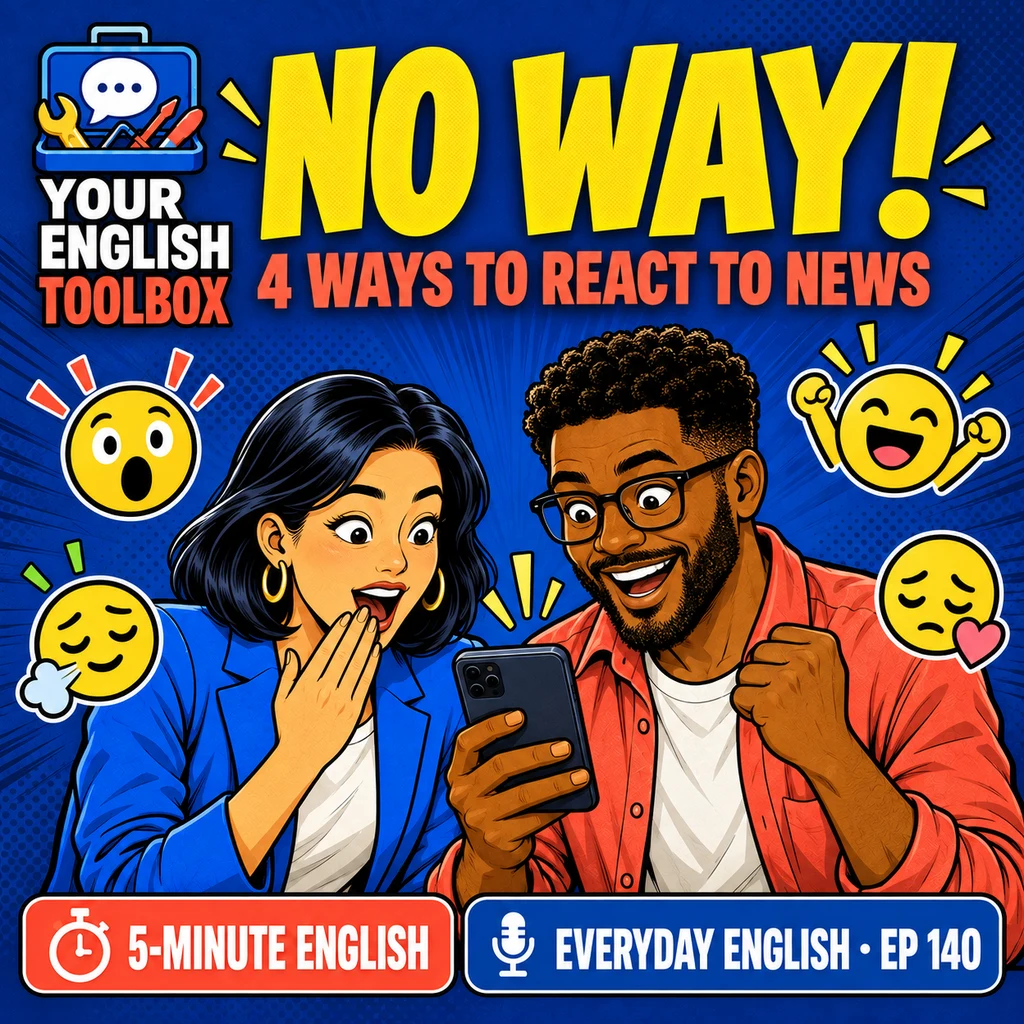
Today we are learning four natural ways to react to news.
Welcome to Your English Toolbox.
I am Martin.
And I am Julia.
This is episode six of Everyday Useful Expressions, our series of ready-made English for real situations.
Today we are learning how to show surprise, happiness, relief and sympathy.
What is the first message?
Your photograph won the local competition.
No way!
That is our first expression: No way!
It is an informal way to express strong surprise or disbelief.
For example: “I met my favourite actor yesterday.” “No way!”
Or: “They upgraded our tickets for free.” “No way!”
Your tone shows whether the surprise is positive or negative.
But we should be careful because “No way” can also mean a very strong refusal.
Exactly.
“No way!
You won?” expresses surprise.
“No way.
I refuse” has a completely different meaning.
It is also quite informal.
So use it with friends and relaxed conversations, not as your automatic reaction in every professional situation.
Understood.
What is the second message?
Your sister has been offered the job she wanted.
That’s great news!
This expression shows warm, positive interest.
It is more engaged than simply saying “good”.
For example: “The doctor says I can start running again.” “That’s great news!”
Or: “Our application was accepted.” “That’s great news!”
A natural follow-up could be: When does she start?
That is important.
A good reaction often continues with a question.
It shows that you are genuinely listening.
What is message number three?
The missing documents have been found, so we do not need to repeat the whole application.
What a relief!
We use what a relief when worry, pressure or uncertainty has ended.
For example: “The test results were normal.” “What a relief!”
Or: “The airport found my suitcase.” “What a relief!”
This expression focuses on the disappearance of worry.
So if a friend gets a new job, “That’s great news” is usually more natural.
But if the friend was afraid the job had disappeared, “What a relief” may also make sense.
Context decides which feeling you want to emphasise.
And the final message?
Anna cannot join the concert because she has broken her ankle.
I’m sorry to hear that.
This expression shows sympathy when someone tells you bad or disappointing news.
It does not mean that you caused the problem.
You are sorry that the other person is experiencing it.
For example: “My interview did not go well.” “I’m sorry to hear that.”
Or: “My father has been unwell.” “I’m very sorry to hear that.”
The word very can add warmth when the news is serious.
A helpful follow-up might be: How is she feeling?
Or: Is there anything we can do?
The expression opens the door to support.
It should not sound like a formula that ends the conversation.
Let us compare all four reactions.
No way! expresses strong informal surprise.
That’s great news shows happiness about positive news.
What a relief shows that worry or uncertainty has ended.
And I’m sorry to hear that shows sympathy after bad news.
Time for a quick challenge.
Choose the most natural reaction before we answer.
Situation one.
A friend tells you that she has won two tickets to New York.
No way!
Situation two.
Your colleague tells you that his professional qualification has been approved.
That’s great news!
Situation three.
A hospital confirms that an alarming result was a mistake.
What a relief!
Situation four.
A friend tells you that her favourite café is closing.
I’m sorry to hear that.
Now practise a complete reaction.
Your friend says: “I finally passed my driving test.”
You could say: That’s great news!
When did you take it?
A reaction plus a natural question keeps the conversation alive.
On the episode page at yourenglishtoolbox.com, you will find five additional ways to react to news.
Each one includes its meaning, tone, two examples and active practice.
The direct link is in the episode description.
So, was the first message true?
Which one?
The photography competition.
No. I invented it for the lesson.
I’m sorry to hear that.
But your reaction was excellent.
That’s great news.
And you used another expression naturally.
What a relief.
Now you are simply showing off.
No way!
See you next time, friends.
Goodbye.