The audio controls above still work. Interactive translation, saving and practice need JavaScript. You can read the complete transcript and download your study materials below.
Complete English transcript
Martin, how was the science festival?
Interesting.
And the talk about memory?
Also interesting.
What about the speaker?
Very interesting.
You spent an entire evening there and returned with only one adjective.
It is a reliable adjective.
Reliable, yes.
Precise, no. Was the festival fascinating, thought-provoking or engaging?
Now the evening sounds more interesting already.
That is exactly the problem we are solving.
Welcome to Your English Toolbox and Practice Arena Five-Minute English.
I am Martin.
And I am Julia.
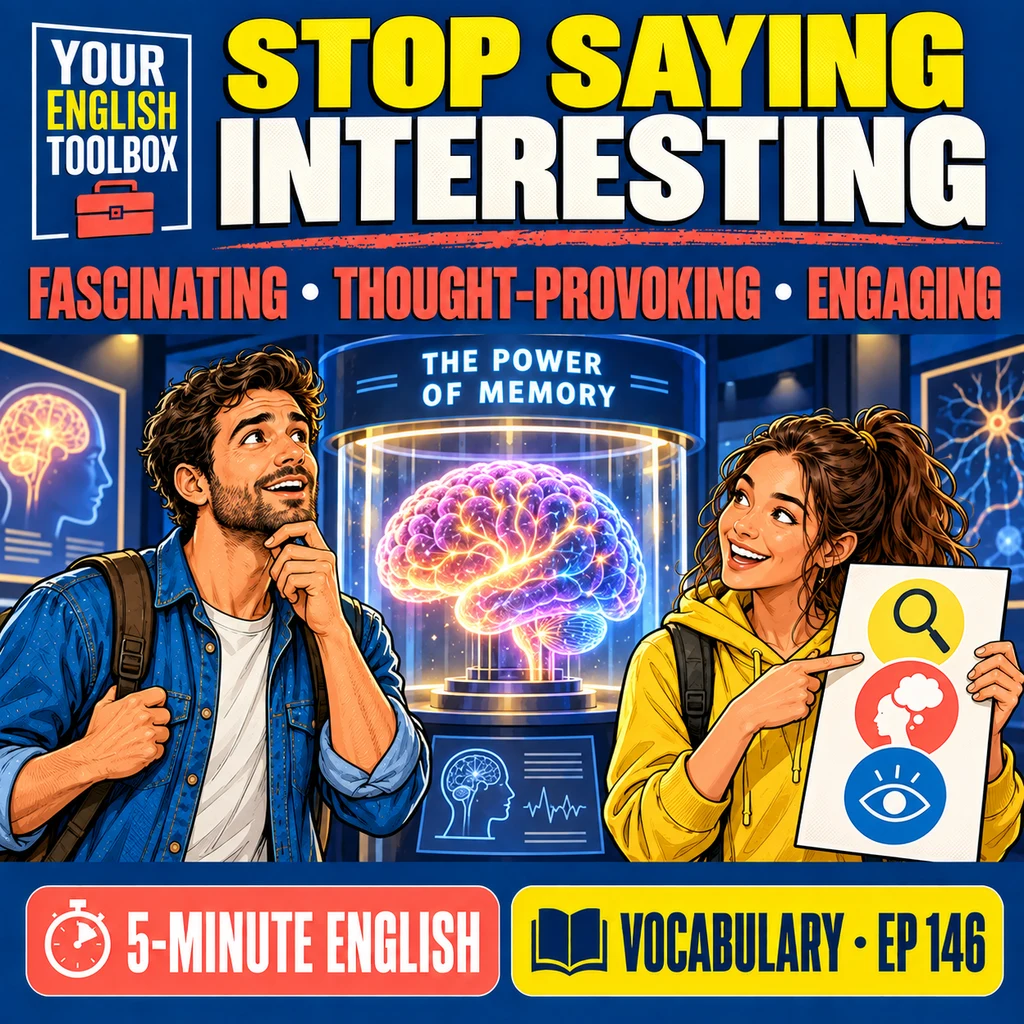
Today we are replacing the general word interesting with three more precise words: fascinating, thought-provoking and engaging.
Let us begin with fascinating.
Fascinating means extremely interesting, often because something is unusual, complex or full of surprising detail.
At the festival, I saw an exhibition about how the brain creates memories.
Was it interesting?
It was fascinating.
I wanted to examine every object and read every explanation.
That is the key idea.
Something fascinating holds your attention very strongly.
For example: The documentary reveals a fascinating story about life under the ocean.
The word is stronger than interesting.
Our second word is thought-provoking.
Thought-provoking describes something that makes you think seriously or consider an idea in a new way.
The talk asked whether forgotten memories still influence our decisions.
That question stayed in my mind all evening.
It was thought-provoking.
We often use this word for a book, film, article, question, exhibition or discussion.
For example: The film offers a thought-provoking view of success.
Something can be uncomfortable and still be thought-provoking.
The focus is deeper reflection, not pleasure.
And remember the hyphen when you write it: thought-provoking.
Our third word is engaging.
Engaging means pleasant and effective at holding your attention or encouraging your involvement.
The speaker used stories and questions, so the audience wanted to participate.
Then she was an engaging speaker.
We can describe an engaging lesson, presentation, book, conversation or personality.
For example: The teacher turned a difficult topic into an engaging lesson.
How is engaging different from fascinating?
Fascinating focuses on how strongly the subject attracts your interest.
Engaging focuses on how the material or person keeps your attention.
A fascinating topic can still be presented badly.
Thought-provoking focuses on the thinking that continues during or after the experience.
So the exhibition was fascinating, the central question was thought-provoking, and the speaker was engaging.
Now your review is precise.
Let us compare the words once more.
Fascinating means extremely interesting and strongly attractive to your attention.
Thought-provoking means making you think deeply or differently.
Engaging means holding your attention through an appealing, involving style.
Time for a quick challenge.
Choose fascinating, thought-provoking or engaging before we answer.
Situation one.
A podcast reveals surprising details about an ancient city, and you cannot stop listening.
It is fascinating.
Situation two.
A film changes the way you think about privacy and technology.
It is thought-provoking.
Situation three.
A trainer uses stories and questions to keep everyone involved.
The trainer is engaging.
Situation four.
A book holds your attention and also makes you reconsider an important belief.
It may be both fascinating and thought-provoking.
Now improve this sentence: The presentation was interesting.
Did the subject strongly attract your curiosity?
It was fascinating.
Did it make you reconsider an idea?
It was thought-provoking.
Did the speaker keep everyone involved?
It was engaging.
On the episode page at yourenglishtoolbox.com, Cinema Mode lets you follow the exact words while the audio plays.
Use it to notice these three adjectives inside complete sentences.
The direct link is in the episode description.
So, Martin, what is your final review of the festival?
The exhibition was fascinating.
Good.
The question about memory was thought-provoking.
Very precise.
And the speaker was so engaging that nobody checked their phone.
That may be the strongest review of all.
It certainly was not an ordinary interesting evening.
See you next time, friends.
Goodbye.