The audio controls above still work. Interactive translation, saving and practice need JavaScript. You can read the complete transcript and download your study materials below.
Complete English transcript
Martin, you used the word scared three times this morning.
I had three worrying situations.
You had a presentation, you were waiting for an important result and a large dog ran towards you.
Exactly.
I was scared, scared and scared.
The general meaning is possible, but English can be much more precise.
Then give me three better words.
Nervous, anxious and terrified.
Welcome to Your English Toolbox and Practice Arena Five-Minute English.
I am Martin.
And I am Julia.
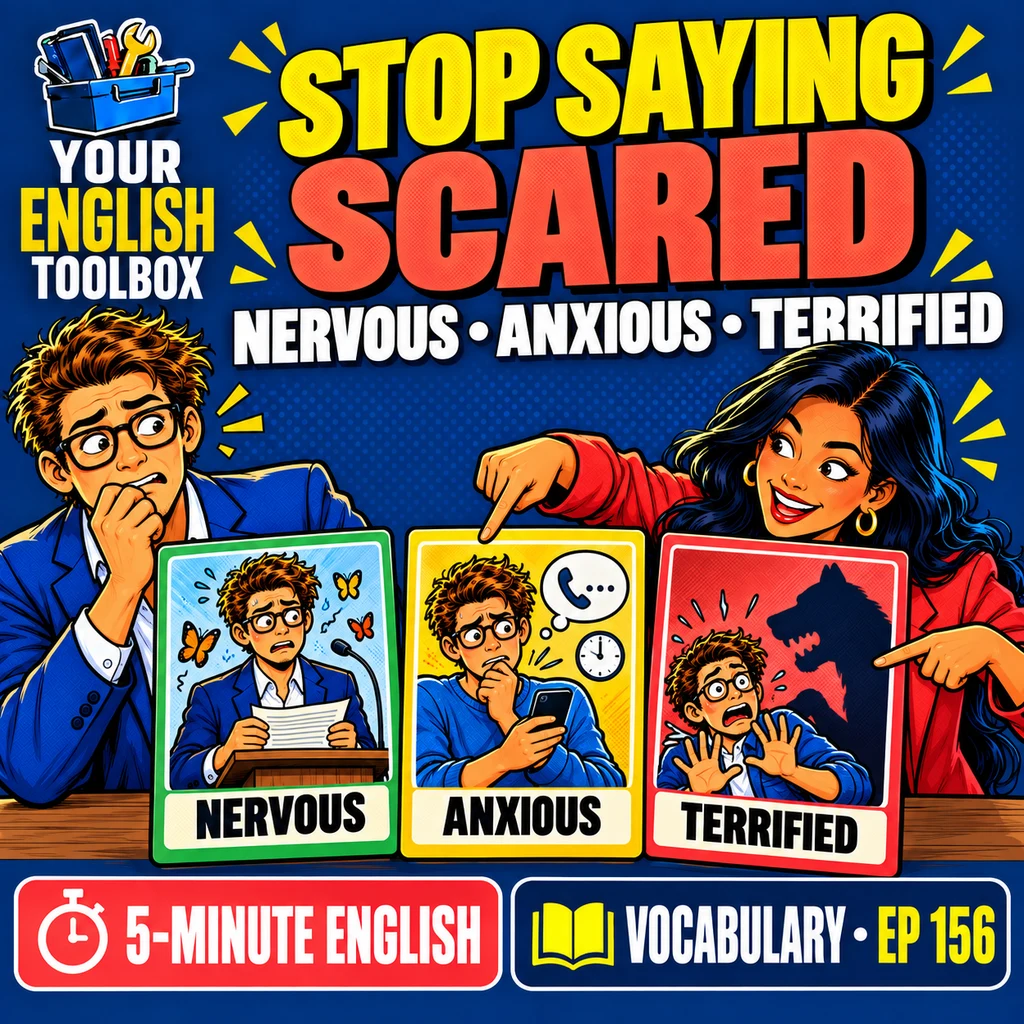
Today we are replacing the general word scared with three more precise words: nervous, anxious and terrified.
They all involve fear or worry, but they describe different experiences.
Let us begin with nervous.
Nervous usually describes worry or tension before a specific event or performance.
Before my presentation, my hands felt cold and I kept checking my notes.
You were nervous about the presentation.
We often feel nervous before an interview, an exam, a first date or a difficult conversation.
For example: She felt nervous before speaking to the whole team.
Or: I always get nervous when I have to fly.
Nervous can include excitement as well as fear.
The event matters to you, and you are waiting for it to happen.
Common patterns are nervous about something and nervous before something.
Our second word is anxious.
Anxious describes worry, unease or tension, often connected with uncertainty.
You were waiting for an important medical result, and you could not concentrate on anything else.
I felt anxious about the result.
The worry continued because you did not know what would happen.
For example: Many employees are anxious about the possible changes at work.
Or: He became anxious when his daughter did not answer her phone.
Anxious can be stronger or more persistent than nervous, but context matters.
And using anxious in an everyday sentence does not automatically describe a medical condition.
The useful pattern here is anxious about something.
So I was nervous before the presentation, but anxious while waiting for uncertain news.
Exactly.
Our third word is terrified.
Terrified means extremely frightened.
When the large dog ran towards me, I thought it was going to attack.
You were terrified.
The fear was intense and immediate.
For example: The passengers were terrified when the car began to slide on the ice.
Or: She is terrified of heights and cannot look down from a tall building.
Common patterns are terrified of something, terrified by something and terrified that something may happen.
Terrified is already a very strong word, so we usually do not need very.
Absolutely terrified is possible when you want extra emphasis.
Let us compare the three words.
Nervous often describes tension before a specific event.
Anxious often describes continuing worry about uncertainty or possible problems.
Terrified describes extreme fear.
The situation and intensity help you choose.
Time for a quick challenge.
Choose nervous, anxious or terrified before we answer.
Situation one.
You are about to begin your first driving lesson, and your stomach feels tight.
You are nervous.
Situation two.
Your company may close a department, but nobody will give you clear information.
You are anxious about what may happen.
Situation three.
You wake up and see smoke coming through the bedroom door.
You are terrified.
Situation four.
You have an interview tomorrow and you also feel excited about the opportunity.
You are probably nervous, not terrified.
Now improve this sentence: I was scared.
Ask yourself two questions.
How intense was the feeling?
And was I facing an event, uncertainty or immediate danger?
Then choose the precise word.
On the episode page at yourenglishtoolbox.com, you can download the printable vocabulary guide and practise these contrasts with complete examples.
The direct link is in the episode description.
Martin, how did the presentation go?
It went well.
I was nervous before it, but calm once I started.
And the important result?
Everything was fine, so I am no longer anxious.
What about the large dog?
It wanted the sandwich in my hand.
Were you terrified?
For three seconds.
Then I was hungry.
That is a much easier problem.
See you next time, friends.
Goodbye.