The audio controls above still work. Interactive translation, saving and practice need JavaScript. You can read the complete transcript and download your study materials below.
Complete English transcript
It was another busy Saturday morning at the café.
Two customers brought their coffees back to the counter within an hour.
I was the person in charge of the shift, so I had to find out why.
I thought Sue had made both drinks incorrectly.
What did you say to Sue?
Something I wish I had said differently.
The same Sue you told us about last Sunday?
Yes.
She has worked at the café much longer than I have.
And you had just learnt to ask her for help without sounding like you were giving an order.
Welcome to Your English Toolbox, the podcast that trains your English while you live your real life.
I am Martin.
And I am Julia.
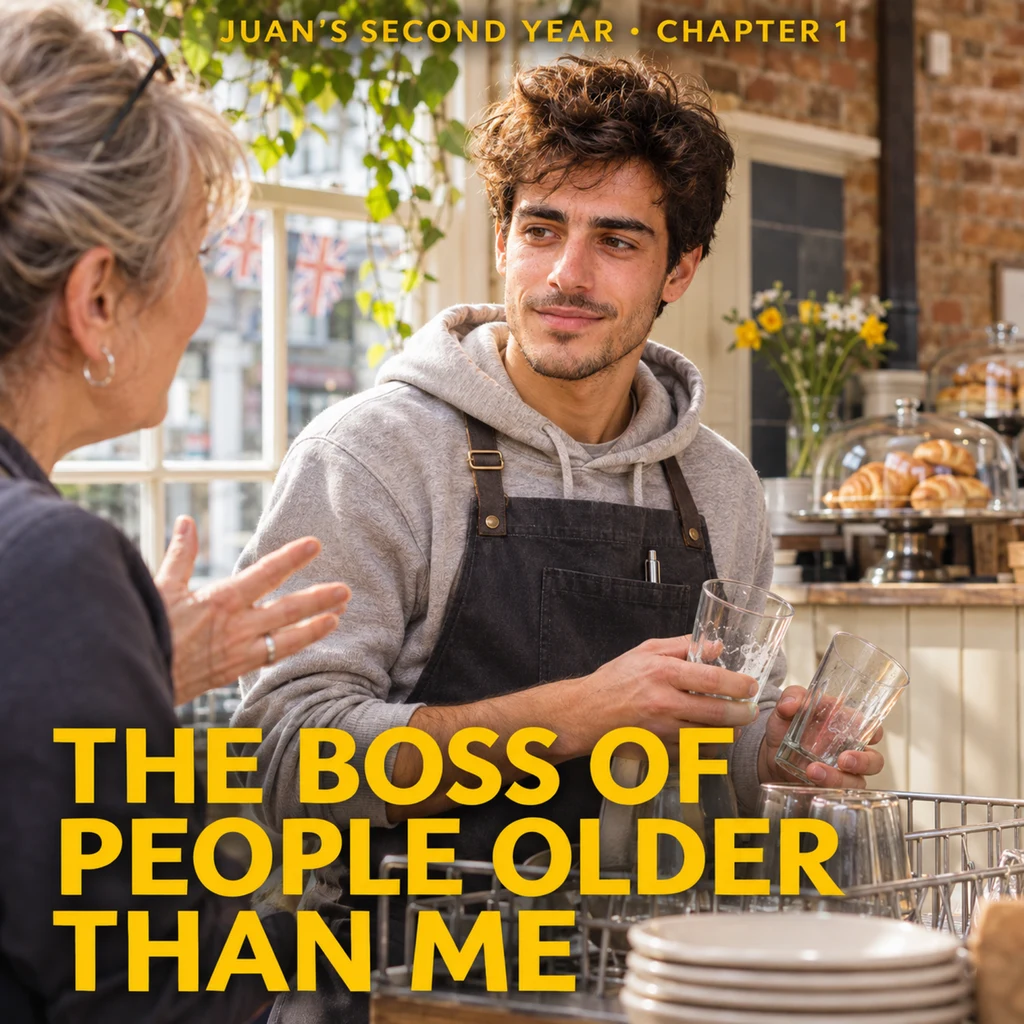
This is Juan's Second Year, the story of a young Spanish man learning to live and work in English in Wolverhampton.
Juan is here with us again.
Hello, everyone.
Last week, I told you how I became the Saturday shift supervisor at the café.
I learnt that a clear instruction can still need care, and that I should ask Sue what she meant instead of guessing.
Today the problem is different.
Yes, and I would have liked a quieter second week as supervisor.
Take us back to the counter.
It was Saturday just after eleven.
The café was busy because two buses had arrived together.
I was taking orders, Sue was making drinks, and Eli was bringing cups to the tables.
A customer came back and said she had ordered a cappuccino, but the cup said latte.
Then another customer came back with the same problem.
Did either customer say the drink itself was wrong?
I did not ask them that question.
I saw two cups with the wrong names, and I looked towards Sue at the coffee machine.
So your first conclusion was that Sue had made the wrong drinks.
Yes.
I thought I knew what had happened before I had checked the order tickets.
What did you say to her?
I asked, why did you make these wrong?
That is a strong question.
I know.
It sounds as if I have already decided she is responsible.
How did Sue respond?
She put down the jug and said, show me the tickets.
She did not raise her voice.
We looked at the first cup together.
What did the ticket say?
Latte.
So did the second ticket.
Sue had made two lattes, exactly as the tickets said.
But the customers had said cappuccino.
Yes.
I had entered latte twice when I took their orders.
The mistake started with me at the till, even though I was looking at the coffee machine.
It was easy to see why you first looked towards Sue.
Yes, but I should have checked the tickets first.
Sue asked me whether the buttons had changed on the screen.
It was just me, two buses and a very fast line of customers.
What did you do next?
I apologised to Sue.
Then I apologised to the customers and we made the right drinks.
For the rest of the shift, I repeated each order before pressing the button.
Did that slow everything down?
A little.
But it was faster than making the same drink twice.
There are two English problems inside this story.
The first is how to raise a problem without accusing someone before you know what happened.
The second is how to correct yourself clearly when the mistake turns out to be yours.
Juan, if you could go back to that moment, what would you say first?
I would say, I noticed that two drinks came back with different names from the ones the customers asked for.
Could we check the tickets together?
The word noticed is helpful here.
It reports what you saw, not who caused it.
Could we check the tickets together is also practical.
It asks for a shared action that may reveal what happened.
Of course, if the issue is urgent, you can be more direct about stopping the work while you check.
I still have to take responsibility for the shift.
I just do not have to guess who is to blame.
Juan, can you give us the exact words of your apology to Sue?
You are right.
I entered the orders incorrectly.
I am sorry I assumed the mistake was yours.
That is a complete apology.
It says what you did and what you assumed.
It does not ask Sue to reassure you or turn the moment into a story about your embarrassment.
She did not have time to reassure me anyway.
There were five people waiting for coffee.
Let us give our listeners three phrases they can use at work.
Listen to each one, then repeat it during the pause.
I noticed a problem with these orders.
You can replace orders with a report, a delivery or a booking.
Could we check what happened together?
That invites investigation without hiding the problem.
I am sorry I assumed that was your mistake.
That is for the moment when your first conclusion turns out to be wrong.
I wish I had known those three sentences when the coffees came back.
Could that question help outside the café?
Andrei and I once thought the other had booked a library room.
We checked the calendar together and found another room instead of arguing.
What will you do on your next shift, Juan?
I will repeat each order before I press the button, even when two buses arrive at once.
We will follow more of Juan's second year in the next chapter.
Today, you can read the full transcript and study these phrases on the episode page.
The direct link is in the description.
And thank you for coming back to the café with me.
Thank you for listening.
See you next Sunday.
See you then.