The audio controls above still work. Interactive translation, saving and practice need JavaScript. You can read the complete transcript and download your study materials below.
Complete English transcript
Martin, our neighbour has asked me one small question about the street party.
That sounds easy.
She wants to know where to put one table.
One table?
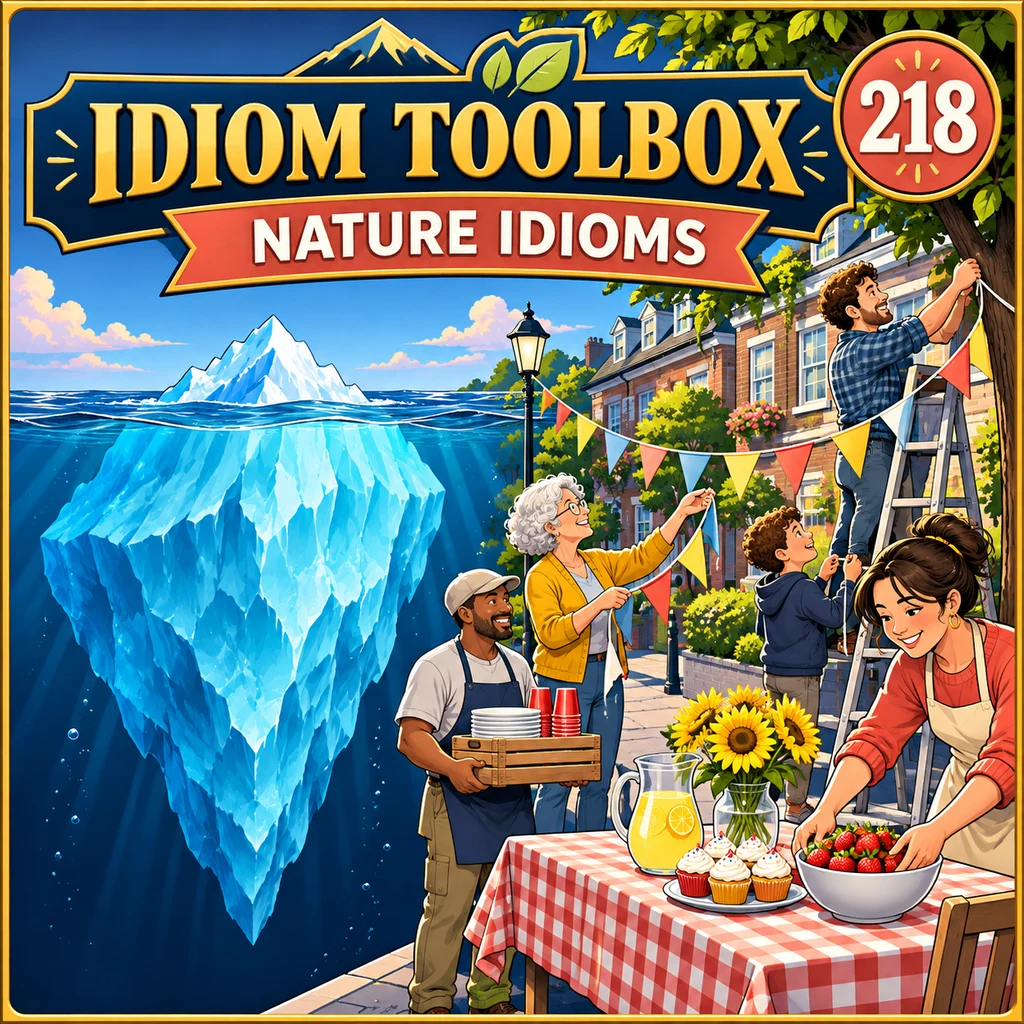
Yes, but that is only the tip of the iceberg.
What is underneath?
We need twenty tables, the musicians might be late, and nobody knows if it will rain.
Today we will explore four nature idioms through one very uncertain street party.
Welcome to Your English Toolbox.
These expressions come from lesson seventeen of our free Idiom Toolbox course.
The direct lesson link is in the description, with examples and practice on our website.
Let us begin with the tip of the iceberg.
An iceberg is a very large piece of ice in the sea.
The tip is the small part you can see above the water.
Most of the iceberg is hidden below the surface.
So the tip of the iceberg means a small visible part of a much larger situation or problem.
The question about one table is only the tip of the iceberg.
It suggests there are more problems we have not seen yet.
It does not mean every hidden detail is a disaster.
For example, one mistake in the report may be the tip of the iceberg if other errors are still being discovered.
Back to our party.
What is the next problem?
The musicians may arrive late, and nobody agrees on the order of events.
We could stop trying to control every minute and go with the flow.
Go with the flow means to accept what happens and adapt, rather than insisting that everything follows your plan.
If the music starts late, we can begin with food and talk to our neighbours.
We are not ignoring the problem.
We are staying flexible.
You can also go with the flow when you visit a new city without planning every hour.
Now our neighbour has found a few coins for the party budget.
That is kind, but compared with the total cost, it is a drop in the ocean.
A drop in the ocean is a very small amount compared with what is needed or with the whole situation.
One drop is tiny compared with an ocean.
Imagine a charity needs ten thousand pounds, and we raise five pounds.
Five pounds is a drop in the ocean compared with the goal.
It can still be helpful, especially when many people contribute.
Finally, a friend asks where the party is happening.
I tell her it is in our neck of the woods.
Your neck of the woods is an informal way to say your local area or the place where you live.
You might ask, what is the weather like in your neck of the woods?
Or, are there any good cafés in your neck of the woods?
It does not have to be near an actual forest.
Can we use it when we are asking about a place we have never visited?
Yes, if we are talking to someone who lives there or knows it well.
For example, I will be in your neck of the woods next week.
That means I will be in your area next week.
And if someone is visiting our neighbourhood, I can ask them to come to the party.
As long as we find more than one table.
Our neighbour has a suggestion for the food.
Everyone could bring one small dish to share.
One dish might look like a drop in the ocean when you are feeding a whole street.
But if many neighbours bring something, those small contributions can add up.
That gives the expression a useful point of view.
We compare one contribution with the size of the need, rather than saying the contribution has no value.
And if the plan changes as people arrive, we can still go with the flow.
We found tables, and the neighbours are bringing food.
Let us see if the party is ready for a test.
You see one problem, but you know many more are hidden.
Which expression fits?
The tip of the iceberg.
The plan changes, and you decide to adapt instead of worrying about every detail.
Which expression fits?
Go with the flow.
And a very small amount compared with what is needed?
A drop in the ocean.
Your friend asks about a café near your home.
Which idiom describes your local area?
My neck of the woods.
The full lesson and more practice are waiting on our website.
You will find the direct link in the episode description.
Thanks for learning with us.
See you next time.