The audio controls above still work. Interactive translation, saving and practice need JavaScript. You can read the complete transcript and download your study materials below.
Complete English transcript
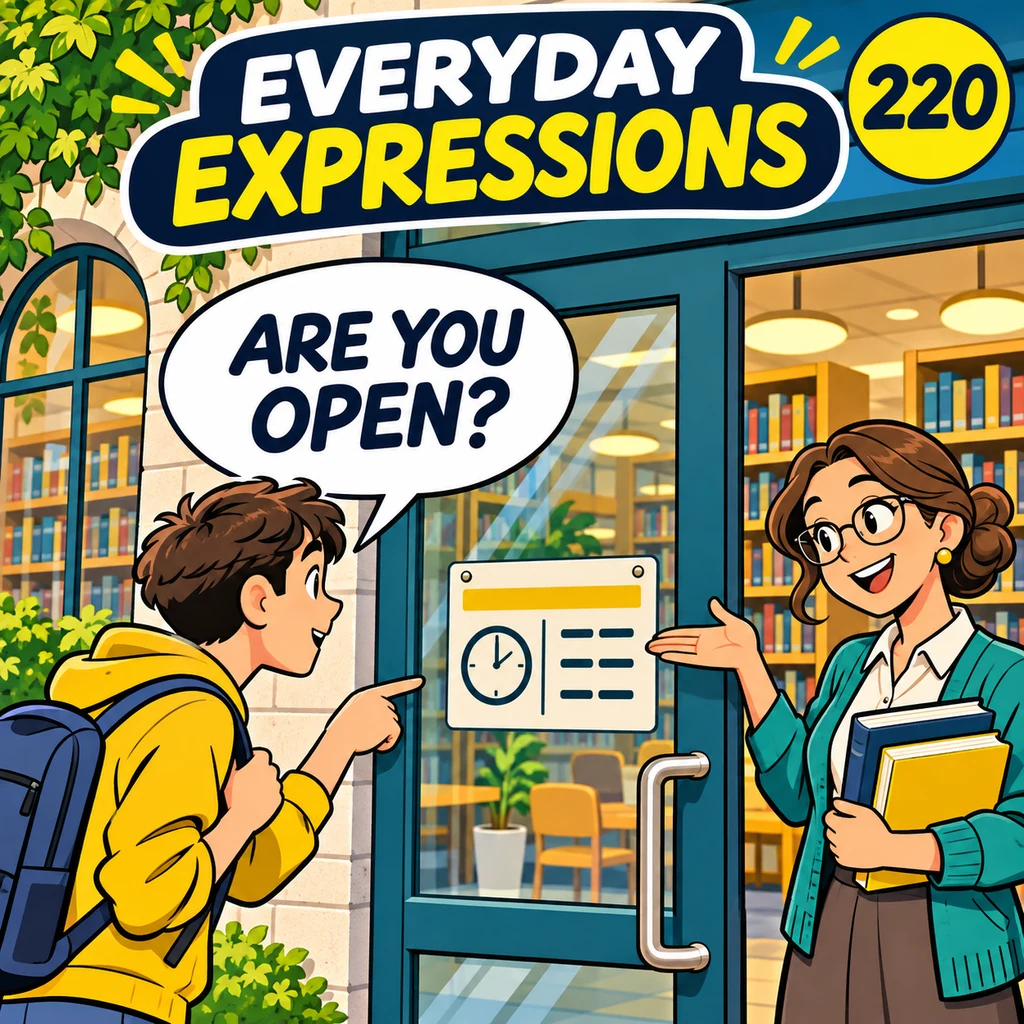
Julia, I am standing outside the library.
Is the door open?
Yes, but a sign says the library will close soon.
Then you need one useful question before you go inside.
Are you still open?
Exactly.
Today we will practise three ways to ask about opening hours without guessing.
Welcome to Everyday Useful Expressions, from Your English Toolbox.
Imagine you arrive at a café in the evening.
You see someone inside, but you are not sure whether the café is still serving customers.
You can ask, are you still open?
Are you still open?
Still asks whether something is continuing now.
The café was open earlier, but is it open at this moment?
The person might say, yes, we are open for another hour.
Or, sorry, we are closed now.
If the answer is yes, your next question may be, what time do you close?
What time do you close?
That asks for the closing time.
You might hear, we close at eight.
Or, we close in ten minutes.
At eight gives a time on the clock.
In ten minutes tells you how much time remains from now.
Let us put those questions together.
Excuse me, are you still open?
Yes, we are.
What time do you close?
We close at eight.
Thank you.
Simple, clear, and useful.
Now imagine that you are planning a visit for next weekend.
You do not need to know whether the shop is open right now.
You need to know about a different day.
Ask, are you open on Sundays?
Are you open on Sundays?
On Sundays usually asks about Sundays in general.
The answer might be, yes, we are open on Sundays from ten until four.
Or, no, we are closed on Sundays.
If you mean one particular Sunday, you could ask, are you open this Sunday?
That difference can be useful on a holiday weekend.
The usual hours and this Sunday's hours may not be the same.
What if you want to plan the start of your visit?
Ask, what time do you open?
That asks for the opening time, not the closing time.
For example, the answer might be, we open at nine in the morning.
You can also ask, what time do you open tomorrow?
Adding tomorrow makes the day clear.
And if you hear a time but are unsure, it is fine to check.
You could say, did you say nine in the morning or nine in the evening?
Then listen to the answer before you make your plans.
On a telephone call, the person may speak more quickly than you expect.
You can ask, could you repeat the time, please?
That is a useful way to check without pretending you understood.
There is another detail that can change your plans.
Sometimes a café is open, but its kitchen stops serving food earlier.
If you want dinner rather than a drink, you can ask, are you still serving food?
The answer might be, yes, the kitchen closes at nine.
Or, sorry, we are only serving drinks now.
The building is still open, but the service you need may have finished.
At a library, the same idea can apply to a particular desk or service.
You could ask, is the information desk still open?
That is more precise than asking only about the building.
Now imagine someone tells you, we close at half past seven.
Half past seven means seven thirty.
If the time matters, you can repeat it back.
So you close at seven thirty, is that right?
A quick check can save you from arriving after the doors have closed.
And you have practised another natural exchange in English.
Let us practise choosing the right question.
You are outside a shop right now and wonder whether it is still serving customers.
What can you ask?
Are you still open?
You know the shop is open, but you want the closing time.
Your turn.
What time do you close?
Now you want to know whether the library usually opens on Sundays.
What can you ask?
Are you open on Sundays?
Let us return to Martin outside the library.
Excuse me, are you still open?
Yes, but we close in ten minutes.
Then I have just enough time to return this book.
And next time, you can check the hours before leaving home.
On the episode page, you can read the transcript and practise five extra expressions for everyday situations.
The link is in the description.
Thanks for learning with us.
See you next time.