The audio controls above still work. Interactive translation, saving and practice need JavaScript. You can read the complete transcript and download your study materials below.
Complete English transcript
Part One.
Situation.
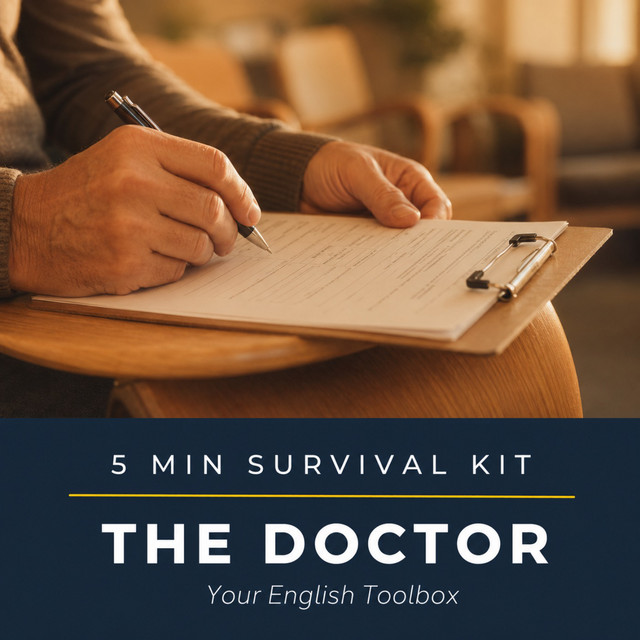
You are sitting in a waiting room.
Your name gets called.
You walk in.
You sit down.
And the doctor asks you something you were not expecting.
Your mind goes blank.
You know something is wrong with your body.
But right now, in this moment, you cannot find the words to explain it.
That feeling, that specific silence, is one of the most frustrating moments for anyone living in an English-speaking country.
And today, we are going
to fix it.
Part Two.
What this is.
Welcome to your English toolbox.
I am Robert.
This is the Five Minute Survival Kit, a short, sharp, practical series, designed for one specific type of person.
You live in an English-speaking country, or you are planning to.
Your English is not perfect, but your life does not wait for perfect.
Every episode in this series gives you the exact words you need for one real situation.
No grammar explanations.
No long
lists.
Just the sentences that actually work, the ones you can use today.
This episode is your survival kit for the doctor's office.
Let's go.
Part Three.
The Five Sentences.
Here are the five sentences you need to know before you walk into any doctor's office.
Number One.
I have had this pain for about three days now.
This sentence does two things at once.
It tells the doctor what the problem is, and it tells them how long it
has been happening.
Duration matters to doctors.
Always give them a time.
Number Two.
It hurts here, and it gets worse when I move.
Simple, clear, and incredibly useful.
Point to the area, say this sentence, and the doctor immediately understands the situation.
Number Three.
I am not sure if this is related, but I have also been feeling very tired.
This sentence is important because symptoms are often connected.
Doctors need the full picture, and this phrase gives you
a natural, polite way to add information without interrupting.
Number Four.
Could you explain that again, please?
I did not fully understand.
This is not a sign of weakness.
This is a sign of intelligence.
Medical English is fast and technical.
Every good doctor respects a patient who asks for clarity.
Use this sentence without shame.
Number Five.
What should I do if it gets worse before my next appointment?
This is the question most people forget to ask, and
it is the most important one.
It shows the doctor you are responsible, and it gives you a plan for the worst case.
Always ask this before you leave.
Part Four.
Now, the rescue sentence.
Every Survival Kit episode has one.
This is the single phrase that works when everything else disappears from your mind.
Memorize it.
Write it on your phone if you need to.
Here it is.
I am sorry, my English is still improving.
Could you speak
a little more slowly, please?
Say that sentence with confidence, not apology.
Every decent doctor in the world will slow down for you, and the ones who do not, well, that tells you something useful about them, too.
Part Five.
Real Story.
A friend of mine, she moved from Brazil to Toronto three years ago.
Her first doctor's appointment was a disaster.
She understood about half of what the doctor said, nodded at everything, and left with a prescription she
was not sure she needed.
Six months later, she went back.
This time, she had three sentences ready.
She used the rescue sentence twice.
She asked the last question before leaving.
She told me afterwards, for the first time, I felt like a person in that room, not just a patient who could not speak.
That is what the right words do.
They give you back your dignity.
Before you go, let's do a quick recap.
Five sentences for the
doctor's office.
One, I have had this pain for about three days now.
Two, it hurts here, and it gets worse when I move.
Three, I am not sure if this is related, but I have also been feeling very tired.
Four, could you explain that again, please?
Five, what should I do if it gets worse before my next appointment?
And your rescue sentence?
I am sorry, my English is still improving.
Could you speak a little more slowly,
please?
Save these.
Practice them once before your next appointment.
You do not need perfect English to get excellent medical care.
You need the right sentences at the right moment.
And now, you have them.
I am Robert.
This has been your five-minute survival kit.
Next episode, The Phone Call.
See you there.