The audio controls above still work. Interactive translation, saving and practice need JavaScript. You can read the complete transcript and download your study materials below.
Complete English transcript
Martin, how is your day going?
Busy.
Very busy.
Extremely busy.
That answer works, Julia, but it does not tell me what kind of busy day you are having.
Fair point.
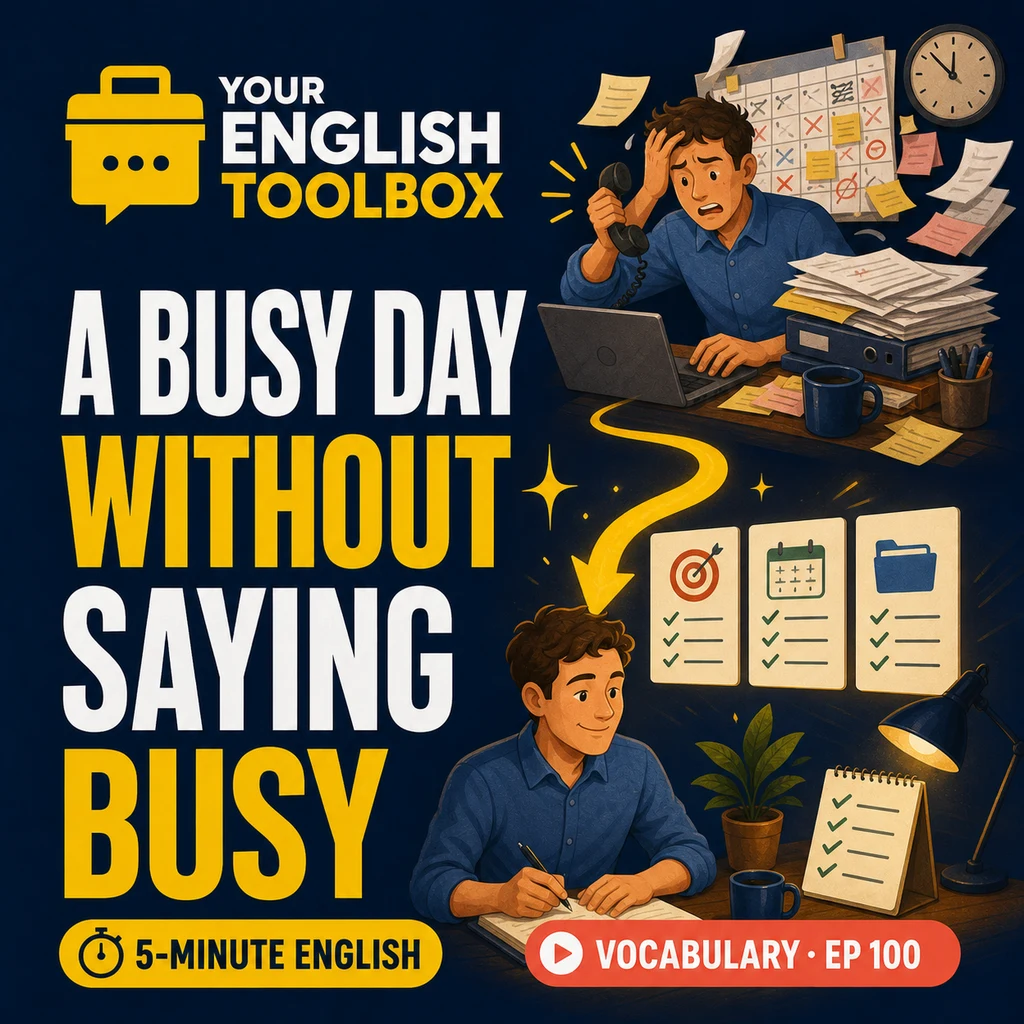
My morning was hectic, at lunchtime I felt overwhelmed, but this afternoon looks manageable.
Three words, three different pictures.
That is much more useful than saying busy three times.
And that is our challenge today: hectic, overwhelmed and manageable.
Welcome to Your English Toolbox and Practice Arena Five-Minute English.
I am Martin.
And I am Julia.
One situation, three useful words, and a few minutes of clear Slow English.
Listen first. Julia, tell me about your morning.
It was hectic.
My phone kept ringing, two people needed urgent answers, and I had a meeting at nine.
So hectic describes a period with a lot of fast, confused activity.
Exactly.
A hectic morning, a hectic schedule, or a hectic week.
It feels busy and slightly chaotic.
Then what happened?
At eleven, I looked at everything I still had to do, and I felt overwhelmed.
Now the word describes you, not the schedule.
Right.
The morning was hectic, but I was overwhelmed.
I felt that the work was too much for me.
Did the day improve?
Yes.
I cancelled one unnecessary meeting and divided the big task into three small steps.
Suddenly, the afternoon felt manageable.
Meaning you could deal with it successfully.
Yes.
Not easy, not empty, but possible to control.
Let us notice the difference.
Hectic describes the situation: lots of activity, movement and pressure.
Overwhelmed describes a feeling: you think you cannot cope with everything.
And manageable describes something you can handle, even if it still needs effort.
Here is a common mistake.
We normally say, “I feel overwhelmed” or “I am overwhelmed,” not “I am hectic.”
Good distinction.
A person can have a hectic day, but saying “I am hectic” sounds unnatural in most situations.
And manageable is often used for work, costs, pain, schedules or problems: “The workload is manageable.”
Now pronunciation.
Listen to the stressed part: HEC-tic.
HEC-tic.
A hectic morning.
Next: over-WHELMED.
The final letters E-D make a /d/ sound.
Overwhelmed.
I felt overwhelmed.
And MAN-age-able.
Four syllables, with the stress at the beginning.
Manageable.
The task is manageable.
Let us put them into one slow sentence.
My morning was HEC-tic, I felt over-WHELMED, but the afternoon became MAN-age-able.
And once more, naturally.
My morning was hectic, I felt overwhelmed, but the afternoon became manageable.
Mini challenge.
I will give you three situations.
Say the best word before Julia answers.
Ready?
Situation one: your calendar is full, messages arrive constantly, and you run from one meeting to another.
Hectic.
Yes: “It has been a hectic day.”
Situation two: you have so many responsibilities that you do not know where to begin.
Overwhelmed.
“I feel overwhelmed by everything I need to do.”
Situation three: the project is difficult, but you have enough time, help and a clear plan.
Manageable.
“The project looks manageable now.”
One final speaking challenge.
Think about tomorrow.
Complete this sentence aloud: “My day will be blank because blank.”
You could say, “My morning will be hectic because I have three appointments.”
Or, “My workload is manageable because I have a clear list.”
And if you feel overwhelmed, say it.
Naming the feeling clearly can help you ask for support.
Quick recap: hectic means busy and chaotic.
Overwhelmed means feeling unable to cope.
Manageable means difficult but possible to control.
Continue with lesson VOC-B1-01 in Practice Arena.
Choose the right word, complete the dialogues and record your own answer.
One situation, three useful words.
See you in the next five-minute practice.
And remember: your day may be hectic without being impossible.